On Friday, November 6, 2026, the U.S. Supreme Court added one of the most consequential business and consumer-finance disputes of its term to the docket, granting Goldman Sachs Bank USA’s petition for a writ of certiorari in Goldman Sachs Bank USA v. Brown (Docket No. 25-1408). At the center of the appeal lies a high-stakes statutory collision that has divided federal appellate courts for two decades: when a bank allegedly violates a bankruptcy court’s automatic debt-collection freeze, can it use the fine print of a credit card contract to force the debtor out of a public bankruptcy courtroom and into private, individual arbitration?
For Wall Street lenders, credit card issuers, and corporate creditors, the stakes could scarcely be higher. Over the past thirty years, the Supreme Court has steadily expanded the reach of the Federal Arbitration Act (FAA), enabling corporations to funnel everything from employment disputes to consumer fraud claims into confidential, one-on-one arbitration tribunals governed by strict class-action waivers. Yet federal bankruptcy courts have remained a stubborn exception—an institutional enclave where judges routinely refuse to enforce pre-dispute arbitration clauses when doing so threatens the centralized, collective machinery of federal insolvency law.
By stepping into Goldman Sachs’ dispute over Apple Card collection notices, the justices are preparing to decide whether bankruptcy courts retain the authority to police violations of their own statutory protections—or whether the FAA’s pro-arbitration mandate overrides even the foundational “breathing spell” of the U.S. Bankruptcy Code.
Here is an in-depth legal and financial analysis of how an Apple Card dispute in Virginia escalated to the nation’s highest court, the competing statutory doctrines colliding before the justices, and what the ruling will mean for Wall Street lenders and millions of American borrowers.
1. From Apple Card Statements to the Supreme Court: Origins of the Dispute
The case now headed to Washington did not begin with a multi-billion-dollar corporate restructuring, but with two individual consumer bankruptcies in western Virginia.
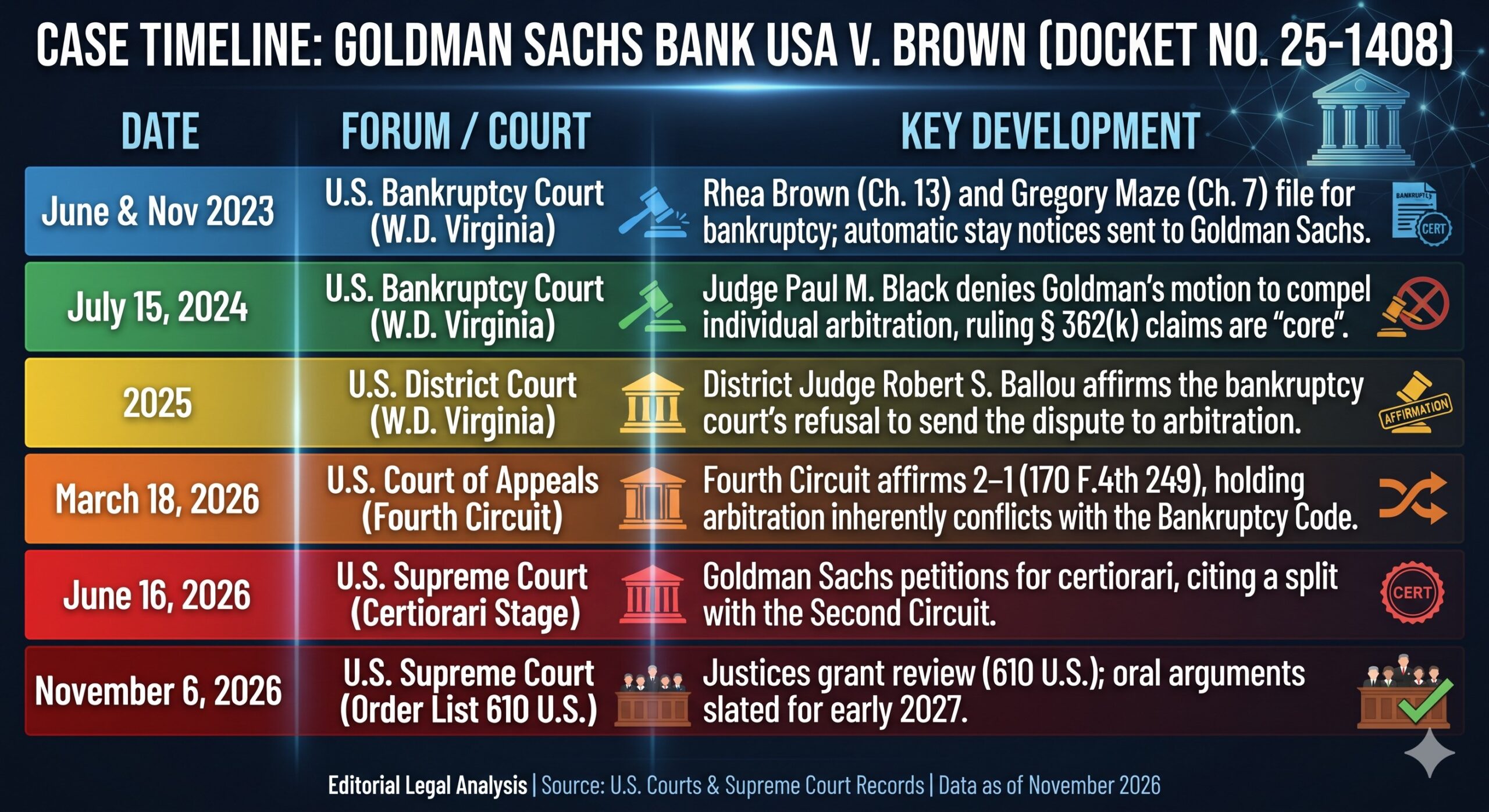
In June 2023, Virginia resident Rhea Ann Brown filed a Chapter 13 bankruptcy petition. Five months later, in November 2023, Gregory Kevin Maze filed for Chapter 7 liquidation. Both consumers held credit card accounts—specifically Apple Cards—issued by Goldman Sachs Bank USA, operating its consumer banking arm under Marcus by Goldman Sachs. When Brown and Maze opened their accounts, both accepted standard-form cardholder agreements containing broad mandatory arbitration provisions alongside class-action and consolidation waivers.
Upon receiving their bankruptcy petitions, the federal Bankruptcy Noticing Center electronically notified Goldman Sachs of the filings and the immediate legal imposition of the automatic stay under 11 U.S.C. § 362(a). Under federal bankruptcy law, the automatic stay operates as an instant, nationwide injunction that halts all collection calls, dunning letters, lawsuits, and account demands the moment a debtor files for protection.
According to court filings, however, the collection notices did not stop. Brown and Maze alleged that Goldman Sachs continued sending post-petition billing statements and payment demands on pre-petition credit card balances for months after receiving formal notice of their bankruptcies. Seeking actual damages, punitive damages, attorneys’ fees, and injunctive relief on behalf of a proposed nationwide class of similarly situated debtors, Brown and Maze filed an adversary lawsuit against the bank under 11 U.S.C. § 362(k)—the Bankruptcy Code provision expressly authorizing individuals injured by willful stay violations to recover damages.
Case Timeline – Goldman Sachs Bank USA V. Brown – Docket No. 25-1408
2. The Fourth Circuit’s 2–1 Ruling and “Deterrence in the Dark”
Rather than litigating the merits of the alleged collection notices in open court, Goldman Sachs moved to compel individual arbitration under the Apple Card agreement. U.S. Bankruptcy Judge Paul M. Black denied the motion in July 2024, and U.S. District Judge Robert S. Ballou affirmed.
On March 18, 2026, a divided three-judge panel of the U.S. Court of Appeals for the Fourth Circuit upheld those rulings in a landmark 2–1 published decision (Goldman Sachs Bank USA v. Brown, 170 F.4th 249). Writing for the majority, Circuit Judge Paul Niemeyer—joined by Judge Pamela Harris—applied the Supreme Court’s 1987 test from Shearson/American Express Inc. v. McMahon, which permits courts to override the Federal Arbitration Act when enforcing an arbitration clause would create an “inherent conflict” with another federal statute’s underlying purposes.
Both sides agreed that a lawsuit to enforce the automatic stay is both statutorily and constitutionally a “core” bankruptcy proceeding—a claim that arises solely from the Bankruptcy Code itself and has no independent existence outside an insolvency filing. From there, the Fourth Circuit majority identified three fundamental ways private arbitration would subvert federal bankruptcy architecture:
- Eroding Judicial Supervision of the Automatic Stay: The automatic stay is the linchpin of federal bankruptcy protection, halting the chaotic race to the courthouse by creditors. Allowing private arbitrators—who lack contempt power and specialized insolvency jurisdiction—to adjudicate stay violations strips bankruptcy judges of their core authority to enforce their own statutory injunctions.
- Fragmenting Centralized Administration: Congress designed bankruptcy courts to centralize all disputes involving a debtor’s estate in a single, uniform forum. Scattering stay-violation claims into isolated, bilateral arbitrations risks inconsistent rulings across identical credit card portfolios.
- Sending Deterrence “Into the Dark”: Crucially, Congress authorized punitive damages under § 362(k) to deter institutional creditors from ignoring bankruptcy filings. Judge Niemeyer warned that relegating punitive-damage claims to confidential, private arbitration proceedings would shield repeat corporate offenders from public accountability—effectively sending statutory deterrence “into the dark”.
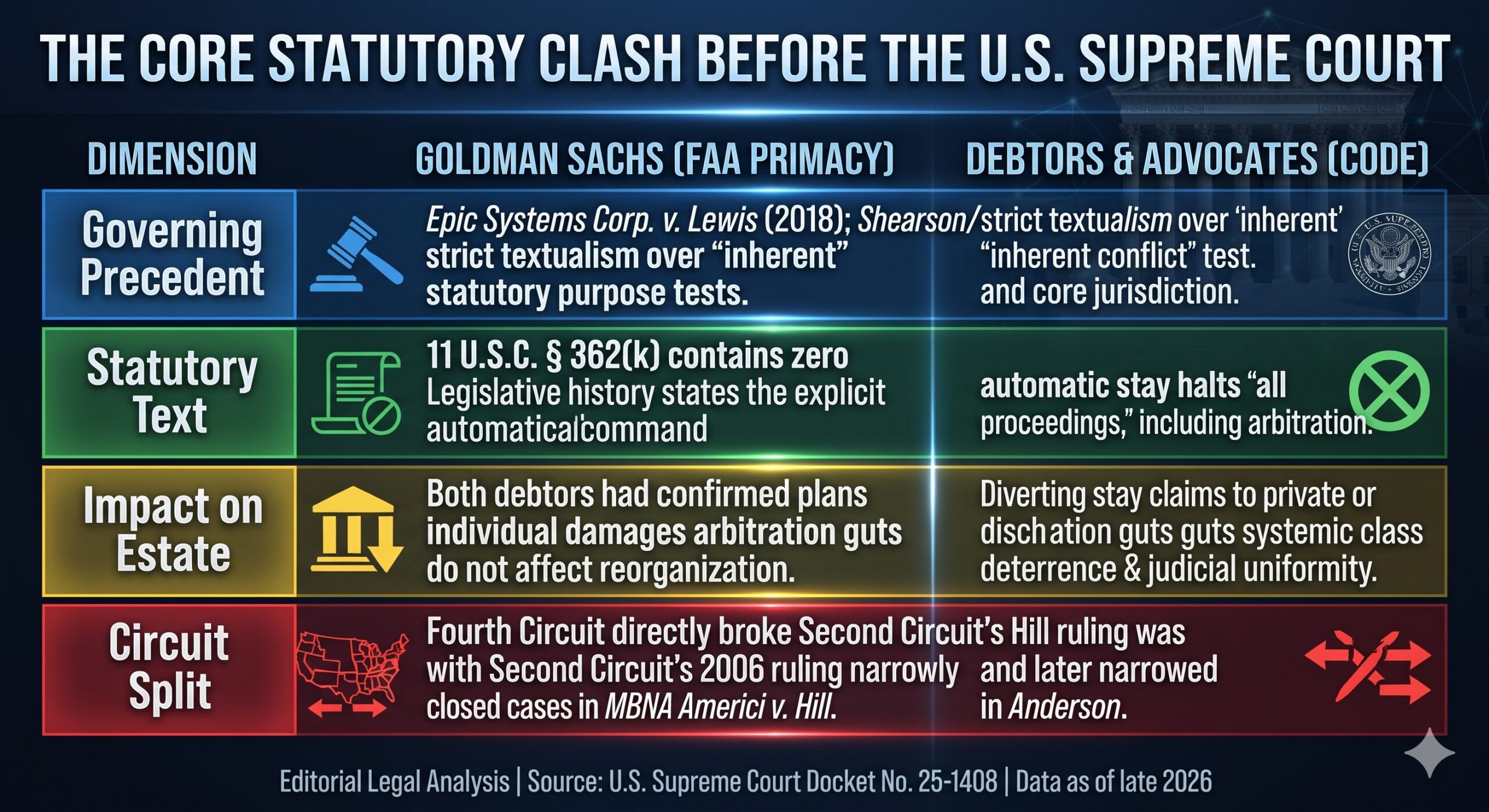
In a sharp dissent, Circuit Judge Robert King argued that the majority had misapplied Supreme Court precedent and needlessly manufactured a direct circuit split with the Second Circuit’s 2006 decision in MBNA America Bank, N.A. v. Hill. Because Brown’s Chapter 13 repayment plan had already been confirmed and Maze had already received his Chapter 7 discharge before they filed suit, Judge King contended that arbitrating their damage claims could no longer disrupt an active reorganization.
3. The Legal Showdown: Textualism vs. Statutory Purpose
When Goldman Sachs filed its Supreme Court petition in June 2026, its legal team framed the case around the textualist jurisprudence championed by the Court’s conservative majority.
The Core Statuary Clash Before The U.S. Supreme Court
Goldman Sachs’ primary weapon is the Supreme Court’s 2018 landmark ruling in Epic Systems Corp. v. Lewis. Under Epic Systems, a party claiming that one federal statute displaces the Federal Arbitration Act bears a heavy burden: it must demonstrate a “clear and manifest” congressional intention in the statutory text to override arbitration. Goldman Sachs argues that nowhere in § 362(k)—enacted in 1984, nearly six decades after the FAA—did Congress mention arbitration or carve out stay-violation lawsuits from private dispute resolution. In the bank’s view, lower courts have improperly relied on vague invocations of bankruptcy “purpose” to nullify valid arbitration contracts.
Represented by consumer bankruptcy specialists alongside amici including the National Consumer Bankruptcy Rights Center (NCBRC) and the National Association of Consumer Bankruptcy Attorneys (NACBA), Brown and Maze counter that bankruptcy law operates on a fundamentally different constitutional and statutory plane. Unlike ordinary breach-of-contract or statutory wage claims, an automatic-stay violation is a direct defiance of a federal court’s statutory injunction. Allowing a creditor to enforce a pre-bankruptcy contract clause to escape the very court whose stay it violated, debtors argue, turns the Bankruptcy Code upside down—and effectively immunizes large banks from class-wide accountability when automated billing systems repeatedly harass bankrupt consumers.
4. Why Wall Street and Consumer Advocates Are Watching Closely
The Supreme Court’s eventual decision—expected by June 2027 following oral arguments early next year—will reverberate far beyond credit card dockets.
- The Class-Action Shield for Financial Institutions: Major banks, fintech lenders, auto-finance companies, and debt buyers embed arbitration and class-action waiver clauses into virtually every retail credit agreement. If Goldman Sachs prevails, creditors facing systemic post-bankruptcy collection errors or discharge-injunction violations will be able to compel individual, confidential arbitrations—eliminating multi-million-dollar bankruptcy class actions overnight.
- Corporate Restructuring Ripple Effects: While Brown involves consumer credit cards, a broad ruling elevating the FAA over core Bankruptcy Code provisions could embolden commercial counterparties, derivatives dealers, and bondholders in complex Chapter 11 corporate reorganizations to demand private arbitration over core estate disputes, slowing down multi-billion-dollar restructurings.
- The Fate of “Bankruptcy’s Arbitration Countercurrent”: Legal scholars have long noted that bankruptcy courts represent one of the final bastions resisting the Supreme Court’s near-total enforcement of mandatory arbitration. Affirming the Fourth Circuit would preserve bankruptcy judges’ discretionary gatekeeping power over core insolvency rights; reversing it would extend Epic Systems straight into the heart of federal bankruptcy courtrooms.
Conclusion
By granting review in Goldman Sachs Bank USA v. Brown, the Supreme Court has set the stage for a definitive reckoning between two pillars of federal commercial law. On one side stands the Federal Arbitration Act’s strict command that private contracts be enforced according to their terms; on the other stands the Bankruptcy Code’s promise of a centralized, publicly enforced sanctuary for financially distressed debtors. How the justices resolve that tension in 2027 will reshape the balance of power between institutional creditors, consumers, and federal bankruptcy courts for decades to come.
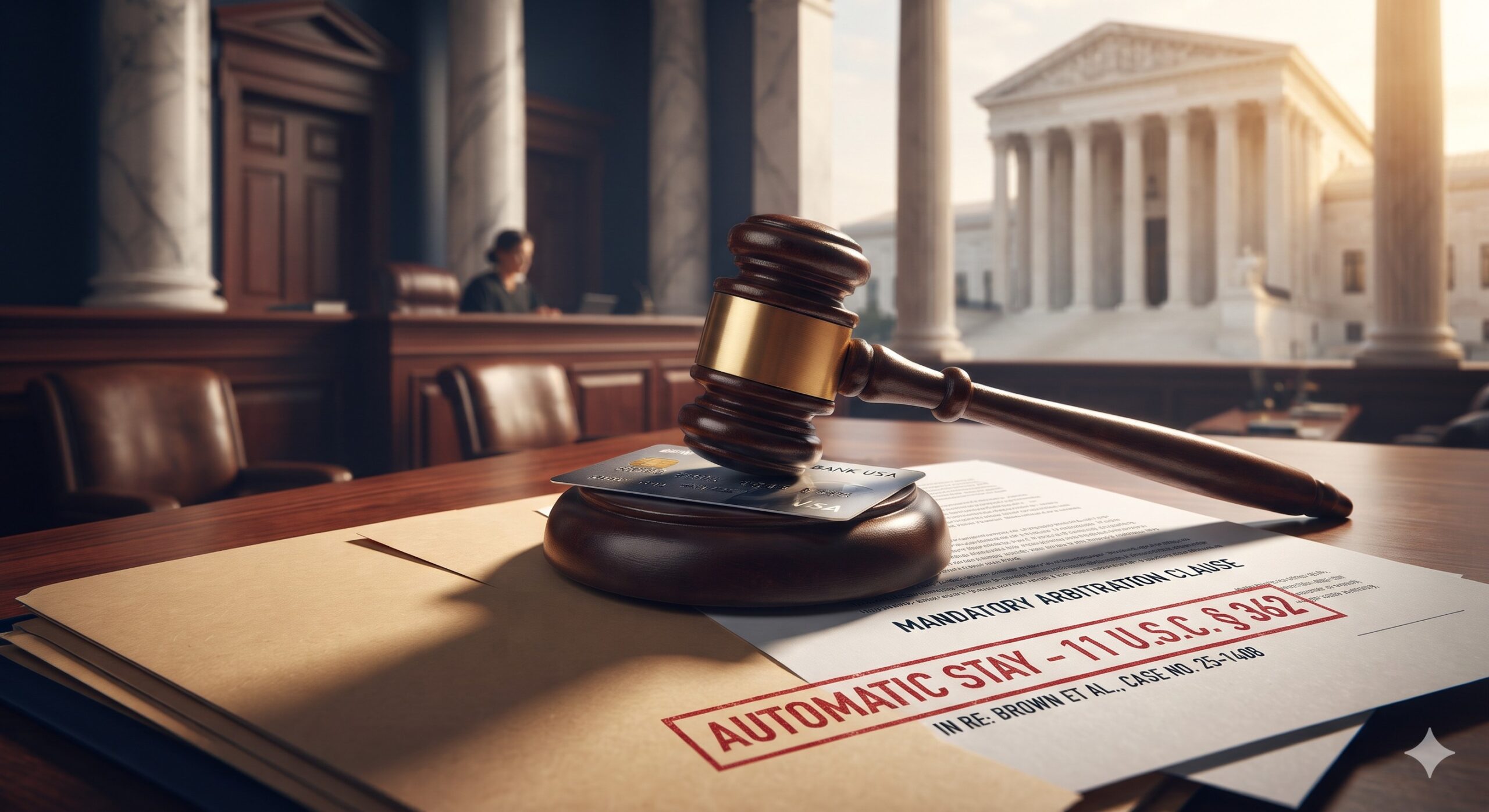
* Conceptual illustration generated using AI