
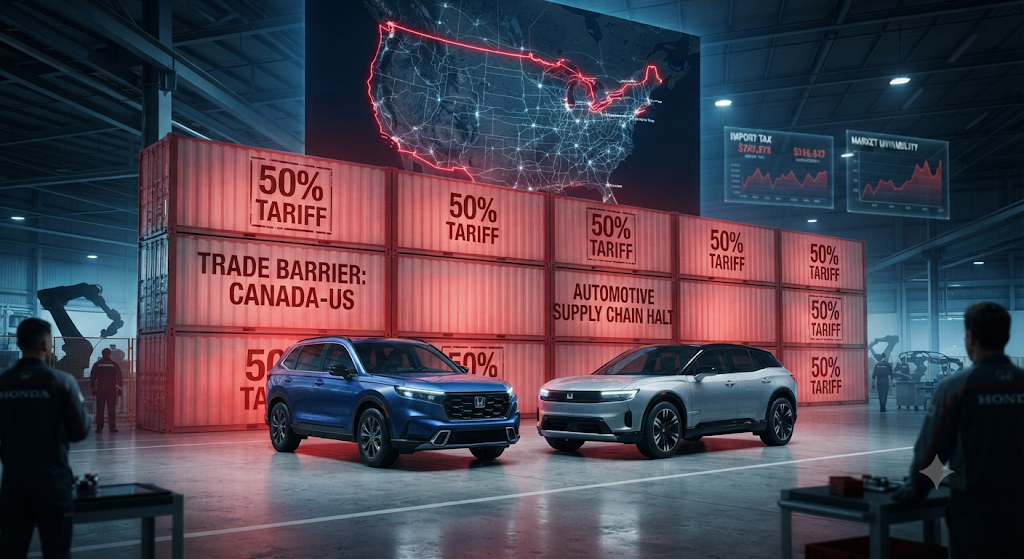
In the highly diplomatic, risk-averse world of global automotive manufacturing, multinational CEOs rarely issue public ultimatums regarding U.S. trade policy. Corporate relations teams prefer back-channel lobbying to front-page confrontations. However, when the structural foundation of a company’s most profitable market is threatened, diplomatic silence is abandoned.
This week, executive leadership at Honda Motor Co. delivered one of the most dire public warnings in the company’s modern history. Addressing the rising political rhetoric in Washington surrounding a proposed 50% baseline tariff on Canadian automotive imports, Honda executives did not mince words: implementing such a tariff would not merely disrupt supply chains—it would be “catastrophic” for the entire North American automotive industry, devastating consumer pricing, and stranding tens of billions in recently deployed capital.
While political proponents frame these tariffs as a mechanism to force manufacturing back into the American Midwest, Honda’s explicit warning exposes the intricate, fragile reality of borderless auto manufacturing. Here is an in-depth macroeconomic and supply-chain analysis of why Honda is uniquely exposed to this tariff threat, the existential risk to its $15 billion Canadian EV hub, and why a 50% duty fundamentally breaks the mathematics of the North American car market.
1. Honda of Canada Mfg. (HCM): The Crown Jewel of Ontario
To understand Honda’s panic, one must examine the sheer scale of its Canadian footprint. Honda is not a peripheral player in Canada; it is an industrial titan.
Established in 1986, Honda of Canada Mfg. (HCM) in Alliston, Ontario, was the first Japanese automobile facility built in Canada. Over the last four decades, it has evolved into a hyper-efficient, massive production hub specifically engineered to supply the United States. The Alliston complex currently has the capacity to produce over 400,000 vehicles and 190,000 engines annually.
Crucially, HCM is the primary North American manufacturing artery for two of the best-selling, highest-margin vehicles in Honda’s lineup: the Honda CR-V and the Honda Civic (including their rapidly expanding hybrid variants).
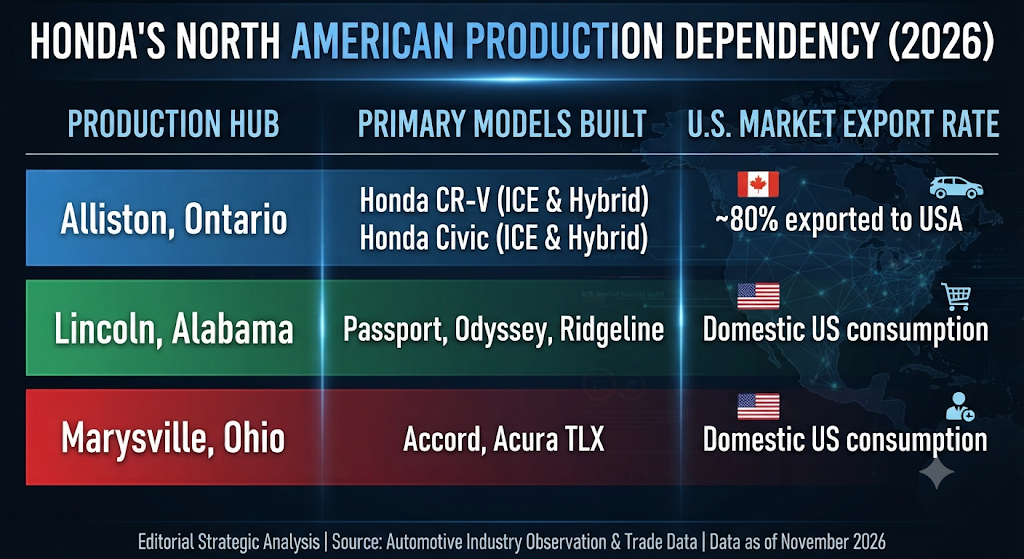
Honda’s North American Production Dependency – 2026
Because 80% of the CR-Vs and Civics rolling off the Alliston assembly line are destined directly for American driveways, a 50% cross-border tariff acts as a direct, unabsorbable tax on Honda’s core volume drivers.
2. The Mathematics of Ruin: Why 50% is Unabsorbable
In automotive manufacturing, profit margins are notoriously thin. A healthy, high-volume OEM (Original Equipment Manufacturer) typically operates on a global operating margin of 5% to 8%.
When a government imposes a low-single-digit tariff (e.g., 2.5%), an automaker can sometimes absorb the cost internally by squeezing suppliers, reducing corporate margins, or slightly raising the Manufacturer’s Suggested Retail Price (MSRP). A 50% tariff, however, mathematically destroys the vehicle’s viability in the consumer market.
Let us examine the economic mechanics of a 50% tariff on a standard Honda CR-V Hybrid:
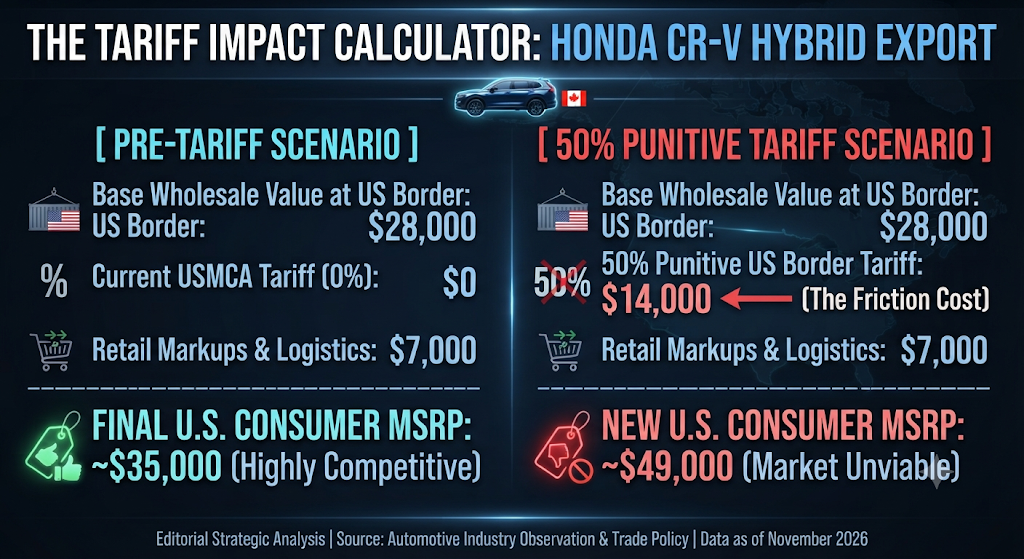
The Traffic Impact Calculator – Honda CR-V Hybrid Export
If Honda is forced to pass a $14,000 tariff penalty onto the U.S. consumer, a mainstream family crossover is suddenly priced like a luxury European SUV. The CR-V would immediately lose all pricing competitiveness against rival vehicles manufactured inside the U.S. border, such as the Nissan Rogue (built in Tennessee) or localized versions of the Toyota RAV4.
Conversely, if Honda attempts to absorb the tariff to maintain market share, it would lose roughly $11,000 on every single vehicle sold—a financial hemorrhage that would obliterate the company’s North American profitability within a single quarter.
3. The $15 Billion Hostage: Derailing the EV Transition
While the immediate threat to CR-V and Civic margins is severe, Honda’s greatest vulnerability lies in its future capital allocations.
In 2024, Honda announced a historic $15 billion CAD ($11 billion USD) investment to build a comprehensive, vertically integrated Electric Vehicle (EV) value chain in Ontario. This was not just an assembly plant; it was a localized industrial ecosystem designed to comply strictly with the US-Mexico-Canada Agreement (USMCA) rules of origin.
Honda’s Canadian EV mega-project includes:
- A new EV assembly plant in Alliston (targeting 240,000 EVs per year by 2028).
- A standalone EV battery cell plant (36 GWh capacity) built in partnership with GS Yuasa.
- A cathode active material (CAM) and precursor processing plant, established in partnership with POSCO Future M.
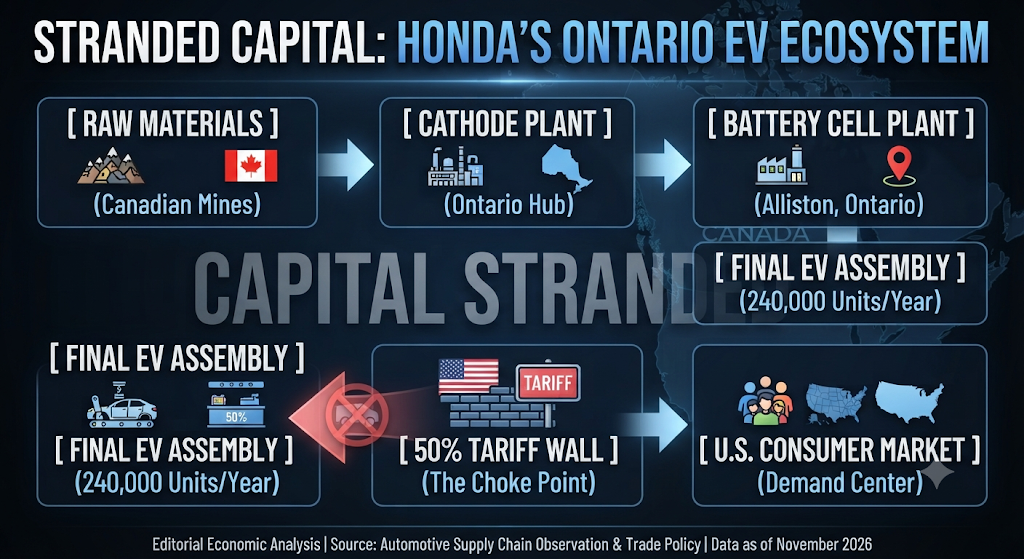
Stranded Capital – Hondas Ontario EV Ecosystem
Honda committed these billions under the legal assurance of the USMCA framework, which promised zero-tariff access to the United States for EVs built with North American parts and labor. A sudden 50% tariff effectively takes this $15 billion investment hostage.
If Canadian-built Honda EVs are slapped with a 50% duty, the entire economic rationale for the Ontario gigafactory collapses. Honda would be left with a state-of-the-art, multi-billion-dollar battery and assembly complex that produces vehicles completely priced out of the only consumer market large enough to sustain it.
4. The Systemic Contagion: Why Honda is Speaking for the Industry
Honda is currently acting as the vocal tip of the spear, but the catastrophe they are warning about applies to nearly every automaker operating in North America. The integration of the U.S. and Canadian auto sectors is so absolute that applying a tariff is akin to placing a tourniquet on the industry’s carotid artery.
- The Component Ricochet: Vehicles built in U.S. assembly plants (like Ford in Michigan or General Motors in Ohio) rely heavily on stamped metals, internal combustion engines, and electronics manufactured in Ontario. A 50% tariff on Canadian auto parts would immediately halt production lines in the American Midwest due to part shortages and soaring input costs.
- The Threat of Retaliation: Ottawa would not absorb a 50% tariff passively. The Canadian government would be forced to impose symmetrical retaliatory tariffs on American goods. Because Canada is the number one export destination for U.S.-built vehicles, American auto workers building cars for export would immediately feel the pain of reciprocal border taxes.
When Honda executives use the word “catastrophic,” they are not engaging in corporate hyperbole. They are describing the literal unspooling of a highly optimized, cross-border supply chain that has taken 60 years to build.
Conclusion: A Crisis of Trust and Capital
Honda’s stark warning regarding a 50% tariff on Canadian autos highlights a growing crisis of trust between global manufacturers and U.S. trade policy. The automotive industry operates on ten-year product cycles and multi-billion-dollar, immobile factory investments. It requires baseline geopolitical stability to function.
If Washington demonstrates that established free-trade agreements like the USMCA can be overridden overnight by punitive, double-digit tariffs, the foundation of North American manufacturing is permanently fractured. Honda’s message to policymakers is mathematically unambiguous: a 50% tariff does not protect the American auto industry; it detonates the supply chain, inflates prices for the American middle class, and paralyzes the transition to electric vehicles.
In the interconnected world of 2026 auto manufacturing, you cannot punish your neighbor without setting fire to your own factory.
* Conceptual illustration generated using AI