
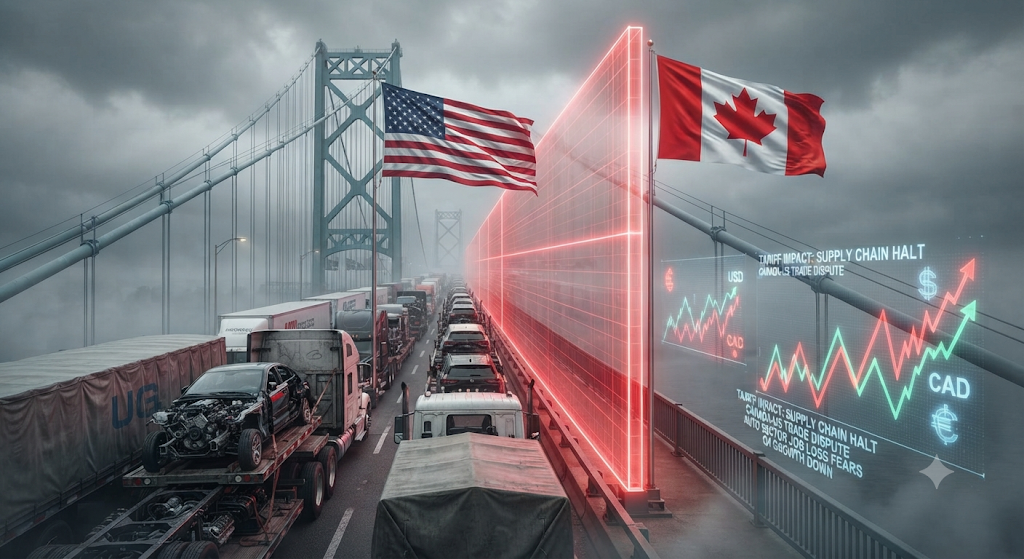
For over half a century, the North American automotive industry has operated under a singular, unbreakable geographic logic: the United States and Canada are not two separate manufacturing markets, but one deeply integrated industrial nervous system. Governed first by the 1965 Auto Pact, then NAFTA, and currently the US-Mexico-Canada Agreement (USMCA), the border between Detroit, Michigan, and Windsor, Ontario, has functionally served as an internal assembly line.
In late 2026, that frictionless industrial architecture faces a catastrophic threat. Driven by an aggressive resurgence of “America First” protectionism and escalating disputes over trade imbalances, digital services taxes, and critical mineral sourcing, the White House has floated the unprecedented threat of applying sweeping baseline tariffs on Canadian exports—including automotive parts and finished vehicles.
While the political rhetoric is aimed squarely at Ottawa, the economic shockwaves will not be confined to Canadian borders. A U.S. tariff on Canada represents a direct assault on the operational viability of global automakers—from the Detroit Three to Japanese heavyweights like Toyota and Honda, and European conglomerates like Volkswagen.
Here is an in-depth macroeconomic analysis of why U.S. tariffs on Canada would act as a devastating friction point, crippling global carmakers, derailing the electric vehicle (EV) transition, and ultimately passing billions in collateral costs onto the American consumer.
1. The Ambassador Bridge Artery: The Anatomy of Integration
To understand the sheer destructiveness of a tariff on Canadian auto exports, one must understand how modern “Just-in-Time” (JIT) automotive logistics actually function.
A car is not built in a single factory. Modern auto manufacturing relies on hyper-fragmented, specialized sub-assemblies. A single automotive component—such as a steering column, a transmission system, or an internal combustion engine—may cross the U.S.-Canadian border up to six or seven times before the vehicle is finally assembled and driven onto a dealer lot.
The primary conduit for this flow is the Ambassador Bridge connecting Detroit and Windsor, across which hundreds of millions of dollars in auto parts travel every single day.
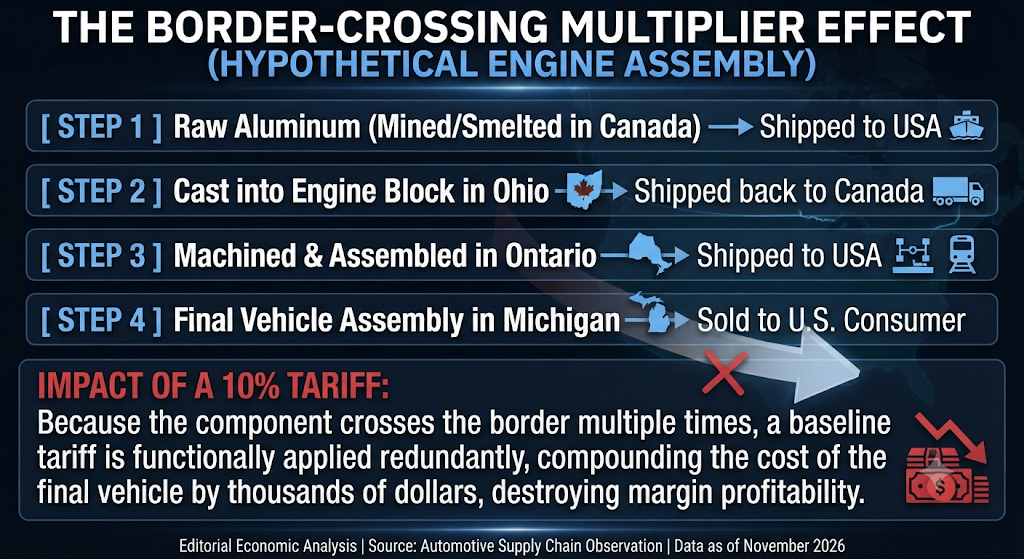
The Border-Crossing Multiplier Effect – Canada and USA
If the U.S. imposes a tariff on Canadian imports, it is not simply taxing a finished foreign product; it is taxing its own domestic supply chain. Every time a semi-truck sits in a customs queue to calculate shifting tariff duties, the “Just-in-Time” model fractures. For global automakers operating on razor-thin operating margins, this compounding tariff mechanism transforms North America from the world’s most efficient auto-manufacturing bloc into an unnavigable bureaucratic nightmare.
2. The Global OEM Exposure: Toyota, Honda, and Stellantis
The assumption that U.S. tariffs on Canada primarily hurt domestic Canadian companies is fundamentally flawed. Canada’s auto manufacturing sector is almost entirely dominated by foreign Original Equipment Manufacturers (OEMs) who use Ontario as a strategic, highly skilled export hub designed explicitly to feed the vast U.S. consumer market.
Over 80% of all vehicles manufactured in Canada are exported to the United States.
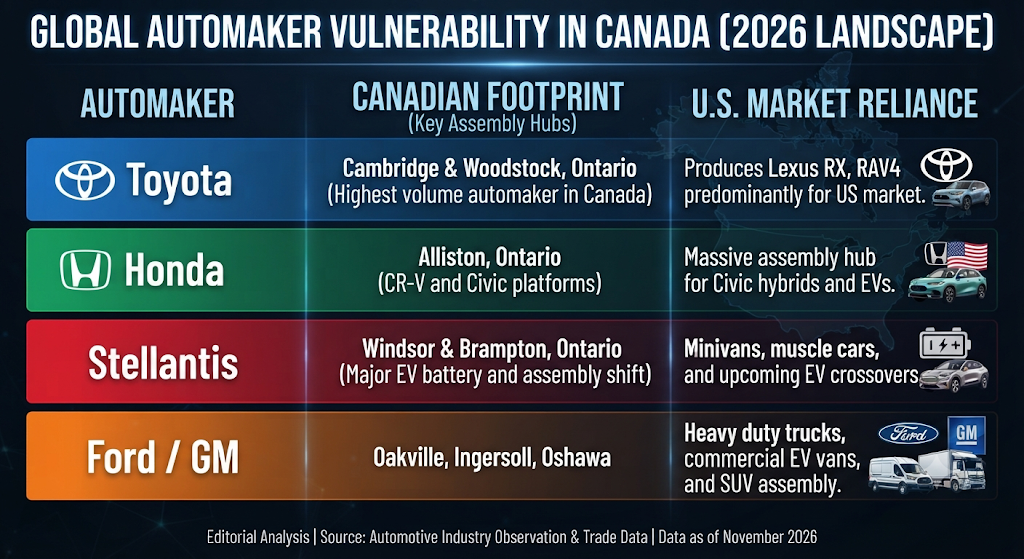
Global Automaker Vulnerability in Canada (2026 Landscape)
If a 10% or 20% tariff is applied to vehicles originating in Canada, Japanese automakers will suffer a disproportionate blow.
- Toyota, which has spent decades optimizing its Cambridge and Woodstock plants to supply RAV4s and Lexus RX models to the U.S., would instantly lose its pricing competitiveness against vehicles assembled in Tennessee or Alabama.
- Honda, which produces highly popular Civic and CR-V models in Alliston, Ontario, would be forced to either absorb the tariff costs—devastating its quarterly earnings—or pass the cost onto the U.S. buyer, risking massive market-share loss to tariff-exempt competitors.
For Stellantis, Ford, and General Motors (the Detroit Three), the pain is equally severe. They rely on Ontario not just for finished vehicles, but for critical stamped metals, drivetrains, and seating assemblies. A tariff wall splits their corporate balance sheets in half.
3. Stranded Capital: The EV Battery Gigafactory Crisis
Perhaps the most devastating long-term consequence of U.S. tariffs on Canada would be the derailment of the North American Electric Vehicle (EV) transition.
Over the last four years, the Canadian federal government and the province of Ontario have committed over $30 billion CAD in subsidies and tax incentives to lure global automakers into building massive EV battery gigafactories on Canadian soil. Canada positioned itself as the ethical, USMCA-compliant alternative to Chinese battery dominance, offering abundant critical minerals (lithium, nickel, cobalt) and clean hydroelectric power.
Global titans took the bait:
- Volkswagen (PowerCo): Building a massive $7 billion cell manufacturing plant in St. Thomas, Ontario, designed to supply VW’s North American EV fleet.
- Stellantis & LG Energy: Constructing the $5 billion NextStar Energy battery plant in Windsor.
- Honda: Committing to a massive $15 billion comprehensive EV supply chain project in Ontario, including cathode and battery assembly.
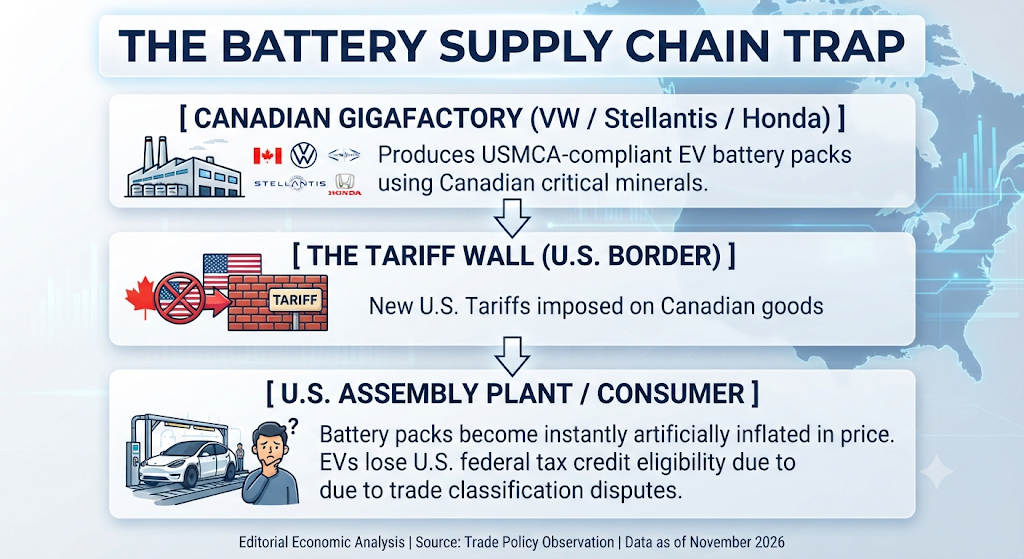
The Battery Supply Chain Trap
If the U.S. applies tariffs to these Canadian-origin batteries, the entire economic rationale for these gigafactories collapses. The billions invested by Volkswagen and Honda were predicated on frictionless, tariff-free access to the American market.
Tariffs would essentially strand this capital. U.S. final-assembly plants relying on these Canadian batteries would face immediate margin compression, making North American EVs radically uncompetitive precisely at a time when global automakers are desperately fighting to lower EV prices to achieve mainstream consumer adoption.
4. USMCA Under Fire: The Legal and Geopolitical Fallout
Implementing baseline tariffs against Canada represents a de facto violation of the US-Mexico-Canada Agreement (USMCA), the very trade deal negotiated and celebrated by Washington just years prior to replace NAFTA.
Automakers have spent billions over the last five years re-architecting their supply chains to comply with strict USMCA “Rules of Origin”—which dictate that 75% of auto content must be made in North America, and 40-45% must be made by workers earning at least $16 an hour, to qualify for zero-tariff treatment.
If the U.S. capriciously applies tariffs despite these automakers achieving USMCA compliance, it destroys the foundational trust required for long-term capital investment. Automotive CEOs will realize that compliance with U.S. trade treaties offers no actual protection against sudden political tariff shocks.
Consequently, global boardrooms may accelerate a strategy of “localization isolationism.” Rather than building integrated North American supply chains, automakers will be forced to duplicate factories—building one set of supply chains exclusively inside the U.S. border to avoid tariffs, and abandoning Canadian and Mexican facilities. This massive capital redundancy will fundamentally reduce global automaker profitability and dramatically increase the baseline cost of producing a car.
Conclusion: A Tax on the American Consumer
While tariffs are politically framed as a weapon to punish foreign competitors and protect domestic manufacturing, the structural reality of the automotive industry ensures that the true victim of a U.S. tariff on Canada is the American car buyer.
Global carmakers like Toyota, Honda, Ford, and Volkswagen cannot simply magically relocate complex Canadian supply chains and multi-billion-dollar battery plants to Ohio or Michigan overnight. Relocating an automotive supply chain takes five to seven years. In the interim, the compounding costs of border tariffs on engines, batteries, and finished vehicles will be passed directly to the consumer.
By applying tariffs to America’s most deeply integrated economic ally, policymakers risk breaking the very supply chains that keep North American automakers globally competitive. In 2026, dropping a tariff wall between Detroit and Windsor is not an act of economic defense; it is an act of industrial self-sabotage.
* Conceptual illustration generated using AI