

The political geography of the United States has undergone a tectonic shift over the past decade. For generations, American political strategy was defined by a static map of predictable state-level loyalties, interspersed with a handful of perennial swing states. Today, that map is being aggressively rewritten. The traditional boundaries that separated the Democratic and Republican vote banks have dissolved, replaced by a new structural divide based on education, geography, and class.
As we analyze the ground reality of the 2026 midterm election cycle, it is clear that the United States is no longer simply divided into “Red States” and “Blue States.” Instead, the progression of both major political parties is defined by a hyper-local, urban-versus-rural fracture that cuts across every single state and regional province in the country.
Here is a comprehensive analysis of how the Democratic and Republican parties are progressing across the distinct geographic and cultural regions of the United States, the shifting demographic coalitions driving these changes, and what this means for the future of American governance.
1. The Democratic Fortresses: The Coasts and the Urban Archipelago
Historically, the Democratic Party was the political home of the blue-collar industrial worker. In 2026, the party’s progression has taken a radically different trajectory. The modern Democratic coalition is heavily anchored in high-density urban centers, major technology and financial corridors, and affluent suburban districts.
This demographic progression has allowed the Democrats to build impenetrable fortresses along the Pacific West Coast (California, Oregon, Washington) and the Northeast corridor (New York, Massachusetts, Maryland).
The Tech and Corporate Corridors
In states like California and New York, the Democratic progression is fueled by the knowledge economy. The IT hubs of Silicon Valley, the financial centers of Manhattan, and the biotechnology corridors of Boston consistently deliver massive vote margins for Democratic candidates. The party’s platform—focused on climate change, reproductive rights, and corporate regulation—resonates deeply with college-educated professionals.
The Suburban Shift
The most significant Democratic progression over the last few election cycles has been the capture of the suburbs. Previously a reliable Republican vote bank, the affluent, college-educated suburbs surrounding major tier-1 and tier-2 cities have shifted decisively toward the Democrats. This suburban realignment has effectively neutralized Republican strongholds in states like Virginia and Colorado, transforming them from competitive battlegrounds into reliable Democratic states.
However, this urban-centric strategy comes with a distinct disadvantage. By concentrating their voters in high-density coastal states and urban clusters, Democrats suffer from extreme geographic inefficiency in the US Electoral College and the Senate, where rural landmass carries disproportionate political weight.
2. The Republican Heartland: Consolidating the Hinterland and the South
While the Democrats have conquered the cities and the coasts, the Republican Party has executed a massive consolidation of the American hinterland. The GOP has successfully transitioned into a populist, working-class party that dominates the rural geography of the United States.
The Republican progression is most visible in the Deep South, the Great Plains, and the Mountain West. States like Alabama, Oklahoma, Wyoming, and Idaho consistently deliver overwhelming supermajorities for Republican candidates.
The Working-Class Realignment
The defining feature of the modern Republican progression is the absorption of the non-college-educated working class. Across rural counties and small industrial towns, voters who previously aligned with Democrats due to union affiliations have shifted to the GOP. The Republican platform—focused on border security, trade protectionism, cultural conservatism, and domestic manufacturing—has struck a powerful chord in regions left behind by the digital and globalized economy.
The Florida and Ohio Phenomenon
The most striking evidence of the Republican geographical progression is the transformation of Florida and Ohio. For decades, these two states were the ultimate political battlegrounds, deciding presidential elections with razor-thin margins. By 2026, both states have been moved firmly into the safe Republican column.
In Florida, the GOP has successfully courted the growing conservative Hispanic and Latino vote banks, particularly in South Florida, completely erasing the traditional Democratic edge. In Ohio, the collapse of legacy manufacturing industries drove blue-collar workers into the Republican fold, turning the state deep red.
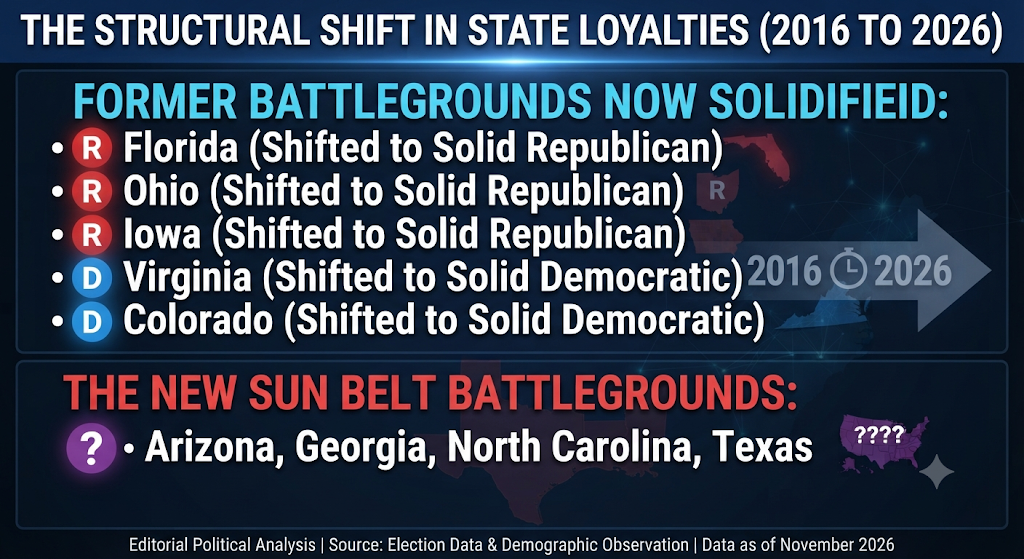
The Structural Shift in State Loyalties – 2016 to 2026
3. The Rust Belt: The Trench Warfare of the Midwest
If the coasts are blue and the South is red, the industrial Midwest—often referred to as the Rust Belt—remains the site of the most intense political trench warfare in the country. The progression of both parties in states like Pennsylvania, Michigan, and Wisconsin is entirely static, with elections routinely decided by margins of less than one percent.
In these states, the national divide is perfectly replicated on a micro-scale.
- The Democratic Strategy: Democrats rely on driving massive voter turnout in the major urban centers like Philadelphia (Pennsylvania), Detroit (Michigan), and Milwaukee (Wisconsin), while attempting to hold their ground in the surrounding university towns and affluent suburbs.
- The Republican Strategy: Republicans focus on maximizing turnout in the vast rural counties and mid-sized industrial towns that have suffered from factory closures and economic stagnation.
The progression here is purely a numbers game. Whichever party can squeeze a slightly higher turnout from their respective base claims the state. There is virtually no crossover voting; the electorate is entirely polarized, making the Rust Belt the most fiercely contested political real estate in the United States.
4. The Sun Belt Expansion: Demographic Upheaval and Migration
The most dynamic shift in the progression of both parties is currently playing out in the Sun Belt—the rapidly growing states stretching across the southern and southwestern United States, specifically Arizona, Georgia, Texas, and North Carolina.
For decades, the Sun Belt was a reliable Republican fortress. However, massive demographic changes and internal domestic migration have turned these states into the new frontline of American politics.
The Migration Effect
Following the pandemic and the normalization of remote work, millions of Americans migrated from high-cost, high-tax Democratic states (like California and New York) to lower-cost Sun Belt states (like Texas, Arizona, and North Carolina). These domestic migrants brought their voting habits with them.
The Rise of the New Metros
The Democratic progression in the Sun Belt is driven by the explosive growth of new corporate and tech hubs. Cities like Atlanta (Georgia), Phoenix (Arizona), and Austin (Texas) are expanding rapidly, pulling in young, diverse, and college-educated professionals. This has turned Georgia and Arizona into pure toss-up states.
Even Texas, the crown jewel of the Republican electoral map, is seeing its margins tighten. While Republicans maintain statewide control in Texas by turning out massive numbers in the rural hinterlands and mid-sized oil and agricultural hubs, the Democrats are steadily eating into their lead by dominating the massive urban triangle of Dallas, Houston, and Austin. The progression in the Sun Belt dictates that the Republican Party must find ways to appeal to suburban voters, or risk losing their demographic stronghold over the next decade.
5. The Micro-Geography: Blue Dots in a Red Sea
To truly understand how Democrats and Republicans are progressing, one must look beyond the state borders. The ground reality is that the United States is not an alternating checkerboard of red and blue states; it is a vast sea of red rural geography punctuated by deeply concentrated islands of blue urban centers.
A state like Illinois is overwhelmingly Democratic at the state level, but if you look at a county map, 80% of its landmass votes Republican. The state’s political direction is entirely dictated by the massive population density of Chicago. Conversely, a state like Texas features heavily Democratic cities like Austin and Houston, but the state remains Republican because the sheer volume of rural and exurban voters outnumbers the urban core.
This pin-code level polarization means that state governments are increasingly out of sync with large portions of their own populations. Rural conservatives in blue states feel completely alienated from their state capitals, while urban liberals in red states find themselves living under state laws that contradict their core values.
The progression of the Democratic and Republican parties in 2026 highlights a nation that has sorted itself into distinct cultural, economic, and geographic camps. The Democrats have consolidated the centers of the new economy—the tech hubs, the financial capitals, and the universities. The Republicans have established total dominance over the foundational economy—the agricultural heartlands, the energy-producing regions, and the industrial towns.
As the battleground shifts from the old industrial Midwest toward the rapidly growing Sun Belt, the ability of either party to secure a lasting national majority will depend entirely on their capacity to cross this geographic divide. Until then, the United States remains a nation where your pin-code is the single most accurate predictor of your political identity.
* Conceptual illustration generated using AI