
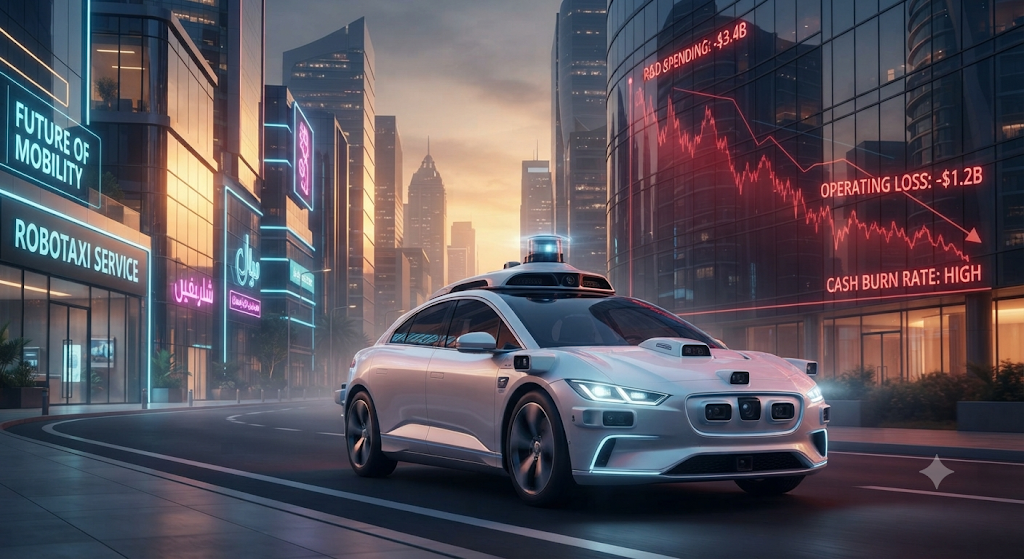
If you stand on the corner of virtually any major intersection in San Francisco, Phoenix, Los Angeles, or Austin in late 2026, the sight of a Jaguar I-Pace or a custom-built Zeekr minivan gliding silently by without a human driver is no longer science fiction. It is a mundane daily reality. Waymo, the autonomous driving subsidiary of Alphabet (Google’s parent company), has unequivocally won the technological race for Level 4 autonomy in the United States, leaving competitors like General Motors’ Cruise and Apple’s defunct Titan project in the dust.
Now, Waymo is attempting to scale its engineering triumph globally, announcing strategic international expansions into European and Middle Eastern markets.
However, beneath the sleek spinning LiDAR sensors and the triumphant press releases lies a harsh macroeconomic truth that Wall Street is increasingly scrutinizing. Despite operating the world’s most advanced autonomous fleet, Waymo remains a highly localized, heavily subsidized, cash-burning enterprise. It is a magnificent engineering marvel trapped within the economic realities of a deeply unprofitable business model.
Here is an in-depth analysis of Waymo’s aggressive overseas expansion, the brutal unit economics of operating a robotaxi fleet, and why autonomous ride-hailing in 2026 remains a premium niche rather than a ubiquitous global utility.
1. The Global Pivot: Exporting the “Waymo Driver”
For years, Waymo’s strategy was strictly confined to the American Sunbelt and select tech hubs, optimizing its AI against the predictable grids of Arizona and the complex, foggy hills of San Francisco. But to justify the tens of billions of dollars Alphabet has poured into the project over the last fifteen years, Waymo must prove that its technology is geographically scalable.
In 2026, Waymo shifted its focus to international markets, seeking environments with favorable regulatory frameworks, wealthy urban populations, and predictable weather patterns.
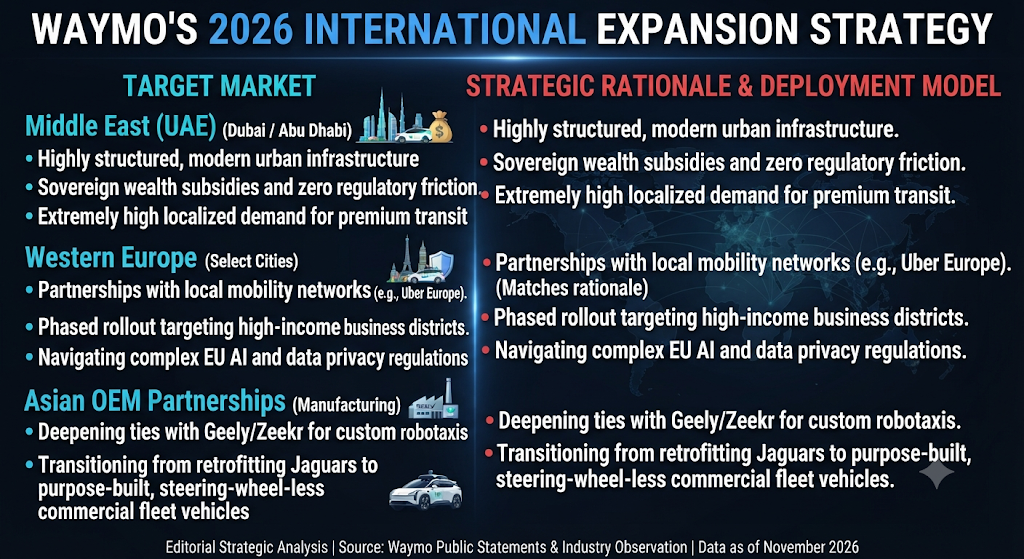
Waymos 2026 International Expansion Strategy
This international expansion is primarily being executed through strategic partnerships. Rather than attempting to build entirely new, vertically integrated taxi networks in foreign capitals, Waymo is increasingly relying on the Uber network to handle customer acquisition and dispatch, while Waymo simply provides the “Driver” (the autonomous hardware/software stack) and the vehicle.
Yet, even with these partnerships, expanding internationally exposes the profound fragility of Waymo’s operational model.
2. The Cash Bonfire: The Unit Economics of Autonomy
The fundamental promise of the robotaxi was simple: eliminate the human driver, and you eliminate the largest operational cost of ride-hailing. Once the AI is perfected, the software scales infinitely, and profit margins soar.
By late 2026, that assumption has been proven fatally flawed. While Waymo eliminated the driver inside the car, it replaced that driver with a massive, invisible infrastructure of hardware, remote operators, and maintenance depots that cost exponentially more than paying an Uber contractor.
Alphabet categorizes Waymo within its “Other Bets” financial segment. Quarter after quarter, this segment reports multi-billion-dollar operating losses. To understand why, one must look at the brutal unit economics of a single Waymo vehicle.
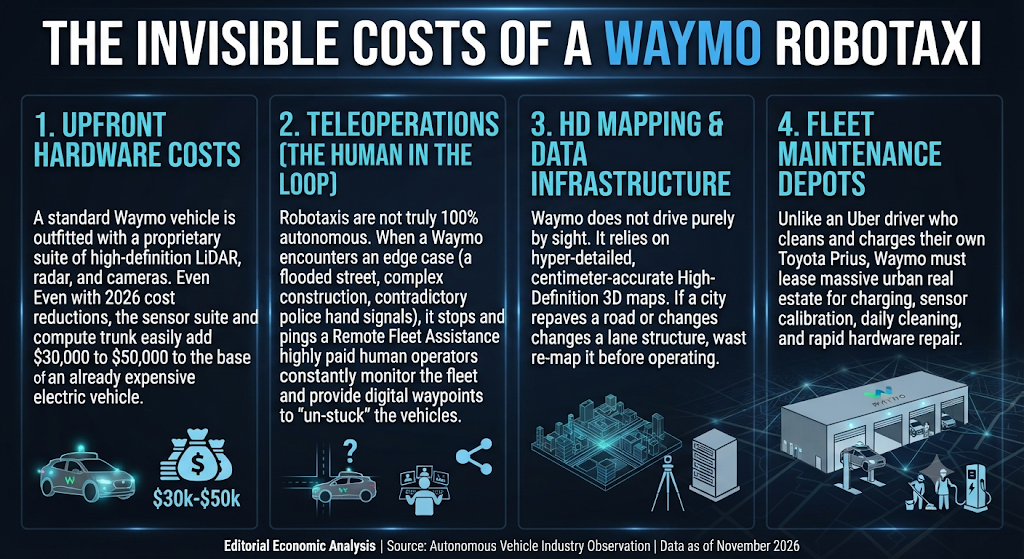
The Invisible Costs of a Waymo Robotaxi
When you factor in R&D depreciation, teleoperations, physical depots, and hardware, the cost per mile of operating a Waymo significantly exceeds the cost of paying a human gig-worker. The service only survives because it is subsidized by Google’s Search and Cloud revenues.
3. The Geo-Fenced Niche: Why It Isn’t Replacing Your Car
Despite its technological brilliance, Waymo’s service in 2026 remains a niche luxury. It is restricted by Operational Design Domains (ODDs)—a set of strict conditions under which the AI is permitted to operate.
If you live within the designated geofence in Phoenix or Dubai, and the weather is relatively clear, a Waymo provides a magical, private, and exceptionally safe transportation experience. It is immensely popular among affluent urban professionals, women seeking secure late-night transit, and tech enthusiasts.
However, if you live outside the mapped zone, or if there is a severe blizzard, heavy fog, or unpredictable rural infrastructure, the service simply does not exist.
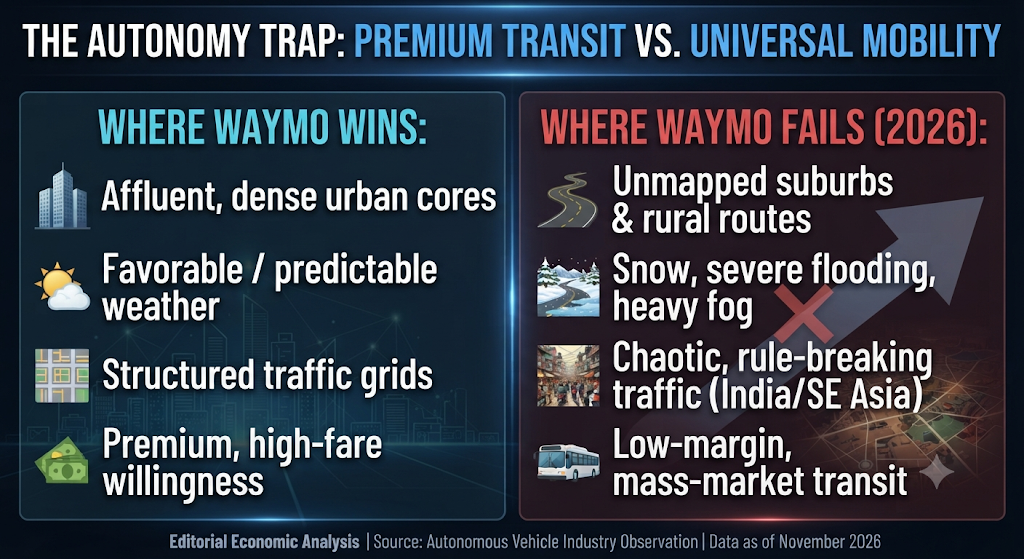
The Anatomy Trap – Premium Transit vs. Universal Mobility
Because of this intense reliance on HD mapping and perfect conditions, Waymo cannot organically scale across a country the way Uber or Lyft did. Uber scaled globally in years because humans are generalized intelligence engines; a driver can navigate a dirt road in Mumbai or a snowy street in Montreal without downloading a 3D map. Waymo, conversely, must conquer the world one painstakingly mapped, heavily sanitized city block at a time.
4. The Existential Question: Fleet Operator or Software Licensor?
As Waymo pushes overseas, the core strategic question facing Alphabet’s board is what kind of business Waymo is actually trying to build.
Currently, Waymo operates as a vertically integrated Fleet Operator. It owns the cars, pays for the charging, handles the customer service, and maintains the depots. This is a capital-intensive, low-margin business historically reserved for municipal transit authorities or rental car companies (like Hertz or Avis). Silicon Valley tech giants typically abhor this business model, preferring asset-light software margins.
Financial analysts argue that for Waymo to ever turn a profit and justify its valuation, it must pivot entirely to becoming a Software Licensor—the “Windows of the Car.”
Under this model, Waymo would abandon owning its own robotaxi fleets. Instead, it would license the “Waymo Driver” software and sensor stack to major automakers (Toyota, Ford, BMW, Hyundai) for consumer vehicles, taking a monthly subscription cut. While Waymo is tentatively exploring this with companies like Zeekr, automakers are fiercely protective of their own software ecosystems and hesitate to surrender their vehicle data to Alphabet.
Conclusion: A Marvel Without a Margin
Waymo’s expansion into international markets in 2026 proves that its autonomous technology is genuine, robust, and capable of adapting to new, structured environments. It has achieved what many skeptics claimed was impossible: deploying safe, reliable, driverless cars into the wild on a daily basis.
Yet, solving the engineering problem of autonomy did not solve the economic problem of mobility. By replacing the human driver with an army of remote operators, expensive LiDAR sensors, and massive maintenance depots, Waymo has built the most technologically advanced—and most expensive—taxi company in human history.
Until the cost of the hardware plummets, or until Waymo transitions from operating physical taxi fleets to licensing software, it will remain exactly what it is today: a spectacular, cash-burning glimpse of the future, geofenced for the wealthy, and entirely subsidized by the profits of the Google search engine.
* Conceptual illustration generated using AI