

On November 5, 2026, the Internal Revenue Service released Revenue Procedure 2026-35, unveiling its annual inflation adjustments across nearly 70 federal tax provisions for the 2027 tax year. While the seven statutory marginal tax rates remain unchanged—ranging from 10% at the entry level to 37% for top earners—the IRS has widened every income threshold by roughly 3.2% and raised standard deductions across all filing statuses.
For American households navigating persistent cost-of-living pressures, these annual adjustments serve as an essential structural safeguard against “bracket creep”—the phenomenon where cost-of-living raises push workers into higher tax brackets without any actual increase in real purchasing power.
Before calculating your 2027 tax picture, one critical calendar distinction applies: these newly released figures govern income earned between January 1 and December 31, 2027, which taxpayers will file in the spring of 2028. They do not alter the 2026 tax returns due in April 2027. However, because open enrollment for workplace benefits is currently underway and payroll withholding resets in January, understanding where you land now can unlock immediate financial planning advantages.
Here is a comprehensive breakdown of the 2027 federal income tax brackets, the expanded standard deductions, real-world paycheck savings, and key shifts across family credits, health accounts, and estate rules.
1. The 2027 Federal Income Tax Brackets: Where Your Income Lands
Under permanent rate structures solidified by the Working Families Tax Cuts legislation, the federal income tax system maintains seven progressive brackets: 10%, 12%, 22%, 24%, 32%, 35%, and 37%.
A common misconception among taxpayers is that landing in the 24% bracket means the IRS taxes every dollar of your earnings at 24%. In reality, federal tax brackets are strictly marginal. Your taxable income—calculated after subtracting either the standard deduction or your itemized deductions from your adjusted gross income—is sliced into layers, with each layer taxed only at the rate assigned to that specific band.
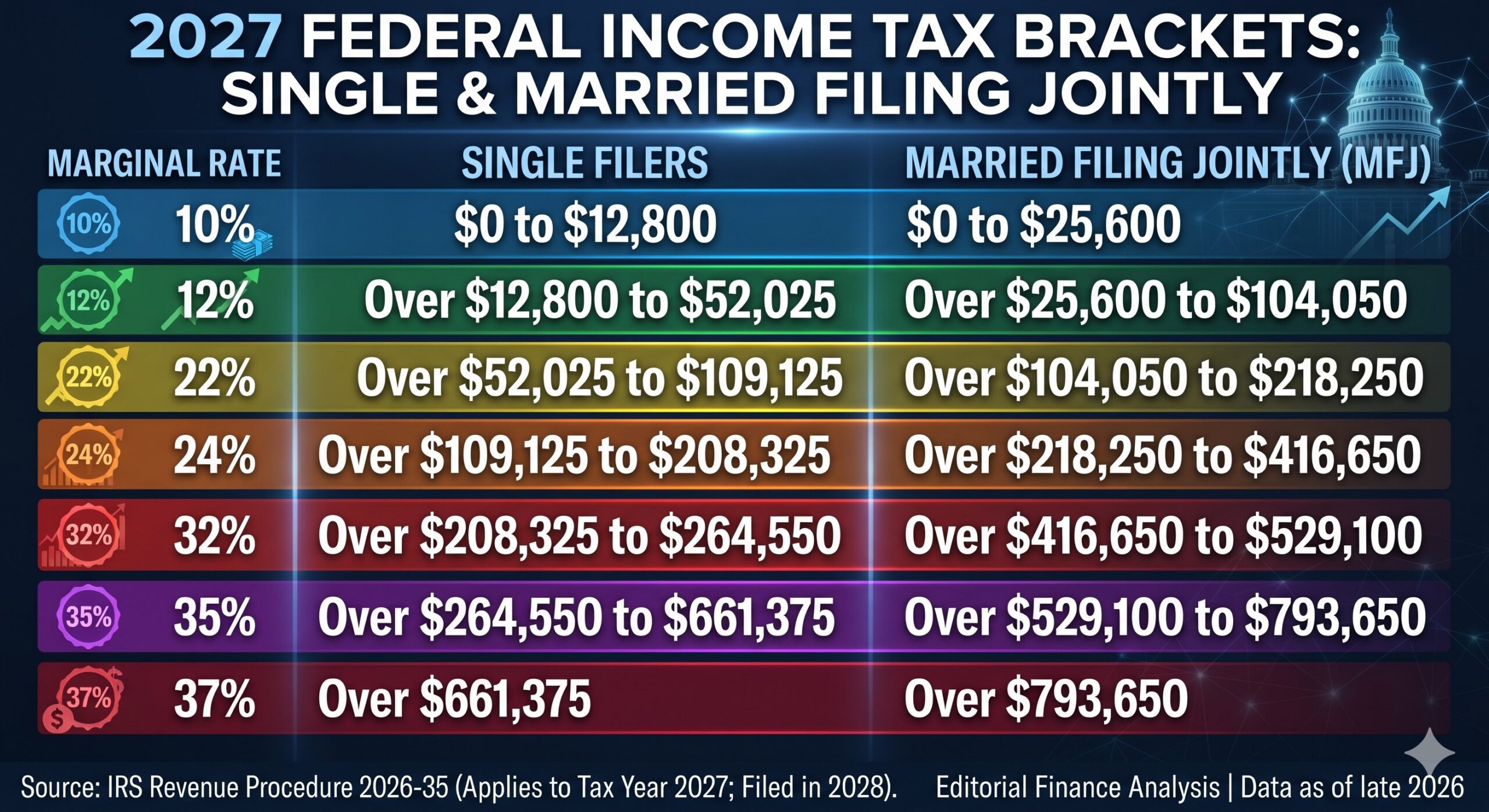
2027 Federal Income Tax Brackets – Single and Married Filing Jointly
For taxpayers filing as Head of Household—typically unmarried individuals supporting a qualifying dependent—or Married Filing Separately, the IRS has adjusted the income thresholds accordingly:
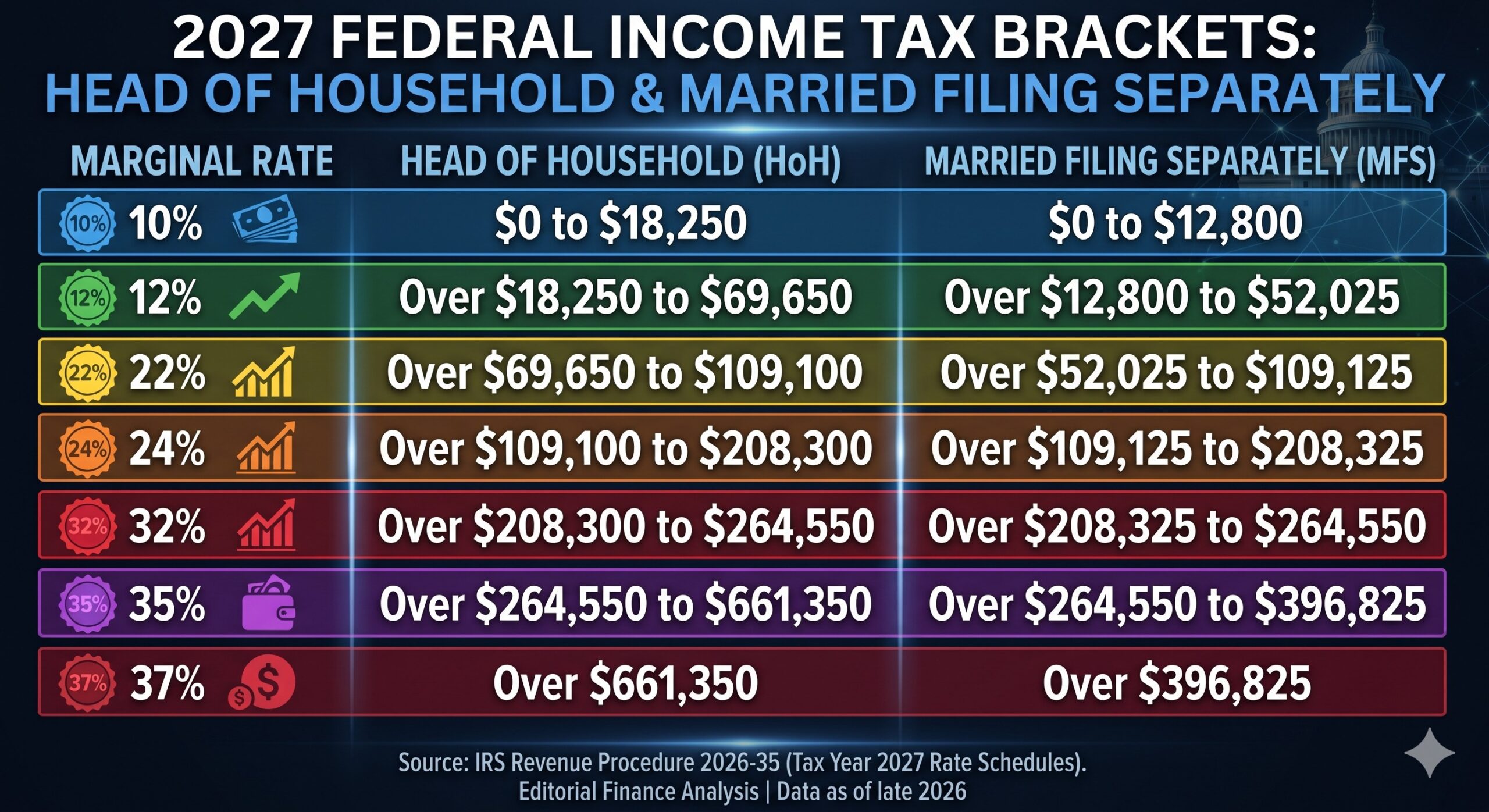
2027 Federal Income Tax Brackets – Head Of Household and Married Filing Separately
Notice the wider cushions at the lower and middle tiers: a married couple filing jointly can now earn up to $104,050 in taxable income before a single dollar is touched by the 22% rate—up from $100,800 in 2026. When combined with the standard deduction, a married couple can earn $137,250 in gross income in 2027 and remain entirely within the 10% and 12% marginal brackets.
2. Bigger Standard Deductions: Your Tax-Free Income Floor Rises
Before any tax rate applies to your paycheck, the standard deduction shields an initial block of income from federal taxation altogether. Because nearly nine out of ten American households claim the standard deduction rather than itemizing mortgage interest, state and local taxes, and charitable gifts, this adjustment delivers the broadest benefit across the workforce.
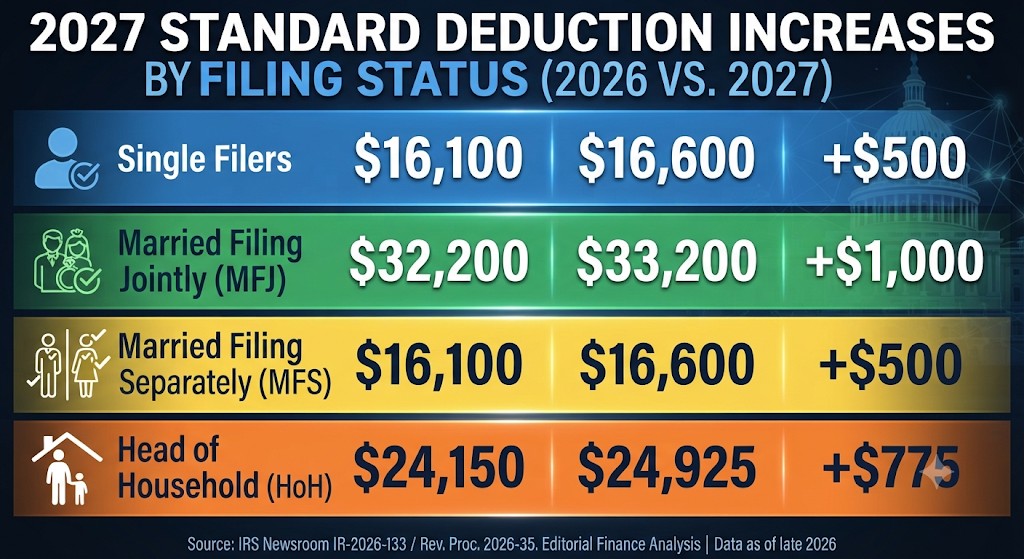
2027 Standard Deduction Increases – By Filing Status – 2026 Vs. 2027
Additional Rules for Seniors, Blind Filers, and Itemizers
- Aged or Blind Taxpayers: For tax year 2027, the additional standard deduction for taxpayers who are age 65 or older or blind rises to $1,700 per qualifying condition for married individuals, and $2,100 for unmarried filers who are not surviving spouses. Furthermore, eligible taxpayers aged 65 and older continue to benefit from the separate $6,000 senior deduction enacted through 2028.
- Personal Exemptions Remain Zero: Consistent with permanent statutory rules, the personal exemption remains at $0 for 2027.
- High-Earner Itemized Deduction Cap: While the overall limitation on itemized deductions remains eliminated for most taxpayers, households in the top 37% marginal bracket face a statutory cap on the tax benefit derived from itemized deductions.
3. Paycheck Math: How Much Will You Actually Save in 2027?
To see how these adjustments play out on a real household balance sheet, consider three common taxpayer profiles earning the exact same gross income in 2027 as they did in 2026, claiming the standard deduction:
Scenario A: Single Filer Earning $60,000
Subtracting the $16,600 standard deduction leaves $43,400 in taxable income. The first $12,800 is taxed at 10% ($1,280), and the remaining $30,600 is taxed at 12% ($3,672).
- 2027 Federal Income Tax: $4,952 (an effective tax rate of 8.25%)
- 2026 Federal Income Tax: $5,020
- Direct Tax Savings: $68
Scenario B: Single Filer Earning $100,000
After the $16,600 standard deduction, taxable income equals $83,400. Taxed progressively across the 10%, 12%, and 22% bands, the total bill drops noticeably.
- 2027 Federal Income Tax: $12,890 (an effective tax rate of 12.89%)
- 2026 Federal Income Tax: $13,170
- Direct Tax Savings: $280
Scenario C: Married Couple Earning $120,000 With Two Children (Under 17)
Subtracting the $33,200 joint standard deduction brings taxable income to $86,800. Before credits, the couple owes $2,560 on the first $25,600 (10%) and $7,344 on the remaining $61,200 (12%), totaling $9,904. Applying two expanded Child Tax Credits ($2,300 each, or $4,600 total) slashes their liability.
- 2027 Federal Income Tax: $5,304 (an effective tax rate of 4.42%)
- 2026 Federal Income Tax: $5,640
- Direct Tax Savings: $336
While flat-wage savings are modest, the larger financial victory arrives if you receive a 3% to 3.2% annual raise in 2027: the wider brackets absorb that wage increase so your effective tax rate does not creep upward.
4. Beyond the Brackets: Credits, Workplace Accounts, and Estate Rules
Revenue Procedure 2026-35 also lifts dollar caps across dozens of family credits, employee benefit accounts, and wealth-transfer exclusions:
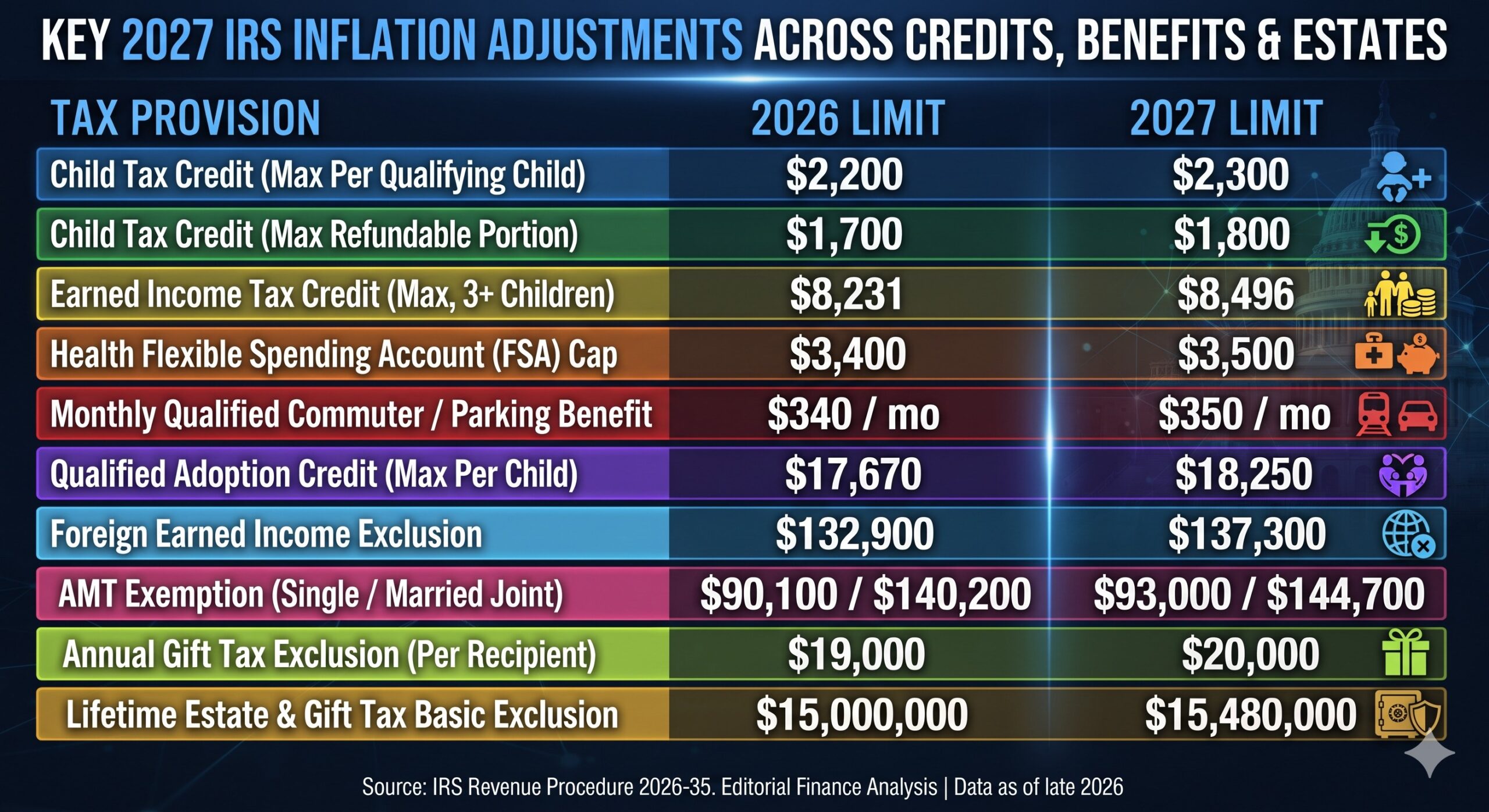
Key 2027 IRS Inflation Adjustments Across Credits, Benefits and Estates
What Was Not Adjusted for Inflation
Not every line item in the tax code moves with consumer prices. By statute, the modified adjusted gross income (MAGI) phaseout thresholds for the Lifetime Learning Credit remain frozen at $80,000 to $90,000 for single filers ($160,000 to $180,000 for joint returns), gradually eroding its real value as wages rise. Meanwhile, the IRS is expected to announce 2027 retirement contribution limits for 401(k) plans and IRAs in a separate notice later this month.
5. Three Smart Tax Moves to Make Before 2027 Begins
- Calibrate Workplace Benefit Elections Now: With corporate open enrollment active across November 2026, factor in the higher $3,500 Health FSA limit (and $700 maximum carryover) alongside the $4,500 self-only / $9,000 family HSA limits already set for 2027. Every pre-tax dollar routed into these accounts reduces your taxable income at your highest marginal rate.
- Review W-4 Withholding for January: Because the expanded standard deduction and wider brackets take effect on January 1, 2027, payroll software will automatically adjust withholding slightly downward. If you experienced a major life event—such as marriage, a new child qualifying for the $2,300 Child Tax Credit, or a secondary side-income stream—submit an updated Form W-4 before the new year.
- Plan Strategic Gifting Across Calendar Years: Families executing wealth-transfer or 529 education funding strategies can utilize the $19,000 per-recipient gift tax exclusion before December 31, 2026, and immediately deploy the expanded $20,000 exclusion starting January 1, 2027.
Conclusion
The IRS’s 2027 tax adjustments do not represent a sweeping legislative rewrite of the U.S. tax code, yet their cumulative impact across paychecks, family credits, and tax-advantaged accounts is tangible. By lifting the standard deduction to $16,600 for individuals and $33,200 for married couples while widening every marginal bracket by roughly 3.2%, Revenue Procedure 2026-35 ensures that inflation-driven wage gains stay in workers’ pockets rather than disappearing into higher tax tiers. Knowing precisely where your income lands is the first step toward keeping more of what you earn in 2027.
* Conceptual illustration generated using AI