

On October 24, 2026, officers from the Enforcement Directorate (ED) Panaji Zonal Office, working alongside Customs and Central Industrial Security Force (CISF) personnel, intercepted Mumbai-based advocate Rashesh Bharatkumar Upadhyay (also known as Rashesh Shah) at Chhatrapati Shivaji Maharaj International Airport. Upadhyay was attempting to board an early-morning connecting flight to Delhi without a booked return ticket.
His arrest under the Prevention of Money Laundering Act (PMLA), 2002, marks a critical breakthrough in one of the largest financial crime investigations in Indian history. What initially appeared to be a localized “digital arrest” cyber-extortion case in Goa has unravelled into a staggering financial network. The investigation reveals cumulative banking transactions approaching ₹28,000 crore, cash deposits exceeding ₹2,900 crore, and a web of over 400 mule accounts spanning 20 states and Union Territories.
The arrest of a legal professional highlights an alarming evolution in organized cybercrime: transnational syndicates are no longer relying solely on tech-savvy hackers and anonymous call centers. Instead, they are actively co-opting legal, banking, and financial intermediaries to launder proceeds, bribe officials, and unfreeze compromised banking infrastructure.
Here is an investigative breakdown of the ED’s ₹28,000 crore cyber fraud probe, the mechanics of the mule account network, the specific role played by legal intermediaries, and what this case reveals about the systemic threat of digital extortion in India.
1. The Genesis: From a ₹2.60 Crore Goa Complaint to a National Cascade
The scale of modern cybercrime often conceals its modest origins. The ED’s money-laundering investigation originated from a single First Information Report (FIR) registered by the Goa Police on June 9, 2025. A woman reported losing ₹2.60 crore after falling victim to a sophisticated “digital arrest” scam—a psychological extortion tactic where fraudsters pose as police, Customs, or CBI officers on video calls, falsely claiming the target is implicated in drug trafficking or money laundering, and demanding immediate transfer of funds into “government verification accounts”.
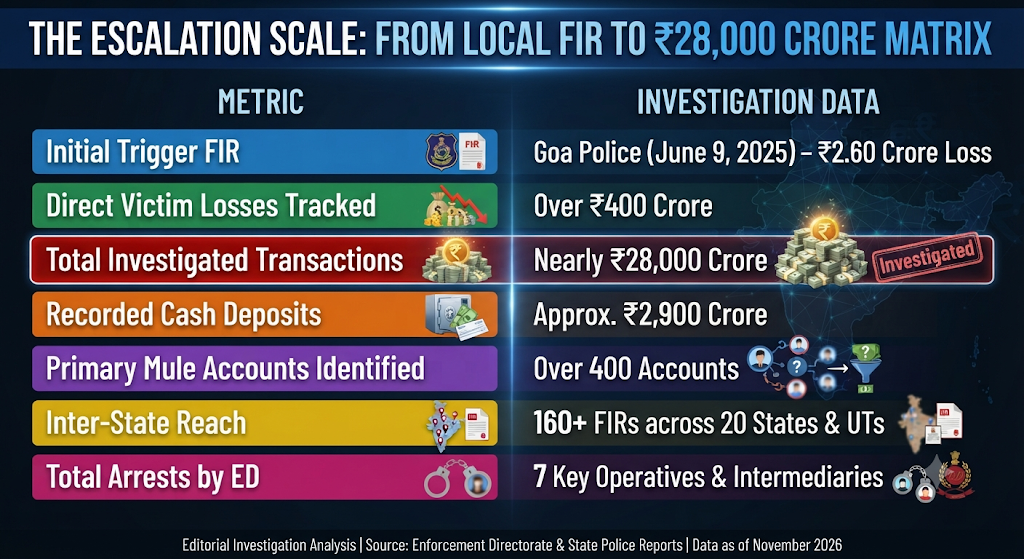
The Escalation Scale – From Local FIR to Rs.28000 CRORE Matrix
When the ED took over the financial trail under PMLA, forensic accountants traced the ₹2.60 crore stolen from the Goa victim. Instead of resting in a single destination, the funds were instantly fragmented across dozens of layered accounts.
As investigators mapped the beneficiary nodes, the accounts began linking to hundreds of other pending cybercrime complaints nationwide. To date, accounts embedded within this specific network have surfaced in over 300 victim complaints and 160 separate FIRs registered across 20 states and Union Territories. While direct victim losses tied strictly to documented complaints currently stand at over ₹400 crore, the total velocity of capital moved through these accounts reaches a astounding ₹28,000 crore.
2. The Mule Account Engine: Shell Entities and Cash Laundering
At the core of this ₹28,000 crore enterprise lies a vast, multi-layered infrastructure of mule bank accounts. Cybercrime syndicates cannot operate without access to functional banking channels to receive, split, and extract stolen funds before law enforcement can freeze them.
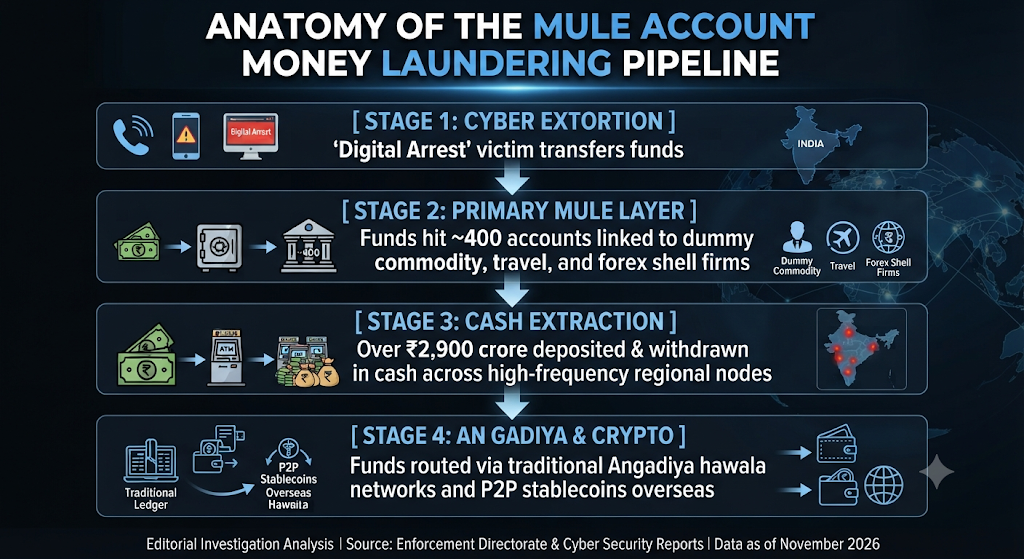
Anatomy Of The Mule Account – Money Laundering Pipeline
According to ED submissions before the special PMLA court, the syndicate utilized approximately 400 primary mule accounts. These accounts were not merely opened using stolen individual identities; a significant portion were registered under the names of dummy commercial entities—specifically shell companies purporting to operate in commodity trading, travel services, and foreign exchange (forex) operations.
Commercial accounts were selected deliberately because they handle higher daily transaction limits without automatically triggering bank anti-money laundering (AML) fraud algorithms. The investigation revealed that ₹2,900 crore of the total volume was deposited directly in cash across various branches. This massive cash injection indicates a dual-purpose operation: laundering illicit domestic cash while simultaneously providing clean digital liquidity for offshore cyber-syndicate handlers.
3. The Unfreezing Industry: The Role of Legal Intermediaries and Bribes
The arrest of advocate Rashesh Upadhyay illuminates a critical, sinister dimension of the money-laundering ecosystem. When cybercrime victims lodge complaints on the national 1930 helpline or with state police, law enforcement agencies rapidly issue freeze orders to banks under Section 102 of the Code of Criminal Procedure (now Section 106 of the Bharatiya Nagarik Suraksha Sanhita) to lock suspect accounts.
For a cyber syndicate, a frozen mule account containing millions of rupees represents trapped capital and a direct link to law enforcement. This is where specialized intermediaries step in.
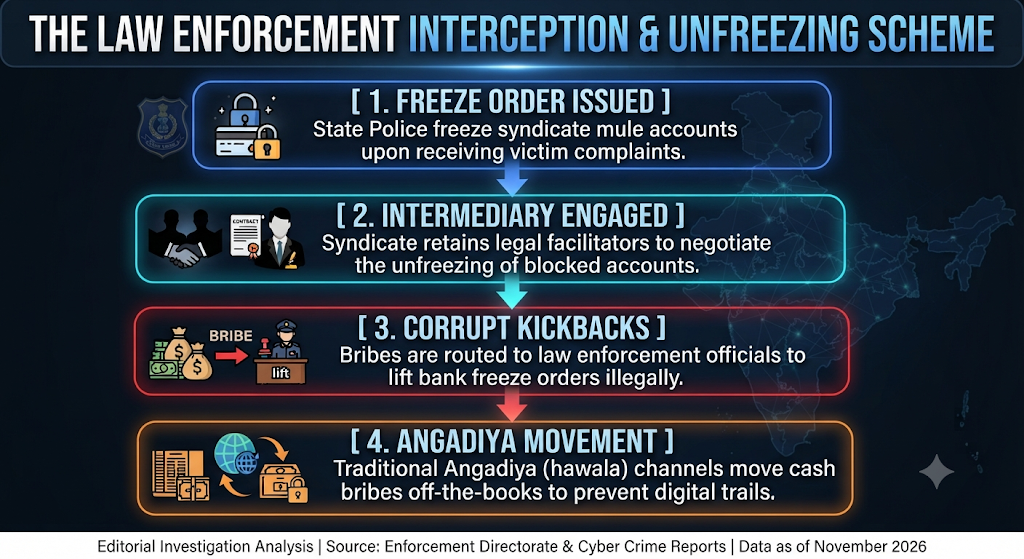
The Law Enforcement Interception and Unfreezing Scheme
The ED alleges that Upadhyay served as a vital operational bridge between the cybercrime network and corrupt law enforcement personnel. When state police forces froze accounts associated with the network, Upadhyay allegedly negotiated bribes and kickbacks to secure the release of these frozen funds.
To move these illicit payments without leaving digital traces, the network relied heavily on traditional Angadiyas—informal, trust-based hawala banking networks operating primarily out of Mumbai, Gujarat, and Delhi. Cash collected from cyber victims was handed to Angadiyas, who then delivered physical cash kickbacks to corrupt intermediaries and officials tasked with unfreezing the accounts.
By arresting seven individuals—including financial layerers, hawala managers, and now a key legal intermediary—the ED is systematically dismantling the protection mechanism that allowed this syndicate to operate across state lines.
4. Structural Vulnerabilities: Why the System Failed to Catch ₹28,000 Crore
The sheer magnitude of a ₹28,000 crore cyber fraud network operating across 400 bank accounts exposes severe systemic blind spots within the Indian banking and regulatory architecture.
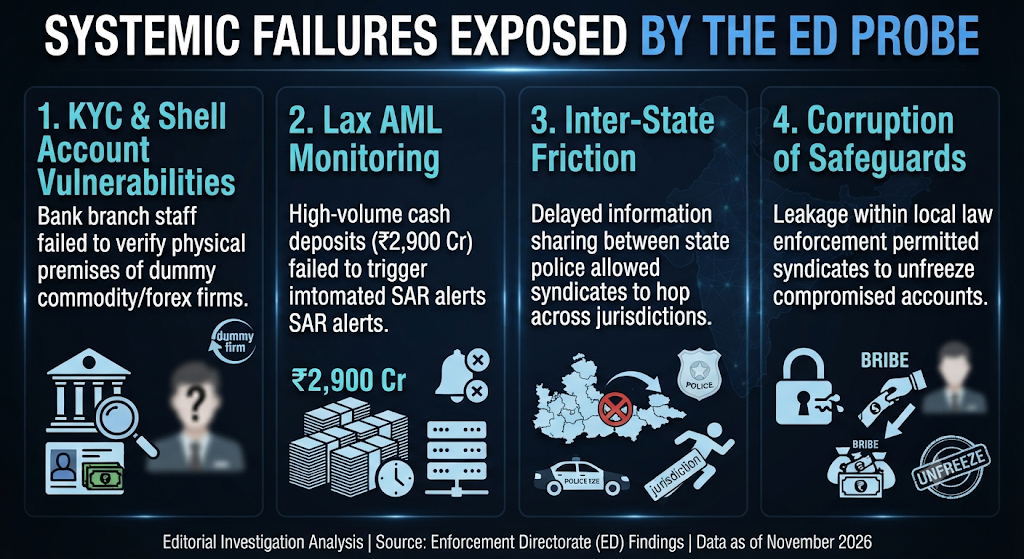
Systemic Failures Exposed By The ED Probe
- Failure of Know Your Customer (KYC) Audits: The creation of 400 commercial mule accounts under the guise of travel and commodity trading firms indicates severe laxity—or direct insider collusion—at the branch level. Standard banking norms require physical verification of business premises for commercial accounts handling large transaction volumes.
- Delayed Suspicious Transaction Reporting (STR): Despite processing nearly ₹28,000 crore in total volume and ₹2,900 crore in cash, these accounts remained active long enough to service over 300 separate cyber-fraud incidents. Automated Financial Intelligence Unit (FIU-IND) flags should have paralyzed these accounts far earlier.
- Jurisdictional Arbitrage: Fraudsters strategically spread mule accounts across 20 different states and Union Territories. When a victim filed a complaint in Goa or Karnataka, local police faced immense administrative hurdles obtaining account records from banks located in distant states, granting the syndicate time to siphon funds via hawala channels.
The Imperative for Institutional Clean-Up
The ED’s arrest of advocate Rashesh Upadhyay at Mumbai airport signals a decisive shift in how financial intelligence agencies are tackling cybercrime. Law enforcement is recognizing that shutting down fake call centers is insufficient if the financial infrastructure—the mule accounts, hawala brokers, corrupt bankers, and crooked legal intermediaries—remains intact.
The ₹28,000 crore scale of this case demonstrates that “digital arrest” scams are not isolated petty frauds; they are high-level financial crimes that threaten public trust in the national banking system.
As the ED deepens its custody interrogation of Upadhyay and moves to identify the specific officials who accepted bribes to unfreeze accounts, the message to the financial and legal sectors is unmistakable: facilitating, laundering, or turning a blind eye to the proceeds of cyber-extortion carries severe criminal consequences under the PMLA. Dismantling this ₹28,000 crore network is a vital step toward safeguarding the integrity of India’s financial ecosystem.
* Conceptual illustration generated using AI