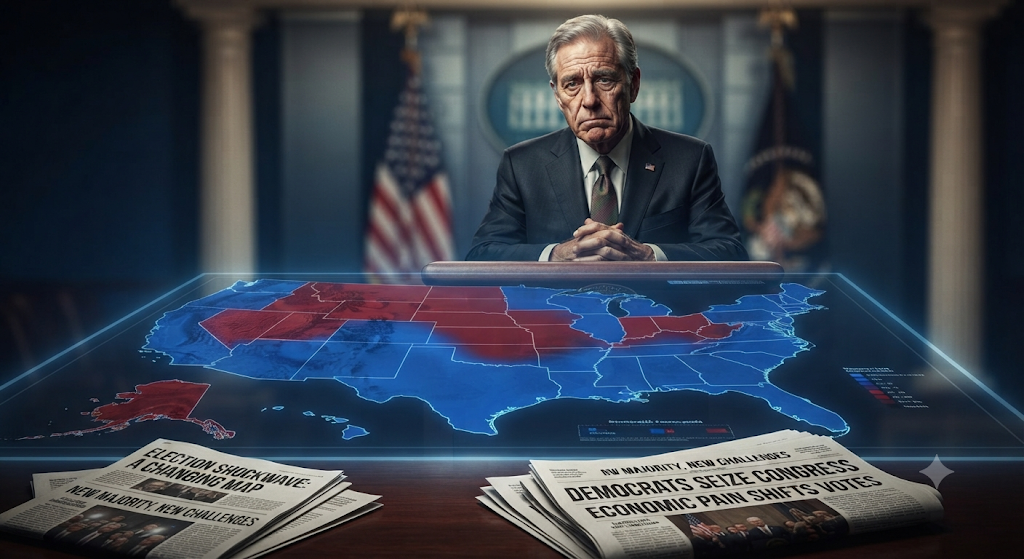
The political landscape of the United States has just undergone a seismic recalibration. As the final ballots of the November 2026 midterm elections are tallied, the results present a stunning rebuke to the incumbent administration. The Democratic Party has successfully seized control of both the House of Representatives and the Senate, executing a “blue wave” that swept through traditional conservative strongholds and erased the Republican legislative majority.
For President Donald Trump, this is the most significant electoral drubbing since 2020. Unlike his presidential victory in 2024—which was built on an unexpected, expansive coalition of working-class whites, Hispanic voters, and young Americans—this midterm cycle exposed the fragility of a political strategy heavily dependent on personal loyalty and high-risk executive actions.
With the spectre of Democratic-led congressional probes looming over the next two years, the White House faces a deeply uncertain future. Here is an analytical breakdown of the structural factors that drove the 2026 midterm defeat, the specific policy missteps that alienated the American electorate, and the harsh political lessons Donald Trump must absorb as the nation shifts its gaze towards 2028.
1. The Economics of Disillusionment: Inflation and the Tariff Trap
In the lead-up to the midterms, the Republican strategy banked on the assumption that a combination of tax cuts and Trump’s populist appeal would insulate the party from electoral backlash. However, working-class voters—whether Republican, Democrat, or undecided—ultimately vote on affordability.
By late 2026, the cost of living had become an insurmountable political liability for the incumbent administration. The price of basic necessities, from eggs and ground beef to medicine, remained painfully high. Much of this inflationary pressure was self-inflicted through aggressive trade policies. The administration’s heavy reliance on sweeping tariffs against trading partners ranging from China and Canada to India and Mexico functioned exactly as economists warned: as a massive, regressive tax on American citizens, leading to rising prices across imported commodities.
The Lesson: Populist rhetoric cannot mask daily financial pain. When the working-class base that propelled a candidate to power finds themselves struggling to afford groceries and petrol, they will penalise the party in charge, regardless of cultural messaging.
2. The Iran Conflict and the Betrayal of “America First”
Perhaps the most consequential factor in the midterm collapse was the administration’s foreign policy pivot. A core tenet of the “Make America Great Again” (MAGA) movement was a firm promise to extract the United States from “never-ending and endless wars” in the Middle East.
However, the decision to launch a joint military offensive with Israel against Iran in February 2026 shattered that promise. The resulting eight-month conflict sent shockwaves through the global energy market. The Strait of Hormuz—a vital artery for global oil supply—became a volatile chokepoint, sending fuel prices skyrocketing at American petrol pumps.
This intervention shocked and embittered the conservative base. For rural voters in the American Midwest, who rely on gas-guzzling vehicles to traverse long distances for work and basic amenities, the cost of the war was not an abstract geopolitical chess move; it was a daily financial drain.
The Lesson: Foreign military interventions carry immediate domestic consequences. Wading into a major conflict without weighing the pros and cons alienated the administration’s core supporters, who felt betrayed by a hawkish foreign policy that drained their wallets.
3. The Collapse of the 2024 Coalition
Donald Trump’s 2024 victory was heralded as a masterclass in political realignment, successfully drawing significant margins from traditionally Democratic vote banks, including African American men, Hispanic communities, and Indian Americans. By November 2026, that coalition was completely fractured.
According to the AP Voter Poll, the shift away from the Republican party was staggering:
- Hispanic Voters: Roughly 6 in 10 Hispanic voters nationally backed the Democratic candidate in their local House race. In 2024, nearly 40% of this demographic backed Trump.
- Youth Vote: Voters under 30, who were evenly split in 2024, shifted dramatically, with 70% supporting Democrats in their area in 2026.
A primary driver of this demographic collapse was the administration’s severe crackdown on illegal immigration. The widely publicised ICE raids—rebranded as “NICE” raids—resulted in women and children being picked up from schools and homes. This aggressive approach deeply disturbed the social fabric of immigrant communities across the US, alienating the very minority and immigrant voters who had previously given the administration the benefit of the doubt on economic grounds.
The Lesson: Demographics are not destiny, but they require careful maintenance. Expanding a political tent requires policies that nurture newly acquired voters; aggressive, divisive crackdowns will rapidly send them back to the opposition.
4. The Candidate Quality Crisis: Loyalty vs. Electability
The 2026 midterms also exposed a severe flaw in the president’s political calculus: the prioritisation of absolute personal loyalty over broader electoral appeal.
In crucial races across the country, Trump elevated handpicked candidates over the objections of local Republican establishments. The results were disastrous. High-profile Senate candidates in North Carolina and South Carolina—such as Michael Whatley and Lindsey Graham—lost races the party was heavily favoured to win. In Texas, embattled loyalist Ken Paxton was soundly defeated.
These choices placed the Republican party on the defensive in red states, forcing them to spend vital resources protecting seats that should have been secure.
The Lesson: Endorsements based purely on fealty do not translate into general election victories. A candidate must possess the political agility to win independent and moderate voters, especially in an environment dominated by economic anxiety.
5. Institutional Overreach and the Corruption Perception
American voters have long demonstrated a low tolerance for leaders who attempt to dismantle the institutional guardrails of the Republic. Throughout the term, Trump sought to aggressively dominate institutions ranging from the judiciary to the US Congress. He also pushed to weaken key elements of the Voting Rights Act and sought to nationalise the administration of midterm elections to destroy mail-in voting. These moves diminished vital guardrails and frightened voters across the board.
Compounding this institutional overreach was a pervasive stench of moral and financial corruption. Approximately 6 in 10 voters stated that Trump places a higher priority on his personal interests than the country’s. The public reacted poorly to reports that the President’s personal wealth grew by an unprecedented $2.2 billion in his first year back in office, fuelled by opaque crypto deals, critical mineral deals in Pakistan, and lobbying windfalls from tech titans. Furthermore, his associations with the Jeffrey Epstein files deeply alienated middle-class voters who were already weary of his rhetoric.
The Lesson: The American electorate remains deeply suspicious of executive overreach and self-enrichment. The presidency cannot be run as a personal corporate enterprise without triggering a severe electoral backlash.
6. The Next Two Years: Subpoenas and the Veto Pen
With the loss of both chambers of Congress, the strategic posture of the Trump administration must fundamentally alter. The legislative window for the MAGA agenda has firmly slammed shut.
The incoming Democratic majorities in the House and Senate will arrive armed with subpoena power, expansive committee budgets, and a mandate for aggressive oversight. Investigations into the administration’s foreign policy, personal business dealings, the handling of the Epstein probe, and allegations of corporate corruption will dominate the news cycle.
In response, the President has already signalled his primary defensive weapon. On election night, Trump posted an image of his signature red cap, replacing the traditional slogan with a single word stitched onto it: VETO. The next two years will be characterised by legislative gridlock, as the administration attempts to slow-walk document requests, assert executive privilege, and veto progressive legislation passed by the new Congress.
Conclusion: Can the Strategy Evolve?
The 2026 midterm elections serve as a harsh political reality check. Donald Trump has learned—or at least has been shown—that a political movement cannot survive on grievance and base loyalty alone when macroeconomic indicators turn hostile. When the cost of petrol rises due to foreign wars, and when the administration appears more focused on personal wealth and institutional battles than on the welfare of the citizenry, the American voter will ruthlessly enforce accountability.
As the unofficial race for 2028 begins today, the question is not whether the Republican Party can survive this defeat, but whether its leader is capable of internalising these lessons. If the administration continues to double down on isolationist purges and economic tariffs, the Democratic supermajority may only solidify its grip on Washington.
* Conceptual illustration generated using AI