
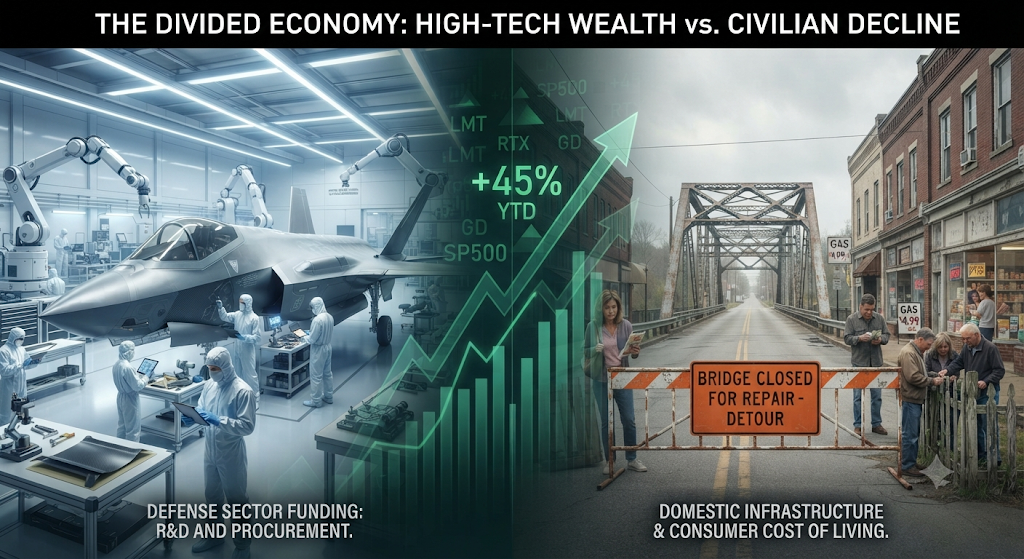
There is a deeply entrenched narrative in global geopolitical discourse: the United States economy relies on war to generate vast amounts of wealth. Proponents of this view point to the American ascent out of the Great Depression during World War II, the booming stock prices of defense contractors during modern proxy conflicts, and the country’s status as the undisputed leader in global arms exports.
However, examining the macroeconomic data reveals a far more complex reality. While it is undeniably true that military conflicts generate astronomical profits for a concentrated sector of the American economy—specifically the military-industrial complex—war does not inherently make the American public wealthier. Instead, wartime economies are characterized by a massive reallocation of capital: transferring wealth from civilian taxpayers to defense contractors, funded by deficit spending, elevated national debt, and systemic inflation.
Here is an investigative analysis separating the illusion of wartime prosperity from the mathematical reality of defense economics, tracing how the United States finances its conflicts and who actually captures the economic gains.
1. The World War II Illusion: GDP Growth vs. Civilian Prosperity
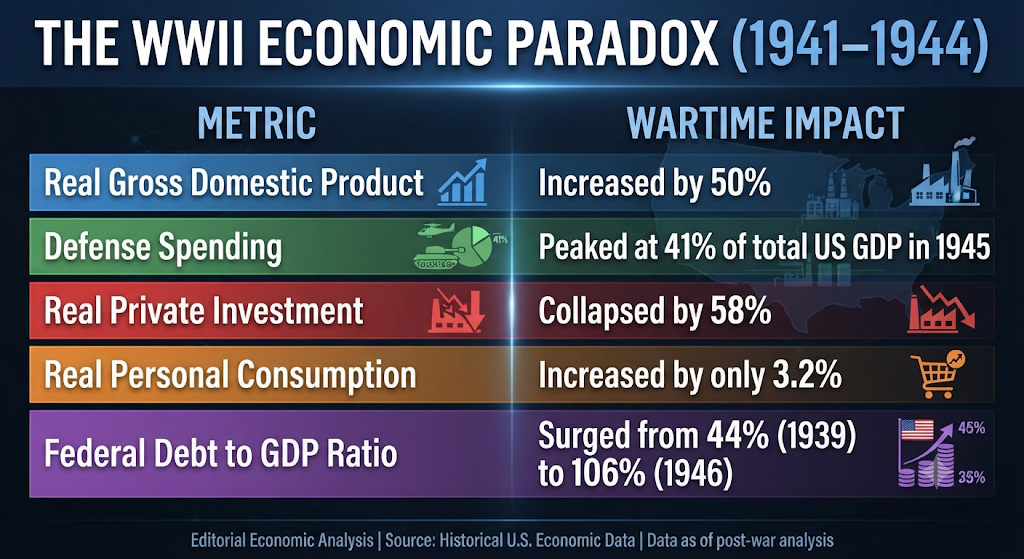
The belief that war is economically beneficial is heavily rooted in the American experience of World War II. Between 1941 and 1944, the U.S. gross domestic product (GDP) surged by an astonishing 50%. Unemployment, which had plagued the nation for a decade, vanished overnight as millions of men mobilized for combat and women entered defense manufacturing.
On paper, the U.S. economy appeared to be booming. In reality, the GDP metric was heavily distorted by government military expenditure.
The WWII Economic Paradox – 1941 to 1944
The surge in output consisted of tanks, bombers, and munitions—goods that produce zero long-term economic utility or compounding civilian wealth. While GDP soared, the average American faced strict rationing of gasoline, meat, sugar, and consumer goods. Real private investment fell by 58% as civilian factories were forcibly retrofitted for wartime production.
Furthermore, this “boom” was financed via massive borrowing. U.S. federal debt held by the public skyrocketed from 44% of GDP in 1939 to 106% by 1946. World War II did not create lasting organic wealth; it temporarily mobilized idle resources via debt, a bill that the American taxpayer spent the next three decades paying down.
2. The Military-Industrial Complex: Where the Wealth Actually Concentrates
If war does not make the general public wealthier, who captures the economic upside? In his 1961 farewell address, President Dwight D. Eisenhower coined the term “military-industrial complex” (MIC) to describe the formidable union of the defense establishment and the arms industry.
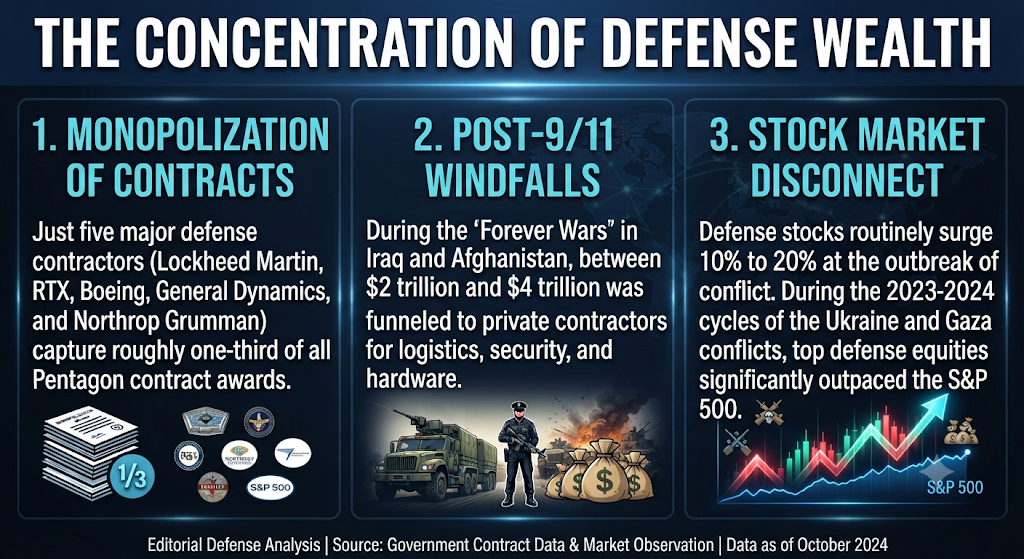
Today, the financial mechanics of the MIC demonstrate that while war may be a macroeconomic burden, it is a highly lucrative corporate enterprise. The system operates on a straightforward model: global instability and conflict drive government procurement, which in turn secures long-term revenue streams for private aerospace and defense corporations.
The Concentration of Defense Wealth
The privatization of modern warfare has accelerated this wealth concentration. During the wars in Iraq and Afghanistan, the U.S. outsourced core military functions—from base logistics to diplomatic security—to private military contractors like KBR (formerly Kellogg Brown & Root). This ensured that hundreds of billions of taxpayer dollars bypassed public infrastructure entirely, flowing directly into corporate balance sheets.
3. The Arms Export Engine: Profiting from Proxy Wars
While direct U.S. military involvement carries heavy domestic costs, the American defense sector has perfected the art of monetizing foreign conflicts through foreign military sales (FMS).
When the United States provides security assistance to allies—such as Ukraine, Israel, or Taiwan—the funds allocated by Congress rarely leave the United States. Instead, the money is routed directly to domestic defense manufacturers to replenish U.S. stockpiles or build new weapons systems for export.
- Record Export Volumes: In 2023, U.S. arms exports hit a record $238 billion, a staggering 43% increase from the previous year, driven almost entirely by European nations rearming in response to the war in Ukraine and ongoing conflicts in the Middle East.
- Recycling Global Capital: Arms sales effectively recycle foreign capital (including petrodollars from the Middle East) back into the U.S. economy, supporting high-tech manufacturing jobs in key electoral swing states.
This export engine aligns corporate financial incentives with perpetual global geopolitical tension. Peace is economically stagnant for the MIC; regional proxy wars represent sustained, high-margin revenue cycles.
4. The Macroeconomic Toll: Inflation and Opportunity Cost
The argument that defense spending is fundamentally good for the broader economy relies on “Military Keynesianism”—the idea that government spending on weapons stimulates demand and creates jobs. However, this perspective ignores the fundamental economic principle of opportunity cost, often illustrated by the “broken window fallacy.”
Every trillion dollars spent on precision-guided munitions, fifth-generation fighter jets, or overseas deployments is a trillion dollars not invested in domestic infrastructure, civilian healthcare, education, or renewable energy research.
Furthermore, financing wars without raising taxes inevitably leads to systemic inflation.
The Vietnam War and the Inflationary Spiral
During the 1960s, the U.S. government attempted to fund the Vietnam War simultaneously with President Lyndon B. Johnson’s expansive “Great Society” domestic programs—a strategy famously dubbed “guns and butter.”
To avoid the political backlash of raising taxes to fund an increasingly unpopular war, the Federal Reserve accommodated the fiscal expansion by increasing the money supply. By 1968, defense spending hit 10% of GDP. The result was a severe inflationary spiral that fundamentally destabilized the U.S. economy throughout the 1970s, eroding the purchasing power of the American working class.
The Modern Fiscal Constraint
Today, the fiscal environment is even more fragile. Unlike the pre-WWII era, when national debt was relatively low, the United States entered 2026 with a debt-to-GDP ratio hovering near 100%. Borrowing trillions of dollars to fund overseas military commitments or defense buildups now carries massive debt-servicing costs, consuming a growing share of the federal budget and leaving the government vulnerable to future economic shocks.
Conclusion
The assertion that “America always makes a vast amount of money during wars” requires a precise definition of who “America” is.
If “America” refers to the highly consolidated defense industry, private military contractors, and their institutional shareholders, the statement is unequivocally true. For these entities, armed conflict is a structural business requirement that guarantees decades of risk-free, taxpayer-funded revenue.
However, if “America” refers to the broader civilian economy and the average taxpayer, war is a massive engine of wealth destruction. Military conflicts divert capital away from productive, life-enhancing civilian investments and replace them with depreciating military assets. They saddle future generations with exorbitant national debt and dilute the purchasing power of the working class through inflation. Ultimately, war does not enrich the nation; it merely concentrates its capital into the hands of the few who are in the business of building the arsenal.
* Conceptual illustration generated using AI