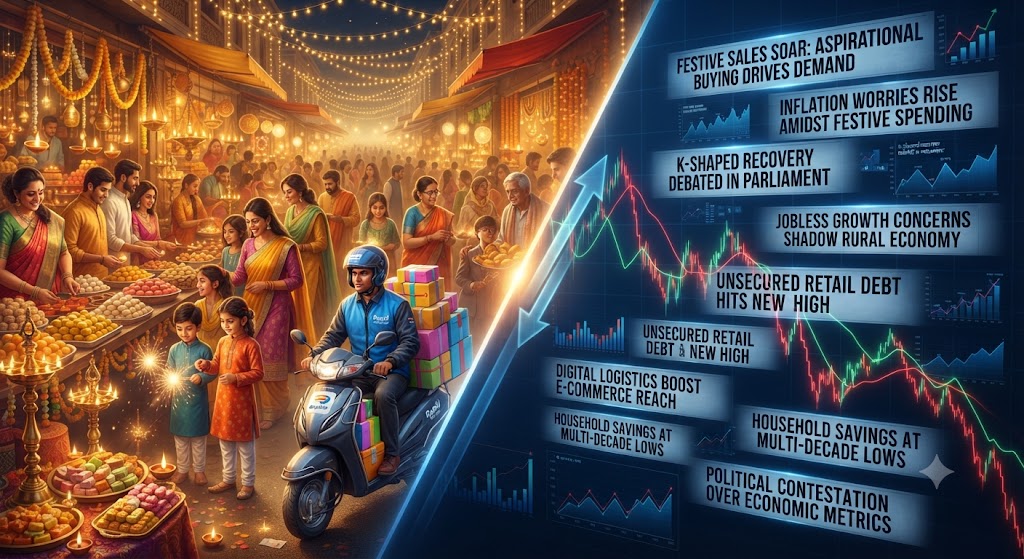
Every autumn, as the monsoons recede and the festival calendar unfolds from Ganesh Chaturthi and Durga Puja to Dhanteras and Diwali, the Indian economy undergoes a massive seasonal acceleration. The festive window—stretching over six to eight weeks—is not merely a period of cultural celebration; it serves as the primary consumption engine of the nation, accounting for over 30% to 35% of total annual retail sales, driving seasonal employment, and mobilizing capital across supply chains from micro-artisans to multinational tech platforms.
In 2026, festive trade statistics are breaking historic records. Online Gross Merchandise Value (GMV) alone is projected by industry tracking bodies to cross ₹1.50 lakh crore to ₹1.55 lakh crore ($17.0–$17.6 billion), registering a 25% to 29% year-on-year growth. Overall retail commerce across physical and digital channels is estimated to exceed ₹6.05 lakh crore, propelled by rising volume orders, expanding quick-commerce logistics, and deep penetration into Tier-2, Tier-3, and semi-urban markets.
Yet, this booming narrative of festive prosperity sits at the absolute center of a fierce political divide. While the ruling government projects record-breaking festival spending as definitive proof of robust macroeconomic fundamentals, high consumer confidence, and a thriving middle class, the political opposition—led by Lok Sabha Leader of Opposition Rahul Gandhi and the Indian National Congress—presents a starkly contrasting narrative.
The opposition argues that the headline festive numbers mask a severe K-shaped economic recovery, deep-seated income inequality, persistent rural wage stagnation, high youth unemployment, and escalating household debt driven by distress financing and easy credit.
Here is an in-depth macroeconomic and political analysis of how India’s festive season shapes the national economy, the arguments fueling the opposition’s counter-narrative, and the underlying structural realities of Indian consumption.
1. The Macroeconomic Engine: Quantifying the Festive Surge
The Indian economy is fundamentally driven by private final consumption expenditure (PFCE), which contributes nearly 60% of national GDP. Within this framework, the festive season acts as a massive liquidity injector. Manufacturers, logistics networks, FMCG conglomerates, and financial institutions gear their entire operational year toward this high-velocity window.
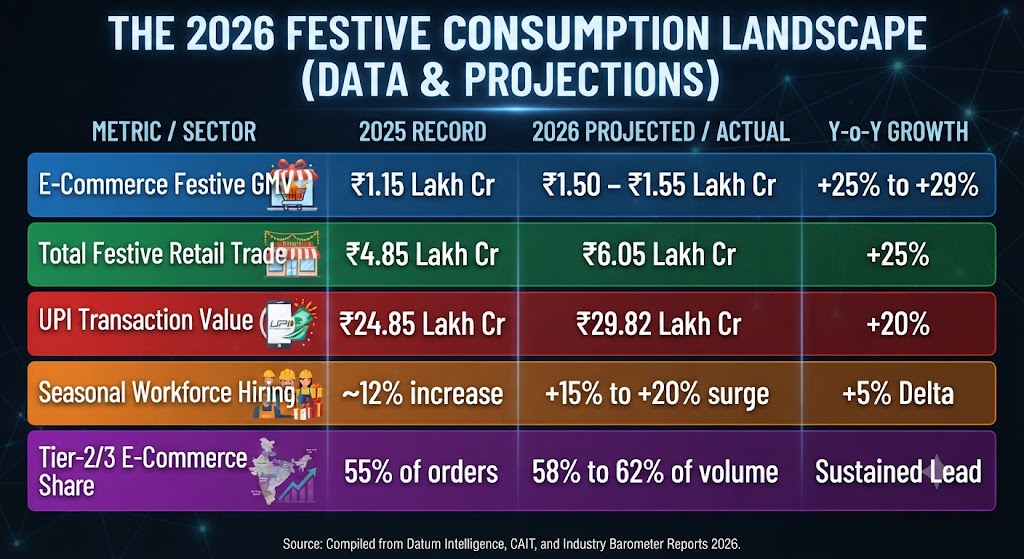
The 2026 Festive Consumption Landscape (Data & Projections)
Several key structural shifts define the 2026 festive economic engine:
- Volume-Driven Expansion Over Price Hikes: Unlike previous cycles where festive revenue growth was inflated by higher unit prices, the 2026 growth is predominantly volume-driven. More households are placing orders across smaller basket sizes, prioritizing high-utility home goods, apparel, and daily consumer durables over singular luxury spikes.
- The Quick-Commerce Surge: The rapid proliferation of quick-commerce platforms (Blinkit, Zepto, Swiggy Instamart) has expanded from daily groceries to high-value festive electronics, apparel, and festival essentials, generating over 100% year-on-year volume spikes during festive peak days.
- Democratization Beyond Metros: Over 55% to 60% of total e-commerce orders and a significant portion of premium smartphone and consumer appliance sales now originate from Tier-2, Tier-3, and semi-urban hubs, reflecting expanding digital logistics and localized credit access.
- Credit and Fintech Liquidity: Festive sales are heavily greased by digital financing mechanisms, including Unified Payments Interface (UPI) credit rails, No-Cost Equated Monthly Instalments (EMIs), and Buy-Now-Pay-Later (BNPL) platforms.
2. The Opposition’s Counter-Narrative: Rahul Gandhi and the K-Shaped Critique
Against this backdrop of record-breaking shopping statistics, the opposition political bloc offers a radically different interpretation of India’s economic health.
Rahul Gandhi and Congress strategists contend that celebrating gross festive sales figures produces a false sense of national economic immunity. Their critique centers on five core structural arguments:
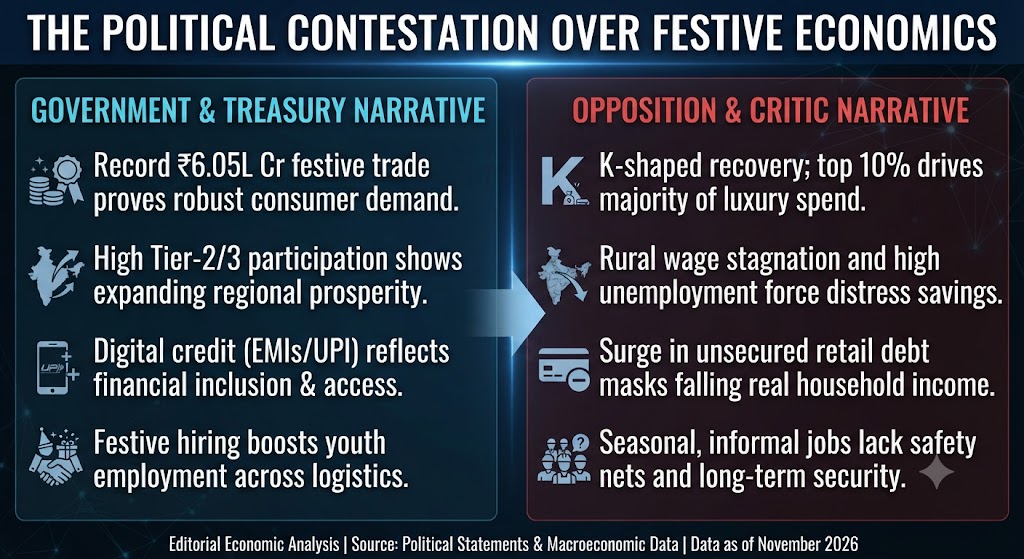
The Political Contestation Over Festive Economics
A. The K-Shaped Consumption Divide
The opposition’s central economic thesis is that India is experiencing an asymmetric, K-shaped recovery. While the upper-middle class and wealthy urban segments (the top arm of the ‘K’) possess disposable income to buy premium smartphones, passenger vehicles, and luxury jewelry, the lower-income rural and urban informal working class (the bottom arm of the ‘K’) is struggling under elevated food inflation and flat real wages.
Rahul Gandhi has repeatedly pointed out that high headline sales in premium categories obscure the severe pressure on basic wage goods and staple food consumption among rural households.
B. Debt-Fueled Consumption vs. Real Income Growth
A major point of contention raised by opposition economists is the nature of festive spending. Critics argue that much of the recorded festive spike is financed by rising unsecured consumer debt rather than growth in real disposable income. Reserve Bank of India (RBI) data tracking personal loans, credit card balances, and fintech credit indicates a sharp rise in household leverage over recent years. The opposition frames this reliance on high-interest BNPL schemes and multi-month EMIs as a symptom of microeconomic stress, where families borrow to maintain basic festive standards rather than spending out of genuine surplus.
C. Informal Sector Vulnerability and “Economic Tsunami” Warnings
During public address series and policy briefings, Rahul Gandhi has warned of an underlying “economic tsunami,” asserting that small-scale manufacturing, traditional neighborhood kirana stores, and cottage industries are being crushed by concentrated e-commerce monopolies and systemic policy missteps. While corporate retail platforms record double-digit festive growth, opposition leaders argue that traditional street vendors and local artisans face squeezed margins, shifting the festive wealth toward centralized corporate balance sheets.
3. Structural Synthesis: Reconciling the Two Realities
Is the Indian festive economy a triumphant story of mass consumer empowerment, or is it a fragile bubble masking deep inequality? Economic data suggests that both narratives contain valid, intersecting truths.
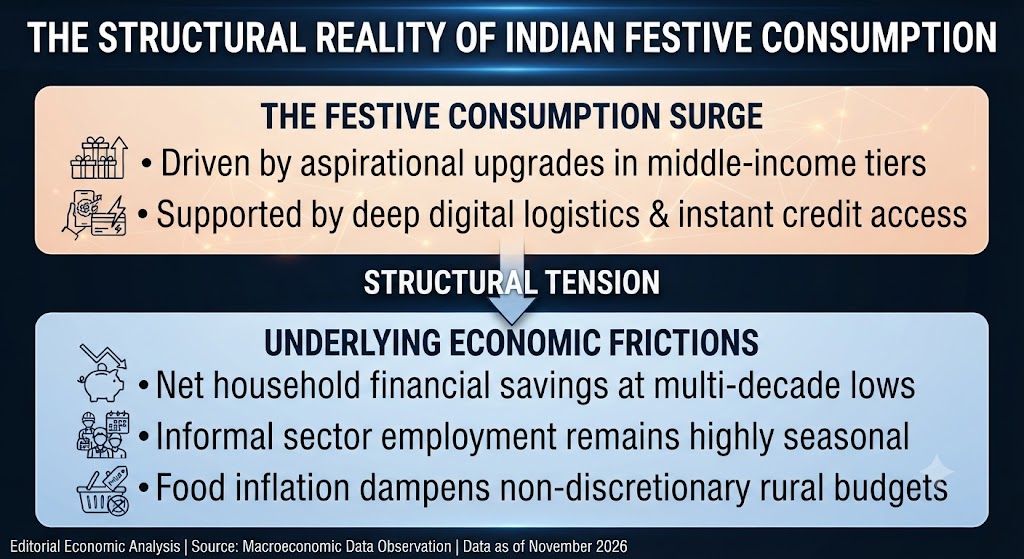
The Structural Reality Of Indian Festive Consumption
- Aspirational Upgrading is Real: The growth in festive trade is not merely an illusion of the rich. The massive expansion of e-commerce and quick-commerce into Tier-2 and Tier-3 cities shows that aspirational consumption—access to better electronics, durable appliances, and fashion—has broadened significantly across middle-income demographics.
- Savings Pressure is Real: Concurrently, macro data confirms that net household financial savings in India have dipped to historic lows as a percentage of GDP, while household liabilities have increased. Consumers are indeed spending willingly during the festive window, but they are doing so with a smaller financial safety margin than in previous decades.
- The Political Utility of Economic Narratives: For the government, festive consumption serves as tangible, high-visibility proof of national progress and administrative success. For the opposition, highlighting inflation, credit distress, and income gaps serves as a vital political counterweight to challenge official growth claims and mobilize low-income voter bases.
Conclusion: Beyond the Festive Banners
India’s festive season in 2026 demonstrates the extraordinary scale, resilience, and adaptability of its domestic market. The record-breaking transaction volumes, expanding digital logistics, and vibrant retail activity provide a vital boost to national GDP, sustaining millions of seasonal livelihoods and driving industrial output.
However, the political debate spearheaded by Rahul Gandhi and the opposition highlights crucial structural vulnerabilities that cannot be ignored. For festive-led growth to transform into permanent, broad-based economic prosperity, national policy must look beyond short-term consumption spikes. Sustained economic strength will require bridging the K-shaped divide—ensuring real wage growth in the rural interior, building long-term formal employment, protecting small-scale enterprises, and safeguarding household financial health long after the festive lights are dimmed.
* Conceptual illustration generated using AI