

On the evening of October 29, 2026, the global financial system witnessed an event without historical precedent. Over a high-velocity, 20-minute window starting at 20:05 UTC, digital assets valued at approximately $6.36 billion were systematically drained from hot wallets across ten distinct blockchains belonging to Binance—the world’s largest cryptocurrency exchange.
To put the magnitude of this heist into perspective, it eclipses the previous record holder—the $1.5 billion exploitation of Bybit in February 2025—by more than fourfold. In physical or digital financial history, there is no comparable single theft. It is more than six times larger than Saddam Hussein’s removal of $1 billion from the Central Bank of Iraq in 2003.
While Binance co-CEO Richard Teng moved quickly to reassure users that the exchange’s corporate funds and Secure Asset Fund for Users (SAFU) will fully cover all user losses, the sheer scale and technical sophistication of the attack have sent shockwaves across Wall Street and digital asset markets. Bitcoin plunged toward $77,000, while shares of crypto-linked public equities like Coinbase, MicroStrategy, and Robinhood suffered sharp sell-offs.
Here is an investigative analysis of how the breach occurred, the on-chain race to freeze funds, the state-sponsored threat actors behind the intrusion, and what this $6.3 billion vulnerability means for the future of centralized crypto infrastructure.
The Anatomy of the Attack: 20 Minutes of Automation
Unlike traditional bank robberies or standard exchange hacks that rely on stolen private keys or simple phishing links, the October 29 attack was a masterclass in multi-chain automated execution.
According to technical post-mortems by blockchain intelligence firms TRM Labs, Chainalysis, and Elliptic, the attacker executed a pre-planned, multi-blockchain script that compromised Binance’s hot wallet signing infrastructure.
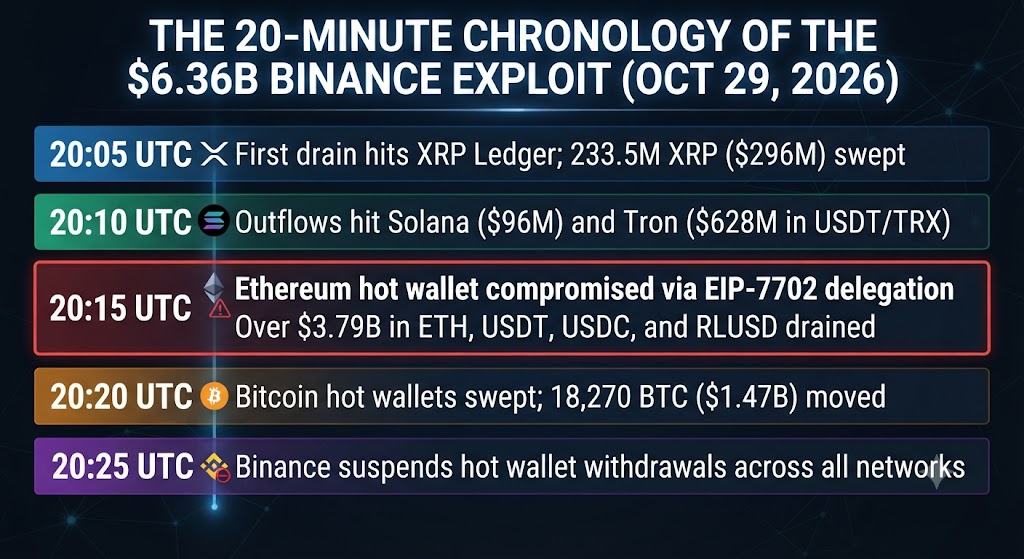
The 20-minute chronology of the $6.36B Binance Exploit(Oct 29, 2026)
The EIP-7702 Vector and Compromised Signers
On the Ethereum network—which accounted for $3.79 billion of the total theft—the attacker utilized an advanced Ethereum Improvement Proposal (EIP-7702) delegation mechanism. This allowed the attacker to turn Binance’s primary hot wallet into a sweeper account controlled by pre-signed authorizations prepared well in advance.
At the same time, on nine other blockchains (including Bitcoin, Tron, Solana, Avalanche, and Arbitrum), Binance hot wallets initiated ordinary, validly signed transfers to the attacker’s addresses.
Initial statements from Binance indicated that an engineer’s laptop had been infiltrated, providing the initial access vector into a service container. However, co-CEO Richard Teng later clarified that the attack was far more complex than a “one-click” employee exploit. The attackers directly instructed Binance’s signing infrastructure, indicating a deep, multi-layered penetration of the exchange’s internal withdrawal authorization pipeline.
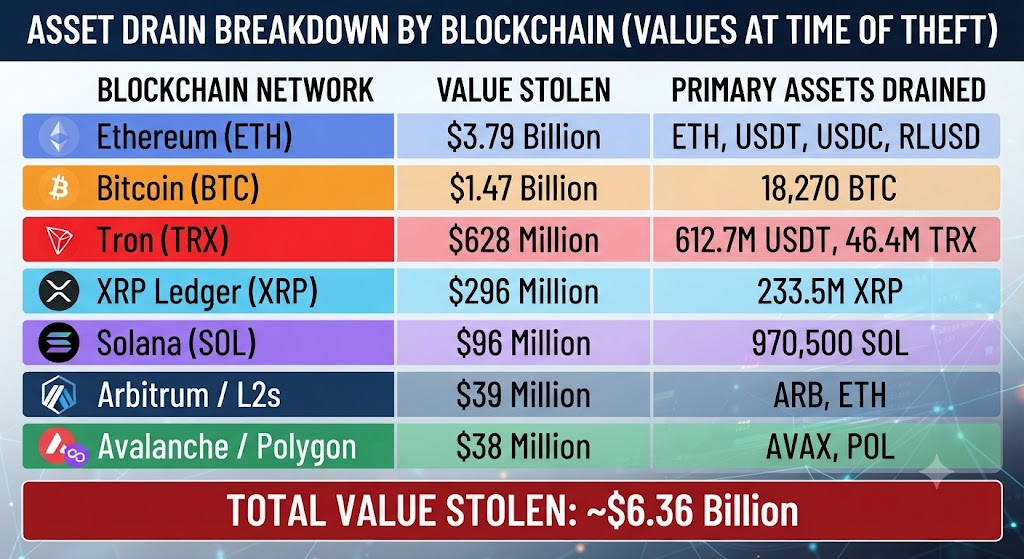
Asset Drain Breakdown by Blockchain (values at time of theft)
The On-Chain Counter-Offensive: Stablecoin Freezes and Decentralized Loans
As word of the breach spread through security channels, a chaotic on-chain race began between the hackers, Binance security teams, and major stablecoin issuers.
Because centralized stablecoins contain built-in blacklisting functions, issuers acted at unprecedented speed:
- Tether (USDT), Circle (USDC), Ripple (RLUSD), and World Liberty Financial coordinated to freeze roughly $2.67 billion in stablecoins before the attacker could move them off-chain or convert them.
- Arbitrum’s Security Council executed an emergency intervention to freeze an additional $39 million worth of ETH and ARB tokens.
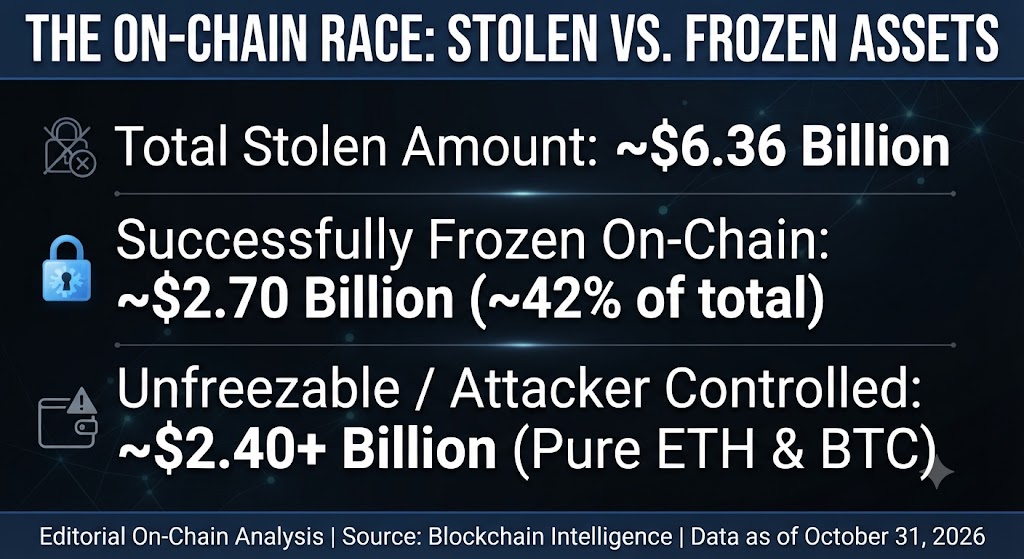
The on-chain race – stolen vs. frozen assets
Anticipating these swift issuer freezes, the attacker raced against time. Before Circle and Tether could blacklist the addresses, the hacker dumped hundreds of millions in USDT onto decentralized market makers and deposited stablecoins into decentralized lending protocols like Aave, borrowing native Ethereum (ETH) against the stablecoin collateral.
Because native Bitcoin and Ethereum lack central blacklist mechanisms, the attacker successfully secured over 420,000 ETH and 18,270 BTC—worth roughly $2.4 billion—in unfreezable, sovereign assets beyond the reach of any corporate or law enforcement entity.
Attribution: The North Korean Connection
While law enforcement investigations remain ongoing, major blockchain intelligence firms—including TRM Labs, Chainalysis, and Pangolin Intelligence—have attributed the breach with “high confidence” to TraderTraitor (also known as the Lazarus Group), an elite state-sponsored cyberwarfare unit operating under North Korea’s Reconnaissance General Bureau.

Evidence pointing to north korean state-sponsored attackers
Western intelligence officials and UN security panels have long pointed out that state-sponsored cybercrime serves as a primary funding engine for North Korea’s weapons programs and international sanctions evasion. The $6.3 billion Binance theft brings total crypto assets stolen by DPRK-linked units in 2026 alone past $7.5 billion—marking a terrifying industrialization of state-sponsored cyber warfare.
Solvency, SAFU, and the Structural Future of Exchanges
The immediate question facing the crypto ecosystem was whether an exchange—even one as dominant as Binance—could absorb a $6.3 billion hit without collapsing into an FTX-style insolvency spiral.
Financial analysts and security experts emphasize that while the dollar figure is staggering, it does not currently pose a systemic solvency risk for Binance for two key reasons:
- Cold Wallet Isolation: The vast majority of user assets on Binance are stored in offline “cold” wallets that were completely untouched by the breach. The attack was strictly confined to hot wallet liquidity used to process active daily withdrawals.
- Corporate Reserves and SAFU: Binance maintains multi-billion-dollar corporate treasury reserves alongside its dedicated Secure Asset Fund for Users (SAFU). Co-CEO Richard Teng confirmed that company reserves will absorb all non-recovered losses, ensuring no individual user suffers an uncompensated balance deduction.
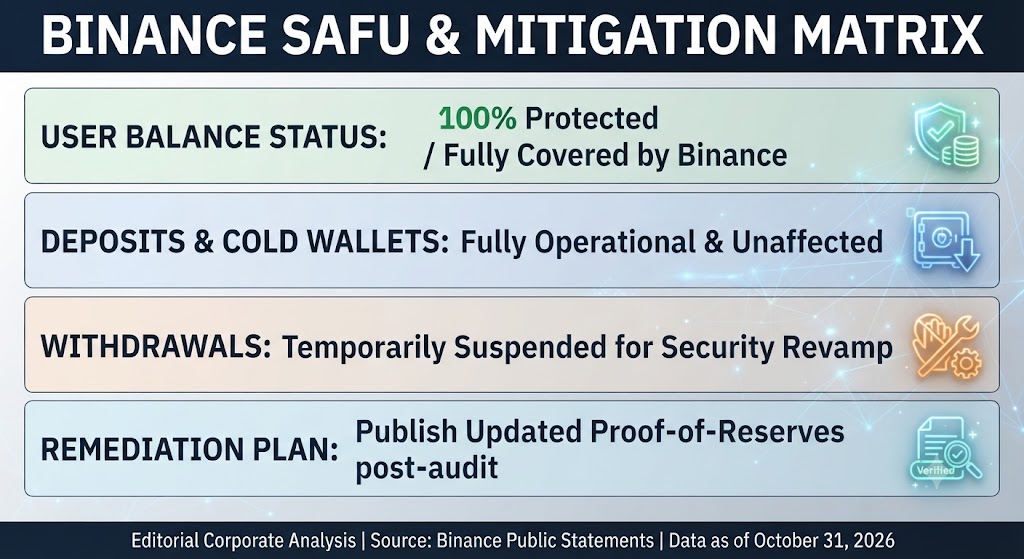
Binance safu and mitigation matrix
However, the broader implications for the crypto industry are profound. The fact that a nation-state threat actor could penetrate the hot wallet signing infrastructure of the world’s most sophisticated cryptocurrency exchange in 20 minutes exposes a fundamental vulnerability in centralized custody.
If automated signing infrastructure can be co-opted to sweep multi-chain assets simultaneously, traditional Proof-of-Reserves audits and hot-wallet security standards must be completely re-engineered.
Conclusion: A Watershed Moment for Digital Assets
The $6.36 billion Binance hack of October 29, 2026, will be remembered as a defining watershed moment in the history of global finance. It demonstrates that as digital asset markets mature into trillion-dollar asset classes, the threats they face have evolved from rogue script-kiddies into highly coordinated, state-sponsored cyber industrial complexes.
While Binance’s deep balance sheet and swift coordination with stablecoin issuers prevented a catastrophic platform run, the breach serves as an urgent wake-up call. True security in the digital asset era will require moving beyond simple key management toward multi-party computation (MPC) hardware isolation, real-time AI-driven withdrawal circuit breakers, and global regulatory coordination to track and dismantle state-sponsored laundering pipelines.
The $6.3 billion lesson is clear: in an interconnected, algorithmic financial world, speed and security are no longer just technical preferences—they are the price of survival.
* Conceptual illustration generated using AI