

In the quiet of their homes, victims across India receive a video call from someone posing as a senior officer from the Central Bureau of Investigation (CBI), the Mumbai Police, or the Customs Department. The backdrop features official logos, law enforcement insignia, and stern-faced uniformed personnel. The victim is informed that a parcel registered in their name containing narcotics, forged passports, or illegal contraband has been intercepted at an airport.
Under threats of immediate imprisonment and financial ruin, the caller places the victim under a fake, psychologically suffocating “digital arrest”—ordering them to stay on camera for hours or even days, cutting off contact with family, and demanding their life savings be transferred to “government verification accounts” to clear their name.
There is no concept of a “digital arrest” under Indian law. Yet, this sophisticated psychological extortion network has siphoned hundreds of crores from unsuspecting citizens.
In response to this growing national crisis, India’s premier investigative agency has launched a massive, multi-phased counter-offensive. Under Operation Chakra-VI, the CBI executed sweeping nationwide raids across 89 locations in 20 states during September 2026, arresting key operatives responsible for laundering funds across complex criminal networks.
With subsequent tactical strikes hitting 22 additional locations across 10 states and the Supreme Court of India ordering a unified, pan-India probe into both the cyber syndicates and complicit banking staff, the state is mounting its most aggressive crackdown yet.
Here is an in-depth analytical breakdown of the CBI’s nationwide raids, the mechanics of the ₹42.36 crore digital arrest cases, the crucial role of banking insiders, and the Supreme Court’s decisive judicial intervention.
1. Operation Chakra-VI: The September Multi-State Blitz
Operation Chakra was established by the CBI as a specialized, intelligence-led framework to identify, map, and dismantle organized, transnational cybercrime infrastructure. While earlier iterations targeted fake technical support centers and cryptocurrency scams, Operation Chakra-VI shifted its primary lens toward digital arrest networks and their complex financial laundering pipelines.
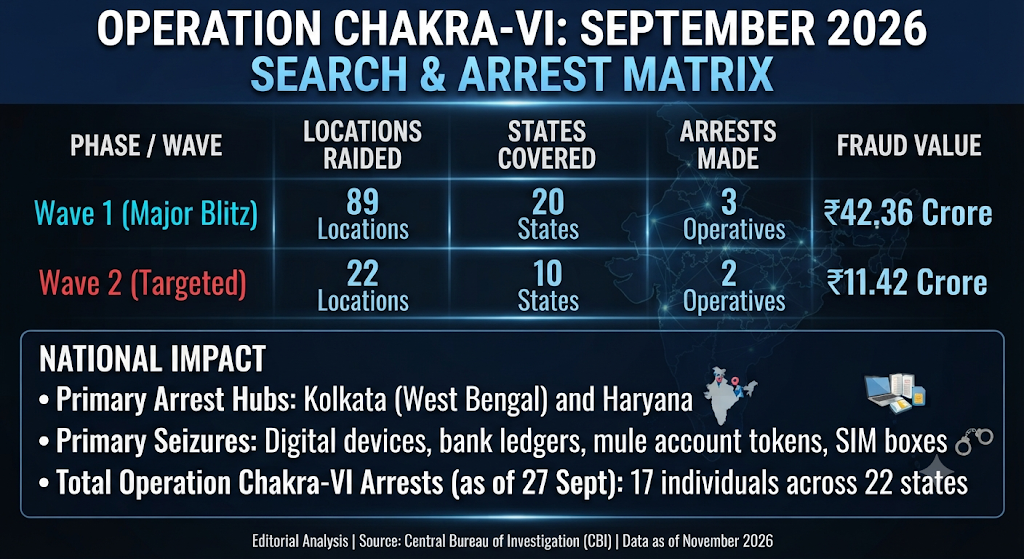
Operation Chakra-VI – September 2026 Search and Arrest Matrix
In September 2026, following months of technical telemetry and financial audit tracing across interconnected bank accounts, the CBI deployed coordinated search teams across 89 locations in 20 states. The operation targeted three primary FIRs—originally registered by state police forces before being taken over by the central agency due to their inter-state scope—accounting for a combined loss of ₹42.36 crore.
The Role of the “Money-Movers”
During the September blitz, the CBI arrested three key operatives in Kolkata and Haryana. Crucially, forensic analysis revealed that these individuals were not merely the low-level callers making the extortion videos. Instead, they functioned as the critical financial layerers.
Once a victim transferred funds under coercion, these operatives rapidly routed the money through a cascade of primary, secondary, and tertiary “mule” bank accounts. Portions were withdrawn as cash via automated teller machines (ATMs) across state borders, while remaining balances were converted into stablecoin cryptocurrencies (USDT) to be funneled to offshore handlers.
Building upon the intelligence gathered during the September searches, the CBI launched a follow-up wave targeting 22 locations across 10 states, arresting two additional key syndicate members connected specifically to a single ₹11.42 crore digital arrest fraud.
2. The Mechanics of a “Digital Arrest” Syndicate
The term “digital arrest” is a completely fabricated deception designed to exploit fear and respect for authority. However, the operational machinery supporting it is highly organized, utilizing advanced technical and human infrastructure.
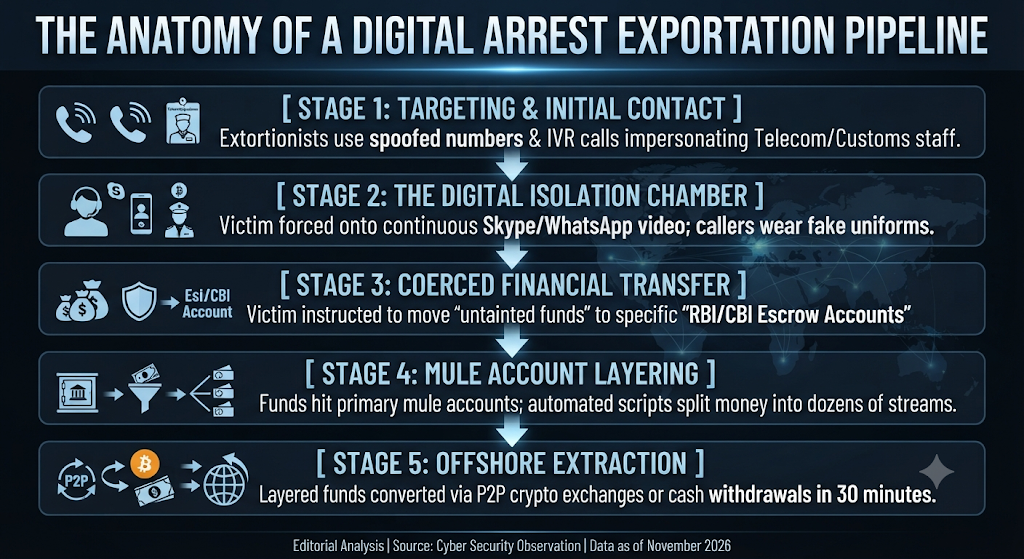
The Anatomy Of A Digital Arrest Exporation Pipeline
The success of these operations relies on three foundational components:
- Impersonation and Social Engineering: Fraudsters set up physical mock-up rooms resembling police stations or courtrooms. They present forged warrant letters bearing real-sounding case numbers, official seals, and national emblems to terrify victims into compliance.
- Mule Account Infrastructure: The lifeblood of the scam is the availability of thousands of active bank accounts. These are opened using stolen identities, impoverished individuals paid small commissions, or shell companies registered under fictitious addresses.
- Speed of Liquidation: Once money is deposited into a mule account, the syndicate moves with extreme velocity. Within minutes, automated banking tools and internal handlers disperse the funds across secondary layers, staying steps ahead of standard cybercrime reporting helplines (like 1930).
3. The Judicial Hammer: The Supreme Court Orders a Unified Probe
As digital arrest complaints surged nationwide, regional police forces often struggled with jurisdictional limitations. A victim residing in Bengaluru might transfer money to a mule account opened in Assam, controlled by an operative in Kolkata, with server infrastructure hosted overseas.
Recognizing that fragmented state-level investigations were allowing syndicates to operate with relative impunity, the Supreme Court of India issued a milestone order entrusting the CBI with a unified, pan-India investigation into digital arrest cases.
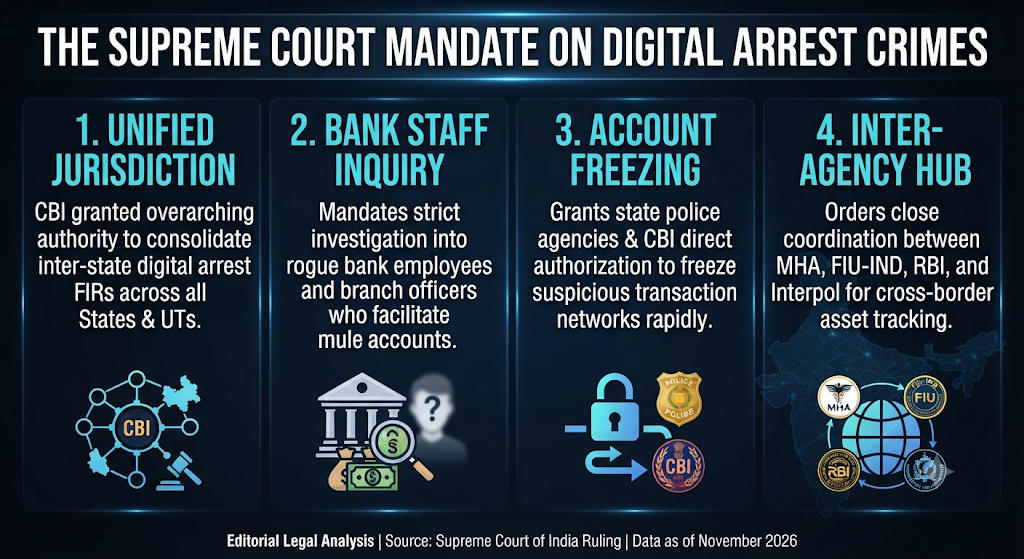
The Supreme Court Mandate On Digital Arrest Crimes
The Focus on Complicity Among Bank Staff
The Supreme Court’s directive placed specific, unprecedented emphasis on investigating the role of bank staff.
Investigation data revealed a troubling pattern: cybercrime syndicates could not operate at scale without internal assistance inside financial institutions. Rogue bank employees and branch officers were routinely found bypassing mandatory Know Your Customer (KYC) verification protocols, issuing pre-activated internet banking credentials to unauthorized handlers, and ignoring blatant red flags when dormant accounts suddenly processed millions of rupees in high-frequency transactions.
By mandating that the CBI investigate the banking ecosystem directly, the Supreme Court signaled that financial institutions could no longer treat mule accounts as mere passive anomalies. Bank officials who turn a blind eye to fraudulent account creation now face direct criminal prosecution as co-conspirators in the extortion syndicate.
4. International Coordinates and the Technical Battlefront
Digital arrest scams are rarely confined within national boundaries. While the mule accounts and local money-movers operate within India, the masterminds and call center hubs are frequently located across Southeast Asian cyber-complexes (such as in Myanmar, Cambodia, and Laos) or in Eastern Europe.
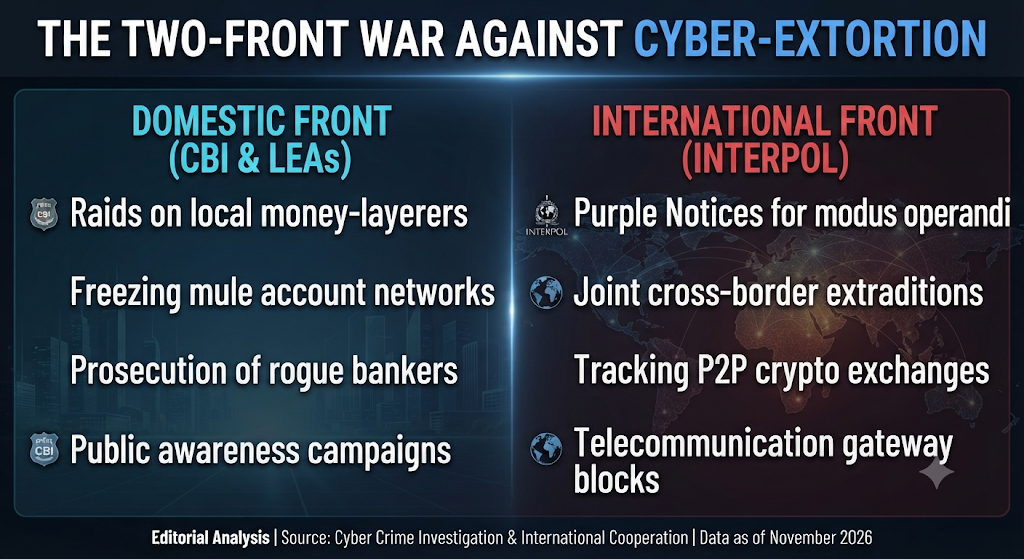
The Two-Front War Against Cyber-Extortion
Under Operation Chakra-VI, the CBI is actively leveraging NCB-New Delhi (Interpol’s national central bureau in India) to coordinate with international law enforcement partners. Through global intelligence exchanges, foreign server logs are being subpoenaed, international crypto wallets traced, and Purple Notices issued to track the specific software tools used to spoof official Indian government telephone numbers.
Conclusion: Reclaiming Public Trust in the Digital Era
The CBI’s multi-wave raids under Operation Chakra-VI—spanning 89 locations in September and expanding into targeted strikes across 10 states—mark a decisive turning point in India’s war on cybercrime. By dismantling the financial infrastructure that allows digital arrest syndicates to convert fear into liquid capital, law enforcement is demonstrating that anonymity in the digital space is an illusion.
However, winning this battle requires a sustained, multi-pronged effort. As the Supreme Court’s mandate makes clear, stopping digital arrests is not merely about arresting the callers on video screens; it requires cleaning up systemic vulnerabilities inside the banking system, enforcing strict KYC compliance, and fostering high public awareness.
Citizens must internalize one fundamental truth: no law enforcement agency, court, or police officer in India will ever arrest someone over a video call or demand money to clear a charge.
As the CBI continues to pursue these transnational syndicates and hold complicit insiders accountable, Operation Chakra-VI stands as a crucial shield protecting public trust in India’s expanding digital economy.
* Conceptual illustration generated using AI