
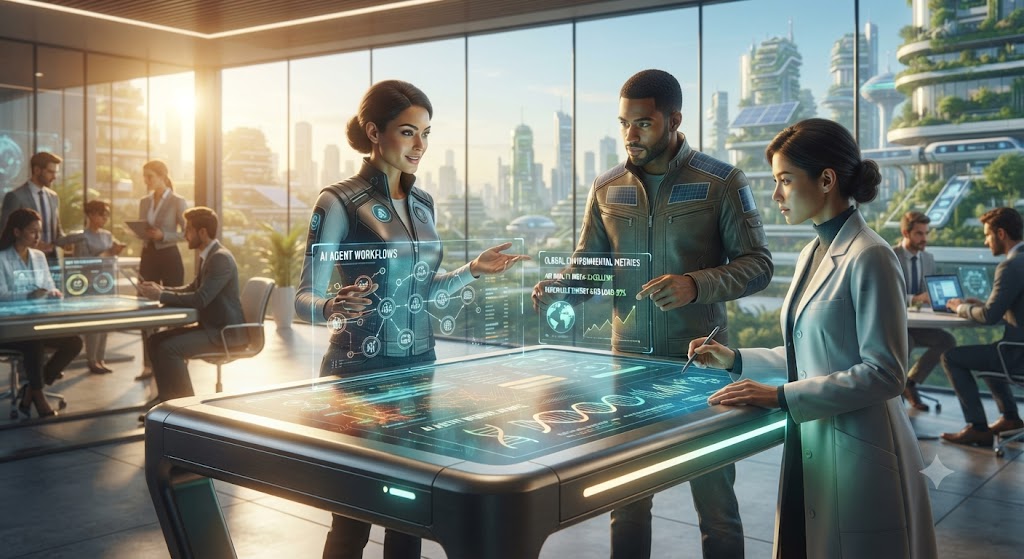
The global labor market is undergoing its most profound structural shift since the dawn of the Industrial Revolution. As we project five years into the future—toward 2031—the nature of employment is moving far beyond simple digital transformation or remote work arrangements. The integration of autonomous artificial intelligence agents, spatial computing, green technology infrastructure, and synthetic biology is fundamentally altering what it means to build a career.
The emerging workplace of 2031 will not be defined by a dystopian complete replacement of human labor, nor by a simple continuation of traditional corporate ladders. Instead, it will be characterized by a two-tiered economy: professionals who learn to orchestrate intelligent systems, and those whose routine cognitive or physical tasks are progressively automated away. Understanding the specific structural forces shaping the five-year career landscape is essential for professionals, employers, and educators aiming to remain viable.
1. From Execution to Orchestration: The New Professional Paradigm
For decades, career progression relied on individual execution capacity—how quickly an engineer could write code, how efficiently an analyst could compile financial models, or how meticulously a technical writer could draft documentation.
By 2031, basic execution will carry near-zero marginal economic value. Autonomous AI agents routinely handle routine software drafting, Tier-1 and Tier-2 customer service, primary legal discovery, and baseline data analysis. The value of human professionals has shifted decisively upstream: from execution to orchestration, verification, and strategic judgment.
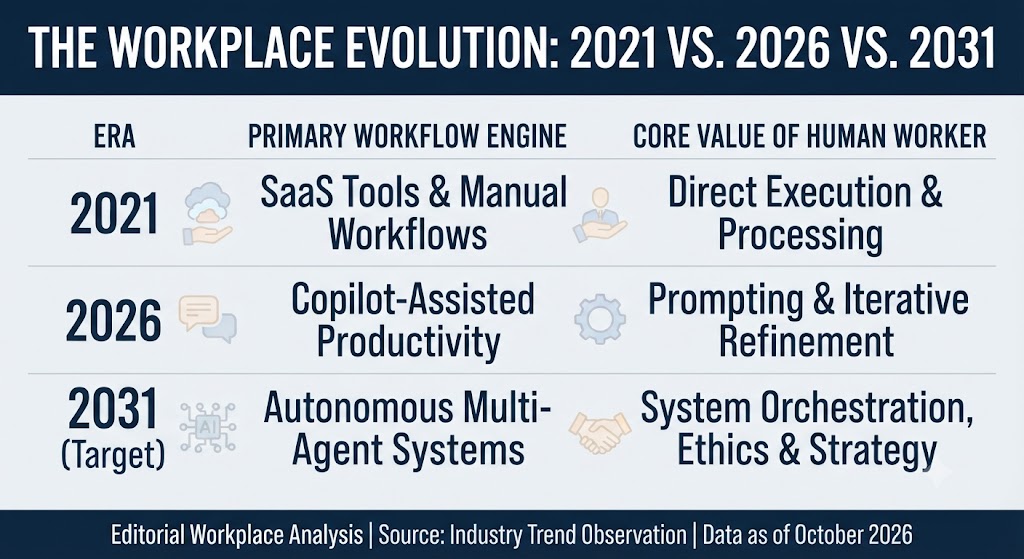
The workplace evolution – 2021 vs. 2026 vs. 2031
In this environment, a software architect in 2031 does not write syntax line-by-line; they manage swarms of autonomous coding agents, auditing system security, validating business logic, and ensuring architectural compliance. A marketing director does not design single campaigns; they oversee generative content engines that dynamically personalize media in real-time across millions of individual consumer touchpoints.
2. The Divided Labor Market: What Fades and What Flourishes
The five-year job outlook presents a stark divergence between declining traditional roles and rapidly expanding technical, green, and human-centric sectors. The World Economic Forum and global labor market assessments indicate that while tens of millions of routine positions will be consolidated, over a hundred million new, highly specialized roles will emerge.
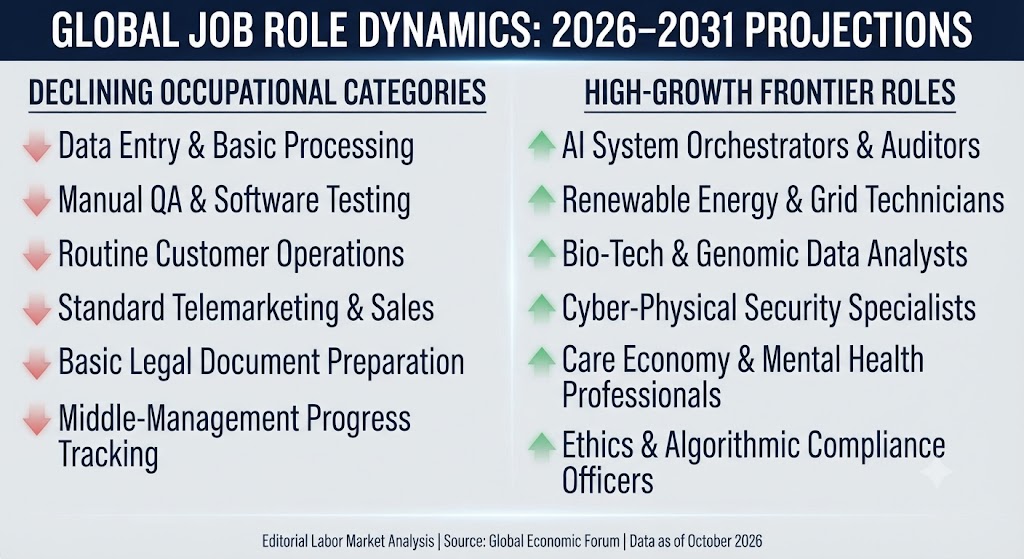
Global Job Role Dynamics – 2026-2031 projections
The Decline of Middle-Layer Processing
Roles centered on information aggregation and routine monitoring are suffering the highest rates of contraction. Middle management layers responsible primarily for progress reporting, basic quality assurance, and manual data transcription are being replaced by integrated AI monitoring systems.
The Surge in Physical and Complex Domain Roles
Conversely, occupations that require direct physical dexterity in unstructured environments—such as renewable energy grid installation, specialized construction, and industrial maintenance—are experiencing robust growth. Simultaneously, high-complexity fields combining deep domain expertise with technical literacy (such as bioinformatics, quantum algorithm development, and climate adaptation engineering) face acute talent shortages.
3. The Human Premium: Non-Automatable Core Competencies
As artificial intelligence handles increasingly complex analytical workloads, human capabilities that cannot be reduced to algorithmic calculation have become premium economic assets.
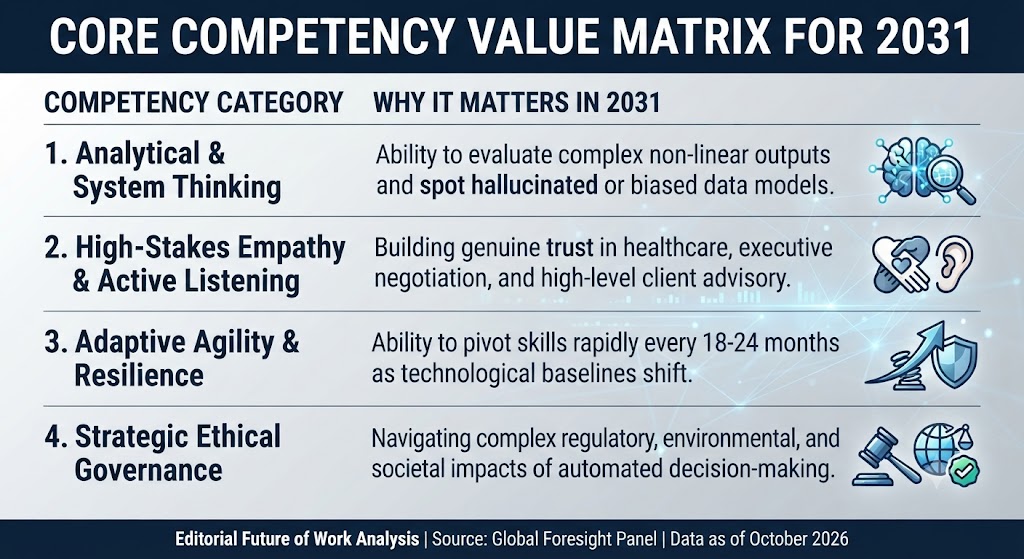
Core competency value matrix for 2031
Empathy, active listening, and social influence are no longer viewed as optional “soft skills” in job descriptions; they are fundamental operational requirements. In fields like healthcare, education, and executive management, clients and teams demand authentic human connection, ethical oversight, and contextual understanding that synthetic agents cannot genuinely provide.
4. The Demise of the 40-Year Linear Career
The concept of joining a single corporation, climbing a predictable hierarchical ladder for thirty or forty years, and retiring with a standard pension is obsolete. By 2031, the average professional career resembles a portfolio model rather than a linear staircase.
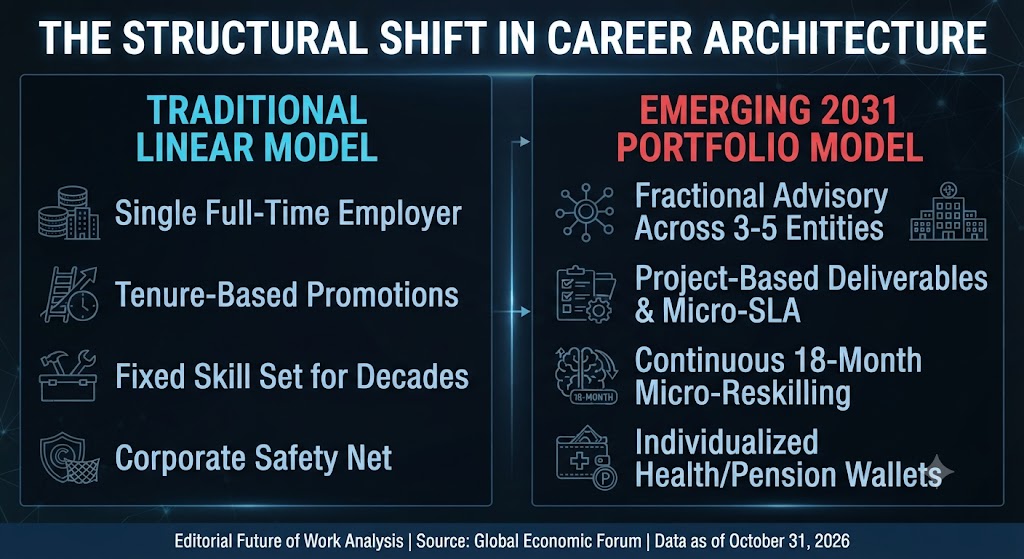
The structural shift in career architecture
Driven by the rise of fractional consulting, gig economy platforms for high-skilled knowledge workers, and AI-enabled solopreneurship, millions of professionals maintain multiple income streams simultaneously. An individual might work as a part-time fractional product lead for two early-stage startups, manage an automated e-commerce micro-business, and offer specialized advisory services to enterprise clients.
This shift provides greater individual autonomy, but it demands unprecedented self-direction, financial discipline, and continuous personal brand management.
5. Actionable Blueprint: How to Future-Proof Your Career for 2031
Navigating the five-year career transition requires deliberate, proactive strategy rather than passive adaptation. Professionals across all sectors must implement a structured framework to maintain market relevance.
Step 1: Conduct an Automation Audit of Your Role
Map out your daily weekly tasks. Identify which activities are routine, rule-based, or structured. Any task that follows a repeatable pattern will likely be automated or streamlined within 24 to 36 months. Shift your focus toward non-repeatable, strategy-heavy, and high-touch human activities.
Step 2: Build AI Fluency, Not Just Digital Literacy
Basic computer literacy is no longer sufficient. Future-proof professionals must understand how to query, fine-tune, orchestrate, and audit AI tools relevant to their industry. Learn the mechanics of agentic workflows, data privacy boundaries, and algorithmic evaluation.
Step 3: Develop T-Shaped Micro-Specializations
Cultivate deep, specialized expertise in a niche vertical (the vertical bar of the “T”) combined with broad digital and interpersonal adaptability across domains (the horizontal bar). Specialized niche knowledge—such as regulatory compliance for medical AI devices or sustainable supply chain logistics—creates defensible value.
Step 4: Commit to Perpetual Reskilling
Treat education as a continuous, lifelong operating system update rather than a one-time degree. Allocate dedicated hours every week to acquiring micro-credentials, experimenting with emerging technology platforms, and studying cross-industry trends.
Conclusion: Embracing the Augmented Future
The career landscape five years from now will be neither unblemished nor entirely bleak; it will be dynamic, demanding, and fundamentally restructured. While automation will continue to displace friction-heavy, routine tasks, it will simultaneously unlock unprecedented productivity and create brand-new industries that do not exist today.
Surviving and thriving in 2031 requires abandoning the expectation of static job security. By cultivating non-automable human skills, building AI orchestration capabilities, and embracing continuous adaptability, professionals can confidently step into the future—not as victims of technological disruption, but as architects of the new augmented economy.
* Conceptual illustration generated using AI