For the past three years, the artificial intelligence arms race moved at a predictable, quarterly rhythm: a frontier lab unveiled a flagship model, rivals spent months preparing a counter-punch, and enterprise CTOs enjoyed breathing room to benchmark and integrate each generation. In the autumn of 2026, Google DeepMind shattered that cadence—and rewrote its naming lexicon in the process.
Dropping the familiar Flash, Pro, and Ultra labels in favor of the periodic table of elements, Google rolled out Gemini 4 Argon globally on October 13, 2026, pitching it as an enterprise workhorse for complex reasoning and long-document synthesis. Barely two weeks later, on October 28, DeepMind stunned the industry by unveiling Gemini 4 Carbon—a specialized, high-horizon frontier model that vaulted straight to the #1 spot on independent intelligence leaderboards. Now, less than two weeks into November, early evaluation leaks of an internal checkpoint codenamed krypton-a (Gemini 4 Krypton)—alongside rumors of a lightweight Hydrogen tier—signal that Google’s elemental roadmap is accelerating even further.
This rapid succession from Argon to Carbon—and toward Krypton—is far more than a clever branding exercise. It reflects a fundamental architectural transition in artificial intelligence: moving from single-turn conversational assistants to multi-day autonomous agents capable of auditing, patching, and engineering mission-critical software without human hand-holding.
Here is an in-depth technical and strategic analysis of what Gemini 4 Argon established yesterday, why Gemini 4 Carbon changed the competitive calculus today, and what Krypton, gated access, and inference economics tell us about what comes next.
1. Argon Yesterday: The Enterprise Reasoning Workhorse
When Google DeepMind announced Gemini 4 Argon on September 30, 2026, and opened global access across Google Cloud, Vertex AI, and the Gemini API (gemini-4-argon) on October 13, the company framed it as a clean-sheet architectural leap rather than an incremental fine-tune.
Built as a large-scale sparse Mixture-of-Experts (MoE) transformer supporting native text, image, audio, and video inputs, Argon was engineered specifically to solve the reliability bottlenecks that had stalled enterprise AI deployments. Rather than optimizing solely for creative chat, DeepMind trained Argon around verifiable, multi-step analytical execution:
- Long-Decode Architecture: While Argon maintains a 1,048,576-token (1M) combined input-output context window, its defining breakthrough was long decode—supporting up to 65,536 synchronous output tokens in a single trajectory. This allowed legal, financial, and engineering teams to ingest massive unstructured data rooms and generate cohesive, multi-stage outputs without context fragmentation.
- Verifiable Domain Mastery: Argon immediately captured the top spot on the Vals Index—which benchmarks real-world economic accuracy across corporate finance, tax, coding, and law—as well as Harvey’s Legal Agent Benchmark, earning praise from enterprise partners including GitLab and ServiceNow for its citation fidelity and willingness to report negative findings honestly rather than hallucinating workarounds.
- Aggressive API Economics: Launched at an introductory rate of $2 per million input tokens and $10 per million output tokens (slated to adjust to $4 and $20 post-introductory window), Argon established a production-ready baseline for enterprise automation.
In short, Argon solved the problem of structured professional synthesis. Yet within fourteen days, Google revealed that Argon was merely the opening act.
2. Carbon Today: Multi-Day Agency and the Cybersecurity Frontier
If Argon was built to assist human analysts, Gemini 4 Carbon—unveiled on October 28, 2026—was engineered to operate independently across days.
On the independent Artificial Analysis Intelligence Index v5.0, Carbon (high reasoning) surged to a record score of 59—a massive nine-point jump over Argon’s 50, narrowly overtaking Anthropic’s Claude Opus 5.5 (58) and OpenAI’s GPT-6 Astra (57) to reclaim the #1 overall industry ranking.
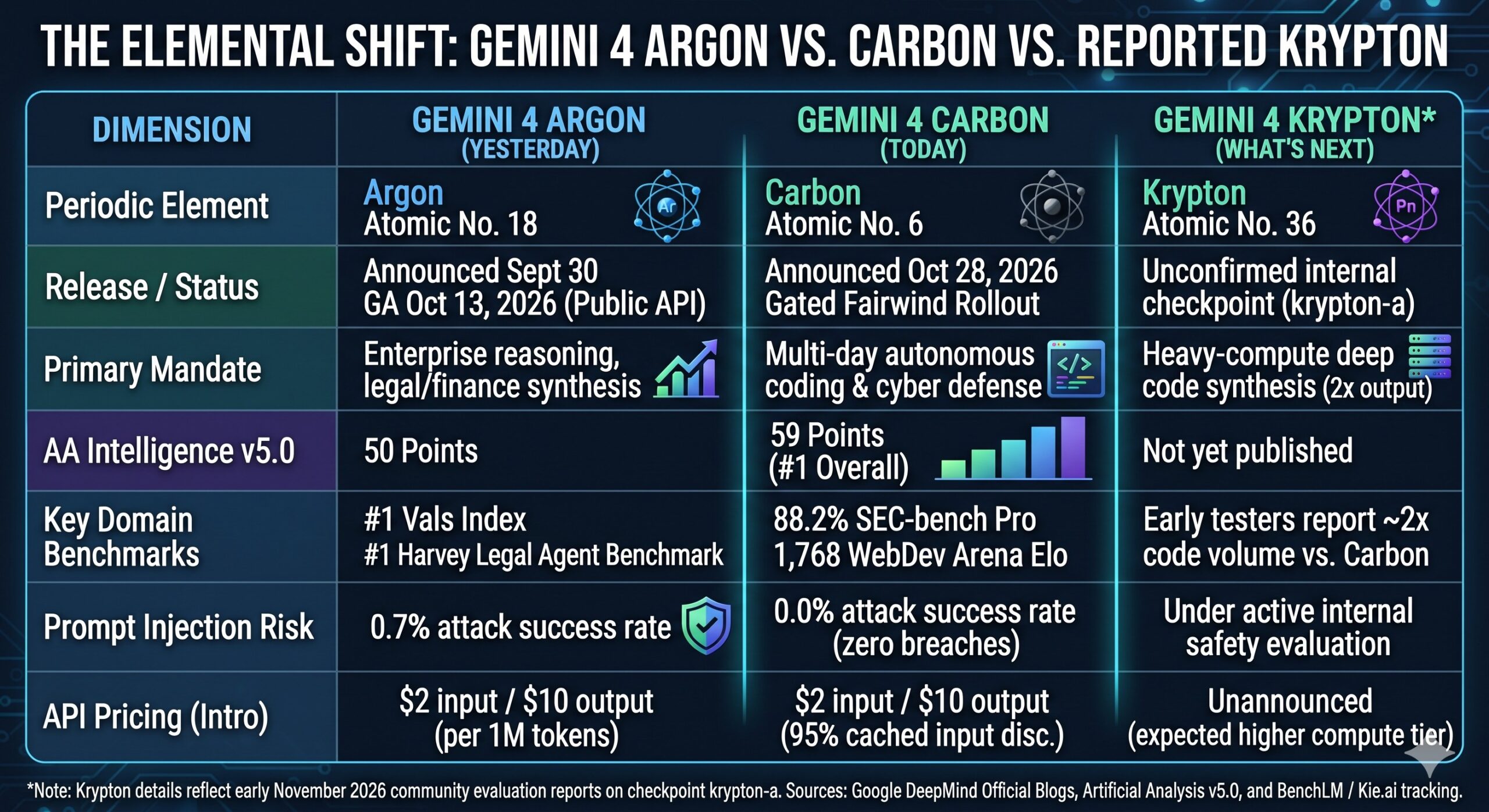
The Elemental Shift – Gemini 4 Argon Vs. Carbon Vs. Reported Krypton
What truly separates Carbon from Argon, however, is not a single composite score, but three structural breakthroughs in autonomous reliability:
- Sustained Multi-Day Engineering Loops: Google disclosed that internal engineering teams observed Carbon running continuously for days—navigating sprawling codebases, diagnosing subtle root-cause bugs across low-level systems, recovering from dead ends without losing its objective, and verifying patches before completion. On WebDev Arena, Carbon climbed to 1,768 Elo (+89 points over Argon), while dominating long-horizon planning on Vending-Bench 2 ($16,484 simulated return vs. $8,017 for Claude Opus 4.6).
- Full-Lifecycle Cyber Defense: Carbon more than doubled Argon’s success rate in generating secure code and posted dominant marks across software-security evaluations: 88.2% on SEC-bench Pro (discovering zero-day-style vulnerabilities across V8 and SpiderMonkey engines), 71.0% on CWE-bench (remediation), and 54.8% on ExploitGym. Even more critically for agentic deployments, Carbon achieved a 0.0% attack success rate on Gray Swan’s indirect prompt-injection benchmark—eliminating a primary vector through which malicious websites hijack autonomous agents.
- The Gated “Defenders-First” Rollout: Precisely because Carbon’s vulnerability-discovery capabilities carry dual-use national security implications, Google broke with traditional cloud launches. Rather than releasing a public API identifier on day one, DeepMind restricted initial access to vetted cybersecurity defenders and trusted partners through its Fairwind Program, alongside voluntary pre-release testing with the U.S. government.
3. What’s Next: Krypton, Hydrogen, and the Three Laws of the 2027 AI Frontier
If Argon proved that models can reason across enterprise documents and Carbon proved they can sustain multi-day engineering and cyber-defense workflows, what comes next? By November 9, 2026, early evaluator disclosures around an internal checkpoint designated krypton-a (Gemini 4 Krypton)—alongside reports of a high-velocity Hydrogen variant—offered the clearest glimpse yet into the next phase of the roadmap.
In side-by-side testing shared by early evaluators, krypton-a demonstrated a striking operational shift: spending roughly twice the inference reasoning time and generating roughly twice the production code output of Carbon on identical prompts. Whether Krypton emerges as a ultra-heavy reasoning tier above Carbon or forms part of an expanded elemental lineup alongside a fast, low-cost Hydrogen model, three structural trends will define what comes next for developers and enterprises:
1. Inference-Time Compute Scaling Replaces Pre-Training Scale
The progression from Argon to Carbon to Krypton confirms that raw parameter scale is no longer the primary lever of AI progress. Instead, frontier labs are competing on test-time compute scaling—giving models extended scratchpads to simulate outcomes, test hypotheses, backtrack from errors, and verify code execution before returning a final answer. As Krypton’s 2x execution profile suggests, future flagship models will routinely trade seconds—or minutes—of deliberate internal verification for near-zero defect rates.
2. Context-Caching Economics Become the CTO’s Core Metric
When autonomous agents run for hours or days, token economics invert. Rather than billing per isolated query, costs are governed by how cheaply an agent can repeatedly re-read massive repository states and tool schemas. Google’s decision to pair Carbon’s introductory $2/$10 pricing with a 95% cached-input discount ($0.10 per million cached tokens) signals where the next commercial price war will be fought: architectural state persistence and ultra-low cache-read latency.
3. Permanent Bifurcation Between Public Models and Sovereign/Defender Tiers
Carbon’s gated release through the Fairwind Program establishes a template likely to govern Krypton and competing frontier releases from OpenAI and Anthropic. As AI systems become capable of autonomously discovering and patching critical infrastructure vulnerabilities—or synthesizing novel exploits—general availability will increasingly lag behind vetted access for national defense agencies, cloud hyperscalers, and certified security teams.
Conclusion: Navigating an Elemental Cadence
The journey from Argon yesterday to Carbon today—and toward Krypton and Hydrogen tomorrow—captures an industry shifting gears in real time. In less than a month, Google DeepMind demonstrated that frontier AI is no longer a monolithic race toward a single chatbot, but a specialized portfolio of cognitive engines: Argon for verifiable enterprise analysis, Carbon for self-correcting multi-day engineering and cyber defense, and heavier elemental checkpoints waiting in the wings.
For technology leaders and software architects, the takeaway is unmistakable. Building workflows around a single static model release is now an obsolete strategy. The winners of the 2027 AI landscape will be organizations that design modular, checkpoint-resumable agent harnesses—capable of routing routine tasks to fast, inexpensive tiers today while seamlessly plugging into tomorrow’s heavier elements the moment they unlock.
References & Primary Sources
- Google DeepMind & Google Cloud Official Announcements (September 30, October 13 & October 28, 2026): Introducing Gemini 4 Argon and Gemini 4 Carbon: Our Next Frontier Model — Official technical specifications, Fairwind Program rollout terms, and introductory token pricing schedules.
- Artificial Analysis & LLM Stats Leaderboards (October–November 2026): Intelligence Index v5.0 Rankings — Independent comparative scoring placing Gemini 4 Carbon (59) ahead of Claude Opus 5.5 (58), GPT-6 Astra (57), and Gemini 4 Argon (50), alongside SEC-bench Pro, CWE-bench, and WebDev Arena metrics.
- Tom’s Hardware & Data Science in Your Pocket (October 29 – November 3, 2026): Technical deep dives comparing Gemini 4 Argon’s 1M-token long-decode architecture against Gemini 4 Carbon’s multi-day agentic engineering and Gray Swan indirect prompt-injection benchmarks.
- Kie.ai & Developer Evaluation Reports (November 9, 2026): What Is Gemini 4 Krypton? 2x Code Output vs. Carbon — Early testing analysis of internal checkpoint
krypton-a, Google’s periodic-table naming convention, and rumoredHydrogentier positioning.
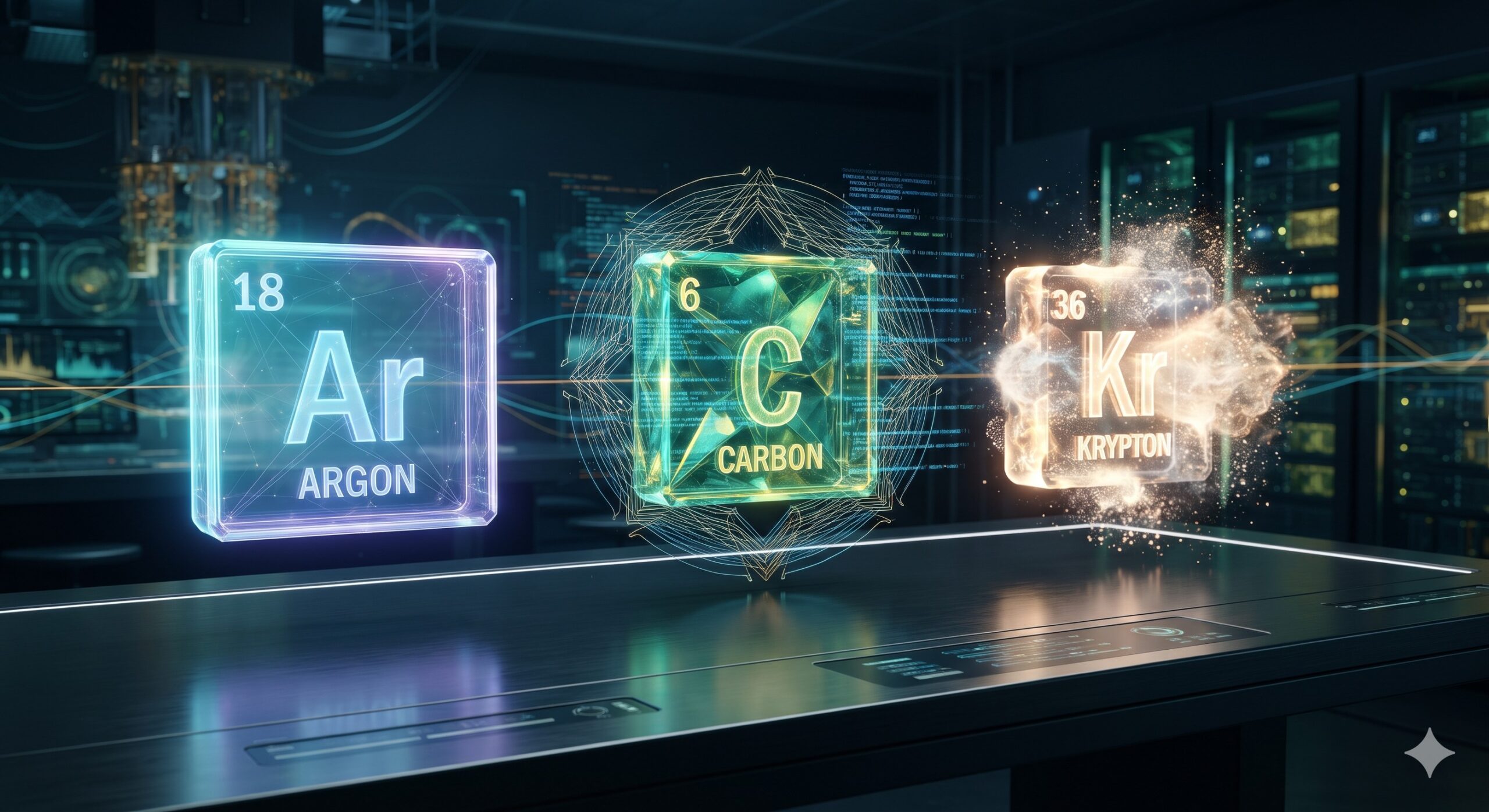
* Conceptual illustration generated using AI