
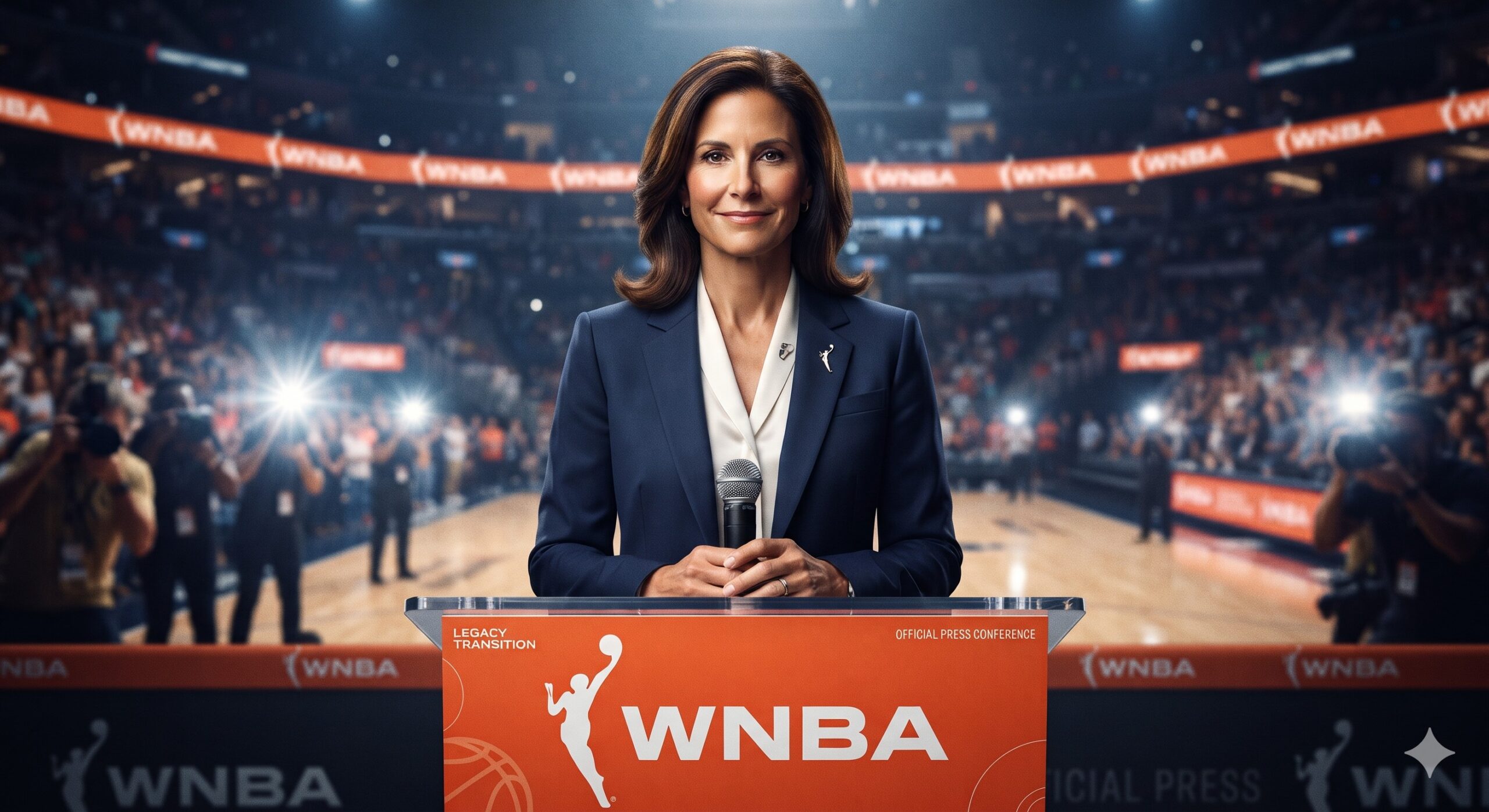
The era of Cathy Engelbert at the helm of the Women’s National Basketball Association (WNBA) is officially drawing to a close. As the first-ever Commissioner of the league—a title upgrade from the previous “President” designation—Engelbert inherited an organization in 2019 that was fighting for its structural and financial sustainability. By the time she announced her retirement, effective December 31, 2026, she had presided over the most explosive, lucrative, and culturally significant period in the history of women’s professional basketball.
However, Engelbert’s tenure was as tumultuous as it was transformative. While the ledger shows unprecedented media rights deals and record-breaking viewership driven by a generational rookie class, the locker rooms tell a story of fractured labor relations, communication breakdowns, and intense culture-war friction.
As the WNBA currently conducts a high-stakes executive search for her successor, examining what Engelbert had to say on her way out provides a critical roadmap for the future of the league. Here is an analytical deep dive into the outgoing commissioner’s final remarks, the metrics of her success, and the institutional challenges she leaves behind.
1. The Exit Remarks: “Dropping the Mic” on a Transformed League
When Cathy Engelbert formally announced her departure in September 2026, her remarks were steeped in the confidence of an executive who had fundamentally repaired a struggling balance sheet. Drawing on her 33-year career at Deloitte, where she served as the first female CEO of a Big Four accounting firm, Engelbert framed her exit as a calculated transition of power at the peak of the league’s value.
“I’m proud of the team we built and everything we accomplished,” Engelbert stated to the press. “A leader knows when it’s time to drop the mic and move on after building a powerhouse team in the league office”.
Her reflection on the financial metrics was particularly pointed. “I look at revenue and merchandise, viewership and attendance,” she noted, emphasizing how every key performance indicator had surged under her watch. “A great leader senses when it’s time for someone else to come in. When I came in, this league was facing questions about our long-term viability and sustainability”.
In a letter dispatched to all WNBA players on the morning of her announcement, Engelbert struck a collaborative tone, writing that she held “enormous pride in what we’ve accomplished together, profound gratitude for the opportunity to lead alongside of you, and complete confidence that the future of the WNBA is brighter than ever”.
Beyond the corporate framing, Engelbert also cited deeply personal reasons for stepping down, highlighting the grueling toll of executive leadership. “My mom is turning 90 this year, and she said that ‘it would be good if you were retired to spend more time with me,'” she shared with a laugh. “I have two children, one I barely see. I’m one of eight kids… They always say can you retire so you can spend more time with us”.
2. The Analytical Legacy: Capital, Expansion, and the Caitlin Clark Effect
To evaluate Engelbert’s assertion that she secured the league’s “viability,” one must look at the hard institutional architecture she engineered during her seven-year run.
The Financial and Media Restructuring
Under Engelbert, the WNBA finally broke free from its historical revenue ceilings. She successfully navigated the league through the COVID-19 “Wubble” season and subsequently spearheaded a landmark $2.2 billion media rights deal. This infusion of capital fundamentally shifted the WNBA from a subsidized operation into a standalone commercial powerhouse.
The 2024-2025 Explosion
The true catalyst of Engelbert’s late-tenure success was the arrival of a generational rookie class, headlined by Caitlin Clark and Angel Reese. Between 2024 and 2025, WNBA franchises experienced a staggering 180% year-over-year growth rate in viewership and engagement—more than double the previous year-over-year record for any major sports league. Engelbert capitalized on this momentum, driving merchandise sales, securing charter flights (a major point of contention for years), and elevating the league’s cultural footprint.
Institutional Expansion
Engelbert also delivered on her promise of footprint expansion. By the time her strategic roadmap concludes in 2030, the league will have added six new expansion franchises, expanding the WNBA’s geographic and commercial reach significantly. Additionally, she laid the groundwork for advanced officiating infrastructure, including the creation of a fully centralized replay center slated to debut in 2027.
3. The Friction: Labor Disputes and the Culture War Trap
However, the “mic drop” narrative obscures a heavily fractured relationship with the players. While Engelbert excelled in boardroom negotiations, her player-relations strategy was widely criticized as disconnected and, at times, tone-deaf.
As the league’s popularity exploded, players demanded a larger share of the revenue and greater protection from the vitriol that accompanied the influx of new fans. Engelbert frequently found herself caught in the crossfire of toxic “culture war” narratives surrounding race, sexuality, and rookie marketability. Her attempts to remain diplomatically neutral often backfired, drawing the ire of veterans who felt unprotected by the league office.
The tension peaked repeatedly during her final years. Superstar A’ja Wilson bluntly summarized the disconnect during the 2026 All-Star Weekend, stating, “My only relationship with Cathy is when she hands me awards, which is great”. Earlier, player Napheesa Collier delivered a blistering public critique of Engelbert’s leadership, exposing a deep rift between the athletes driving the product and the executive suite managing it.
Engelbert did acknowledge these shortcomings, telling reporters, “Communication is and was absolutely something I’ve been talking with the players about, how much they want to hear from us, how much they don’t”.
According to private reports, many players viewed her departure positively, believing the WNBA requires a different style of leadership to navigate its newly massive spotlight. The next commissioner will not be fighting for survival; they will be fighting for equitable distribution, player safety, and cultural cohesion.
4. The Transition: Avoiding the Mistakes of the Past
Perhaps the most structurally important commitment Engelbert made during her exit remarks was her pledge to facilitate a smooth transition of power. When she took the job in 2019, she was thrown into the deep end.
“I had no transition,” Engelbert revealed. “I walked in the door and I was by myself as no one transitioned me into this role”.
Determined not to repeat that institutional failure, she stated, “We’ll run a real succession process in the remaining four months. If we don’t find someone I’ll stay on”. She emphasized her desire to help the next leader seamlessly adapt, “especially considering the elevation of this league”. As of mid-November 2026, that search is actively underway following the league’s annual competition committee meetings.
Conclusion: A Complicated, Indispensable Era
Cathy Engelbert’s legacy as the WNBA Commissioner is defined by a distinct dichotomy. To the investors, owners, and broadcast partners, she was the ultimate financial architect—a CEO who took a league facing existential questions about its viability and transformed it into a multi-billion-dollar enterprise. To the players, she was an aloof corporate manager who struggled to navigate the nuanced, human complexities of a league driven by outspoken, trailblazing women.
As Engelbert steps away to spend time with her 90-year-old mother and her family, the WNBA enters a new epoch. The financial foundation she built is undeniably strong. The challenge for her successor is no longer proving that women’s basketball can make money; it is proving that the league can support, protect, and communicate effectively with the athletes who generate it.
Engelbert may be dropping the mic, but for the WNBA, the most important conversations are just beginning.
References & Citations
- AP News (September 4, 2026): WNBA Commissioner Cathy Engelbert to retire in December after transformative and tumultuous tenure — Source of Engelbert’s exit quotes regarding her family, the succession process, and dropping the mic.
- The Guardian (September 4, 2026): Cathy Engelbert’s WNBA tenure: the wins and losses that defined her seven years — Reporting on player friction, A’ja Wilson’s comments, and the centralized replay center.
- Wikipedia / Deloitte Records (2026): Cathy Engelbert — Biographical data on Engelbert’s 33-year career at Deloitte and the 180% year-over-year growth metric in 2024-2025.
- WTHR (October 2025): WNBA Commissioner Cathy Engelbert vows to repair player relationships after criticism by Collier — Details on the $2.2 billion media deal and expansion goals.
- The Times of India (September 7, 2026): Commissioner Cathy Engelbert’s WNBA exit sparks reaction as players reportedly want ‘different leadership’ — Coverage of private player reactions and the need for new cultural management.
- AP News (November 13, 2026): Engelbert: WNBA commissioner search underway as her retirement nears — Confirmation of the ongoing search following competition committee meetings.
* Conceptual illustration generated using AI