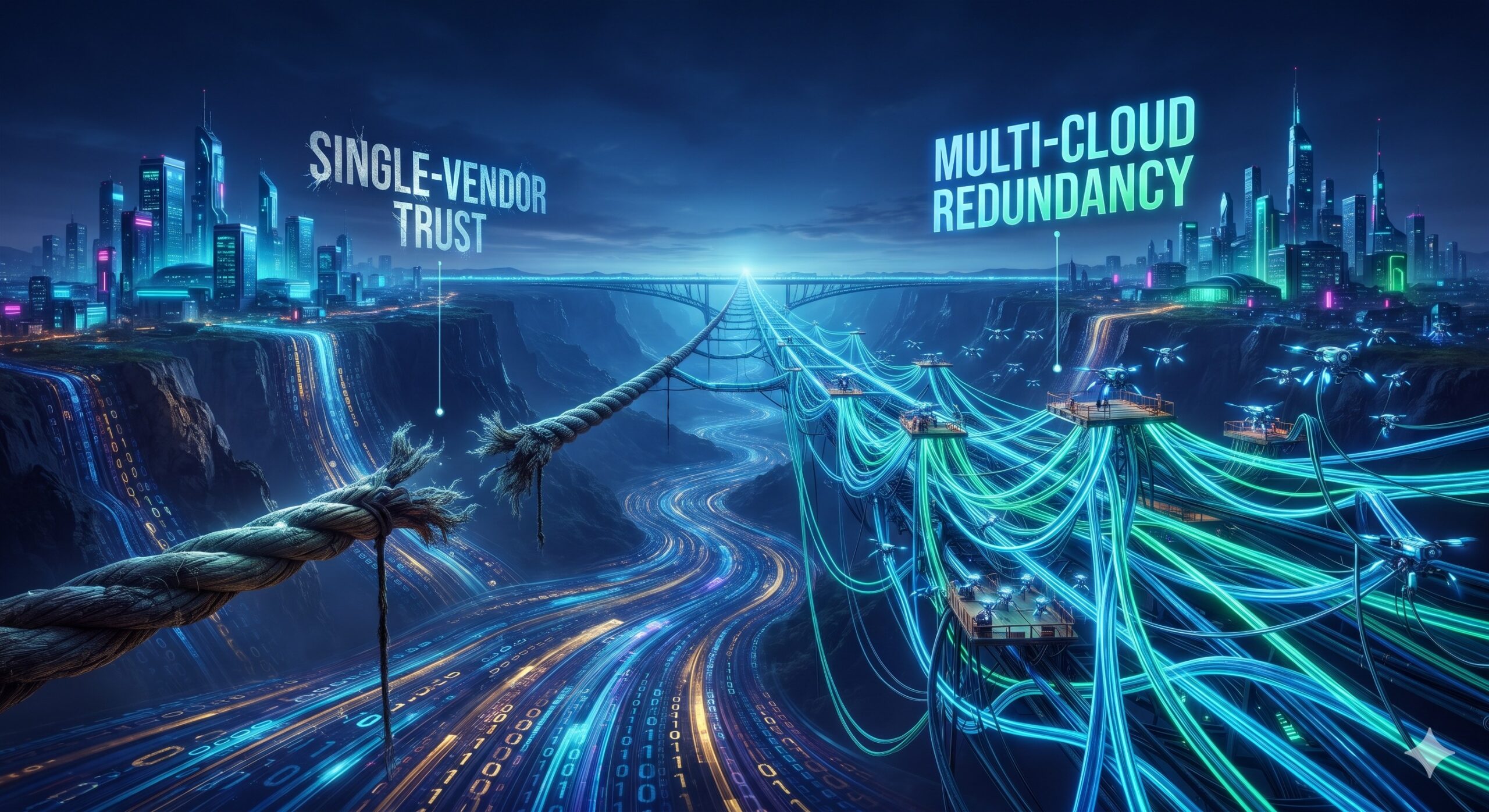
For over a decade, the overarching architectural gospel of enterprise IT has been straightforward: consolidate, simplify, and migrate. By placing entire corporate digital footprints—from email and directory services to data warehouses and AI pipelines—into a single hyperscale cloud environment, organizations believed they were buying ultimate operational efficiency and rock-solid stability.
The planetary-scale Microsoft 365 outage shattered that illusion. When a backend server health-check failure brought core productivity suites, authentication nodes, and API bridges down across 74 nations, governments, hospitals, and multinational enterprises discovered a harsh reality: convenience had birthed a catastrophic single point of failure. As organizations scrambled to enact manual continuity plans, the economic cost of single-vendor dependency became painfully clear.
In the wake of this crisis, Chief Information Officers (CIOs) and Chief Information Security Officers (CISOs) worldwide are rewriting their business continuity playbooks. The strategic pivot of late 2026 is unambiguous: moving away from brittle, single-cloud paradigms toward sophisticated multi-cloud redundancy, hybrid failover orchestration, and sovereign workload distribution.
Here is an in-depth analytical breakdown of why single-cloud reliance collapsed under pressure, the technical hurdles of multi-cloud architectures, and the advanced redundancy strategies enterprises are deploying to ensure an outage never halts business again.
1. The Anatomy of Single-Vendor Vulnerability
To understand why enterprises are rushing to embrace multi-cloud strategies, one must first examine the structural trap that caught thousands of organizations off guard during the November 2026 blackout.
Modern enterprise architecture has evolved far beyond basic data hosting. Cloud providers no longer just provide virtual machines or storage buckets; they supply deeply integrated SaaS, PaaS, and identity management layers. When a company chooses a primary cloud provider like Microsoft Azure or Microsoft 365, they rarely just use its servers—they build their entire operational nervous system upon its proprietary APIs.
THE SINGLE-CLOUD FRAGILITY VS. MULTI-CLOUD RESILIENCE MODEL
| METRIC / VECTOR | SINGLE-CLOUD DEPENDENCY | MULTI-CLOUD REDUNDANCY |
| Primary Risk | Total operational paralysis if authentication/core fails | Complex data egress fees and latency overhead |
| Vendor Lock-in | High; deeply integrated with proprietary APIs and tools | Low; containerized workloads portable across hyperscalers |
| Failover Capability | Dependent on primary provider status pages and internal fixes | Automated, cross-cloud active-active switching |
| Security Posture | Single vulnerability window; uniform misconfiguration risk | Unified posture via CSPMs and zero-trust segmentation |
When core infrastructure nodes fail—as occurred when Exchange Online and Microsoft Graph endpoints timed out—the failure does not stay isolated to email. Downstream applications freeze, customer service portals stall, and corporate authentication protocols lock employees out of auxiliary third-rely tools. As Padma Reddy Sama, co-founder of cloud services provider BharathCloud, noted in the wake of the disruption, the incident laid bare the systemic risks of businesses anchoring their essential communications and collaboration solely to a limited number of technology platforms.
2. The Multi-Cloud Imperative: Moving Beyond “Lift and Shift”
True multi-cloud redundancy is fundamentally different from simply having accounts with two different cloud providers. In the past, many enterprises claimed to be “multi-cloud” because they hosted their website on AWS while storing archival data on Azure. However, these workloads were siloed; if one provider experienced a catastrophic outage, the other could not automatically absorb its operational traffic.
Following the November 2026 outage, enterprises are moving past basic “lift-and-shift” migrations toward true workload portability and active-active multi-cloud architectures.
Containerization and Infrastructure as Code (IaC)
The technical foundation of modern multi-cloud redundancy relies heavily on containerization technologies like Docker and Kubernetes, managed via Infrastructure as Code (IaC) frameworks such as Terraform and Ansible. By packaging applications and their dependencies into standardized containers, enterprises can deploy identical application instances across AWS, Google Cloud Platform (GCP), and Microsoft Azure simultaneously. If a regional zone or entire service ecosystem fails with one provider, automated global load balancers can redirect live traffic to a secondary cloud environment within minutes.
Decoupling Identity and Productivity Suites
One of the most painful lessons learned during the blackout was the danger of tightly coupled identity providers (IdP). Many organizations used their primary cloud email and productivity suite as their single directory authority for all corporate logins.
Enterprises are now decoupling identity verification from day-to-day productivity tools. By implementing federated identity management architectures that utilize independent, vendor-agnostic protocols (such as OpenID Connect or decentralized zero-trust identity layers), organizations ensure that an outage in a collaboration tool does not prevent employees from authenticating into mission-critical engineering or financial systems.
3. Overcoming the Friction: Data Egress, Latency, and Cost
While the strategic value of multi-cloud redundancy is undeniable, implementing it across an enterprise introduces immense technical and financial friction. CIOs navigating post-outage restructuring must balance resilience against three major architectural hurdles:
THE THREE PILLARS OF MULTI-CLOUD FRICTION & MITIGATION
| FRICTION POINT | TECHNICAL CAUSE | ENTERPRISE MITIGATION |
| 1. Data Egress Fees | Cloud providers charge high fees to move data off-network. | Deploying asynchronous caching and optimizing data replication schedules. |
| 2. Cross-Cloud Latency | Real-time synchronization between disparate providers introduces transmission lag. | Utilizing private fiber interconnects and edge-caching nodes at neutral IXPs. |
| 3. Operational Complexity | Managing separate security, IAM, and logging tools across multiple hyperscalers. | Adopting unified Cloud Security Posture Management (CSPM) dashboards. |
The Cost of Data Gravity and Egress Fees
Data has mass—often referred to as “data gravity.” Moving hundreds of terabytes or petabytes of operational data back and forth between rival cloud ecosystems incurs massive data egress charges. Enterprises attempting real-time multi-cloud mirroring frequently face unexpected budget overruns. To mitigate this, architecture teams are shifting toward asynchronous caching and strategic data tiering—keeping core transactional databases synchronized while pushing static assets and backups to low-cost, cloud-agnostic object storage repositories.
Latency and Real-Time Synchronization
For applications requiring instantaneous processing, routing data between different cloud data centers can introduce unacceptable latency penalties. Enterprises are addressing this by partnering with neutral carrier hotels and Internet Exchange Points (IXPs) to establish direct, private fiber interconnects between hyperscalers, bypassing the public internet entirely and stabilizing cross-cloud response times.
Unified Observability and Security Posture
Managing distinct security policies across AWS, Azure, and GCP historically created massive blind spots for security teams. Modern multi-cloud strategies mandate the deployment of centralized Cloud Security Posture Management (CSPM) and Service Orchestration and Automation Platforms (SOAP). These tools provide a single pane of glass, ensuring that identity controls, encryption standards, and threat monitoring remain uniform regardless of which cloud infrastructure is hosting the workload.
4. Out-of-Band Contingencies: Designing for the Worst-Case Scenario
True enterprise resilience requires acknowledging a humbling truth: even a multi-cloud architecture can fail if a catastrophic zero-day bug affects underlying internet routing or global DNS infrastructure. Consequently, leading organizations are resurrecting and modernizing out-of-band (OOB) communication channels.
- Independent Emergency Messaging: Ensuring that executive crisis teams and IT responders have access to encrypted, independent messaging platforms and cellular-backed communication networks that do not share corporate cloud infrastructure.
- Offline Data Access and Local Repositories: Maintaining securely encrypted, local copies of vital business documentation, payroll records, and customer contact manifests on air-gapped hardware servers. As incident management firms advise, backups should never rely on the exact same cloud infrastructure that they are designed to protect.
- Regular Disaster Recovery Drills: Building a multi-cloud failover protocol on paper is insufficient. Enterprises are now instituting mandatory, unannounced “chaos engineering” drills—deliberately severing primary cloud connections to test how quickly automated orchestration platforms can spin up secondary environments without human panic.
Conclusion: The New Standard of Cloud Maturity
The November 2026 Microsoft outage will be remembered as a watershed moment in corporate technology governance. It marked the end of the naive era where enterprises blindly trusted a single software vendor to guarantee uninterrupted global commerce.
As organizations re-evaluate their risk profiles, multi-cloud redundancy has shifted from an expensive luxury reserved for financial institutions to an essential baseline of enterprise architecture. By decoupling identities, containerizing critical workloads, absorbing egress costs through smart data placement, and maintaining independent offline fallbacks, enterprises are building a more robust digital future. In the modern cloud landscape, maturity is no longer measured by how fast your primary server runs, but by how seamlessly you survive when it stops.
References & Primary Sources
- Business Standard (November 13, 2026): Microsoft disruption exposes risks of relying on single provider: Experts — Expert analysis from cloud specialists on single-vendor dependency and multi-cloud necessity following the November 2026 outage.
- The Economic Times (November 13, 2026): The Microsoft trap: One outage can bring the business world tumbling down — Comprehensive reporting on the architectural flaws of modern business technology and the requirement for independent cloud backups.
- Mitkat Advisory Risk Analysis (November 13, 2026): Global Microsoft 365 Outage Threatens Critical Service Continuity — Incident response recommendations, out-of-band communication protocols, and multi-provider redundancy reviews.
- Tata Communications Technical Knowledge Base (October 2026): Multi-Cloud Migration for Enterprise IT Strategy — Architectural breakdown of workload distribution, egress fee mitigation, and performance optimization across multiple cloud environments.
- Stonebranch Enterprise Automation Blog (December 2025 / Updated 2026): Disaster Recovery Failover Workflow for Hybrid IT — Technical analysis of automated disaster recovery orchestration, cross-cloud failovers, and unified control planes.
* Conceptual illustration generated using AI