

Every time a user hits “Send” on an email client, a silent, highly structured protocol dialogue unfolds across the internet. Behind the polished user interfaces of Microsoft Outlook, Gmail, or enterprise mail gateways lies the Simple Mail Transfer Protocol (SMTP)—a robust communication standard that dictates how messages travel between Mail Transfer Agents (MTAs).
While successful deliveries go largely unnoticed, the true test of any transport architecture lies in how it handles failure. When a server goes offline, a recipient’s mailbox fills to capacity, or an invalid address is targeted, the system must communicate the exact nature of the failure with absolute precision.
This precision is governed by two foundational engineering standards: RFC 5321 (which defines the core SMTP protocol and its traditional 3-digit reply codes) and RFC 3463 (which introduces Enhanced Status Codes to provide granular, machine-parsable diagnostics).
Here is an exhaustive, technical deep-dive into how these standards operate, how modern MTAs interpret status codes, and why robust error handling is critical for enterprise mail flow resilience.
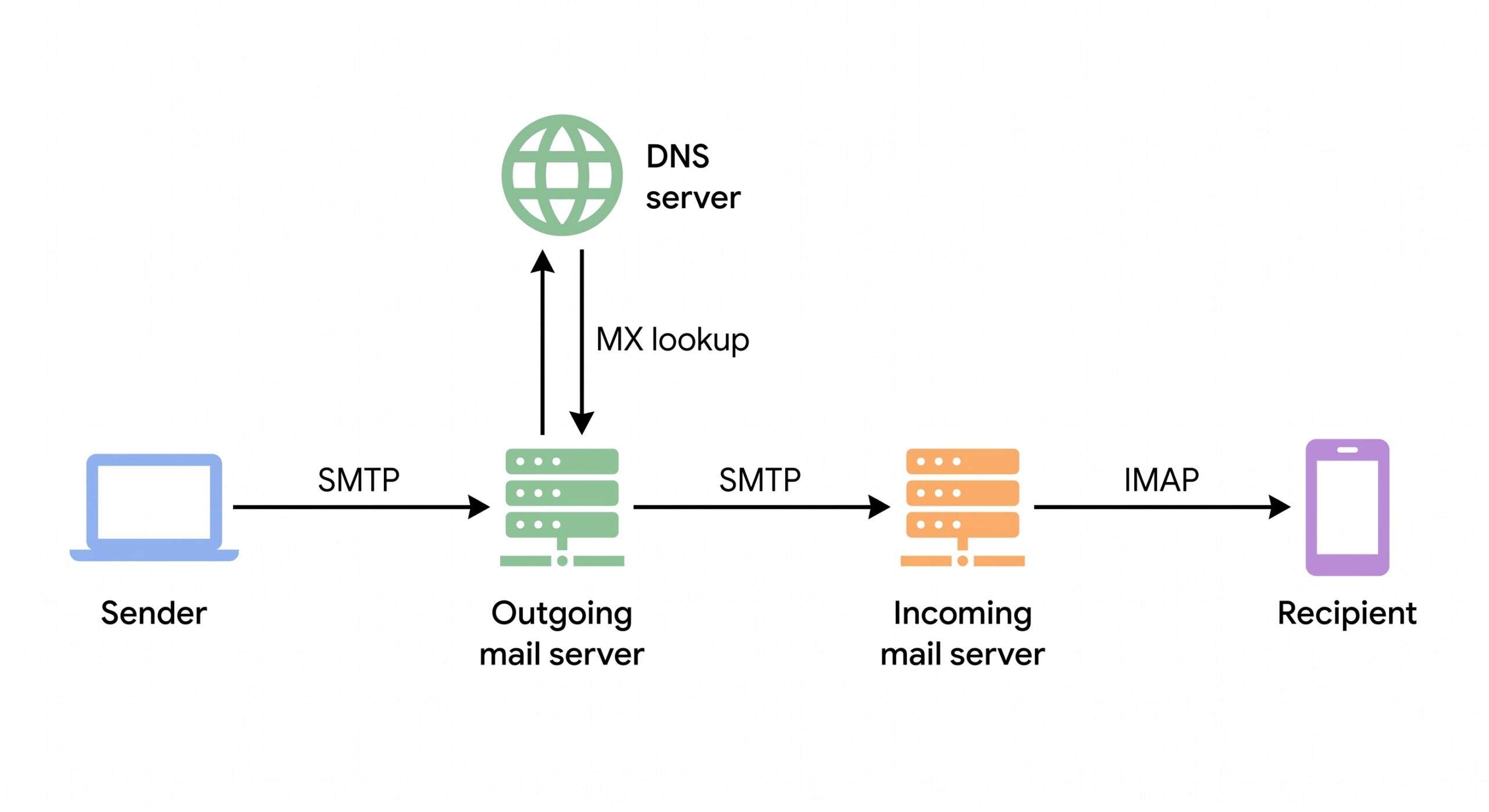
Email delivery and server protocol transmission process. Source: Google AI
1. The Foundation of SMTP Replies: RFC 5321
Defined by the Internet Engineering Task Force (IETF), RFC 5321 (which superseded the classic RFC 821) establishes the core specifications for the transmission of electronic mail over the internet. Within this protocol specification, every command issued by a client MTA (such as HELO, MAIL FROM, RCPT TO, or DATA) must elicit a standardized, 3-digit numeric reply from the receiving server, accompanied by optional human-readable text.
These traditional 3-digit reply codes are structured hierarchically based on their leading digit, dividing responses into four primary operational categories:
RFC 5321 TRADITIONAL 3-DIGIT REPLY CODE ARCHITECTURE
| LEADING DIGIT | CATEGORY | OPERATIONAL MEANING & ACTION |
| 2xx | Positive Completion | The command was successfully executed; the server accepted the instruction (e.g., 250 OK). |
| 3xx | Positive Intermediate | The command was accepted, but the server requires additional input to complete the transaction (e.g., 354 Start mail input). |
| 4xx | Transient Negative | The command failed temporarily; the condition is short-term, and the sender should retry the transmission later (e.g., 451 Mailbox locked). |
| 5xx | Permanent Negative | The command failed permanently; the condition is unrecoverable, and the sender must abort the transmission and generate an NDR (e.g., 550 User unknown). |
While RFC 5321 reply codes provide a clear macro-level directive (e.g., retry for 4xx or bounce for 5xx), they suffer from a significant limitation: they lack granular context. A traditional 550 error code could indicate everything from a non-existent recipient mailbox to a policy-based spam rejection or a blocked IP address. For automated systems administrators and programmatic mail dispatchers, relying solely on broad 3-digit codes made automated error categorization difficult.
2. The Enhancement Revolution: RFC 3463 and Enhanced Status Codes
To bridge the gap between human-readable descriptions and machine-parsable automation, the IETF introduced RFC 3463 (Enhanced Mail System Status Codes). RFC 3463 standardizes a secondary, structured code format known as the Enhanced Status Code (ESC), formatted as three distinct numeric values separated by periods: X.Y.Z.
When integrated into an SMTP dialogue, the ESC is appended directly after the traditional RFC 5321 reply code, creating a comprehensive diagnostic string (e.g., 550 5.1.1 User unknown).
THE STRUCTURE OF RFC 3463 ENHANCED STATUS CODES (X.Y.Z)
| POSITION | COMPONENT | DEFINED VALUES & MEANINGS |
| X | The Class | 2 = Success (Valid delivery) 4 = Persistent Transient (Retry) 5 = Permanent Failure (Bounce) |
| Y | The Subject | 0 = Other or Undefined Status 1 = Addressing (Mailbox/Domain issues) 2 = Mailbox (Quota, status limitations) 3 = System (Storage, OS limits) 4 = Network & Routing (Relay, DNS errors) 5 = Protocol (Syntax, state violations) 7 = Security / Policy (Spam, auth failures) |
| Z | The Detail | Specific granular diagnostic sub-code identifying the precise root cause. |
Deconstructing Common ESC Combinations:
5.1.1(Bad Destination Mailbox): Classified under Class5(Permanent) and Subject1(Addressing). This explicitly indicates that the recipient user account does not exist on the destination domain.4.2.2(Mailbox Full): Classified under Class4(Transient) and Subject2(Mailbox). This tells the sending MTA that while the address is valid, the target inbox has exceeded its storage quota, instructing the queue manager to hold the message for a scheduled retry.4.4.7(Delivery Time Expired): Classified under Class4and Subject4(Routing/Network). This signifies that a transient network or server failure persisted past the queue’s maximum Time-To-Live threshold, resulting in a queue timeout.
3. Interaction and Parsing Mechanics in Modern MTAs
Modern Mail Transfer Agents—whether enterprise platforms like Microsoft Exchange Online, open-source workhorses like Postfix, or high-volume delivery relays like SendGrid—rely heavily on the intersection of RFC 5321 and RFC 3463 to automate mail flow decisions.
When an inbound connection hits a receiving MTA, the software parses the response string using strict pattern-matching algorithms.
MTA ERROR HANDLING DECISION MATRIX
| INBOUND RESPONSE CLASS | PARSING MECHANISM | AUTOMATED MTA ACTION |
| 4xx Transient | Parses Enhanced Status Code (ESC) starting with 4.x.x | Routes message back to the delivery queue and schedules retry backoff timers. |
| 5xx Permanent | Parses Enhanced Status Code (ESC) starting with 5.x.x | Purges the message from the queue and immediately generates a Non-Delivery Report (NDR). |
If an MTA encounters a traditional 451 code paired with an enhanced 4.3.0 (Mail system storage failure), the delivery engine knows not to flood the logs or bounce the message prematurely. Instead, it triggers internal queue retry timers, insulating sending applications from transient network glitches. Conversely, encountering a 550 5.7.1 (Delivery not authorized, message refused) signals an immediate permanent failure, prompting the MTA to purge the message from the queue and generate an automated Non-Delivery Report (NDR) for the sender.
4. Engineering Best Practices for SMTP Error Handling
For systems engineers, software developers, and cloud administrators building automated notification systems or managing enterprise email relays, designing robust error-handling pipelines requires strict adherence to these protocol standards:
- Never Hardcode Solely on 3-Digit Codes: Avoid writing retry or bounce logic that checks only for
550or451. Always parse the accompanying RFC 3463 Enhanced Status Code (X.Y.Z) to ensure accurate categorization of permanent versus transient conditions. - Implement Intelligent Backoff for 4xx Errors: Respect transient status codes (
4.2.2for full mailboxes,4.4.1for no answer from host). Flooding a struggling receiving server with aggressive retries violates SMTP etiquette and frequently lands sending IPs on transient greylist blocks. - Monitor Feedback Loops via Bounce Logs: Regularly audit MTA transport logs for recurring
5.x.xerrors. High volumes of5.1.1(invalid users) or5.7.1(policy blocks) indicate deteriorating database hygiene or reputation issues that require immediate administrative remediation.
Conclusion: The Unsung Protocol of Digital Trust
The resilience of global electronic mail rests upon the rigorous, predictable architecture of RFC 5321 and RFC 3463. By harmonizing traditional 3-digit command replies with granular, machine-parsable Enhanced Status Codes, these standards transform chaotic network failures into structured, actionable diagnostics.
Whether an enterprise is navigating a massive cloud outage or fine-tuning automated mail queues via PowerShell, mastering the mechanics of SMTP error handling remains an indispensable cornerstone of modern systems engineering.
References & Primary Sources
- IETF RFC 5321 (October 2008): Simple Mail Transfer Protocol (SMTP) — The definitive technical specification governing core SMTP protocol commands, server replies, and 3-digit status code categories.
- IETF RFC 3463 (January 2003): Enhanced Status Codes for SMTP — Official specification defining the structure, classes, and sub-codes of RFC 3463 (X.Y.Z) enhanced diagnostic codes.
- Microsoft Learn (August 2026): Email deliverability and non-delivery report error codes in Exchange Online — Technical documentation detailing how enterprise MTAs parse RFC 5321 and RFC 3463 codes during mail delivery failures.
- Postfix Documentation (2025–2026): SMTP Error Mail Delivery Status Code Reference — Open-source MTA architecture guide covering queue management, retry scheduling, and bounce generation based on enhanced status codes.
* Conceptual illustration generated using AI