
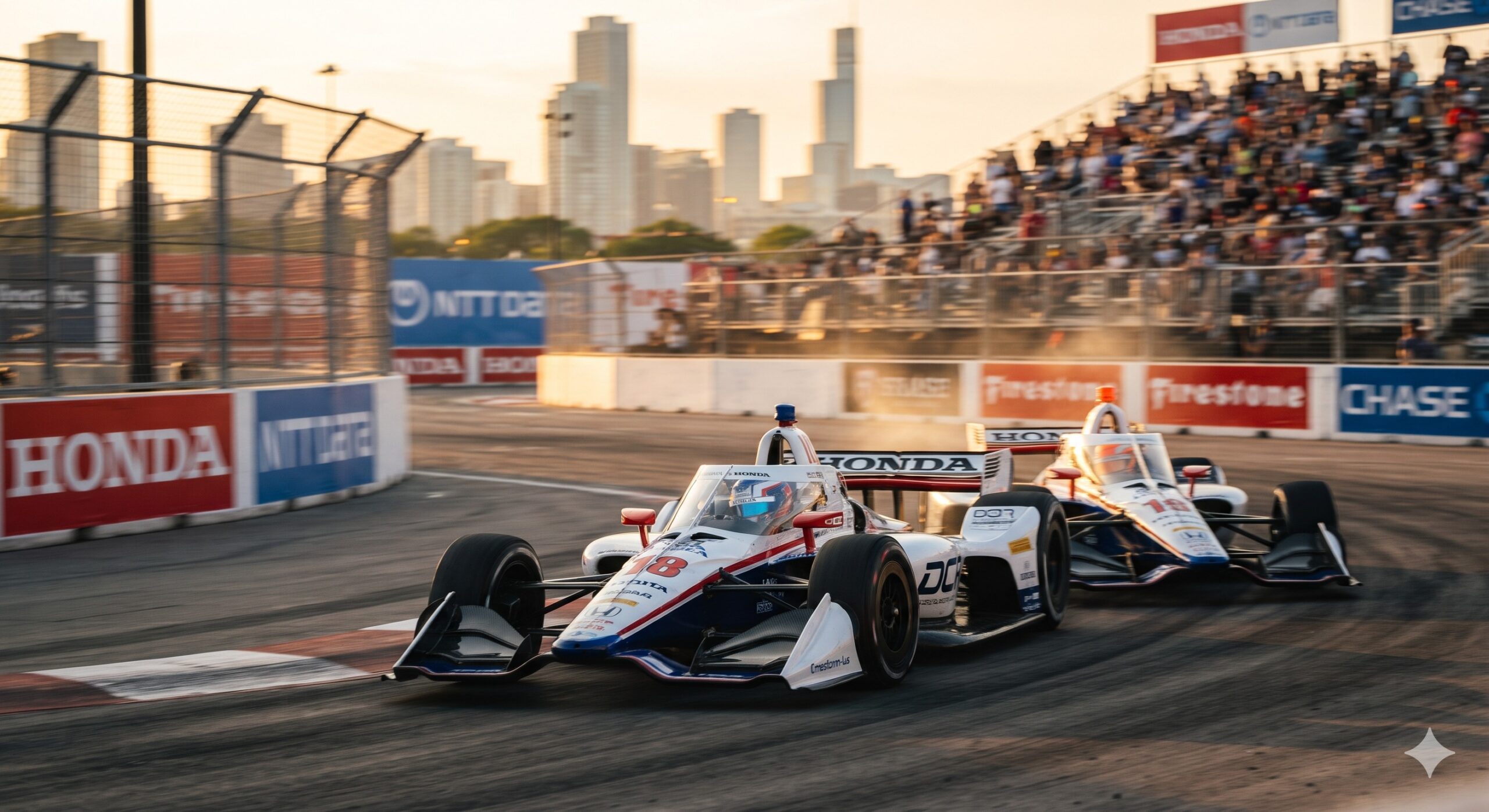
In the modern NTT IndyCar Series, where multi-car super-teams like Chip Ganassi Racing, Andretti Global, Arrow McLaren, and Team Penske command sprawling engineering campuses and driver-in-the-loop simulators, Dale Coyne Racing (DCR) remains one of North American motorsport’s great survival stories. Operating out of a modest shop in Plainfield, Illinois, Dale Coyne’s independent Honda-powered outfit has spent four decades turning limited budgets into giant-killing afternoon surprises.
The 2026 season—an 18-race campaign dominated at the top by Chip Ganassi Racing’s Álex Palou as he captured his fifth series title and fourth consecutive championship—tested Coyne’s resourcefulness once again. Entering the year after another winter of roster uncertainty, DCR assembled one of the paddock’s most intriguing driver pairings: returning French Formula 1 veteran Romain Grosjean in the No. 18 Honda, alongside 23-year-old Norwegian rookie phenom Dennis Hauger in the No. 19 Honda.
By the time the checkered flag fell on the season finale at WeatherTech Raceway Laguna Seca, that blend of seasoned aggression and raw developmental speed had delivered exactly what Coyne needed most. Hauger captured 2026 NTT IndyCar Series Rookie of the Year honors while securing a vital Leaders Circle charter payout spot, and Grosjean came within five laps of delivering the team’s first victory since 2018 during a thrilling runner-up drive on the streets of Markham.
Here is an in-depth analytical review of Dale Coyne Racing’s 2026 campaign, breaking down the statistical ledger of both entries, the technical alliances that stabilized the garage, and why the team’s hard-won success has paradoxically triggered another complete driver reset for 2027.
1. The 2026 Statistical Ledger: Stability and Leaders Circle Survival
For an independent operation like Dale Coyne Racing, championship success is not measured solely in trophies; it is measured by finishing inside the top 22 in entrant points. Achieving that threshold unlocks a coveted Leaders Circle contract—the series’ annual revenue-sharing payout worth roughly $1 million per car, which serves as the financial lifeblood for smaller organizations.
In 2026, both Coyne entries cleared that critical benchmark, giving the organization full-season stability across all 18 races without the mid-season musical chairs that have frequently disrupted DCR’s second seat in recent years.
| METRIC / CATEGORY | NO. 18 HONDA (ROMAIN GROSJEAN) | NO. 19 HONDA (DENNIS HAUGER) |
| Driver Role & Background | Returning F1 / IndyCar Veteran | 2025 Indy NXT Champion (Rookie) |
| 2026 Races Started | 18 Starts (Full Season) | 18 Starts (Full Season) |
| Final Championship Rank | 19th Overall | 22nd Overall (Rookie of Year) |
| Total Championship Points | 259 Points | 228 Points |
| Best Race Finish | 2nd (Markham Street Circuit) | 10th (Twice; 2 Top-10s total) |
| Best Qualifying Result | Top-10 Street/Road Pace | 3rd (St. Petersburg Fast Six) |
| Indianapolis 500 Result | Top-10 Finish | Completed Rookie Program |
| Leaders Circle Status | Secured (Top-22 Entrant) | Secured (Final Top-22 Cutoff) |
| Confirmed 2027 Seat | Unconfirmed / Free Agent | Signed by A.J. Foyt Racing (#14) |
2. Romain Grosjean’s Comeback and the Markham Heartbreak
When Dale Coyne Racing confirmed in February 2026 that Romain Grosjean would return to the No. 18 Honda—completing the full-time grid five years after he first debuted with Coyne in 2021—the move carried mutual urgency. After spending 2025 on the sidelines following his 2024 stint with Juncos Hollinger Racing, the 40-year-old Frenchman needed a competitive platform to prove his speed remained intact; Coyne needed an experienced benchmark capable of extracting maximum pace from a tight budget.
Reunited with veteran championship-winning race engineer Bill Pappas, Grosjean immediately restored front-running credibility to the No. 18 garage. Throughout the spring and summer, Grosjean repeatedly punched into the top half of the field, highlighted by a composed, attrition-defying top-10 finish at the 110th Running of the Indianapolis 500 in May—a notable accomplishment for a driver whose early IndyCar years were defined largely by road- and street-course specialization.
His defining weekend, however, arrived on August 16, 2026, at the inaugural Ontario Honda Dealers Indy at Markham—the new temporary street circuit in Markham, Ontario, that replaced Toronto’s traditional Exhibition Place venue.
In a chaotic 90-lap street fight marked by narrow concrete walls, shifting grip levels, eight retirements, and just 14 cars finishing on the lead lap, Grosjean delivered a vintage display of street-circuit bravery. Controlling the pace out front during the closing stint, Grosjean appeared poised to finally break his long-standing IndyCar winless drought and hand Dale Coyne Racing a fairytale triumph. Instead, Andretti Global’s Marcus Ericsson—hunting his first victory since March 2023—mounted a relentless late charge and executed the race-winning pass with just five laps remaining.
Crossing the line in second place, Grosjean recorded his best IndyCar result since Barber Motorsports Park in April 2023 and the sixth runner-up finish of his IndyCar career. While Grosjean candidly admitted the sting of letting another maiden victory slip away in the final laps, the podium validated his return and anchored his 19th-place championship finish with 259 points.
3. Dennis Hauger’s Rookie of the Year Breakthrough
If Grosjean provided veteran grit, 23-year-old Dennis Hauger injected genuine excitement into Coyne’s future-facing No. 19 entry. Arriving in IndyCar on the back of a dominant 2025 Indy NXT by Firestone championship with Andretti Global—and carrying prior European pedigree as the 2021 FIA Formula 3 champion—Hauger made history before taking a single green flag, becoming the first Norwegian driver to compete in IndyCar in 109 years, ending a drought stretching back to Gil Andersen’s Indianapolis 500 appearances between 1911 and 1916.
Hauger wasted zero time announcing his raw one-lap speed. At the season-opening Firestone Grand Prix of St. Petersburg in March, the Norwegian rookie stunned the paddock by advancing into the elite Firestone Fast Six qualifying shootout on debut and qualifying third overall—outpacing established stars from Penske, Ganassi, and McLaren. He would go on to reach the Firestone Fast Six twice during his rookie campaign, proving that Coyne’s engineering group—bolstered by veteran strategist Michael Cannon—could give a young driver a genuinely quick qualifying car.
| COMPETITIVE STRENGTHS | DEVELOPMENTAL HURDLES |
| • Elite Single-Lap Qualifying Pace (2 Firestone Fast Six appearances; 3rd on debut at St. Petersburg) | • Firestone Tire Degradation Management (Fading late in heavy-fuel stints after strong opening-lap track position) |
| • Clean Racecraft & Consistency (2 Top-10s + 6 additional Top-15s across 18 starts; minimal crash damage) | • Superspeedway & Oval Traffic Adaptation (Navigating aero wash across his first full slate of high-speed ovals) |
| • High-Pressure Points Execution (228 pts secured 22nd overall and locked in Leaders Circle payout) | • Pit-Lane & Out-Lap Execution (Maximizing undercut/overcut windows against multi-car factory pit crews) |
Translating qualifying speed into full-distance race results proved a steeper climb. Across 18 starts, managing Firestone tire degradation over long green-flag stints occasionally dropped Hauger out of top-six running positions during final stints. Even so, his composure kept him out of costly rookie errors: Hauger logged two top-10 finishes and six additional top-15 results, accumulating 228 points to finish 22nd in the overall standings. That exact margin earned him the 2026 IndyCar Series Rookie of the Year crown and secured the final guaranteed Leaders Circle berth for the No. 19 entry.
4. Behind the Garage Wall: Alliances and Engineering Muscle
Dale Coyne Racing’s 2026 resurgence did not happen by accident; it stemmed from deliberate structural upgrades behind the scenes.
First, Coyne leveraged a strategic driver-placement and technical partnership with Andretti Global, which funded and placed its reigning Indy NXT champion Hauger in the No. 19 Honda—mirroring the successful model Andretti previously used when placing Kyle Kirkwood at A.J. Foyt Racing in 2022. Second, Coyne reinforced his engineering room with two of the sharpest technical minds in American open-wheel racing: Bill Pappas overseeing Grosjean’s No. 18 car and Michael Cannon lending veteran setup acumen to the No. 19 side of the garage.
Together, that engineering spine allowed DCR to compete credibly on street circuits and at the Indianapolis Motor Speedway without burning through spare-parts budgets—an operational discipline essential for independent teams navigating IndyCar’s hybrid-era cost structure.
5. The 2027 Paradox: Why Coyne’s Success Always Breeds Turnover
For Dale Coyne, the bitter irony of developing top rookie talent and rehabilitating veterans is that larger teams inevitably come calling once the results arrive.
On September 16, 2026, A.J. Foyt Racing announced that it had signed Dennis Hauger to a multi-year contract to drive its iconic No. 14 Chevrolet beginning in 2027—poaching Coyne’s newly minted Rookie of the Year to anchor its own rebuilding program. Meanwhile, Grosjean’s future in the No. 18 Honda remains unconfirmed heading into the winter offseason, leaving both of Coyne’s 2026 race seats open for 2027.
Yet true to form, Coyne is already auditioning the next wave of open-wheel prospects. On November 2, 2026, newly crowned 2026 Indy NXT champion Nikita Johnson completed an evaluation test in a Dale Coyne Racing Honda at Barber Motorsports Park, signaling that Plainfield’s familiar cycle of talent incubation is already spinning toward 2027.
Conclusion
Dale Coyne Racing’s 2026 IndyCar campaign will not be remembered for championship hardware, yet within the realities of paddock economics, it stands as an unqualified success. By guiding Dennis Hauger to Rookie of the Year honors, locking both entries inside the lucrative Leaders Circle, and putting Romain Grosjean within five laps of a famous street-course victory in Markham, Coyne proved once again that smart engineering and fearless driver pairings can still rattle IndyCar’s established order. Even with both seats back on the market for 2027, the foundation built in 2026 ensures that Dale Coyne Racing will remain the paddock’s most dangerous underdog when the engines fire next spring.
References & Primary Sources
- Motorsport.com (Joey Barnes, November 9, 2026): IndyCar 2026 season review: Dale Coyne Racing — Comprehensive post-season evaluation of Romain Grosjean (#18) and Dennis Hauger (#19), engineering structure, and 2027 seat outlook.
- INDYCAR.com & FOX Sports (August 16–17, 2026): Official Race Results & Recap: Ontario Honda Dealers Indy at Markham — Coverage of Marcus Ericsson’s late pass on Romain Grosjean with five laps remaining and Grosjean’s sixth career IndyCar runner-up finish.
- FormulaRapida.net & RacingNews.Today (November 9–10, 2026): Analysis of the 2026 IndyCar Season: Dale Coyne Racing — Verified championship standings (Grosjean 19th with 259 points; Hauger 22nd with 228 points), St. Petersburg Fast Six qualifying data, and Leaders Circle cutoff analysis.
- RACER (February 12 & November 2, 2026): Reporting on Romain Grosjean’s February 2026 return alongside race engineer Bill Pappas, Dennis Hauger’s September 16 signing with A.J. Foyt Racing for 2027, and 2026 Indy NXT champion Nikita Johnson’s November 2 Barber test with DCR.
* Conceptual illustration generated using AI