
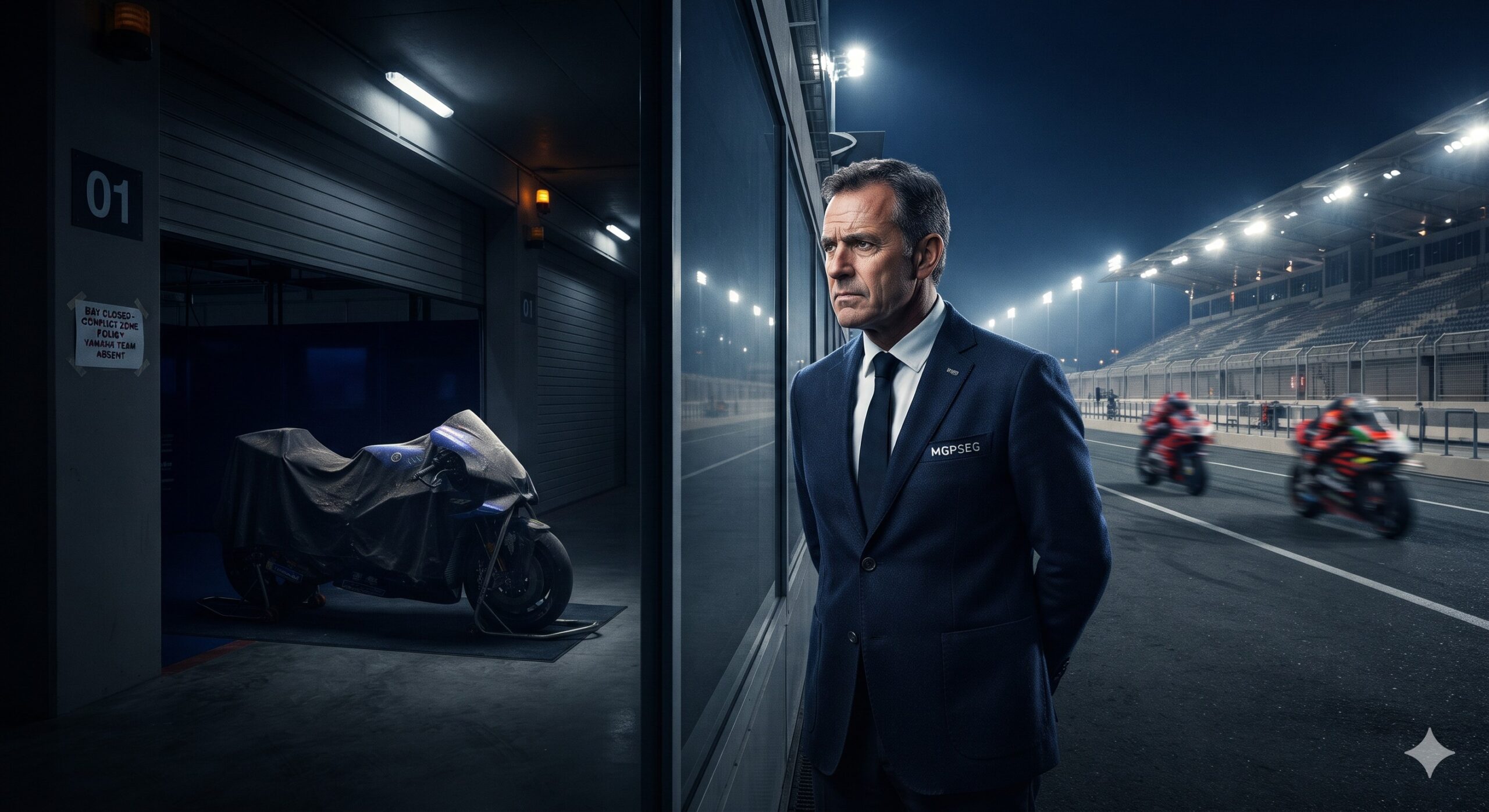
On Monday, November 9, 2026—less than twenty-four hours after the checkered flag fell on one of the most contentious race weekends in Grand Prix motorcycle racing history, MotoGP Sports Entertainment Group (MGPSEG) Deputy CEO Carlos Ezpeleta stepped before reporters to deliver a candid, if polarizing, post-mortem.
Across the preceding ten days, the premier class had been consumed by an extraordinary off-track standoff over staging the November 6–8 Qatar Airways Grand Prix at the Lusail International Circuit amid active military conflict across the wider Persian Gulf region. Nineteen of the grid’s twenty-two regular riders had signed a formal protest letter opposing the trip; Yamaha Motor Co., Ltd. executed an unprecedented corporate boycott withdrawing both its factory squad and satellite Pramac outfit; and Sunday’s main Grand Prix launched with a depleted field of just sixteen riders.
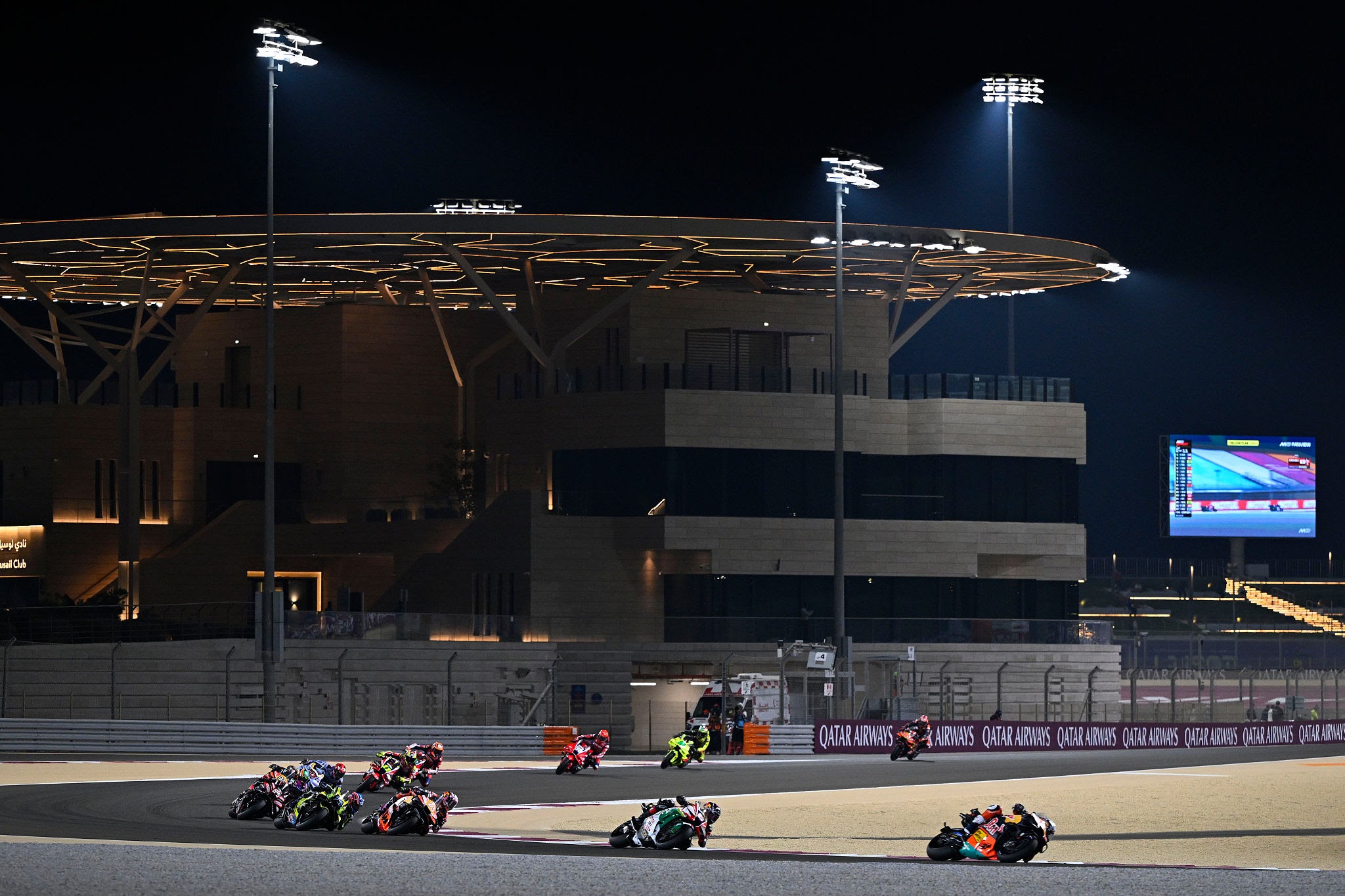
Night racing under geopolitical scrutiny at Lusail. Source: Gold & Goose Photography / Getty Images
Yet because the race weekend itself unfolded without physical incident inside the Lusail perimeter, Ezpeleta framed the championship’s primary failing not as a miscalculation of geopolitical risk, but as a failure of internal message discipline. Speaking on Monday, the MGPSEG executive argued that the public uproar—which he repeatedly characterized as “noise”—had damaged the series far more than the regional security environment itself.
“It is true that we have been more exposed than other sports that have also been in this area, and that has been caused by the noise there has been,” Ezpeleta stated. “It is something we have to control in the future. I say that quite clearly. Other sports have come here, but they have not generated so much uproar. We probably need to work better with the teams and the riders.”
Ezpeleta’s remarks offer a revealing window into the governance philosophy of MotoGP’s leadership under Liberty Media’s corporate umbrella. By diagnosing the Qatar crisis as an optics and alignment problem rather than a structural deficit in rider safety governance, MGPSEG has ignited a fierce debate over where commercial obligations end and corporate duty of care begins.
Here is an in-depth analytical breakdown of Ezpeleta’s post-Qatar assessment, the timeline of the paddock revolt and Yamaha’s withdrawal, the legal and financial mechanics behind force majeure and rider coercion, and what the standoff means for MotoGP’s institutional future.
1. Deconstructing the “Noise” Argument: Optics vs. Substance
At the core of Ezpeleta’s November 9 media briefing was a pointed comparison between MotoGP and other global sports properties operating in the Middle East during the autumn of 2026. While rival championships had navigated regional schedules without prolonged public mutinies, MotoGP’s internal disagreements spilled daily onto international front pages.
“We conduct self-evaluations on everything; there are things we will have to improve, things the teams will have to improve, and others that the riders will have to improve,” Ezpeleta said. “It’s clear that, due to the noise created around the event, we have exposed ourselves unnecessarily. And that’s what we have to correct.”
Analytically, framing a near-total paddock rebellion as controllable “noise” serves a clear strategic purpose for a commercial rights holder:
- Neutralizing Post-Event Liability: Because the November 6–8 event concluded without an attack on the circuit—even though the U.S. Embassy issued a security alert to American citizens in Qatar on Friday, November 6, and military strikes occurred in neighboring Iran and Saudi Arabia over the same weekend—management can point to an uninterrupted broadcast as retroactive vindication.
- Protecting Host-Nation Relationships: Qatar Airways serves as the title sponsor of multiple premier rounds, and Lusail represents a cornerstone Middle Eastern commercial partnership. Publicly airing rider fears of missile strikes or airspace closures directly undermines the image of stability that Gulf host nations pay tens of millions of dollars in hosting fees to project.
- Diffusing Responsibility Across the Paddock: By stating that teams and riders also have areas to improve, Ezpeleta subtly rebuked competitors who voiced their anxieties to the press—most notably Pramac Yamaha rider Jack Miller, who openly questioned who would accept legal liability if the situation deteriorated.
However, critics across the paddock and motorsport media quickly noted the flaw in outcome-based reasoning: escaping a high-risk environment unscathed does not prove that the underlying risk assessment was sound, nor does suppressing public dissent eliminate the structural vulnerabilities that triggered it.
2. Anatomy of a Paddock Standstill: The Ten-Day Escalation
To understand why MotoGP became so visibly fractured, one must trace the rapid chain of events connecting the Malaysian Grand Prix at Sepang to the floodlit grid in Lusail.
| DATE / STAGE | KEY DEVELOPMENT & INSTITUTIONAL IMPACT |
| Late October 2026 (Pre-Sepang) | MGPSEG Deputy CEO Carlos Ezpeleta travels to Doha; Qatari authorities provide assurances covering paddock evacuation, repatriation insurance, and airspace-closure protection. |
| Oct 30–Nov 1, 2026 (Malaysian GP, Sepang) | 19 of 22 regular MotoGP riders sign a collective letter in opposition to racing in Qatar; Jack Miller demands clear promoter liability as management warns of FIM sanctions. |
| Sunday, Nov 1, 2026 (Post-Sepang Race) | Yamaha Motor Co., Ltd. announces full withdrawal of factory (Quartararo, Rins) and Pramac (Miller, Razgatlıoğlu) teams, citing corporate conflict-zone policies & Japanese advisories. |
| Friday, Nov 6, 2026 (Qatar GP Day 1) | Practice opens in Lusail with a depleted field; U.S. issues a security alert for citizens in Qatar amid regional strikes. |
| Nov 7–8, 2026 (Qatar GP Races) | Marc Márquez wins Saturday’s Sprint; Marco Bezzecchi wins Sunday’s 16-bike GP ahead of Márquez (431 pts championship lead). |
| Monday, Nov 9, 2026 (Post-Race Reckoning) | Carlos Ezpeleta states Qatar “noise” left MotoGP “unnecessarily exposed” and separates Yamaha’s commercial breach from FIM rules. |
Despite the off-track turmoil, the championship battle still produced high drama on the asphalt. Championship leader Marc Márquez captured Saturday’s Tissot Sprint—his tenth Sprint victory of 2026—before finishing second behind pole-sitter Marco Bezzecchi in Sunday’s main Grand Prix, leaving Qatar with 431 points and a commanding 60-point cushion over Jorge Martín (371 points) ahead of the final two rounds in Portimão and Valencia. Yet with four Yamaha machines parked in Japan and injured stars including Álex Márquez, Francesco Bagnaia, and Luca Marini absent from Sunday’s start, the visual of a 16-bike premier-class grid served as an unmistakable reminder of the weekend’s political toll.
3. The Legal Trap: Force Majeure, Coercion, and Rider Unionization
Beneath the public rhetoric lay a rigid contractual architecture that trapped both the promoter and the riders.
First, international sports contracts generally require a formal governmental prohibition or an active, direct closure of the host venue to trigger a force majeure cancellation without catastrophic financial penalties. Because most Western governments—including Spain, Italy, and the United Kingdom—had issued elevated travel advisories cautioning against non-essential travel to Qatar rather than imposing legally binding outbound bans, canceling the round unilaterally would have exposed MGPSEG to massive breach-of-contract claims from local promoters.
Second, to force compliance once Qatari authorities guaranteed emergency evacuation logistics and repatriation insurance, riders were warned behind closed doors that refusing to ride in Friday practice without an unequivocal medical or legal justification would trigger severe repercussions—including team-level financial fines and potential FIM sporting sanctions capable of excluding them from the 2026 title run-in and bleeding into the 2027 season.
| STAKEHOLDER | PRIMARY PRIORITY | LEVERAGE & VULNERABILITY |
| MGPSEG (Promoter) (Carlos Ezpeleta) | Fulfilling host-nation TV & sponsorship contracts; avoiding unilateral cancellation losses | Controls commercial contracts, but suffered acute reputational blowback from coercive warnings |
| Manufacturers (Yamaha vs. European) | Corporate duty-of-care laws & national government travel rules (Japanese vs. European policies) | Yamaha invoked internal war-zone employment clauses; faces private commercial settlement talks |
| MotoGP Riders (19-Rider Coalition) | Personal physical safety & avoiding airspace entrapment before Portimão/Valencia | 19 of 22 riders united on paper, yet lack a formal union or binding veto over race-weekend safety |
As a result, the Sepang-to-Lusail standoff brought MotoGP riders closer than at any point in the modern era to establishing an official riders’ union. Unlike Formula 1’s Grand Prix Drivers’ Association (GPDA)—which possesses an established institutional channel to engage the FIA and commercial rights holders—MotoGP riders rely on the informal Safety Commission, a body focused primarily on track barriers and gravel traps rather than geopolitical risk. When riders realized their collective 19-signature letter lacked binding legal force against individual employment contracts, resentment toward series leadership hardened.
4. The Yamaha Precedent: Commercial Breach vs. Sporting Sanctions
Perhaps the most delicate consequence of Ezpeleta’s Monday remarks involves the fate of Yamaha Motor Co., Ltd. Unlike individual riders bound to European squads like Ducati, Aprilia, or KTM—whose management elected to travel—Yamaha operates under strict Japanese corporate governance and employment statutes that explicitly bar sending personnel into designated conflict zones when Tokyo advises against travel.
On November 9, Ezpeleta carefully bifurcated Yamaha’s absence into two distinct institutional tracks:
- Private Commercial Resolution: Acknowledging that Yamaha breached its participation agreement with MGPSEG, Ezpeleta confirmed that financial or contractual remedies will be negotiated strictly behind closed doors. “It’s a commercial contract that we cannot discuss publicly. We’ll talk to Yamaha and, if anything is decided, we’ll announce it. As of today, our relationship with them is purely commercial,” he explained.
- Deferring Sporting Discipline to the FIM: Ezpeleta stressed that MGPSEG neither controls nor wishes to intervene in sporting penalties—such as constructor point deductions or grid sanctions—leaving any disciplinary action solely to the Fédération Internationale de Motocyclisme (FIM), which has thus far remained silent.
This separation carries major implications for global motorsport. If Yamaha escapes sporting punishment and settles its commercial dispute quietly, it effectively establishes a precedent that major manufacturers can unilaterally sit out geopolitically sensitive rounds without jeopardizing their championship standing—a scenario promoters are desperate to avoid. Conversely, imposing harsh sporting penalties on a manufacturer for obeying its home government’s travel safety advisories would trigger a public-relations firestorm across Japan and Europe alike.
Conclusion: Why Silence Cannot Substitute for Trust
Carlos Ezpeleta is correct on one narrow point: the public spectacle of a fractured paddock, a manufacturer boycott, and threats of rider bans left MotoGP far more exposed than its peers during the Qatar Grand Prix weekend.
Where his analysis falls short is in treating that exposure merely as a communications leak to be plugged in the future. In modern global sport, “noise” is rarely the root disease; it is the symptom of stakeholders who feel their legitimate safety concerns are subordinated to commercial calendars. Unless MotoGP Sports Entertainment Group pairs its desire for message control with transparent, pre-agreed geopolitical risk thresholds and a genuine institutional voice for riders, the next regional crisis will inevitably produce the exact same uproar—no matter how tightly management tries to close the paddock doors.
References & Primary Sources
- Motorsport.com (November 9, 2026): Carlos Ezpeleta: Qatar GP “noise” left MotoGP unnecessarily exposed — Full post-race remarks by MGPSEG Deputy CEO Carlos Ezpeleta following the 2026 Lusail weekend.
- Crash.net & Corsedimoto (November 9, 2026): MotoGP chief gives update on Yamaha penalty for missing Qatar — Detailed breakdown of Ezpeleta’s comments distinguishing MGPSEG’s commercial contract talks with Yamaha from FIM sporting jurisdiction.
- Motorcycles.News & RacingNews365 (October 31 – November 2, 2026): Reporting on the 19-rider protest letter in Sepang, Jack Miller’s liability demands, Qatari evacuation guarantees, and potential FIM license sanctions.
- MotoGP.com & Grande Prêmio (November 1–8, 2026): Official statements from Yamaha Motor Co., Ltd. and MotoGP Group regarding Yamaha’s withdrawal, plus official Sprint and Grand Prix classifications from Lusail International Circuit.
* Conceptual illustration generated using AI