
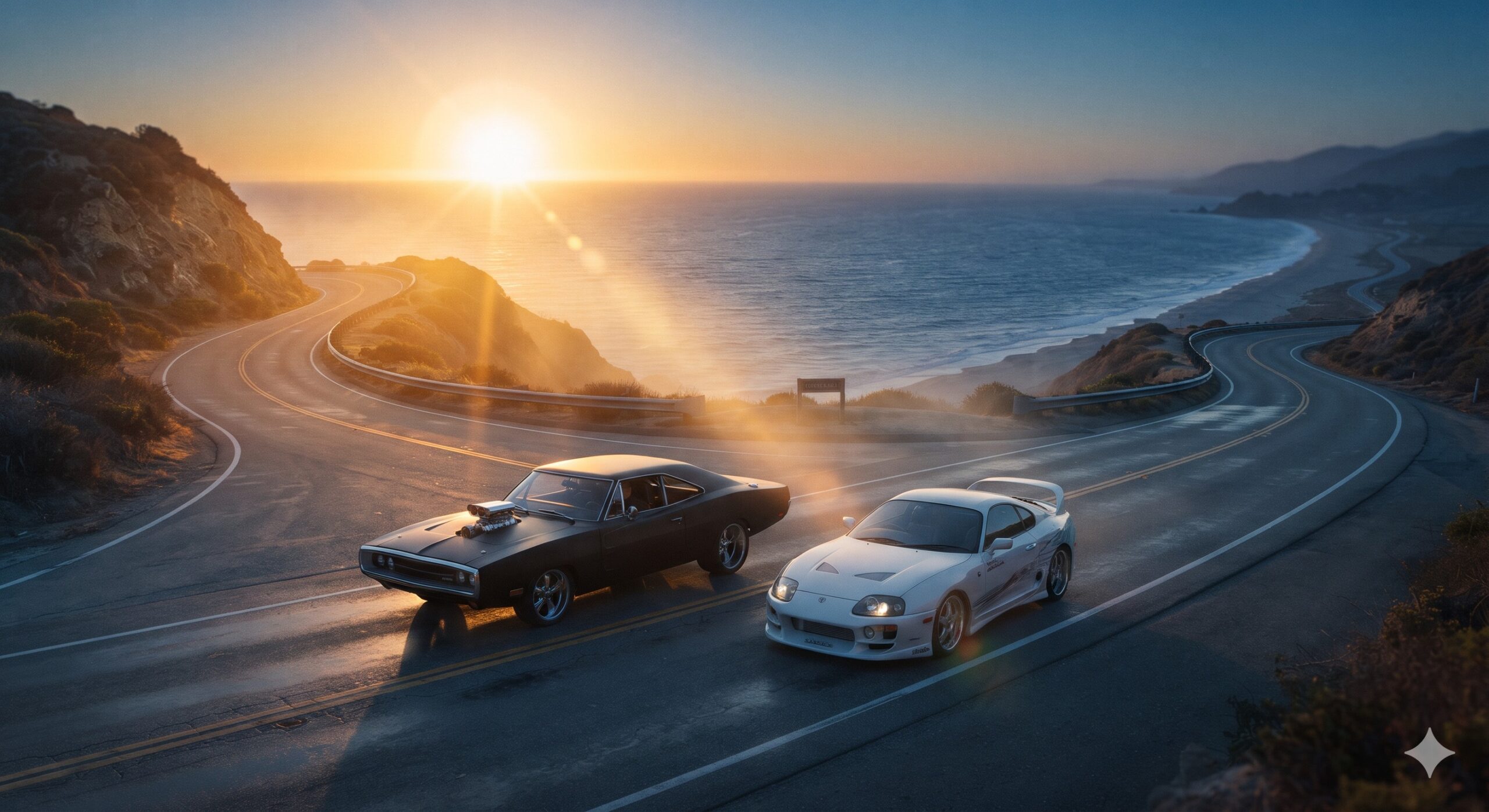
On November 30, 2013, Hollywood’s most unlikely billion-dollar juggernaut collided with a tragedy no screenwriter could have anticipated. Midway through principal photography on Furious 7, 40-year-old star Paul Walker died in a single-vehicle crash in Santa Clarita, California. For Universal Pictures, director James Wan, and co-star Vin Diesel, Walker’s passing was far more than the loss of a beloved friend and co-lead; it removed the structural linchpin that had anchored the Fast & Furious saga since its 2001 debut as a modest street-racing thriller.
What followed was one of the most consequential pivots in modern blockbuster history. Over the ensuing thirteen years—spanning Furious 7 (2015), The Fate of the Furious (2017), the spinoff Hobbs & Shaw (2019), F9 (2021), Fast X (2023), and the long-gestating series finale Fast Forever slated for March 2028—the franchise transformed virtually every dimension of its creative, technical, and commercial DNA.
Paradoxically, Walker’s death propelled the series to its greatest single-film box-office triumph while simultaneously hollowing out its emotional center. Here is an analytical breakdown of everything that changed in the Fast & Furious universe after Paul Walker’s passing—from pioneering digital resurrection technology and narrative recalibrations to escalating tonal absurdity, backstage power struggles, and a steep financial correction.
1. The Technical and Creative Pivot: Reshaping Furious 7
When Walker died, roughly half of his scenes for Furious 7 had been filmed—primarily quieter dramatic beats, leaving several major action sequences in Los Angeles and Abu Dhabi incomplete. Universal immediately halted production, facing three stark options: cancel the film entirely and file an insurance claim, recast Brian O’Conner, or rewrite the third act around existing footage.
Screenwriter Chris Morgan and director James Wan chose a fourth, unprecedented path: retiring Brian O’Conner peacefully rather than killing him on screen. To bridge the missing scenes, the production enlisted Walker’s younger brothers, Caleb and Cody Walker, alongside actor John Brotherton as physical stand-ins. Visual effects powerhouse Weta Digital then executed approximately 350 complex VFX shots, combining facial motion capture, digital lighting integration, and archival voice and facial outtakes from earlier installments in the franchise.
That technological triumph culminated in Furious 7’s iconic final sequence along the Pacific Coast Highway, where Dominic Toretto (Vin Diesel) and a digitally rendered Brian O’Conner share a final nod before their cars diverge onto separate roads—set to Wiz Khalifa and Charlie Puth’s “See You Again”. Released in April 2015, Furious 7 shattered franchise records, earning $1.51 billion worldwide (including $353 million domestically and $391 million in China) on a $190 million budget while securing an 82% Rotten Tomatoes score—the highest critical mark of the entire series.
2. The Loss of the Moral Counterweight and Tonal Escalation
While Furious 7 delivered a cathartic farewell, the films that followed exposed a deep structural problem: Brian O’Conner was never merely Vin Diesel’s sidekick; he was the franchise’s narrative ballast.
In the original 2001 film, Brian was the audience’s entry point—an undercover LAPD officer torn between institutional law and his loyalty to Dom’s outlaw crew. Even after Brian traded his FBI badge for Dom’s criminal family in Fast Five (2011), his grounded, everyman sensibility balanced Dom’s brooding, mythic intensity.
| CREATIVE / BUSINESS AXIS | THE PAUL WALKER ERA (2001–2015) | THE POST-WALKER ERA (2017–2026) |
| Core Emotional Anchor | Dual-lead brotherhood (Dom & Brian as co-equal moral foils) | Patriarchal ensemble led solely by an invincible Dominic Toretto |
| Narrative Tone & Physics | Heightened street crime & tactical automotive heists | Globetrotting superheroics, cyber-weapons & orbital rocket cars |
| Handling of Brian O’Conner | Active field driver, strategist, and emotional bridge to Mia | Off-screen domestic retirement with recurring cameo references |
| Cast & Ego Dynamics | Tightly unified core crew; steady creative continuity | Rotating A-list star influx and public co-star friction |
| Financial Model | Lean-to-mid budgets ($38M–$190M) with surging global ROI | Ballooning budgets ($200M–$340M) amid shrinking China/US returns |
Once Walker was gone, that yin-and-yang equilibrium vanished. Without Brian to question Dom’s decisions or share the burden of leadership, subsequent installments (The Fate of the Furious, F9, and Fast X) leaned progressively into hyper-stylized spectacle to compensate for the missing interpersonal chemistry:
- From Outlaws to Superheroes: Without Brian’s grounded presence, Dom Toretto evolved from a skilled street racer into a near-invulnerable action superhero capable of pulling down concrete structures bare-handed or outrunning submarine torpedoes on Arctic ice.
- Defying Gravity: Seeking ever-larger thrills to hold global audiences, the franchise escalated from bank-vault heists in Rio to swinging cars across ravines by wheel-well cables and launching Tej (Ludacris) and Roman (Tyrese Gibson) into low-Earth orbit inside a rocket-strapped Pontiac Fiero in F9.
3. The Narrative Paradox of Keeping Brian Alive
By choosing not to kill Brian O’Conner in Furious 7, filmmakers created a compassionate tribute—but also saddled every subsequent sequel with an ongoing storytelling dilemma. Because Brian remained alive in-universe as a devoted husband to Mia Toretto (Jordana Brewster) and father to their children, writers had to repeatedly rationalize why one of the crew’s elite drivers stayed home while his wife and closest friends faced existential threats.
In The Fate of the Furious (2017), Dom’s sudden betrayal of the crew required explicit dialogue explaining that Brian and Mia were strictly off-limits for recruitment. By F9 (2021) and Fast X (2023), when Mia returned directly to front-line combat, the scripts relied on awkward exposition stating that Brian was back home watching the children—punctuated by nostalgic nods such as Brian’s signature blue Nissan Skyline GT-R pulling into the Toretto driveway at the close of F9. Those moments satisfied fan sentiment, yet underscored how difficult it was for the saga to move forward while keeping an invisible co-lead parked just off camera.
4. Ensemble Fragmentation and Backstage Power Struggles
Deprived of the central Dom–Brian partnership, Universal and Vin Diesel attempted to sustain box-office scale by expanding the ensemble into a revolving door of major Hollywood stars—bringing in Charlize Theron, Kurt Russell, Helen Mirren, John Cena, Brie Larson, and Jason Momoa alongside Dwayne Johnson and Jason Statham.
However, without Walker serving as a steady diplomatic bridge on set, backstage power dynamics fractured. During production on The Fate of the Furious in 2016, simmering creative tensions between Vin Diesel and Dwayne Johnson erupted into a public feud, leading Johnson to exit the main timeline after F8 and headline the 2019 spinoff Fast & Furious Presents: Hobbs & Shaw ($768.4 million worldwide). Similarly, longtime franchise architect Justin Lin abruptly stepped down as director days into filming Fast X in 2022 over creative disagreements, forcing Louis Leterrier to step in mid-production.
5. Box-Office Gravity vs. Ballooning Production Budgets
The commercial data over the decade following Furious 7 tells a clear story of diminishing marginal returns paired with runaway production costs.
| FILM TITLE (RELEASE YEAR) | BUDGET | DOMESTIC | CHINA | WORLDWIDE |
| Furious 7 (2015) [Final Walker] | $190 Million | $353.0M | $391.0M | $1,510.1M |
| The Fate of the Furious (2017) | $250 Million | $225.8M | $392.0M | $1,197.7M |
| Hobbs & Shaw (2019 Spinoff) | $200 Million | $174.0M | $201.0M | $768.4M |
| F9: The Fast Saga (2021) | $200 Million | $173.0M | $217.0M | $719.4M |
| Fast X (2023) | $340 Million | $146.1M | $145.0M | $727.7M |
While The Fate of the Furious rode residual goodwill from Furious 7 to roughly $1.20 billion worldwide in 2017, domestic ticket sales dropped by more than $127 million in a single cycle. By the time Fast X arrived in May 2023, domestic gross had fallen to $146.1 million and Chinese revenue had contracted by more than 60% from its peak—yet the production budget had swelled to a staggering $340 million before global marketing expenses. That financial squeeze contributed directly to the prolonged development timeline for the eleventh and concluding installment—officially titled Fast Forever and scheduled for release on March 17, 2028—as Universal weighed how to deliver a conclusive send-off without repeating Fast X’s bloated cost structure.
The Enduring Heartbeat of the Saga
More than a decade after his passing, Paul Walker’s absence remains the defining fault line in the Fast & Furious story. His tragic death pushed Hollywood visual effects into new ethical and technical territory, turned Furious 7 into a $1.5 billion cultural event, and forced the franchise to reinvent itself as an ensemble action spectacle. Yet every subsequent chapter has inadvertently proved the same truth: you can upgrade the supercars, multiply the A-list villains, and launch the crew into space, but you can never digitally replicate the genuine friendship that made audiences care about the ride in the first place.
References & Primary Sources
- Britannica & Wikipedia Filmography Archives (Updated 2026): Chronological production history, directorial credits, and cast evolution across The Fast and the Furious (2001) through Fast Forever (slated for 2028).
- The Numbers & Rotten Tomatoes Box Office Data: Verified production budgets, domestic grosses, and worldwide theatrical totals from Furious 7 ($1.51B on $190M budget) through Fast X ($727.7M on $340M budget).
- Weta Digital & Furious 7 Production Breakdowns: Technical documentation detailing the ~350 digital facial-replacement shots and stand-in performances by Caleb and Cody Walker.
- IGN & Industry Retrospective Reports (2026): Critical reception benchmarks (including Furious 7’s 82% Rotten Tomatoes score) and timeline updates on Fast Forever.
* Conceptual illustration generated using AI