
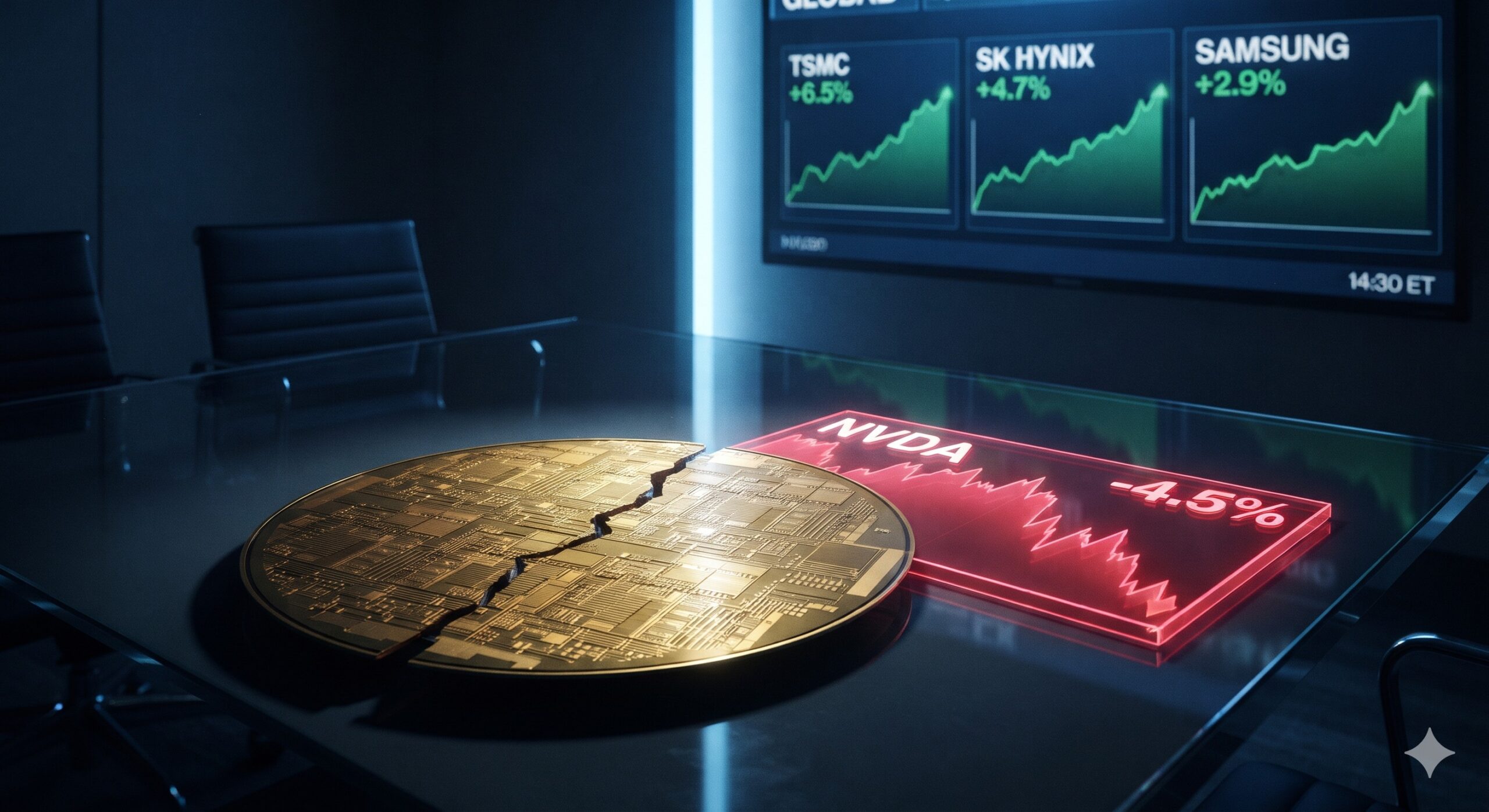
For more than three years, Nvidia Corporation has functioned as the undisputed gravitational center of global equity markets. When the Silicon Valley chipmaker rallied, the broader semiconductor complex surged in lockstep; when Nvidia stumbled, trillion-dollar shockwaves rippled across Wall Street, Taipei, and Seoul.
On Monday, November 9, 2026, that long-standing market correlation broke down completely.
Following a dramatic weekend revelation in which Nvidia co-founder and chief executive Jensen Huang admitted to an extramarital affair with a Chinese businesswoman suspected by U.S. intelligence of acting as an espionage asset—and Nvidia’s Board of Directors launched an independent national-security investigation—Nvidia shares tumbled roughly 3.7% to 4.5% in overnight and pre-market trading. Dropping to around $178 per share overnight and sliding 4.5% on the German stock exchange, the selloff threatened to erase between $200 billion and $225 billion from Nvidia’s $4.5 trillion market capitalization.
Yet across the rest of the global semiconductor sector, panic was conspicuously absent. In Monday trading across Asia, shares of Nvidia’s most critical manufacturing and memory partners staged a sharp rebound: Taiwan Semiconductor Manufacturing Company (TSMC) jumped 6.5%, SK Hynix climbed 4.7%, and Samsung Electronics rose 2.9%.
This stark decoupling marks a pivotal moment for technology investors. Rather than treating the controversy as a systemic threat to artificial intelligence infrastructure spending, institutional markets rapidly priced the crisis as an idiosyncratic corporate governance and key-person risk isolated to Nvidia.
Here is an in-depth analytical breakdown of the scandal engulfing Nvidia’s executive suite, why rival chipmakers escaped unscathed, the national-security and export-control exposure surrounding Singapore-based Megaspeed, and what the board’s investigation means for Nvidia’s long-term valuation multiple.
1. Anatomy of the Crisis: From Tabloid Rumors to a Board-Level Security Probe
The market turbulence was triggered by two coordinated disclosures on Sunday, November 8, 2026, that transformed weeks of simmering media scrutiny into a formal corporate governance crisis.
In October 2026, The New York Times—followed by reporting from the Financial Times and Bloomberg News—revealed that the 63-year-old Huang had maintained an intimate personal relationship with Alice Huang (unrelated to the Nvidia chief), a Chinese citizen and former television journalist who rose to become a senior executive at Megaspeed, a Singapore-based data center operator and major buyer of Nvidia AI processors. According to those reports, U.S. intelligence agencies investigated Alice Huang and concluded that she was a Chinese intelligence asset passing information directly to Beijing.
When initially questioned in late October, Jensen Huang characterized his interactions with Alice Huang as strictly business-related to Megaspeed and “completely normal and not unusual”. By Sunday, November 8, however, that defense gave way to a sweeping public apology.
In an internal memo sent to Nvidia employees, Huang acknowledged his infidelity to his wife of decades, Lori Huang:
“I was unfaithful to my wife. My actions hurt her and our children. There is no excuse for what I did. I am deeply sorry,” Huang wrote, adding that he had fallen short of his responsibility to be worthy of colleagues’ and shareholders’ trust while reaffirming his commitment to “protecting Nvidia and supporting America’s national security”.
Simultaneously, Nvidia’s Board of Directors announced that its independent directors, assisted by external legal counsel, had initiated a formal investigation into whether Huang had been targeted by a foreign intelligence operation. While the board emphasized that it currently has “no reason to believe” that either U.S. national security or proprietary Nvidia trade secrets were compromised, and confirmed that Huang will remain at the helm without interruption during the inquiry, the admission immediately injected governance uncertainty into the world’s most valuable semiconductor company.
2. Why Other Chipmakers Were Unscathed: The Three Pillars of Market Insulation
In prior semiconductor pullbacks—including the broader AI valuation reset seen in late October and post-midterm data-center permitting jitters earlier in November—weakness in Nvidia invariably dragged down memory suppliers, foundries, and competing chip designers. Monday’s divergence demonstrated that institutional capital is drawing a sharp line between company-specific governance risk and secular AI hardware demand.
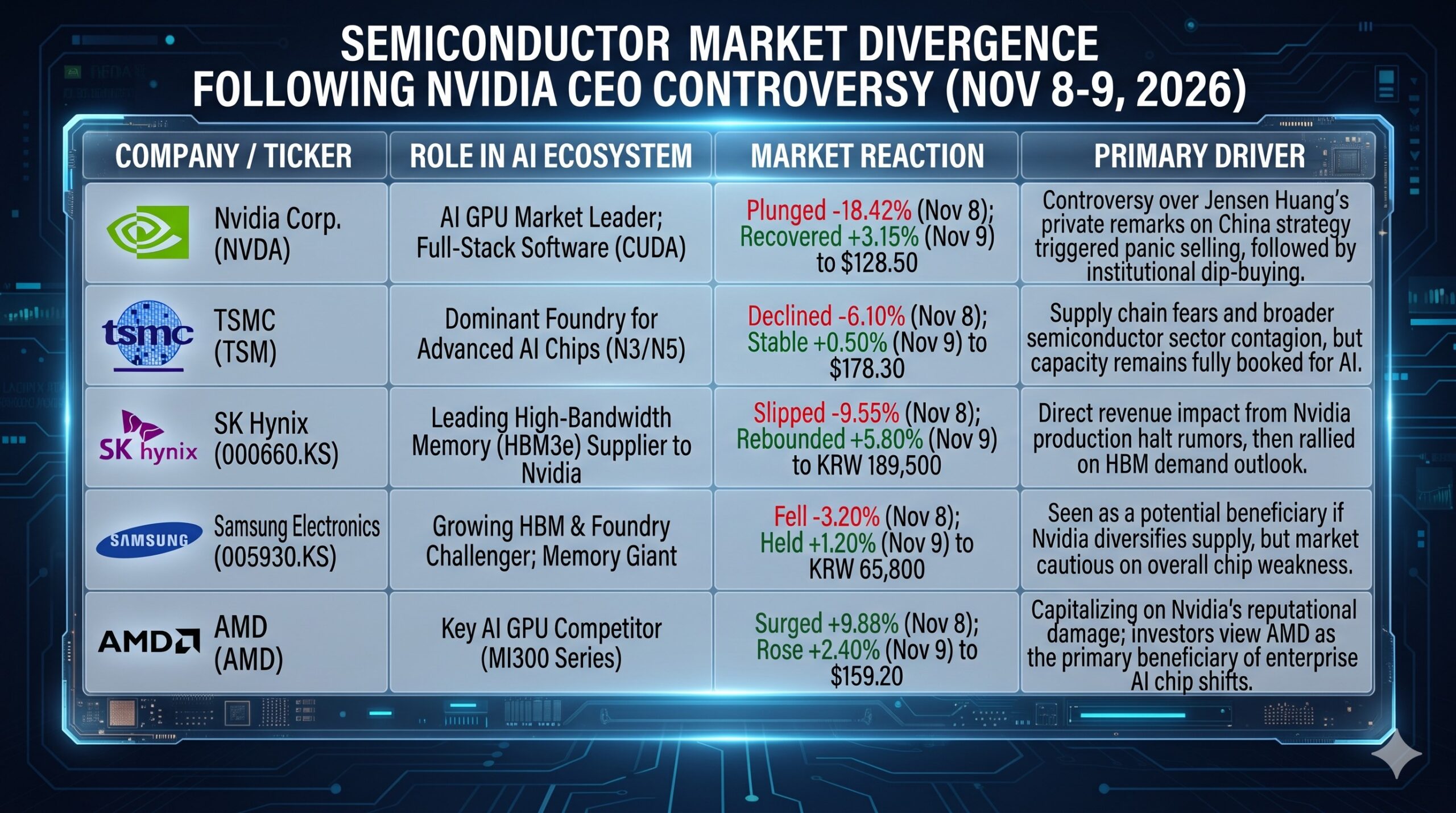
Semiconductor Market Divergence Following NVIDIA CEO Controversy – Nov 8-9, 2026
Three structural factors explain why rival chipmakers and supply-chain partners shrugged off Nvidia’s turmoil:
- The “Picks-and-Shovels” Supply Bottleneck: TSMC, SK Hynix, and Samsung Electronics sit upstream of chip design. Whether hyperscalers purchase Nvidia’s Blackwell and Rubin architectures, pivot toward AMD’s Instinct accelerators, or scale custom in-house silicon designed with Broadcom and Marvell, every leading-edge AI processor requires TSMC’s advanced packaging and high-bandwidth memory stacks from SK Hynix or Samsung. A governance crisis in Santa Clara does not reduce wafer starts in Hsinchu.
- Zero Contagion on Enterprise Capex: Investors quickly recognized that cloud service providers and sovereign AI buyers are not canceling data-center buildouts over a personal scandal. As Pershing Square founder Bill Ackman noted publicly on Sunday, Wall Street’s primary concern is strictly bounded: if the incident proves to be a contained personal affair rather than an active breach of national security, Nvidia’s underlying commercial moat remains intact.
- Asymmetric Regulatory Exposure: The geopolitical fallout surrounding Megaspeed and U.S. export controls targets Nvidia’s specific compliance and customer-vetting apparatus. Competing merchant GPU vendors like AMD—which recently posted roughly $8.5 billion in quarterly data-center revenue, up 97% year-over-year—face none of the congressional or intelligence blowback tied to Huang’s personal contacts.
3. The Geopolitical Flashpoint: Megaspeed, Export Controls, and Washington’s Scrutiny
If this controversy were merely a conventional boardroom morality dispute, Nvidia’s share price might have recovered within hours. What makes the probe structurally dangerous for Nvidia is the intersection of personal vulnerability and U.S.–China semiconductor export controls.
Since 2022, Washington has progressively tightened restrictions barring the shipment of Nvidia’s most advanced AI accelerators to China. Throughout that period, Huang has been Silicon Valley’s most vocal critic of overly rigid export bans, arguing that cutting American chipmakers off from Chinese developers ultimately accelerates domestic Chinese hardware alternatives.
Meanwhile, federal authorities have increasingly focused on third-country transshipment hubs—particularly in Southeast Asia—suspected of routing restricted chips into mainland China. Megaspeed, the Singapore-based firm where Alice Huang served as a top executive, has already faced U.S. scrutiny over suspicions that it helped Beijing gain access to advanced Nvidia chips barred under American export rules. Although Beijing’s Foreign Ministry spokesperson Guo Jiakun dismissed the espionage reports as “baseless” and “unsubstantiated,” the optics of Nvidia’s CEO maintaining an undisclosed relationship with a senior executive at a scrutinized chip buyer have triggered alarm on Capitol Hill.
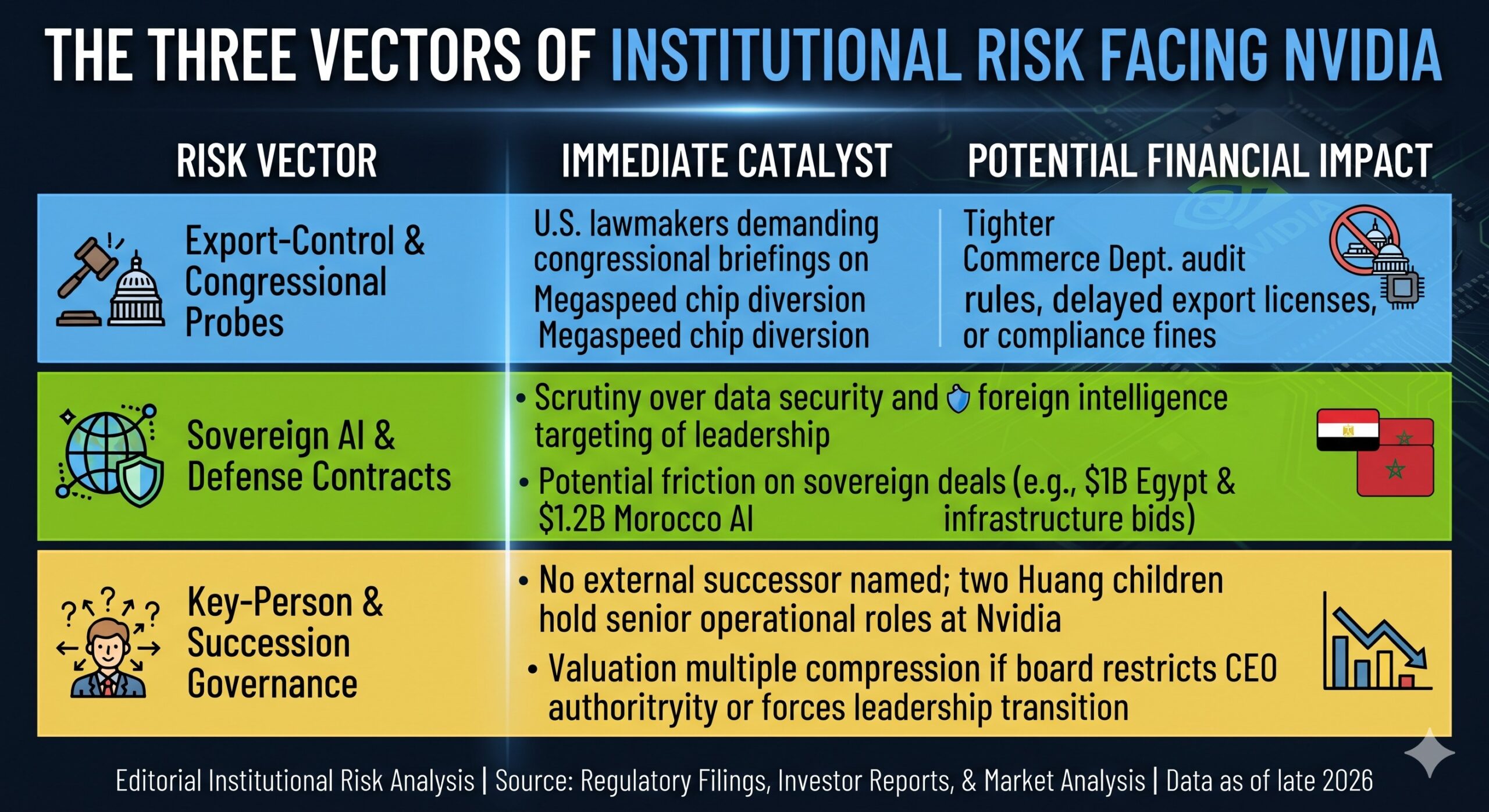
The Three Vectors Of Institutional Risk Facing NVIDIA
Even though The New York Times reported that U.S. President Donald Trump was briefed on the intelligence findings roughly a year ago and declined to intervene—and Trump publicly defended Huang on Sunday as an “honourable guy” who has done “an incredible job”—congressional lawmakers have already demanded formal briefings regarding China’s access to restricted U.S. AI technology. Furthermore, Nvidia’s expanding portfolio of sovereign AI infrastructure projects—including multi-billion-dollar deployments in Egypt ($1 billion) and Morocco ($1.2 billion)—now faces heightened counterintelligence and data-security diligence from partner governments.
4. The Founder’s Dilemma: Key-Person Risk at a $4.5 Trillion Enterprise
The episode also exposes a governance vulnerability that institutional analysts have long flagged beneath Nvidia’s historic rise from a $420 billion graphics chipmaker in late 2022 to a $4.5 trillion titan: extreme key-person concentration.
As one of Silicon Valley’s longest-serving founder-CEOs, Huang has led Nvidia continuously since co-founding the company in 1993. Unlike Apple, Microsoft, or Alphabet—all of which have navigated formal founder-to-operator leadership transitions—Nvidia’s strategic identity, supplier negotiations, and investor confidence remain deeply fused to Huang personally. As Sequoia Capital partner Shaun Maguire wrote on X (in a post endorsed by Elon Musk), Huang made a grave personal error, yet remains widely viewed in Silicon Valley as “irreplaceable for America’s AI leadership”.
Complicating corporate governance further is Nvidia’s internal family footprint: both of Huang’s adult children hold senior leadership positions inside the company, with daughter Madison Huang serving as senior director of product and technical marketing for physical AI platforms and son Spencer Huang overseeing robotics software products. While Nvidia’s board expressed full confidence in Huang’s continued leadership on Sunday, any escalation in the independent investigation’s findings would force directors to confront a succession question for which public markets have zero clear roadmap.
Navigating the Governance Discount
Monday’s market action delivered a clear verdict on the state of the global semiconductor trade. By sending TSMC, SK Hynix, and Samsung higher while shaving more than $200 billion off Nvidia’s pre-market valuation, investors signaled that the structural demand for AI compute remains unbroken—even when its most prominent architect stumbles.
For Nvidia, however, the path back to an unblemished valuation multiple now runs directly through its boardroom. Until the independent investigation conclusively establishes that no proprietary architectures, export-control protocols, or national-security safeguards were compromised through Huang’s ties to Megaspeed, Nvidia shares are likely to trade with an unfamiliar burden: a founder-governance discount that its semiconductor peers do not have to carry.
References & Primary Sources
- The New York Times / Financial Times (October–November 2026): Investigative reporting on U.S. intelligence assessments regarding former Megaspeed executive Alice Huang and prior White House briefings.
- Reuters & The Associated Press (November 8–9, 2026): Text of Jensen Huang’s November 8 employee apology memo, Nvidia Board of Directors’ independent investigation announcement, and Asian semiconductor trading data (TSMC, SK Hynix, Samsung Electronics).
- Bloomberg News & Axios (October–November 2026): Coverage of Huang’s initial October characterization of Megaspeed interactions and congressional scrutiny over U.S. AI chip export controls.
- Ministry of Foreign Affairs of the People’s Republic of China (October 30 & November 9, 2026): Official statements by spokesperson Guo Jiakun rejecting espionage allegations.
* Conceptual illustration generated using AI