
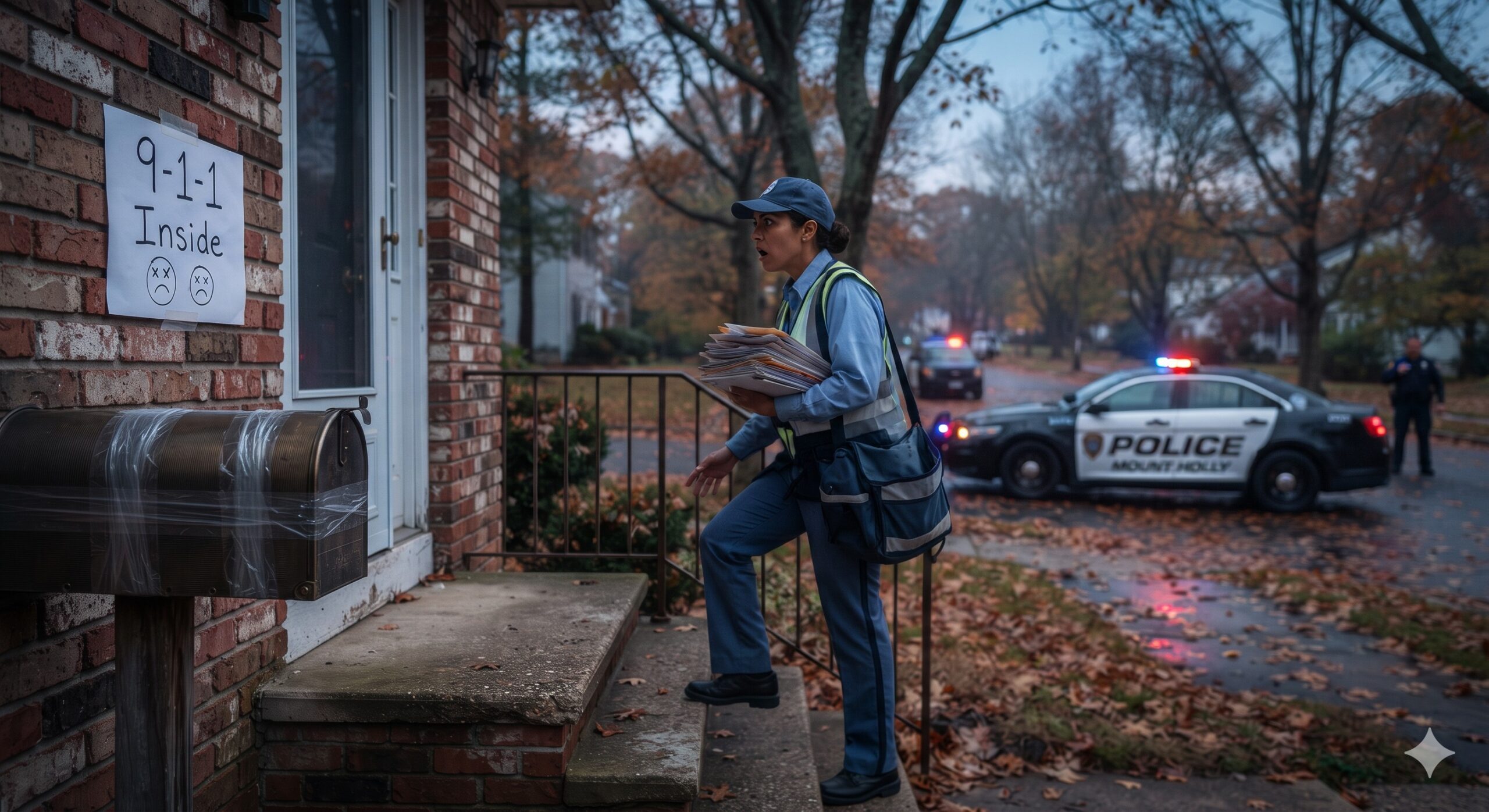
On a quiet, tree-lined cul-de-sac in Mount Holly, New Jersey, routine afternoon mail delivery rarely generates headlines. Yet on Friday, November 6, 2026, a veteran United States Postal Service (USPS) letter carrier walking his familiar suburban route encountered a scene so meticulously staged and unsettling that it has baffled neighbors and drawn national scrutiny.
Approaching a weathered single-family residence on the unit block of Winding Way, mail carrier Dom Clements noticed two immediate anomalies: the home’s mailbox had been completely sealed shut with clear packing tape, and a handwritten sign affixed to the wall beside the front entrance bore the stark warning “9-1-1 Inside” alongside two crude drawings of unhappy faces with “X”s for eyes. Within minutes of Clements dialing emergency services, Mount Holly Township police officers forced entry into the home and discovered the bodies of three elderly residents—two men and one woman—inside.
In candid interviews following the discovery, Clements recounted the eerie realization that the warning message was invisible from the street and appeared deliberately positioned so that he—and only he—would find it. Combined with fresh neighbor accounts describing a deeply reclusive trio of siblings and a blood-stained interior, the Mount Holly tragedy offers a haunting case study in domestic isolation, forensic staging, and the unexpected role postal workers play as the final civic lifeline for disconnected households.
Here is an in-depth journalistic and forensic breakdown of Clements’ first-hand account, the sequence of events on Winding Way, the unanswered questions surrounding the note’s creator, and what the case reveals about aging, isolated households in suburban America.
1. Anatomy of a “Bizarre” Delivery: Dom Clements’ First-Hand Account
For Dom Clements, Friday afternoon began identically to hundreds of prior shifts along the border of Mount Holly Township and Eastampton in Burlington County, roughly 25 miles east of Philadelphia. Walking up the front steps of the Winding Way property to deposit the day’s letters, Clements immediately sensed that the normal rhythm of the doorstep had been disrupted.
First, the residential mailbox had been wrapped tightly in ordinary clear packing tape, preventing any mail from being inserted. Seconds later, Clements’ eyes shifted to the wall directly adjacent to the front door, where a piece of poster board or standard paper was fastened with the exact same clear wrapping tape.
“I walked up to the house, as usual, to deliver the mail. The mailbox was all taped up with just regular wrapping tape, clear wrapping tape,” Clements told the New York Post. “And I was like, ‘Oh, that’s weird,’ and right next to the door, with the same tape holding it up on the wall. And it said, 911 inside, with two rudimentary drawings of faces.”
Clements knocked on the front door and waited, receiving no reply from inside the quiet house. Before placing the emergency call, he briefly conferred with a nearby resident walking along the street to verify whether anything unusual had been observed at the property, then promptly contacted 911 dispatchers.
What unsettled Clements most in the aftermath was not merely the grim nature of the message, but its physical placement. Unlike a sign hung in a front window or posted on a street-facing lawn, the note beside the doorway was completely hidden from passing cars and pedestrians.
“I thought it was weird, because the only person that would have been able to see that sign would have been me, ’cause I’m the only one that goes to that house every day,” Clements explained. “The only person who goes up to the door is the mail carrier. It’s weird. The whole situation was weird. Definitely don’t want it to happen again.”
2. Timeline and Forensic Picture: Inside the Winding Way Investigation
Following Clements’ 911 call, Mount Holly Township Police officers arrived at the unit block of Winding Way shortly before 1:00 p.m. Eastern (around 12:50 p.m.) to execute an emergency welfare check. Entering the dwelling, officers located three deceased individuals inside.
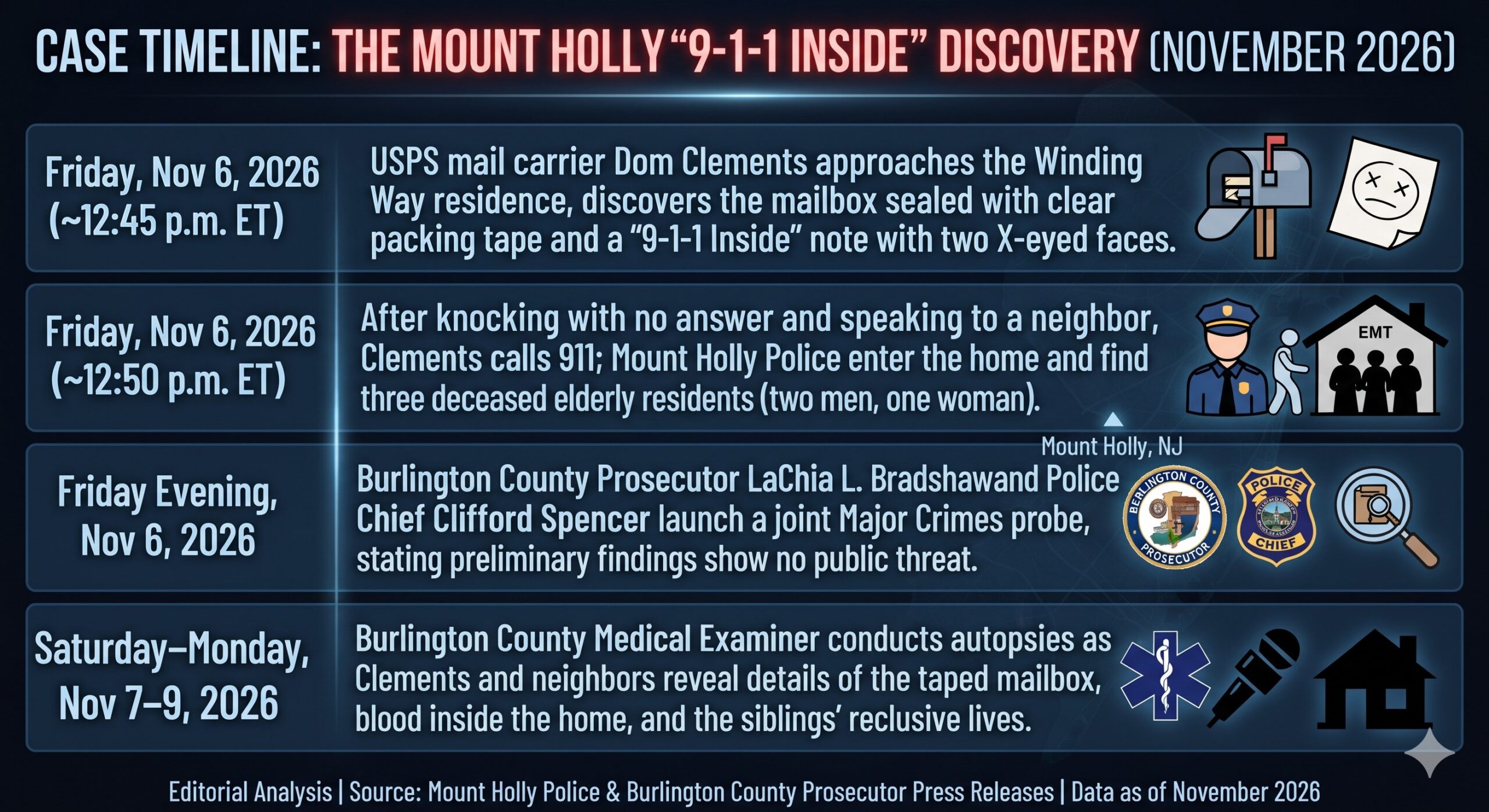
Case Timeline: The Mount Holly “9-1-1 Inside” Discovery – November 2026
By Friday evening, Burlington County Prosecutor LaChia L. Bradshaw and Mount Holly Township Police Chief Clifford Spencer issued a joint statement confirming that detectives from the Prosecutor’s Office Major Crimes Unit and the Mount Holly Criminal Investigation Bureau were leading an active investigation. Seeking to calm anxiety across the tight-knit South Jersey suburb, officials emphasized that “based on preliminary findings at the scene, investigators do not believe there is any threat or ongoing risk to the general public”.
While authorities have withheld the formal identities and exact ages of the decedents pending positive identification and notification of next of kin—and await official cause-and-manner-of-death determinations from the Burlington County Medical Examiner’s Office—accounts from neighbors and Clements have begun to illuminate the lives behind the closed door:
- A Reclusive Sibling Household: Neighbor David Babcock told NBC10 Philadelphia that the home was occupied by three siblings in their 60s—two brothers and a sister—who kept almost entirely to themselves. Another neighbor informed Clements that four siblings had historically been associated with the residence, rarely leaving the premises or operating a vehicle.
- Signs of Physical Deterioration: Both Clements and Babcock noted that the exterior of the home had fallen into visible disrepair, standing out sharply against the well-kept single-family homes lining Winding Way. Babcock remarked that the property had deteriorated to such a degree that prior to Friday’s tragedy, he had anticipated local authorities might eventually condemn the structure and force the residents to relocate.
- A Violent Interior Scene: According to Babcock, police officers on scene indicated to him that investigators encountered a significant amount of blood inside the residence. Despite the troubling condition of the property, both Clements and neighbors described the occupants as quiet, polite individuals who never caused disturbances in the neighborhood.
3. Forensic and Behavioral Analysis: Decoding the Staged Clues
From an investigative standpoint, the physical evidence described at the Winding Way threshold presents three distinct behavioral clues that homicide and Major Crimes detectives routinely analyze when distinguishing between an external intrusion, a sudden medical emergency, and a planned fatal event inside a home.
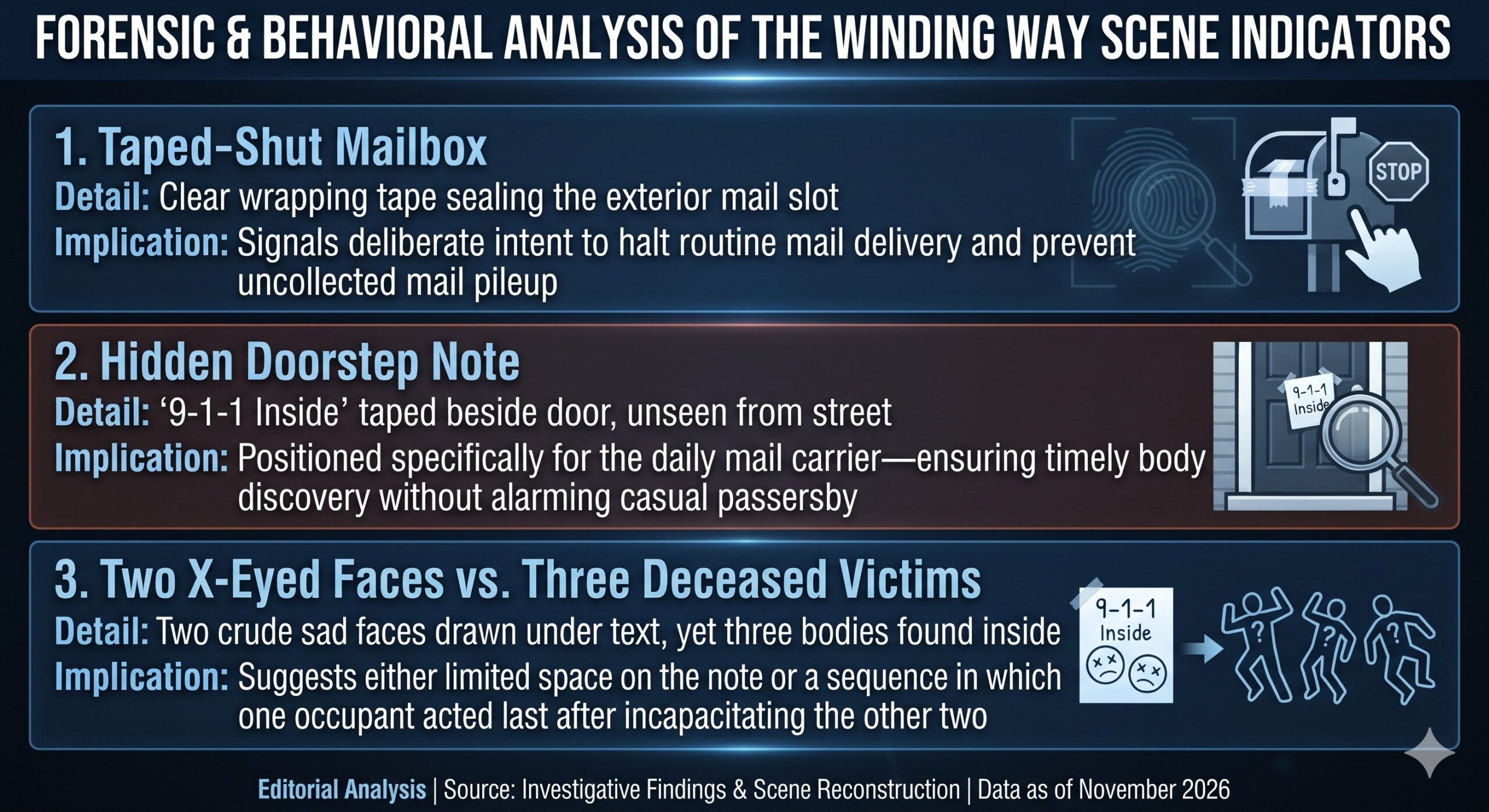
Forensic and Behavioral Analysis of the Winding Way Scene Indicators
- The “Targeted Messenger” Design: In cases where an occupant inside a residence anticipates a fatal outcome—whether a pact or a murder-suicide—perpetrators frequently leave external cues to ensure authorities enter the home before decomposition sets in, while simultaneously avoiding premature interruption. Taping the mailbox shut guaranteed that Clements would pause at the threshold rather than mechanically dropping envelopes through a slot and walking away. Placing the note flush against the recessed entry wall ensured that neighborhood children or dog walkers would not trigger chaos before the mail carrier arrived on his scheduled round.
- The Discrepancy of the Two Faces: One of the most haunting details Clements highlighted is the numerical mismatch on the sign: two rudimentary unhappy faces with “X”s for eyes, despite three individuals perishing inside. While Clements noted that simple spatial constraints on the sign may have limited the drawing, forensic psychologists also examine whether such symbols reflect an author who incapacitated two other occupants before turning on themselves—an interpretation consistent with prosecutors’ immediate assurance that no suspect remains at large threatening the community.
- Absence of Public Threat: In law enforcement communications, an immediate declaration of “no ongoing threat to the general public” issued within hours of discovering three bloody fatalities typically indicates that physical evidence inside the dwelling—such as locked interior doors, recovered implements, or the positioning of the decedents—points toward an internal domestic event rather than a random home invasion.
4. The Postal Lifeline: How Letter Carriers Spot Hidden Domestic Crises
Beyond the immediate mystery in Burlington County, Dom Clements’ actions highlight an underappreciated reality of modern civic infrastructure: the daily mail carrier is often the sole external observer monitoring America’s most isolated households.
Across the United States, millions of older adults and sibling households live in quiet self-isolation—detached from workplace routines, active social circles, or regular medical check-ins. When family members rarely visit and neighbors respect suburban privacy, structural decline inside a home—whether worsening physical health, financial distress, severe hoarding, or caregiver burnout—can escalate unnoticed behind drawn curtains.
Because USPS letter carriers visit virtually every residential address six days a week, they develop an acute, intuitive baseline for normal household patterns. Through national initiatives like the Carrier Alert Program—a joint effort between the USPS and the National Association of Letter Carriers—postal workers regularly trigger life-saving welfare checks when mail accumulates, newspapers sit untouched, or subtle physical anomalies appear on a porch. In Mount Holly, Clements’ vigilance ensured that a silent crisis behind a taped mailbox did not remain hidden for weeks or months.
Awaiting the Medical Examiner’s Verdict
As detectives in Burlington County await final toxicology and autopsy findings from the Medical Examiner’s Office, the tragedy on Winding Way remains suspended between clinical police procedure and profound human sorrow. For Dom Clements, a routine Friday walk up a familiar set of front steps uncovered a chilling tableau he says he hopes never to witness again—a stark reminder that even on the quietest suburban streets, profound despair can unfold unseen until a simple piece of taped paper forces the door open.
References & Primary Sources
- New York Post (November 7–8, 2026): Exclusive interview with USPS letter carrier Dom Clements detailing the clear wrapping tape on the mailbox, the “9-1-1 Inside” doorstep note, and the two rudimentary drawings.
- Burlington County Prosecutor’s Office & Mount Holly Township Police Department (November 6–7, 2026): Joint official statements by Prosecutor LaChia L. Bradshaw and Police Chief Clifford Spencer regarding the unit block of Winding Way investigation and public safety assessment.
- NBC10 Philadelphia & People Magazine (November 7–8, 2026): Neighbor interviews with David Babcock describing the three reclusive siblings in their 60s, property conditions, and police descriptions of the interior scene.
- The Philadelphia Inquirer & FOX 29 Philadelphia (November 7–8, 2026): Local reporting on the Winding Way neighborhood context and Burlington County Medical Examiner post-mortem timeline.
* Conceptual illustration generated using AI