
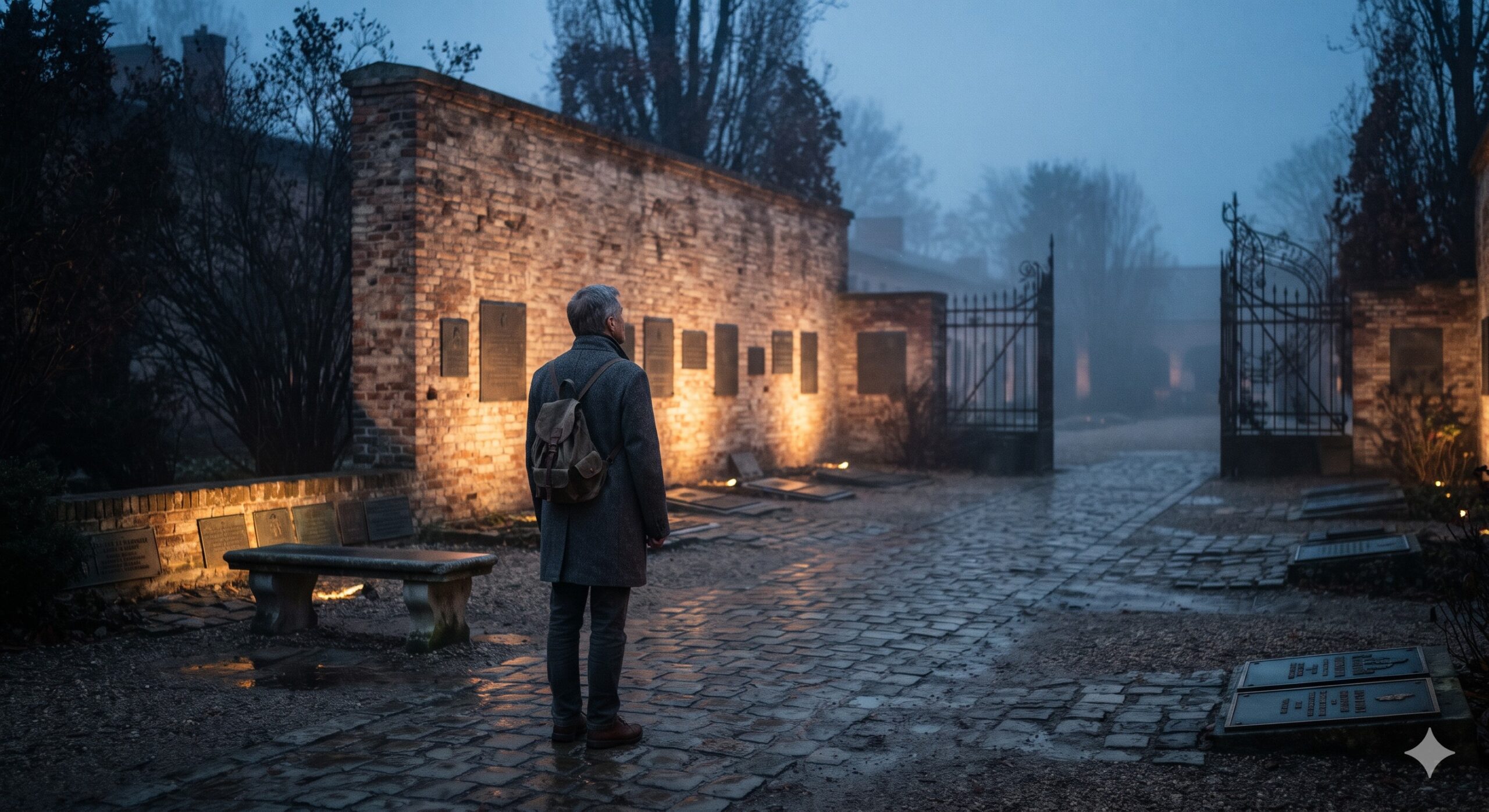
For decades, the global travel industry sold a singular, sun-drenched fantasy: white-sand beaches, infinity pools, and effortless escapism. Today, a rapidly expanding cohort of modern travelers is intentionally moving in the opposite direction—trading leisure resorts for nuclear exclusion zones, genocide memorials, colonial prisons, and the sites of catastrophic industrial disasters.
Known academically as thanatourismand popularly as dark tourism, the practice of visiting locations associated with death, tragedy, war, and historical trauma has transitioned from a niche curiosity into a mainstream pillar of the global travel economy. According to market intelligence released in October 2026, the global dark tourism sector reached an estimated valuation of $35.29 billion in 2026—up from $34.28 billion in 2025—and is projected to climb to $44.51 billion by 2034. Alternative industry forecasts place total experiential demand even higher, estimating the sector at $37.7 billion in 2026.
Driven by post-pandemic shifts toward meaningful, experiential travel, rising historical consciousness, and the viral amplification of social media algorithms, millions of tourists are seeking visceral encounters with humanity’s darkest chapters. Yet as visitor numbers swell across sensitive heritage sites from Poland and Ukraine to India and Cambodia, the industry faces an acute moral dilemma: where does respectful historical remembrance end, and the commercial exploitation of human suffering begin?
Here is an in-depth analysis of the economic forces fueling the dark tourism boom in 2026, the landmarks anchoring the trend globally and across India, how immersive technology is reshaping memorial museums, and the growing backlash against “selfie tourism.”
1. The Economics of Remembrance: Breaking Down the 2026 Market
The surge in dark tourism reflects a structural transformation in how travelers define value. Rather than passive sightseeing, modern travelers—particularly solo travelers, who represent the single largest demographic segment in the sector—are prioritizing destinations that offer emotional depth, historical context, and real-world storytelling.
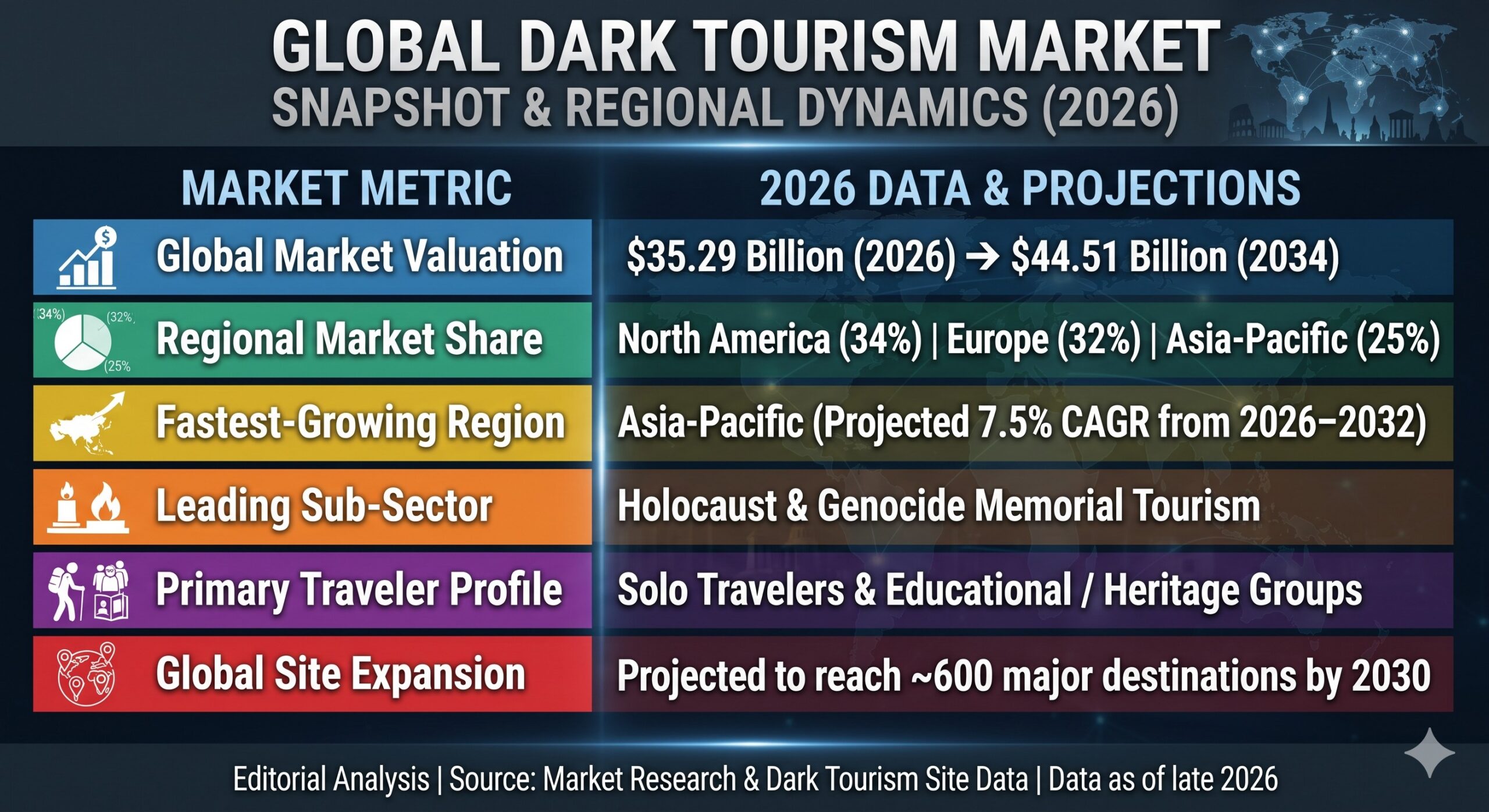
Global Dark Tourism Market – Snapshot & Regional Dynamics 2026
While North America (34%) and Europe (32%) currently account for the largest shares of global revenue—anchored by battlefields, Holocaust memorials, and Cold War landmarks—Asia-Pacific (25%) has emerged as the fastest-growing region, expanding at a projected compound annual growth rate of 7.5% through 2032. Expanding middle-class disposable income, improved regional flight connectivity, and concerted government investments in heritage preservation are driving domestic and international travelers across Asia to confront complex regional histories.
Industry analysts estimate that the number of formally recognized dark tourism destinations worldwide will reach 600 by 2030, spanning four distinct experiential categories:
- Genocide and Conflict Memorials: The largest revenue-generating segment globally, led by Holocaust tourism in Europe alongside war memorials and civil-conflict museums.
- Nuclear and Industrial Disaster Zones: Sites where technological or corporate failure permanently altered the landscape, such as the Chernobyl Exclusion Zone in Ukraine, Fukushima in Japan, and Bhopal in India.
- Carceral and Colonial Oppression Sites: Decommissioned prisons and internment camps—such as Alcatraz in the United States, Robben Island in South Africa, and the Cellular Jail in the Andaman Islands—that chronicle state power and political resistance.
- Abandoned Ruins and Dark Folklore: Ghost towns, volcanic ruins like Pompeii, and sites steeped in historical mystery or supernatural legend.
2. From Auschwitz to Amritsar: Global Landmarks and India’s Dark Heritage
Across the globe, major museums and heritage authorities have spent 2026 upgrading their interpretive infrastructure to meet rising visitor demand without trivializing human tragedy.
In Europe, the Auschwitz-Birkenau State Museum in Poland expanded its educational footprint by opening new permanent exhibitions detailing prisoner experiences and the history of occupied Oświęcim. In the United States, the National Park Service inaugurated the Lincoln Memorial Undercroft Museum in Washington, D.C., in June 2026, utilizing multimedia displays to contextualize civil rights struggles and national division. Meanwhile, in China, operators such as Lvxing Base launched immersive typhoon and flood simulation facilities in October 2026, blending disaster tourism with practical emergency-preparedness training.
In India, dark tourism has quietly become one of the fastest-evolving niches within domestic heritage travel, anchored by sites that document colonial brutality, the trauma of Partition, and industrial catastrophe:
- Amritsar’s Twin Memorials (Punjab): Jallianwala Bagh, where British troops opened fire on unarmed civilians in April 1919, continues to draw millions of visitors who walk past preserved bullet-scarred walls and the Martyrs’ Well. Just minutes away, the Partition Museum preserves over 100 oral survivor interviews and personal artifacts chronicling the displacement of millions in 1947.
- Cellular Jail / Kala Pani (Andaman & Nicobar Islands): Built by British colonial authorities to isolate Indian independence activists across the sea, the radial prison wings, solitary cells, and evening sound-and-light narratives transform a tropical island destination into a solemn reckoning with colonial imprisonment.
- Bhopal Gas Tragedy Sites (Madhya Pradesh): The abandoned Union Carbide pesticide plant and the community-curated Remember Bhopal Museum educate visitors on the December 1984 methyl isocyanate gas leak, foregrounding corporate accountability and environmental justice.
- Mystery and Natural Catastrophe Sites: Beyond political history, Indian travelers increasingly flock to abandoned settlements like Kuldhara and Bhangarh Fort in Rajasthan, as well as high-altitude glacial sites like Roopkund Lake in Uttarakhand, where centuries-old human skeletal remains lie visible beneath clear mountain waters.
3. The Digital Shift: How AR and VR Are Transforming Sites of Trauma
A defining trend of dark tourism in 2026 is the integration of augmented reality (AR), virtual reality (VR), and spatial audio. Historic sites of tragedy face an inherent physical paradox: high foot traffic erodes fragile architecture, yet stripping away context leaves visitors staring at empty fields or crumbling concrete.
Digital storytelling tools are bridging that gap. At battlefields, ruined concentration camps, and disaster zones, tablet-based AR overlays allow visitors to hold a screen up to an empty courtyard and view archival photographs aligned precisely with the modern landscape. Binaural audio tours place survivor testimonies directly in a visitor’s ears, eliminating the need for loud tour-guide megaphones that disrupt the solemnity of memorial spaces. Simultaneously, high-resolution VR reconstructions allow students and global audiences who cannot afford international flights—or who wish to inspect restricted radioactive zones like Pripyat’s abandoned amusement park—to engage with historical environments remotely.
4. The Ethics Trap: Social Media, “Selfie Tourism,” and Moral Disengagement
Despite its educational promise, the rapid commercialization of dark tourism has triggered sharp ethical pushback from historians, survivors’ families, and local communities.
The primary flashpoint is social media performance. Visual platforms like Instagram and TikTok reward dramatic, moody backdrops—leading a subset of visitors to treat sites of mass death as aesthetic props. Over the past two years, viral controversies have repeatedly erupted over tourists posing for smiling selfies on railway tracks at Auschwitz-Birkenau, filming choreographed lifestyle reels inside Berlin’s Memorial to the Murdered Jews of Europe, or scratching graffiti into ancient ruins—behavior that prompted UNESCO to issue stark warnings against destructive “selfie tourism”.
Behavioral researchers studying dark tourism attribute this behavior to moral disengagement—a psychological mechanism where physical and temporal distance from a tragedy lulls tourists into treating a sacred site like a theme park. When tours are marketed as thrilling, adrenaline-fueled adventures rather than solemn educational journeys, visitors easily lose sight of the real human suffering embedded in the ground beneath them.
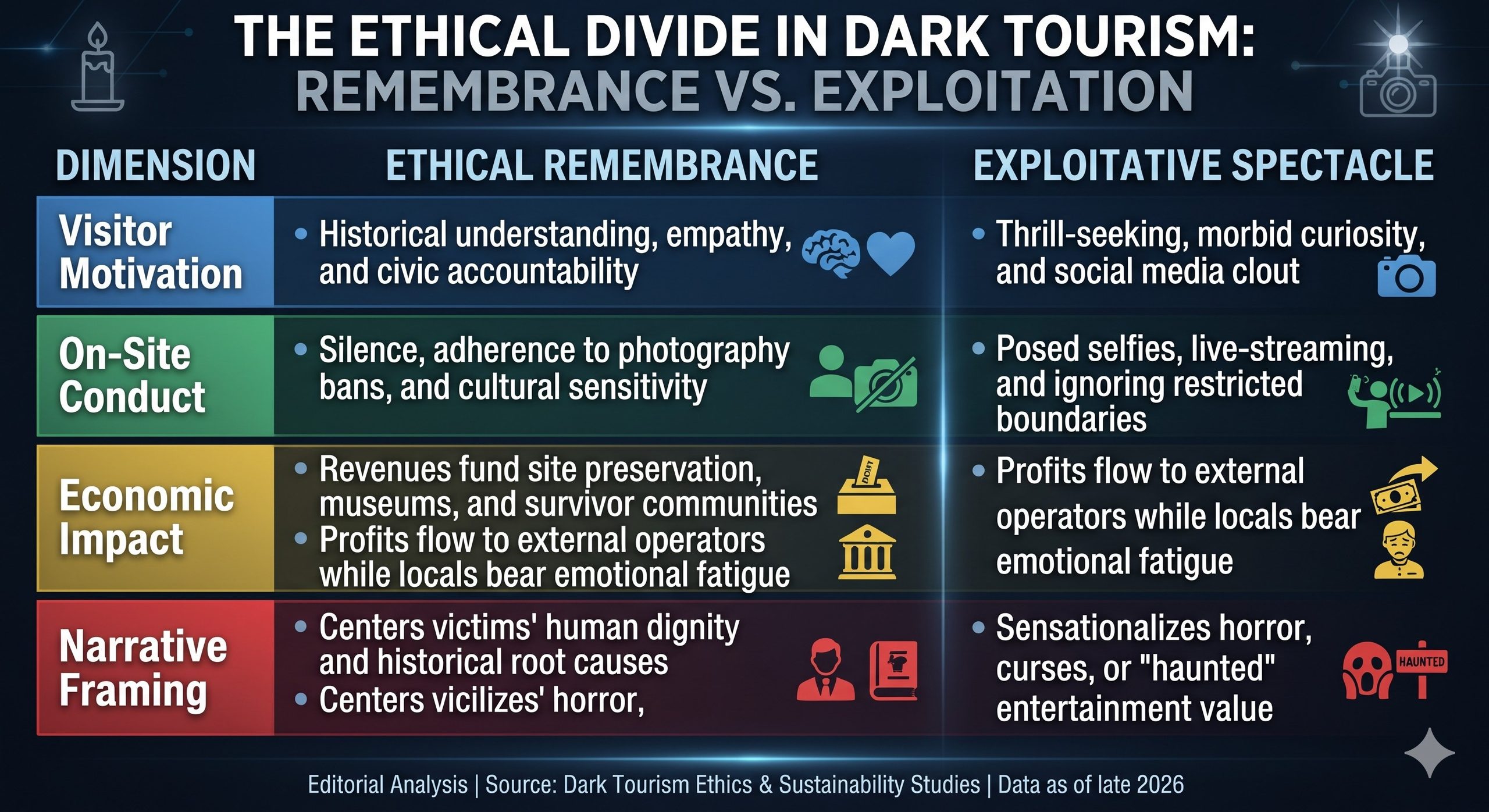
The Ethical Divide in Dark Tourism – Remembrance Vs. Exploitation
Equally overlooked is the emotional labor borne by local guides and host communities. In places like Cambodia’s Tuol Sleng Genocide Museum or Bhopal, local guides who survived atrocities—or whose parents perished in them—must recount traumatizing memories day after day for foreign visitors. Without strict ethical guardrails, dark tourism risks forcing vulnerable communities to repeatedly perform their grief for outside consumption.
Conclusion: Traveling With Historical Humility
The rise of dark tourism in 2026 reflects a deep, unmistakable hunger for truth in an increasingly curated digital world. At its best, standing inside a solitary cell at Port Blair, walking the silent grounds of Jallianwala Bagh, or viewing preserved artifacts at Auschwitz performs an irreplaceable civic function: it turns abstract textbook statistics into undeniable human reality. As one Cambodian tour guide famously remarked to visiting travelers, societies confront painful history today so they do not repeat it tomorrow.
However, whether dark tourism matures into a force for global empathy or degenerates into voyeuristic consumption depends entirely on how travelers and operators behave. Visiting places of tragedy is not a right—it is a responsibility. In an era when $35 billion flows annually toward sites of human sorrow, the most important thing a traveler can pack is not a camera lens, but humility.
* Conceptual illustration generated using AI