
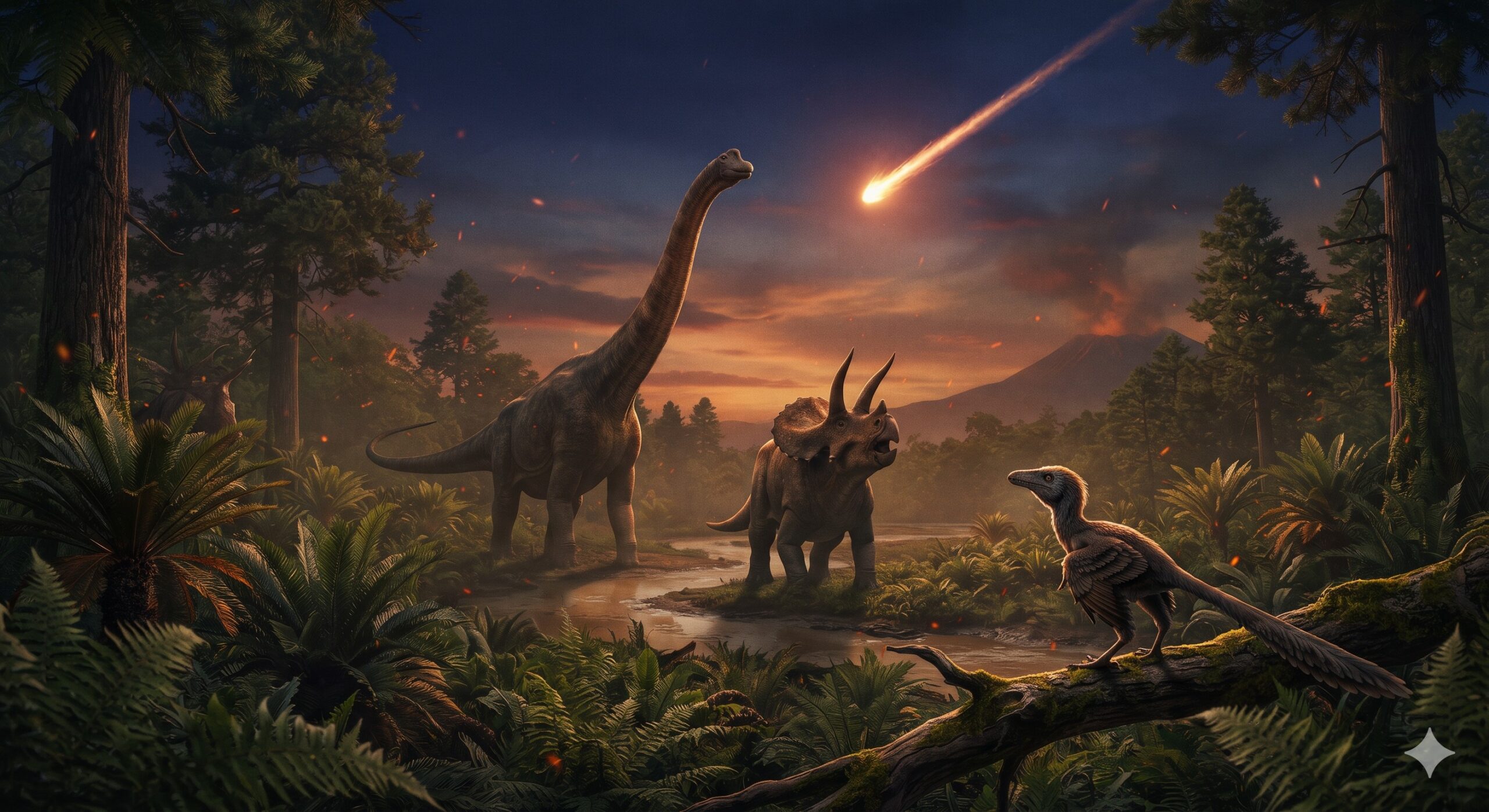
For decades, popular culture framed the end of the dinosaurs as a slow, inevitable twilight—an evolutionary empire already crumbling under volcanic smog, cooling climates, and dwindling biological diversity before a six-mile-wide space rock delivered a mercy killing 66 million years ago. In that traditional telling, the dinosaurs were ecological relics living on borrowed time.
Cutting-edge paleontology, high-precision radiometric dating, and landmark fossil discoveries across North America have systematically overturned that narrative. Rather than limping toward extinction, non-avian dinosaurs were thriving in vibrant, regionally distinct ecosystems right up to the afternoon the Chicxulub asteroid slammed into the Yucatán Peninsula.
Understanding the true story of the dinosaurs’ last stand requires looking beyond the initial fireball. It demands examining the flourishing late-Cretaceous landscapes they inhabited, untangling the fierce scientific debate over India’s Deccan Traps volcanoes, reconstructing the hour-by-hour physics of the global impact winter, and recognizing the overlooked feathered survivors that ensured the dinosaur lineage never truly ended.
1. The Myth of Decline: Proof of a Thriving Final World
For generations, paleontologists debated whether dinosaur biodiversity was already in terminal decline during the Maastrichtian stage—the final geologic chapter of the Cretaceous Period. The problem was largely one of geographic sampling bias. Nearly everything scientists knew with chronological precision about the final moments of the dinosaur era came from a single northern snapshot: the Hell Creek Formation, spanning parts of Montana, North Dakota, South Dakota, and Wyoming.
That northern floodplain ecosystem—dominated by Tyrannosaurus rex, Triceratops, Edmontosaurus, and Ankylosaurus—painted a rich portrait of late-Cretaceous life, yet left researchers wondering whether dinosaurs elsewhere on the planet were already fading away.
Breakthrough geochronological research published in Science by a multi-institutional team led by Andrew Flynn (New Mexico State University), Daniel Peppe (Baylor University), and Stephen Brusatte (University of Edinburgh) decisively answered that question. Analyzing fossil-bearing strata in northwestern New Mexico’s San Juan Basin—specifically a rock unit known as the Naashoibito Member of the Ojo Alamo Formation—researchers used magnetostratigraphy (tracking reversals in Earth’s magnetic field preserved in ancient sediments) and high-precision radiometric dating to establish the exact age of southwestern North America’s final dinosaurs.
The results revealed that these New Mexican fossils date to within roughly 340,000 years of the Cretaceous–Paleogene (K–Pg) impact boundary—making them direct contemporaries of the famous Hell Creek fauna to the north. Crucially, the southwestern ecosystem looked completely different:
- Colossal Sauropods: Towering long-necked herbivores like Alamosaurus sanjuanensis—as massive as a commercial jetliner—still shook the southern lowlands.
- Distinct Herbivore Guilds: Alongside Alamosaurus roamed shovel-beaked hadrosaurs (Kritosaurus), three-horned ceratopsians (Torosaurus), and heavily armored nodosaurs (Glyptodontopelta).
Rather than collapsing into a homogeneous, dying monoculture, dinosaurs were flourishing across distinct regional “bioprovinces”—each adapted to local climate gradients—right until the moment catastrophe struck from space.
2. Volcanism vs. Impact: Settling the Deccan Traps Debate
Even with proof that dinosaurs were thriving until the end, one major geological suspect long complicated the extinction timeline: the Deccan Traps.
Across hundreds of thousands of years straddling the end of the Cretaceous, colossal flood-basalt eruptions in west-central India poured molten lava across more than 200,000 square miles—an area roughly the size of modern-day Spain—pumping immense volumes of carbon dioxide, sulfur dioxide, and toxic aerosols into Earth’s atmosphere. For years, a vocal camp of geologists argued that volcanic climate disruption was the primary killer, or at least delivered the decisive blow in a “one-two punch” alongside the asteroid.
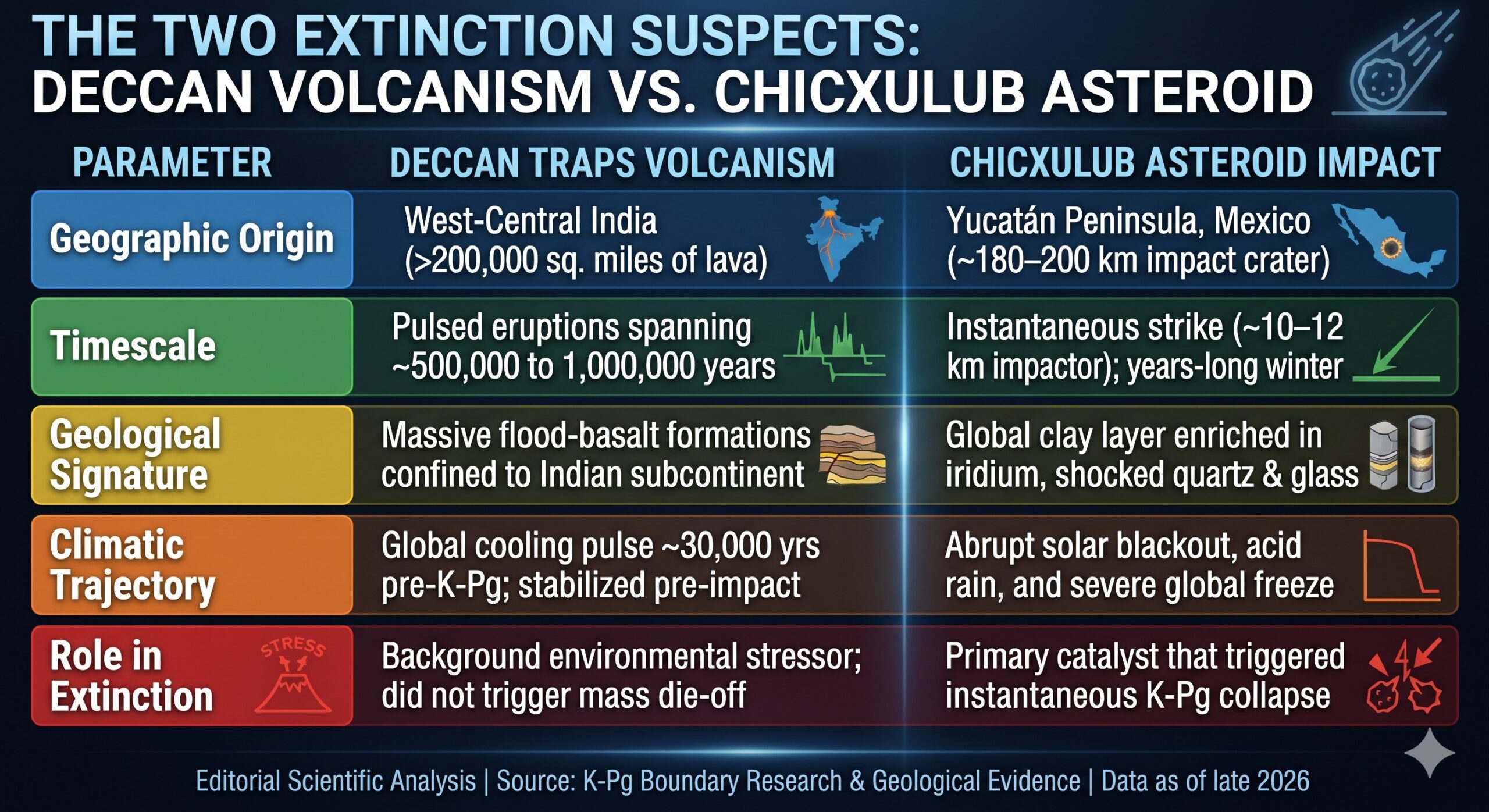
The Two Extinction Suspects – Deccan Volcanism Vs. Chicxulub Asteroid
Modern stratigraphic and paleoclimate evidence has largely resolved the controversy in favor of the asteroid as the primary driver. High-resolution analysis of ancient fossilized peat deposits revealed that while Deccan volcanism did trigger a brief pulse of global cooling roughly 30,000 years before the K–Pg boundary, global temperatures had stabilized and returned to normal well before the extinction event occurred.
By contrast, more than 350 K–Pg boundary sites around the globe—as well as deep-drilling cores extracted directly from inside the Chicxulub crater—preserve a razor-sharp, millimeter-thick clay layer enriched in extraterrestrial iridium, shocked quartz, and molten glass spherules that coincides instantaneously with the disappearance of non-avian dinosaurs and marine plankton. Volcanic activity may have stressed the biosphere, but the asteroid pulled the trigger.
3. The Final Hours and the Global Impact Winter
When the 10-to-12-kilometer asteroid struck shallow marine carbonate and sulfur-rich evaporite rocks off the Yucatán Peninsula during the Northern Hemisphere’s spring 66 million years ago, the initial blast unleashed energy equivalent to billions of nuclear weapons.
Yet for dinosaurs living thousands of miles away in Montana, New Mexico, or Asia, the asteroid itself was only the opening act. What happened beyond the initial impact crater turned a regional cataclysm into a global biological reset:
- Hyper-Velocity Ejecta and Seismic Waves: Within minutes, superheated rock droplets blasted into suborbital trajectories began raining back through the atmosphere worldwide, igniting continent-scale forest fires through thermal radiation. Simultaneously, seismic waves equivalent to a magnitude-11+ earthquake rippled through the crust. At the Tanis fossil site in North Dakota—over 1,800 miles from the crater—inland river waters surged violently within an hour of impact, burying articulated paddlefish and sturgeons alive with microscopic glass impact spherules lodged directly inside their gills.
- The Atmospheric Blackout: The true engine of mass extinction was the chemistry of the target rock. Vaporized sulfur aerosols, pulverized rock dust, and thick wildfire soot lofted into the stratosphere, shrouding the planet in an opaque veil that blocked sunlight for years.
- Photosynthetic Collapse: Deprived of solar radiation, global temperatures plummeted into a prolonged impact winter. Plants withered, forest canopies died back, and microscopic marine plankton—the foundation of oceanic food chains—collapsed.
Without living vegetation to sustain multi-ton herbivores, the entire terrestrial food web imploded from the bottom up. Within a geological blink of an eye, roughly 75% of all species on Earth vanished—including every non-avian dinosaur, alongside giant marine mosasaurs and plesiosaurs, coiled ammonites, and flying pterosaurs.
4. The Survivors: Why Some Dinosaurs Never Left
If the post-impact world was a darkened, acidified, frozen wasteland, why did anything survive at all? Comparing the victims against the survivors reveals a brutal evolutionary filter governed by body size, metabolism, and diet.
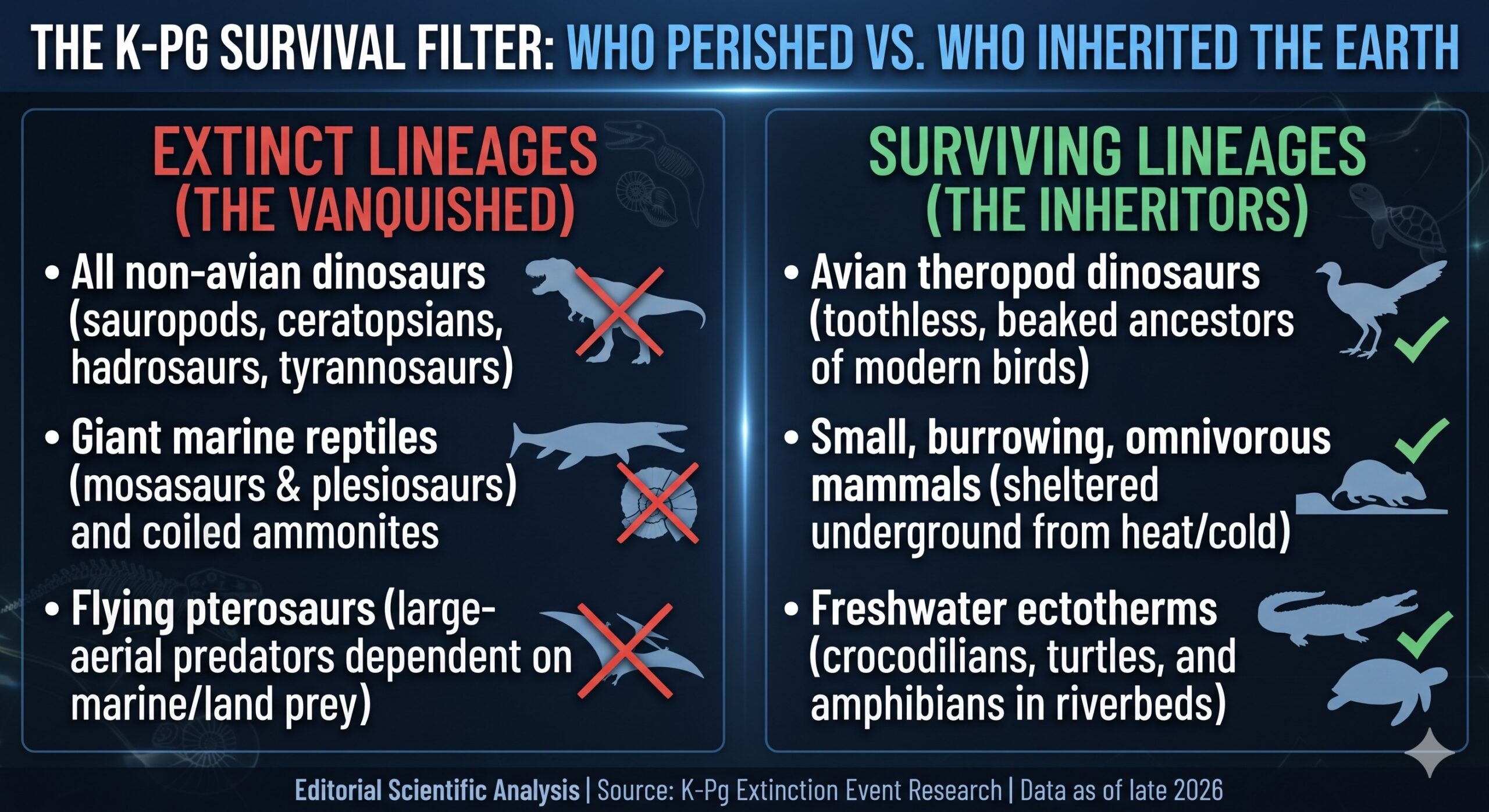
The K-PG Survival Filter, Who Perished Vs. Who Inherited The Earth
Large non-avian dinosaurs faced an insurmountable biological trap. A multi-ton Triceratops or Tyrannosaurus required hundreds of pounds of food daily and needed a decade or more to reach reproductive maturity. When fresh foliage disappeared, large herbivores starved within months, and apex predators starved shortly afterward.
Survival favored the small, the adaptable, and the inconspicuous:
- Burrowing Mammals: Early mammals—mostly rat- to badger-sized creatures—sheltered beneath the soil from the initial thermal pulse and subsisted on insects, fungi, and decaying organic matter.
- Freshwater Dwellers: Crocodilians, turtles, and amphibians escaped the worst atmospheric extremes inside riverbeds and lakes, sustained by detritus-based freshwater food webs.
- Beaked Avian Dinosaurs: Crucially, dinosaurs did not go completely extinct. While toothed birds perished alongside their larger theropod cousins, a lineage of small, toothless, seed-eating avian theropods survived. Equipped with specialized beaks capable of cracking open hard, dormant seeds buried in the post-impact ash—and the ability to fly across devastated landscapes in search of scattered refugia—these feathered survivors weathered the bottleneck and radiated into the more than 10,000 species of birds alive today.
Conclusion: A Story of Contingency, Not Obsolescence
The true story of the dinosaurs’ last stand is not a cautionary tale of evolutionary obsolescence; it is a sobering lesson in cosmic contingency. Fossil records from Montana to New Mexico demonstrate that 66 million years ago, dinosaurs were neither stagnant nor fading away. They were dynamic, ecologically dominant, and actively diversifying across regional habitats.
Had the Chicxulub asteroid arrived a fraction of a second earlier or later in Earth’s orbital path—missing the planet entirely or plunging into deep ocean waters rather than sulfur-rich coastal bedrock—colossal sauropods and tyrannosaurs might still rule the continents, and mammals might have remained nocturnal burrowers in their shadow. Understanding what happened beyond the asteroid reminds us that even the most resilient biological empires on Earth exist at the mercy of planetary physics.
* Conceptual illustration generated using AI