
Over the past fifteen months, Washington has engineered the most aggressive intervention in American industrial policy since World War II. Rather than relying solely on traditional, non-dilutive subsidies under the CHIPS and Science Act, the U.S. Department of Commerce and the Department of War have systematically converted federal grants and strategic loans into direct equity stakes, common shares, and warrants across more than 40 domestic companies.
For a time, Wall Street treated a federal equity stake as the ultimate downside backstop—an implicit guarantee that Washington would never allow its strategic semiconductor champions to fail. By early November 2026, however, that thesis has collided violently with market reality.
While the broader semiconductor industry has endured a turbulent autumn—marked by October’s $1 trillion artificial intelligence valuation reset, shifting political winds following the November midterm elections, and rising odds of a December Federal Reserve interest rate hike—the benchmark PHLX Semiconductor Index (SOX) has demonstrated notable resilience, rebounding 4.21% on November 6 to close at 9,390.25. By contrast, four high-profile, publicly traded semiconductor and quantum-chip companies backed by direct U.S. government equity or warrant holdings—Intel, GlobalFoundries, Wolfspeed, and D-Wave Quantum—have suffered dramatically steeper drawdowns than the broader chip sector.
Here is an institutional analysis of how these four sovereign-backed chipmakers have fared against the wider market, the exact structure of Washington’s holdings in each firm, and the four structural forces turning government backing into a near-term valuation drag.
1. The Divergence: Sovereign Champions vs. The Chip Index
Throughout 2026, the semiconductor market has split into two distinct tiers. At the top sit fabless AI compute leaders and memory suppliers—such as Nvidia, AMD, and Broadcom—whose revenues are directly fueled by the $815 billion capital expenditure wave deployed by cloud hyperscalers. When AMD reported a 97% year-over-year surge in quarterly data-center revenue in early November, its shares rallied sharply even amid broader market jitters.
At the bottom sit capital-intensive domestic manufacturers, specialty foundries, and emerging quantum-silicon developers—the exact cohort targeted by Washington’s industrial-policy portfolio.
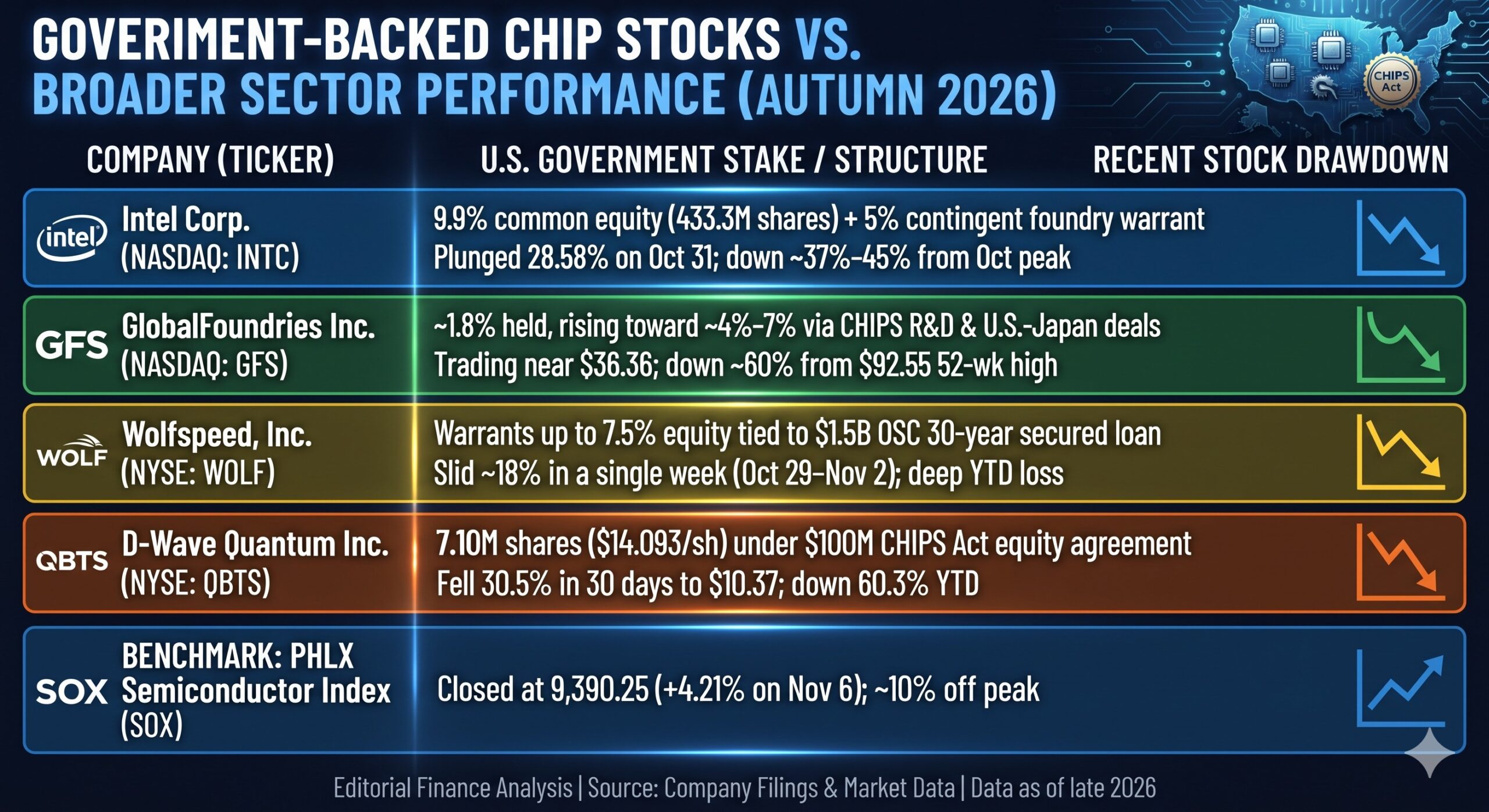
Government-Backed Chip Stocks Vs. Broader Sector Performance – Autum 2026
2. Inside the Four Government-Backed Laggards
Examining each of the four companies individually reveals why state-backed balance sheets have failed to shield public shareholders from steep equity losses.
1. Intel Corporation (NASDAQ: INTC)
Intel serves as the anchor holding of Washington’s semiconductor equity portfolio. In August 2025, the U.S. Commerce Department acquired 433.3 million shares of Intel at $20.47 per share—a 9.9% equity stake financed through roughly $8.9 billion to $11.1 billion in converted CHIPS Act and Secure Enclave funding—alongside a five-year warrant to purchase another 5% at $20 per share if Intel’s ownership of its foundry division drops below 51%.
For much of 2026, sovereign backing fueled a massive speculative rally that lifted Intel shares to nearly $95. That momentum shattered following Intel’s third-quarter earnings release: on October 31, 2026, Intel shares plummeted 28.58% in a single session to $65.76—its worst single-day percentage drop since the 1970s—and slid further to the $56–$59 range in early November. The rout wiped out more than $12 billion in paper value from the Commerce Department’s stake in days, underscoring that despite billions in federal capital, Intel’s external foundry business still faces steep cash burn and sluggish third-party customer adoption. (CEO Lip-Bu Tan subsequently stepped in on November 2 to purchase 150,000 shares for $9.71 million in an effort to steady investor confidence.)
2. GlobalFoundries Inc. (NASDAQ: GFS)
As the largest pure-play specialty and mature-node foundry headquartered in the United States, GlobalFoundries has become deeply intertwined with federal industrial strategy. Under definitive CHIPS R&D and quantum silicon-photonics awards signed in May and July 2026 totaling $1.63 billion, the Commerce Department acquired direct ordinary shares (roughly 1.8% currently calculated), with CEO Tim Breen noting that federal holdings are slated to rise from around 3% toward 7% following an October 14, 2026 U.S.–Japan initiative providing up to $21 billion to finance two new 300mm fabs in Malta, New York.
Yet public equity investors have punished the stock relentlessly. After surging to a 52-week high of $92.55 earlier in 2026, GlobalFoundries tumbled 35.3% in July, 10.6% in August, and 13.9% in October, closing near $36.36 in early November—a staggering 60.7% collapse from its peak. Markets have grown wary of massive multi-year capital outlays for fabrication plants that will not come online until 2029, compounded by cyclical softness in automotive and industrial chip demand.
3. Wolfspeed, Inc. (NYSE: WOLF)
Silicon carbide (SiC) wafer and power-device specialist Wolfspeed illustrates the double-edged nature of federal credit-and-warrant rescues. On October 7, 2026, Wolfspeed disclosed a conditional commitment from the Department of War’s Office of Strategic Capital (OSC) for a 30-year senior secured delayed-draw term loan of up to $1.5 billion, attaching volume-weighted average price (VWAP) warrants for up to 7.5% of Wolfspeed’s fully diluted equity.
Rather than sparking a sustained recovery, the complex debt-and-warrant structure intensified dilution concerns amid prolonged electric-vehicle supply-chain digestion and heavy debt-servicing obligations. Wolfspeed shares fell from $25.88 on October 29 to the $20.85–$22.42 range by early November 2026, continuing a steep downward trajectory that has severely lagged the wider semiconductor index.
4. D-Wave Quantum Inc. (NYSE: QBTS)
Washington’s equity-for-grant model has also extended into next-generation quantum processors. Following the Commerce Department’s May 2026 batch of quantum-computing equity deals, D-Wave Quantum finalized an agreement in September 2026 providing access to up to $100 million in CHIPS and Science Act funding—requiring the company to issue 7,095,721 common shares at $14.093 per share to the federal government.
In the public market, however, D-Wave has suffered a brutal contraction. Shares plunged 30.5% over a single 30-day stretch from late September through October 2026, closing at $10.37 on November 3—leaving even the federal government’s $14.093 entry price underwater. Year-to-date, QBTS has fallen 60.34% from its end-of-2025 close of $26.15 and 66.84% from its January 2026 peak of $31.38, weighed down by widening adjusted EBITDA losses and investor skepticism over near-term commercial quantum revenue. (Fellow CHIPS-backed quantum processor developer Rigetti Computing, NASDAQ: RGTI, experienced a similar 27.8% slide over the same window.)
3. Four Structural Reasons Government Backing Became a Market Drag
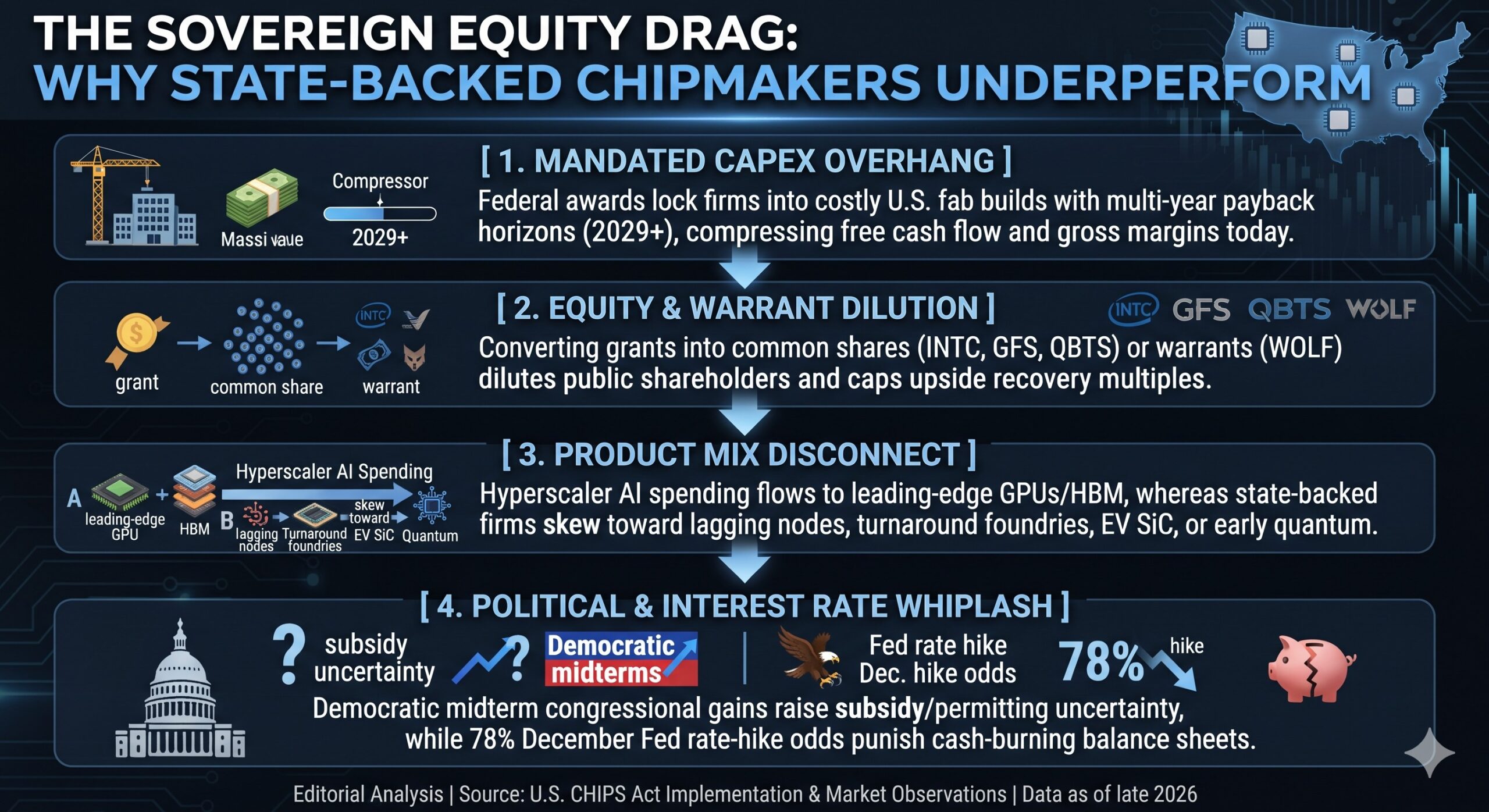
Why are companies with direct sovereign financial backing underperforming peers that rely purely on private capital markets? Four structural dynamics explain the divergence:
The Soverign Equity Drag – Why State-Backed Chipmakers Underperform
- Binding Capital-Expenditure Mandates Crush Near-Term Free Cash Flow: Government funding is never free capital; it is legally tethered to domestic construction milestones, domestic sourcing quotas, and workforce commitments. For foundries like Intel and GlobalFoundries, building greenfield fabs in Ohio, Arizona, and upstate New York requires tens of billions in upfront capital expenditure years before meaningful wafer revenue materializes, starving public shareholders of near-term free cash flow.
- Shareholder Dilution and Governance Overhang: Unlike the 2022–2024 era of straightforward CHIPS grants, the 2025–2026 equity-conversion model dilutes existing common stockholders through massive share issuances and warrant overhangs. Institutional investors also apply a valuation discount when a sovereign shareholder holds board observer rights, veto provisions, or strategic priorities—such as national security supply resilience—that diverge from pure profit maximization.
- Mismatch With Immediate AI Hyperscaler Demand: While leading-edge AI chip designers and high-bandwidth memory makers are monetizing immediate data-center demand in 2026, Washington’s portfolio is heavily weighted toward mature/specialty nodes (GlobalFoundries), distressed manufacturing turnarounds (Intel), cyclical EV power chips (Wolfspeed), and pre-commercial quantum hardware (D-Wave).
- Macroeconomic and Post-Midterm Political Friction: Stronger-than-expected October 2026 U.S. nonfarm payrolls (165,000 jobs added and unemployment falling to 4.1%) pushed market-implied odds of a December Federal Reserve rate hike to 78%, punishing capital-intensive and unprofitable tech names. Simultaneously, the Democratic sweep of Congress in the November 2026 midterm elections introduced fresh political uncertainty surrounding federal industrial subsidies and large-scale data-center permitting.
Conclusion: A Reality Check for State-Directed Tech Investing
The sharp autumn selloff across Intel, GlobalFoundries, Wolfspeed, and D-Wave Quantum offers a sobering lesson for both equity investors and policymakers. Sovereign capital can build fabrication cleanrooms, secure domestic mineral and wafer supply chains, and subsidize strategic research—but it cannot insulate publicly traded stocks from competitive execution risk, margin compression, or market valuation discipline.
Until these four government-backed chipmakers prove they can convert federal balance-sheet support into sustainable, self-funding commercial free cash flow, Wall Street is likely to keep treating Washington’s seal of approval not as a guarantee of outperformance, but as a sign of heavy lifting still ahead.
* Conceptual illustration generated using AI