
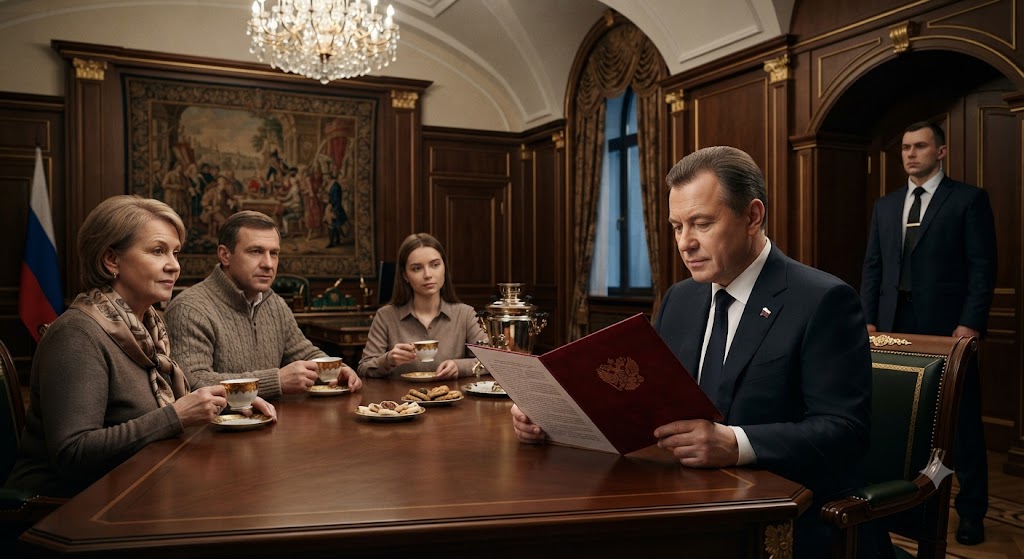
As the war in Ukraine grinds toward its fifth winter in November 2026, the domestic reality within the Russian Federation has settled into a rigid, heavily managed “new normal.” The initial shocks of unprecedented Western sanctions, mass mobilization, and corporate exoduses have faded, replaced by the chronic, low-grade fever of a hyper-militarized society and an overheating wartime economy.
At the apex of this vast, insulated system sits President Vladimir Putin. Historically defined by his extreme physical isolation and reliance on rigid security protocols—epitomized by the infamous “long tables” of the early 2020s—the Kremlin has recognized a vital domestic vulnerability. A leader cannot sustain a “forever war” if the populace believes he is entirely divorced from their daily struggles.
Consequently, the Kremlin’s domestic apparatus has spent the last few years engineering a sophisticated strategy of Curated Proximity. President Putin is actively attempting to project the image of a leader deeply engaged with the mundane, day-to-day activities of ordinary Russians. Yet, how does a deeply isolated, security-obsessed autocrat “live with his people”?
Here is an in-depth analysis of how Vladimir Putin navigates his daily operations in late 2026, managing the Russian micro-economy, choreographing public interactions, and attempting to project empathy through an impenetrable security bubble.
1. The Choreography of Connection: Staging the “Ordinary”
In a democratic system, a leader interacts with the public through town halls, organic campaign stops, and press scrums. In 2026 Russia, public interaction is treated as a high-stakes intelligence operation managed entirely by the Federal Protective Service (FSO).
Putin’s attempts to show he is living alongside his people are executed through highly choreographed, televised set-pieces. Whether he is touring a modernized greenhouse in the Stavropol region, inspecting a KAMAZ truck factory, or drinking tea with the mothers of soldiers, these interactions share a common, rigid architecture.
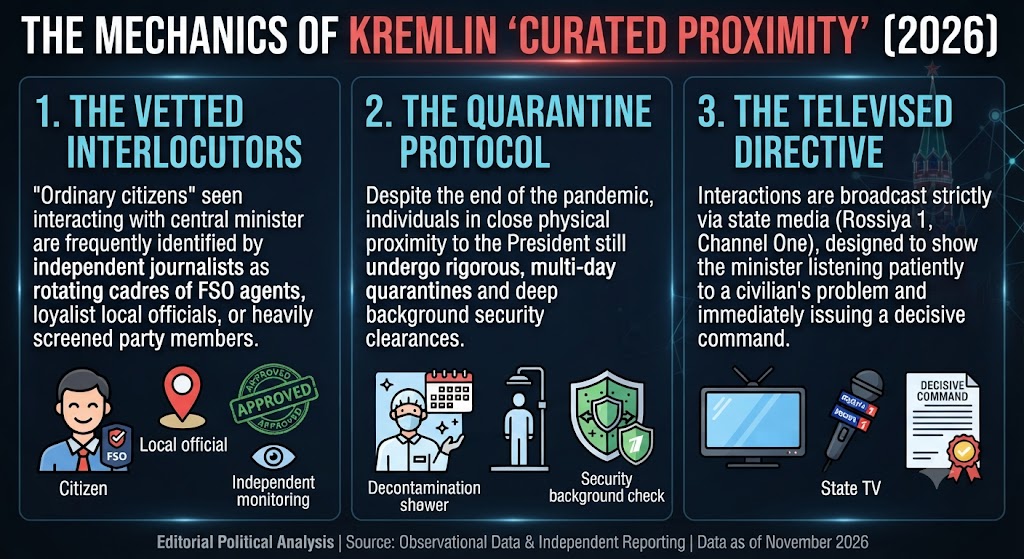
The Mechanics Of Kremlin – Curated Proximity – (2026)
This staging serves a dual purpose. It allows Putin to avoid the genuine, unpredictable anger of a populace exhausted by inflation and conscription, while simultaneously broadcasting the image of a “Good Tsar”—a benevolent father figure who is actively solving the micro-problems of the working class, stepping in where local bureaucrats have failed.
2. The Tsar of Details: Micro-Managing the Daily Economy
To prove he is connected to the day-to-day reality of Russian households, Putin dedicates a vast amount of his daily schedule to the micro-management of the domestic economy.
In late 2026, Russia’s macroeconomic numbers appear resilient, propped up by massive state defense spending. However, the day-to-day reality for Russian citizens is defined by severe labor shortages, persistent inflation (officially hovering around 8-10%, but practically higher for basic goods), and the declining quality of import-substituted products.
Putin’s daily response is highly visible economic theater. During his televised cabinet meetings, he does not dwell exclusively on geopolitics; he focuses aggressively on the grocery store.
- The Focus on Basic Goods: Putin regularly berates government ministers on national television over the price of eggs, poultry, domestic automobiles, and airline tickets. By publicly dressing down a minister over a 15% spike in the price of basic foodstuffs, Putin signals to the babushkas in the provinces that he feels their pain and is actively fighting for their wallets.
- Import Substitution Rhetoric: He spends considerable time promoting “technological sovereignty,” visiting factories that are attempting to build domestic commercial aircraft, software, and consumer electronics to replace departed Western brands.
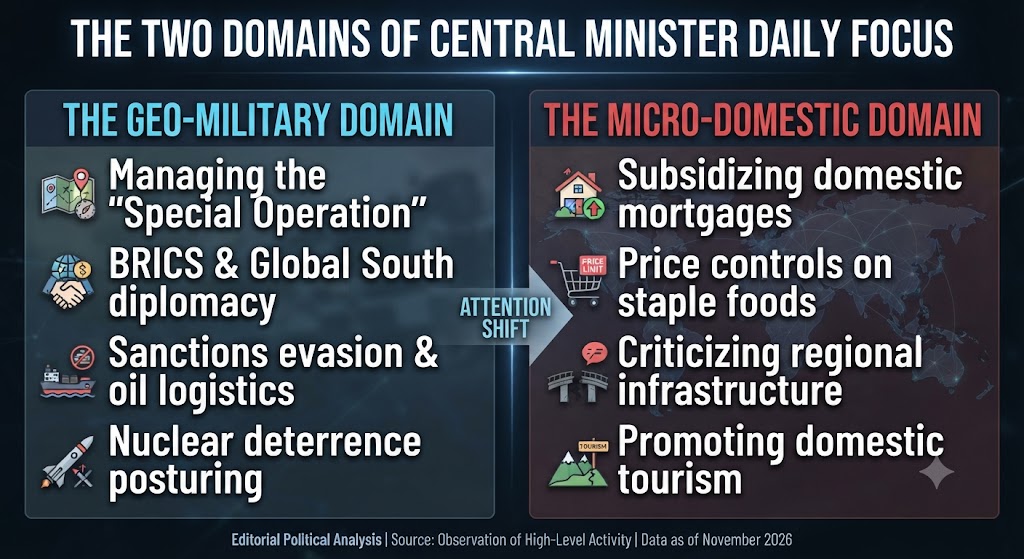
The Two Domains of Central Minister Daily Focus
By heavily publicizing his involvement in the domestic domain, Putin attempts to reassure the public that the war has not consumed his presidency, and that the state remains focused on their baseline quality of life.
3. Managing Grief: The “Mothers of the Motherland”
The most sensitive and volatile aspect of daily life in Russia today is the human cost of the prolonged war. Hundreds of thousands of Russian families in the poorer, outer republics (such as Buryatia, Dagestan, and the rural Urals) are dealing with the daily reality of disabled veterans, delayed death benefits, and the loss of sons and husbands.
Handling this national grief requires extreme narrative control. If Putin ignores the casualties, he appears callous. If he acknowledges the true scale, he admits failure.
His solution is tightly controlled engagement. Several times a year, Putin holds highly publicized meetings with the “Mothers of the Motherland.” Seated at a small, intimate table—a deliberate visual departure from the giant white tables of his past—he pours tea and listens to their stories. He validates their sons’ sacrifices, comparing them to the heroes of the Great Patriotic War (WWII), and promises that the state will clear bureaucratic hurdles regarding survivor pensions and medical care.
However, these meetings are heavily filtered. The women in attendance are almost exclusively members of state-aligned patriotic organizations. Genuine grassroots movements—such as independent councils of wives and mothers demanding the rotation of mobilized troops—are systematically marginalized, labeled as “foreign agents,” or dispersed by police. Putin interacts with the grief of his people, but only the sanitized, state-approved version of it.
4. The Information Silo: Ruling via the “Red Folders”
To understand how Putin manages day-to-day activities, one must understand how he receives information about the world. Unlike modern leaders who are tethered to smartphones and real-time digital feeds, Putin is famously analog. He does not use the internet directly, viewing it as a CIA project and a vector for psychological contagion.
His daily reality is constructed by the “Papki”—the physical red folders delivered to his desk every morning.
- The FSB Briefing: Details domestic security threats, public mood algorithms, and elite infighting.
- The FSO Briefing: Provides raw polling data and public sentiment analysis, serving as his primary gauge of what the “people” are feeling.
- The Ministry of Defense Briefing: Updates on the tactical reality in Ukraine and domestic defense production.
- The Economic Briefing: Provided by technocrats managing the Central Bank and Ministry of Finance, highlighting inflation, currency stability, and labor markets.
Because he relies entirely on these folders, his connection to the day-to-day life of his citizens is inherently mediated by intelligence agencies. This creates a dangerous feedback loop: intelligence chiefs, eager to retain their status and avoid his wrath, often smooth over bad news. Putin’s understanding of daily Russian life is therefore heavily dependent on what his inner circle decides to put on his desk.
Conclusion: The Paradox of the Isolated Populist
As 2026 draws to a close, Vladimir Putin’s attempt to live with his people is a study in profound paradox. He is a populist who fears the populace; a micromanager of egg prices who travels in a multi-car armored motorcade; a leader claiming to share the burdens of ordinary Russians while operating from within the most secure physical and informational bubble on the planet.
Unlike Ukraine’s Zelenskyy, whose leadership model relies on unscripted, proximate exposure to civilian suffering, Putin’s strategy relies on control. By choreographing his interactions, focusing his public anger on domestic inflation, and filtering the nation’s grief through state-approved channels, the Kremlin successfully maintains the illusion that the President is intimately connected to the daily struggles of the working class.
For the average citizen watching the evening news in Vladivostok or Kazan, the message is clear: the war is happening out there, but inside Russia, the Tsar is awake, the state is functioning, and the daily details are under absolute control.
* Conceptual illustration generated using AI