
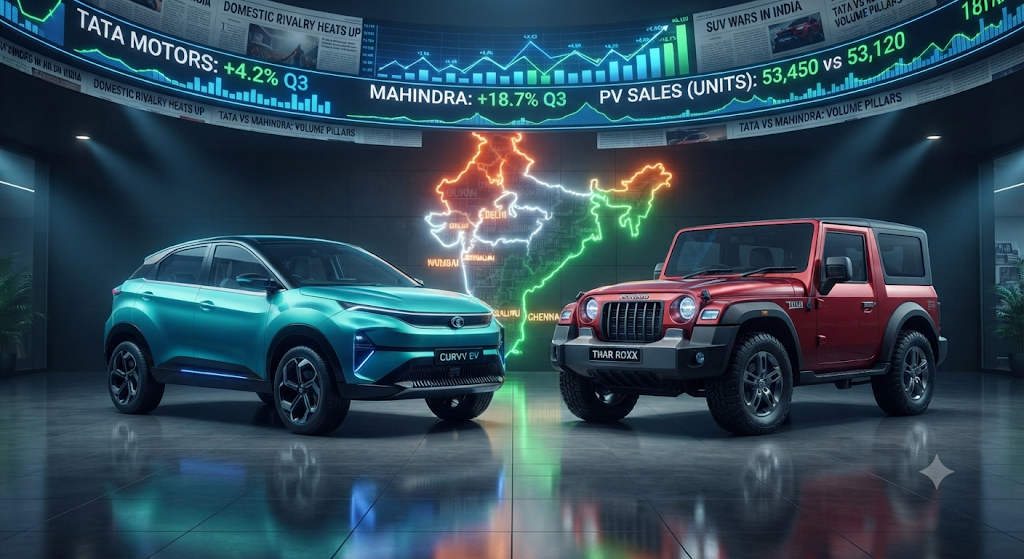
For decades, the hierarchy of the Indian passenger vehicle (PV) market was predictably static: Maruti Suzuki commanded the lion’s share, Hyundai comfortably held the second spot, and a rotating cast of domestic and international players scrapped for the remnants. But as the third quarter of 2026 closes, a fierce, high-stakes battle has completely rewired the industry’s dynamics.
The battle is for the number three position, and the combatants are India’s two domestic heavyweights: Tata Motors and Mahindra & Mahindra (M&M).
When the September 2026 auto dispatch numbers were published, the industry witnessed a virtual photo-finish. Tata Motors and Mahindra were separated by a razor-thin margin of just a few hundred units, both hovering around the 53,000-vehicle mark. This is no longer a temporary anomaly driven by supply chain glitches; it is a structural convergence. Mahindra’s relentless SUV offensive has completely erased the comfortable lead Tata Motors enjoyed over the past three years.
Here is an in-depth, data-driven analysis of how the Indian car market evolved in September 2026, the divergent strategies powering these two homegrown conglomerates, and why their neck-and-neck race defines the golden era of domestic automaking.
1. The September Scorecard: A Margin of Millimeters
To understand the intensity of this corporate rivalry, one must look at the trajectory of passenger vehicle sales over the last thirty-six months. In 2023 and early 2024, Tata Motors held a solid grip on the bronze medal, frequently dispatching 10,000 to 12,000 more units per month than M&M. Tata’s balanced portfolio of hatchbacks, compact SUVs, and early-mover EVs provided high volume, while Mahindra was severely bottlenecked by semiconductor shortages and massive production backlogs for its premium SUVs.
By September 2026, that landscape has shifted dramatically.
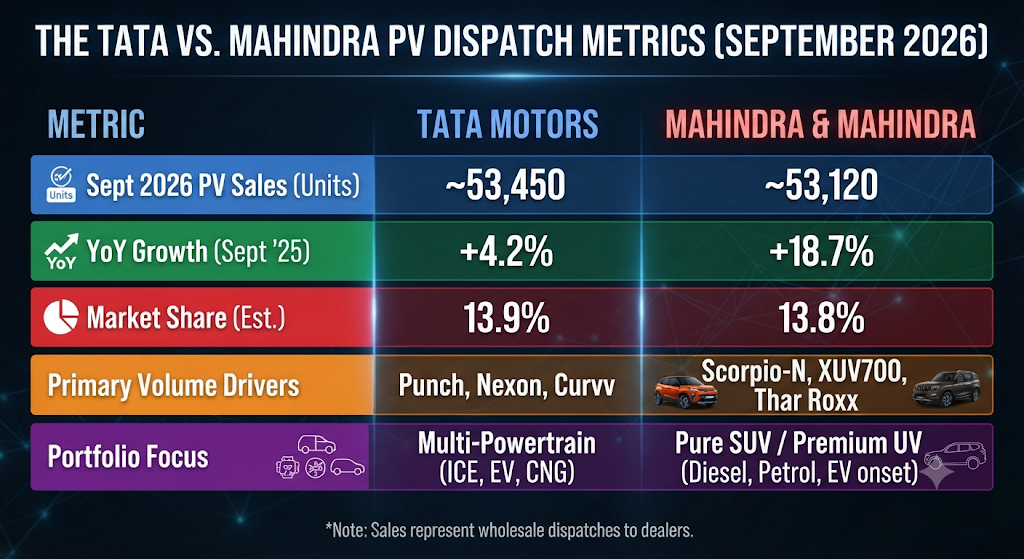
The Tata vs. Mahindra PV Dispatch Metrics (September 2026)
While Tata Motors managed to edge out M&M by a few hundred units to retain the number three spot in September, Mahindra’s year-on-year growth rate is nearly quadruple that of Tata. Mahindra’s aggressive capacity expansion has uncorked its delivery pipeline, turning massive booking backlogs into immediate wholesale revenue.
2. Mahindra’s Strategy: The Premium SUV Juggernaut
Mahindra’s resurgence is built on a high-risk, high-reward strategy: a total commitment to the premium SUV segment. Unlike Tata or Maruti, which rely heavily on high-volume, sub-4-meter vehicles priced under ₹10 Lakh, Mahindra has successfully convinced the Indian consumer to open their wallets for vehicles in the ₹15 Lakh to ₹30 Lakh bracket.
Mahindra is executing on three critical fronts:
- Solving the Capacity Crisis: Two years ago, buying a Mahindra XUV700 or Scorpio-N meant waiting up to 18 months. By late 2026, M&M has aggressively scaled its manufacturing capacity to over 60,000 SUVs per month. The September numbers reflect this unbottlenecked production, allowing Mahindra to fulfill demand in real-time.
- The Lifestyle UV Domination: The launch of the 5-door Thar Roxx fundamentally altered the utility vehicle landscape. By transitioning the Thar from a niche, two-door off-roader into a practical, family-friendly SUV, Mahindra captured a massive swathe of urban buyers who previously would have opted for a Hyundai Creta or Kia Seltos.
- High Average Selling Price (ASP): Because Mahindra sells larger, feature-rich SUVs, its revenue and profit margins per vehicle are significantly higher than its rivals. A single Scorpio-N sale generates the revenue equivalent of nearly two entry-level Tata Punch hatchbacks.
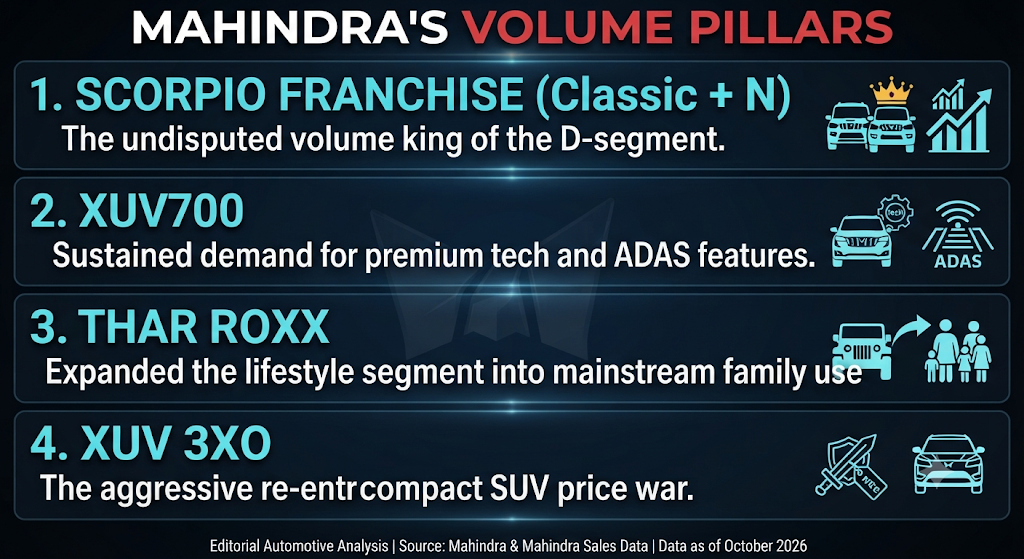
Mahindra’s Volume Pillars
3. Tata’s Strategy: The Multi-Powertrain Moat
If Mahindra’s strategy is the specialized sledgehammer, Tata Motors’ strategy is the diversified Swiss Army Knife. Tata recognized early that the Indian market’s transition away from pure petrol and diesel would not be linear. Consequently, they built a highly flexible, multi-powertrain moat.
Tata’s defense against Mahindra’s surge relies on blanketing every possible consumer fuel preference across multiple price points:
- The CNG Revolution: Tata revolutionized the compressed natural gas (CNG) market by introducing twin-cylinder technology, preserving boot space while offering ultra-low running costs. In September 2026, CNG variants of the Punch, Altroz, and Nexon accounted for a massive portion of Tata’s volume, capturing buyers terrified by volatile petrol prices.
- EV Market Hegemony, but Cooling: Tata remains the undisputed king of the Indian Electric Vehicle market (commanding over 65% market share). However, early-adopter fatigue and infrastructure anxieties have caused the overall EV growth rate to plateau in 2026. While the Nexon.ev, Punch.ev, and the newly launched Curvv.ev bring steady numbers, they are no longer providing the explosive month-on-month growth Tata enjoyed in 2023.
- The Coupe-SUV Counterattack: To fight Mahindra’s larger SUVs, Tata launched the Curvv and revived the Sierra nameplate. The Curvv, with its distinct sloping roofline, has injected fresh styling into the mid-size segment, successfully preventing thousands of buyers from migrating to Mahindra’s showrooms.
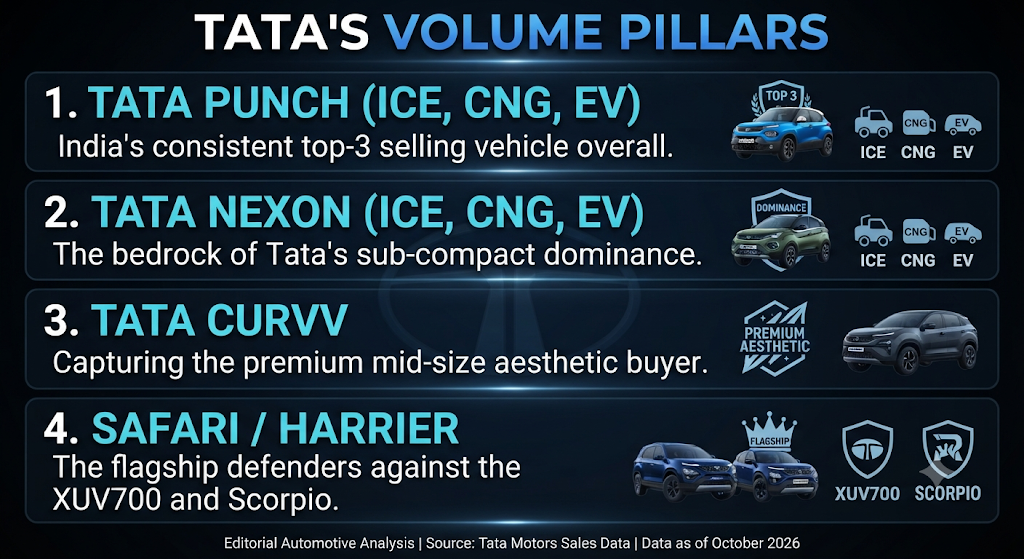
Tata’s Volume Pillars
4. Why the Gap Closed in 2026
The convergence of these two titans in September 2026 is the result of shifting consumer psychographics.
The Indian middle class is experiencing an unprecedented phase of “premiumization.” The entry-level hatchback segment (long dominated by Maruti Suzuki) is shrinking, while the demand for larger, safer, and more technologically advanced vehicles is exploding.
Tata capitalized on the initial wave of this shift by democratizing 5-star Global NCAP safety ratings and making SUVs like the Nexon accessible. However, as consumers move further up the price ladder on their second or third car purchases, Mahindra’s heritage as a true, rugged SUV manufacturer provides a powerful psychological pull.
Furthermore, Tata is experiencing mild cannibalization within its own diverse portfolio—an EV buyer might simply be a lost ICE buyer for the same brand. Mahindra, until its upcoming “Born Electric” (BE) range fully hits the streets in late 2026 and 2027, has been singularly focused on maximizing its highly profitable internal combustion engine (ICE) utility vehicles.
Conclusion: The Real Winner is the Domestic Consumer
The September 2026 sales figures confirm that the battle for the number three spot in the Indian auto industry will not be decided by a knockout, but by a grueling, month-to-month war of attrition.
Tata Motors boasts an unassailable lead in EVs and a brilliant multi-fuel strategy, ensuring it appeals to the pragmatic, cost-conscious, yet safety-minded urban buyer. Mahindra, on the other hand, commands unmatched brand equity in the premium SUV space, riding the wave of Indian consumer premiumization with aggressive production scale.
Regardless of whether Tata or Mahindra officially claims the bronze medal by the end of the fiscal year, the structural reality is a triumph for domestic manufacturing. For decades, Indian consumers looked to Japanese or Korean automakers for quality, reliability, and aspiration. Today, the most fierce, technologically advanced, and consumer-focused battle in the market is being waged by two homegrown giants.
* Conceptual illustration generated using AI