Author Note & Methodology: This analytical assessment evaluates the electoral architecture of Uttar Pradesh as it prepares for its 403-seat Assembly elections in early 2027. Rather than relying on superficial campaign narratives, this analysis integrates Election Commission of India (ECI) granular constituency-level vote share distributions from 2017, 2022, and 2024, state budgetary disbursements under direct benefit transfer (DBT) frameworks, and field-level observations across Paschimanchal, Rohilkhand, Awadh, Purvanchal, and Bundelkhand.
1. Executive Summary: The Structural Shift (2022 vs. 2024 vs. 2027)
The political landscape of Uttar Pradesh—India’s primary electoral battleground—is undergoing a fundamental structural realignment. For nearly a decade, the Bharatiya Janata Party (BJP) dominated the state through an unbeatable electoral formula: high-voltage Hindutva, CM Yogi Adityanath’s uncompromising law-and-order governance framework, an expansive welfare state (labharthi network), and a coalition of upper castes alongside non-Yadav Other Backward Classes (OBCs) and non-Jatav Dalits.
However, the trajectory shifted dramatically between the 2022 State Assembly elections and the 2024 Lok Sabha elections:
- The 2022 Assembly Baseline: The ruling National Democratic Alliance (NDA) secured a strong majority of 273 seats (BJP winning 255 with 41.29% vote share), while the Samajwadi Party (SP) coalition won 125 seats (32.06% vote share). The Bahujan Samaj Party (BSP) collapsed to a single seat (12.88% vote share).
- The 2024 Parliamentary Signal: During the general election, the opposition INDIA bloc (SP + INC) led in approximately 224 Assembly segments, while the NDA’s lead shrank to 174 segments.
UP ELECTORAL REALIGNMENT MATRIX
| ELECTORAL METRIC | 2022 ASSEMBLY VERDICT | 2024 LOK SABHA ASSEMBLY SEGMENT LEADS | STRATEGIC REALIGNMENT & 2027 BENCHMARK |
| NDA Alliance (BJP+) | 273 Seats • BJP: 255 | 41.29% Vote Share • Allies: 18 Seats (AD(S): 12, NISHAD: 6) | ~174 Assembly Segments • Shifted away from ~99 assembly segments compared to 2022. |
| INDIA Bloc / SP+ | 125 Seats • SP: 111 | 32.06% Vote Share • Allies: 14 Seats (RLD: 8*, SBSP: 6*) | ~224 Assembly Segments • SP Leads: ~184 Segments • Congress Leads: ~40 Segments |
| Bahujan Samaj Party (BSP) | 1 Seat • 12.88% Vote Share | 0 Assembly Segments • Vote share compressed sharply under multi-cornered pressure. | Acts as a potential spoiler in tight triangular contests. Strategic focus is on preventing Dalit vote erosion to the INDIA bloc. |
| Total Assembly Baseline | 403 Total Seats | 403 Assembly Segments | 202 Seats Required for Simple Majority |
*Note: RLD and SBSP subsequently realigned with the NDA ahead of the 2024 general elections.
2. Core Drivers Shaping the 2027 Mandate
A. The NDA Strategy: Incumbency, Governance, and Welfare Delivery
The ruling BJP enters 2027 aiming for an unprecedented third consecutive full-term mandate. Its strategy rests on three distinct pillars:
- Welfare Penetration (Labharthi Mobilization): State-level infrastructure investments paired with direct transfers—PM Kisan Samman Nidhi, free rations under PM Garib Kalyan Anna Yojana, PMAY housing, and state electricity subsidies—form a safety net that transcends traditional caste divisions.
- Law & Order as an Economic Pitch: The Adityanath administration continues to highlight strict policing, zero tolerance toward organized crime, and heavy investment in expressways (Ganga, Purvanchal, Bundelkhand) and industrial corridors (Jewar Airport hub) to position UP as a primary investment destination.
- Sub-Caste Alliance Management: The NDA relies on small regional sub-caste parties to secure key voter groups:
- Rashtriya Lok Dal (RLD): Jayant Chaudhary’s RLD mobilizes the Jat agricultural belt in Paschimanchal.
- Apna Dal (Sonelal): Anupriya Patel consolidates Kurmi OBC voters across Central and Eastern UP.
- Suheldev Bharatiya Samaj Party (SBSP): Om Prakash Rajbhar targets Rajbhar voters in Purvanchal.
- NISHAD Party: Sanjay Nishad leads representation among riverine and fishing communities.
NDA COALITION 2027
| PARTY | KEY DEMOGRAPHIC BASE | PRIMARY REGIONAL POCKETS | STRATEGIC VALUE IN NDA ALIGNMENT |
| Bharatiya Janata Party (BJP) | Core urban base, Upper Castes, Non-Yadav OBCs, & Beneficiaries (Labharthis) | Statewide presence across all 403 constituencies | Anchors the coalition framework, providing state leadership, national branding, and comprehensive welfare delivery machinery. |
| Rashtriya Lok Dal (RLD) | Jat agrarian community & farming households | Paschimanchal (Western Uttar Pradesh) | Consolidates agrarian and Jat votes in the sugar belt, counteracting opposition attempts to unify farmer networks. |
| Apna Dal (Sonelal) | Kurmi OBC sub-caste base | Central & Eastern Uttar Pradesh (Awadh & Purvanchal) | Secures essential non-Yadav OBC backing, cementing strategic holds in key agrarian and rural seats. |
| Suheldev Bharatiya Samaj Party (SBSP) | Rajbhar Most Backward Classes (MBC) base | Purvanchal (Eastern Uttar Pradesh) | Drives turnout among MBC communities, providing a decisive edge in tightly contested eastern assembly segments. |
| NISHAD Party | Mallah, Kewat, and Riverine MBC communities | Eastern & Central Uttar Pradesh (Ganga-Yamuna riverine belts) | Mobilizes riverine sub-castes across crucial rural corridors, strengthening backward-caste unity under the NDA banner. |
B. The Opposition Realignment: The PDA Coalition & Sub-Caste Social Engineering
Akhilesh Yadav’s Samajwadi Party has reshaped its strategy away from its traditional “MY” (Muslim-Yadav) image toward the PDA formula (Pichhde, Dalit, Aalpashankhyak—Backward Classes, Dalits, and Minorities).
- Non-Yadav OBC Integration: The SP has given organizational prominence and candidacies to leaders from the Kurmi, Maurya, Kushwaha, Shakya, and Sainthwar communities. This directly challenges the BJP’s post-2014 OBC coalition.
- Absorbing the BSP’s Base: With Mayawati’s BSP showing decreased electoral returns, non-Jatav and Jatav Dalit voters are increasingly splitting between the SP-led alliance and the BJP. The SP’s focus on the Constitution, reservation rights, and public sector employment transparency resonates with educated Dalit youth.
- Congress Partnership: The tactical alliance with the Indian National Congress (INC) provides a unified platform that prevents the splitting of anti-incumbency votes while reassuring urban progressive and minority voters.
3. Detailed Regional Breakdown (403 Assembly Seats)
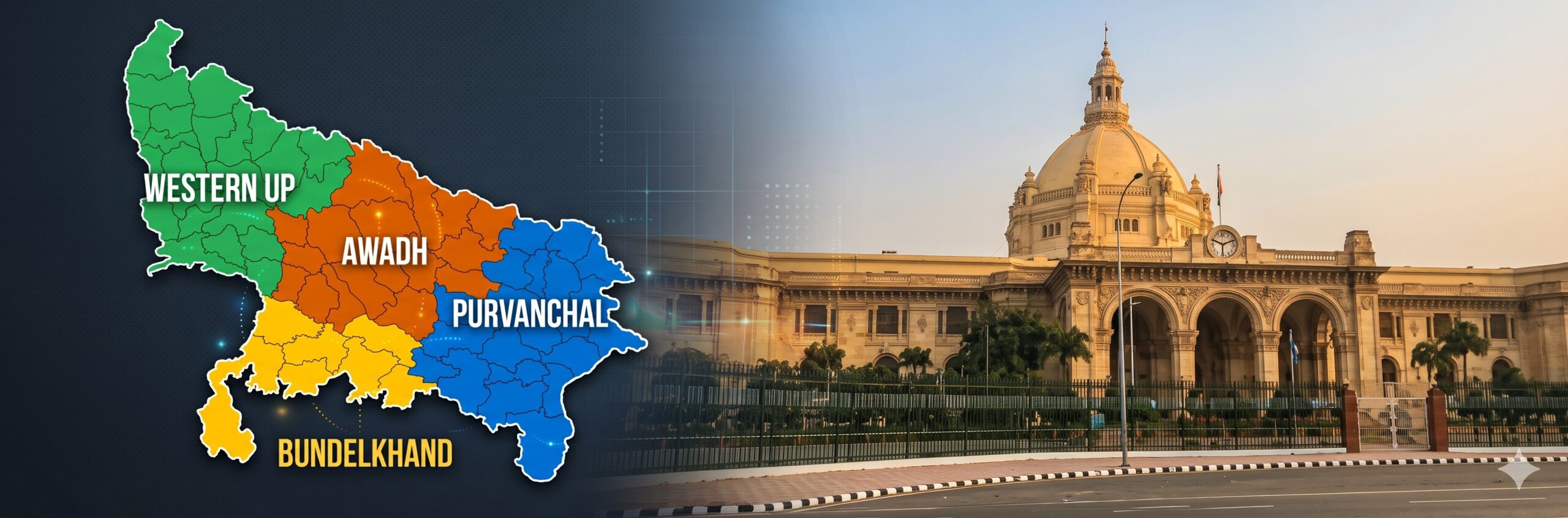
Uttar Pradesh is not a single political unit; it consists of six distinct socio-economic regions. The 2027 outcome will be decided across these key battlegrounds:
REGIONAL MATRIX & KEY VARIABLES
| REGION | SEATS | PRIMARY DYNAMICS & KEY ISSUES | SOCIO-ECONOMIC & ELECTORAL IMPACT |
| Purvanchal | 130 | Severe sub-caste fragmentation (Rajbhar, Nonia, Nishad, Kurmi); agrarian distress. | Highly sensitive to coalition micro-alliances (SBSP, NISHAD, Apna Dal). Sub-caste mobilization directly decides margins in tight multi-cornered contests. |
| Awadh | 118 | Urban-rural split; administrative sentiment; central state welfare delivery. | High concentration of state welfare (PMAY, Ration, PM-KISAN) beneficiaries; urban hubs focus on governance, employment, and infrastructure delivery. |
| Western UP (Paschimanchal) | 71 | Sugarcane MSP, Jat-Muslim dynamics, RLD vs ASP (Chandrashekhar Azad) impact. | Agrarian trade routes and sugarcane price clearance drive farmer sentiment; Dalit vote consolidation under ASP challenges traditional alliance structures. |
| Rohilkhand | 52 | High Muslim demographic percentage; agrarian supply chains & handicraft exports. | Strategic voting patterns dominated by minority demographic consolidation alongside local MSME export performance and agricultural supply chains. |
| Bundelkhand | 19 | Water infrastructure, drought relief, deep welfare dependency (PMAY/DBT). | Heavy reliance on Direct Benefit Transfer (DBT) and irrigation schemes (e.g., Har Ghar Nal, Ken-Betwa link); traditionally consolidates behind stable delivery machinery. |
| Doab Belt | 13 | Mixed agricultural demographic; connectivity to Prayagraj-Kanpur industrial hubs. | Intersected by major industrial and transit corridors; voter sentiment is shaped by rural-urban trade logistics, infrastructure, and regional employment. |
1. Purvanchal (130 Seats): The Ultimate Sub-Caste Battlefield
Purvanchal accounts for over 30% of the entire Vidhan Sabha. In 2017, the NDA swept this region, but in 2022 and 2024, the opposition made notable gains.
- Key Caste Variables: The region features high concentrations of Rajbhars, Nonia-Chauhans, Nishads, Patel-Kurmis, and Pasis.
- The Strategic Challenge: Alliance management is critical here. If the BJP’s allies (Apna Dal, SBSP, NISHAD Party) fail to transfer their voters to BJP candidates—or vice versa—the SP’s broadened candidate slate can secure crucial wins in tight contests.
2. Paschimanchal / Western UP (71 Seats): Agrarian Distress vs. Coalition Consolidation
Western UP features a mix of Jats, Muslims, Gurjars, Dalits, and Rajputs.
- Agrarian Demands: Sugarcane procurement prices, timely mill payments, and agricultural electricity rates remain central campaign topics.
- The Third-Front Variable: The emergence of Chandrashekhar Azad’s Azad Samaj Party (ASP) alongside Asaduddin Owaisi’s AIMIM (forming local pacts like the Samajik Parivartan Morcha) creates a wild card. While intended to challenge both national blocs, any split in Dalit and minority votes directly impacts the SP-Congress alliance in competitive seats.
3. Awadh (118 Seats) & Rohilkhand (52 Seats): Governance vs. Counter-Mobilization
- Awadh: Home to Lucknow and Ayodhya, this region serves as the governance centerpiece for the Adityanath administration. The BJP relies on urban voter turnout, commercial development, and law-and-order appeals, while the opposition targets rural stress and public sector recruitment concerns among unemployed youth.
- Rohilkhand: With a high minority population alongside Lodhi and Kurmi OBC bases, voting here often polarizes along clear lines. Candidate selection and minority turnout intensity will decide victory margins.
4. Disruption Vectors: Factors That Could Shift 2027
- Youth Employment & Recruitment Examination Integrity: Public recruitment exam leaks and delays in government hiring processes have created voter friction among educated youth across rural and semi-urban UP. How effectively the state addresses recruitment transparency will directly shape first-time voter sentiment.
- The Contraction of the BSP: Should the BSP’s overall vote share fall below 10%, its traditional Jatav Dalit base will continue to disperse. A shift of these voters toward the INDIA bloc could alter close contests, whereas a shift toward the BJP (via welfare schemes) would help secure the ruling party’s baseline.
- Hyper-Local Candidate Selection vs. Party Branding: In 2022, 47 seats were decided by margins under 5,000 votes. At the state level, local candidate reputation, accessibility, and sub-caste identity often carry more weight than national campaign messaging.
5. Strategic Conclusions for Political Observers
- Complete Shift to Bipolarity: The era of four-cornered contests (BJP vs. SP vs. BSP vs. INC) in Uttar Pradesh has largely ended. The state has consolidated into a direct face-off between the NDA and the INDIA bloc.
- Margin of Victory Hinges on Booth Engineering: The election will be won or lost at the booth level. The NDA’s ground network (Panna Pramukhs) and welfare tracking system face a direct challenge from SP’s localized PDA outreach committees.
- Sub-Caste Micro-Targeting Rules Supreme: Broad community appeals are no longer sufficient. Success in 2027 requires micro-level ticket distribution tailored to specific sub-caste demographics in individual constituencies.
Source: GST Munshi
* Conceptual illustration generated using AI