
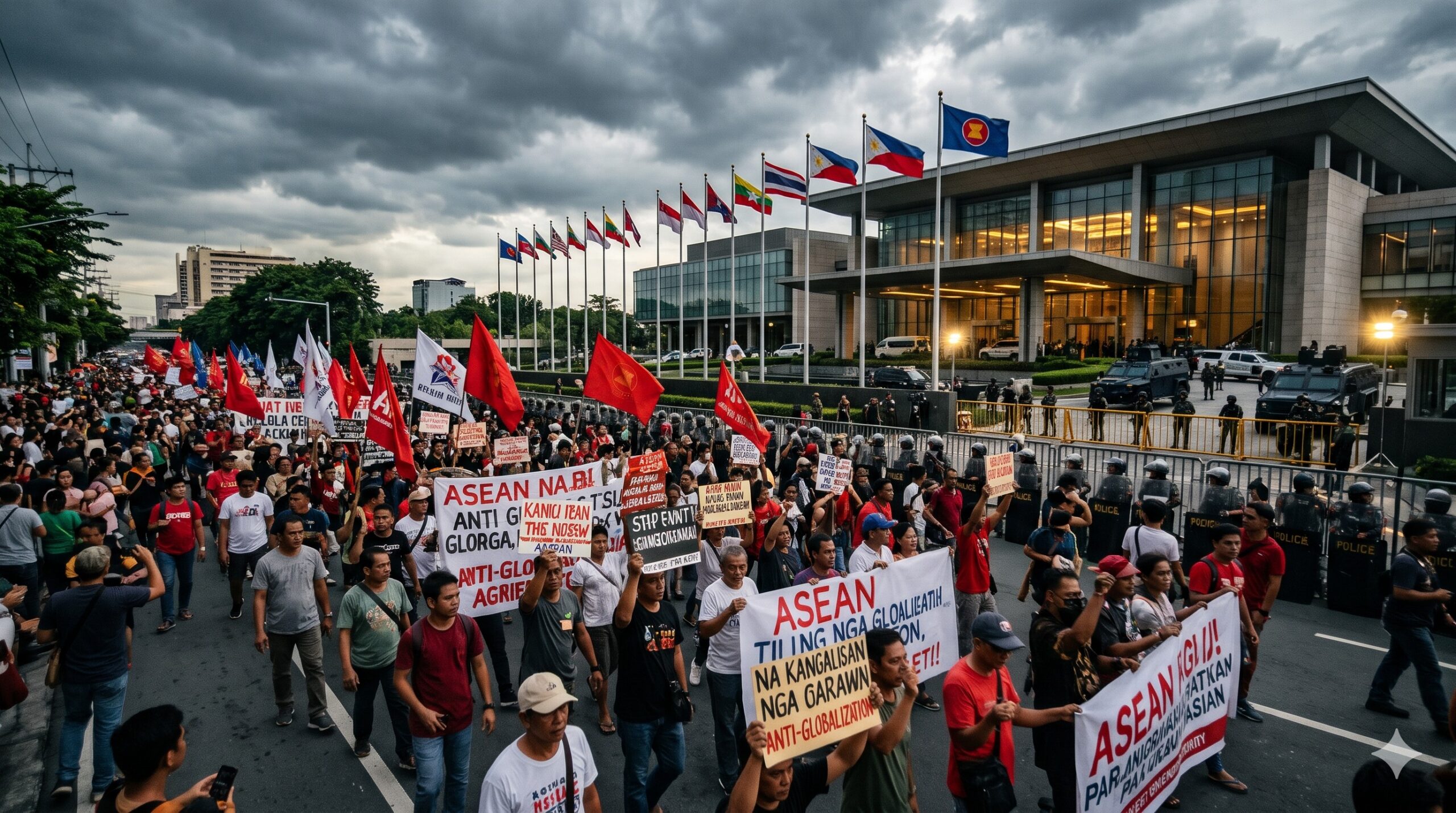
The air over Metro Manila is thick with a familiar, high-stakes tension. As Air Force One touched down at the tail end of the Association of Southeast Asian Nations (ASEAN) summit, US President Donald Trump was greeted not only by military bands and red-carpet formalities but by the fiery backdrop of thousands of demonstrators filling the capital’s streets. Protesters burning effigies and decrying US-led technology and mineral initiatives underscored a stark geopolitical reality: the Indo-Pacific is no longer just a boardroom concept for great powers; it is a contested front line.
Against this volatile backdrop, Trump’s brief whistle-stop in the Philippines served as a prelude to a grueling diplomatic circuit that includes a high-profile Quad leaders’ meeting alongside Indian Prime Minister Narendra Modi, Japanese Prime Minister Sanae Takaichi, and Australian Prime Minister Anthony Albanese, before pressing onward to China for the APEC summit.
Beneath the polished facade of joint communiqués and photo ops lies a complex web of strategic posturing, historical friction, and grassroots resistance. Here is an exhaustive, analytical exploration of the root causes, power dynamics, and competing worldviews defining the Manila summits.
1. Root Causes: Why Manila Became a Flashpoint of Protest
The immediate catalyst for the mass demonstrations gripping Manila centers on growing regional pushback against US-led geopolitical architectures—specifically security and technology pacts like the “Pax Silica” initiatives focused on artificial intelligence and critical mineral supply chains.
However, the root causes run much deeper:
- Sovereignty vs. Alignment Pressures: Smaller ASEAN member states have long championed “ASEAN Centrality”—a diplomatic doctrine designed to prevent Southeast Asia from becoming a binary chessboard for US-China rivalry. The high-visibility consolidation of the Quad (US, India, Japan, Australia) often forces regional actors into uncomfortable positioning.
- Economic Anxiety and Resource Extraction: Protesters drawn from labor unions, student groups, and indigenous coalitions voiced sharp opposition to corporate-led trade frameworks that they argue prioritize Western tech sovereignty over local labor rights and environmental protections.
- Spillover of Global Conflicts: Demonstrations also targeted wider foreign policies, linking local economic grievances with global flashpoints, including ongoing conflicts in West Asia and military escalation risks in the South China Sea.
2. Historical Parallels: The Ghost of Cold War Alliances
To understand the friction defining the 2026 Manila summits, historians look back to the mid-20th century, when Southeast Asia served as the primary theater for proxy containment strategies.
HISTORICAL EVOLUTION OF INDO-PACIFIC ALLIANCE ARCHITECTURES
| ERA | STRATEGIC PARADIGM | DOMINANT DYNAMICS |
| Cold War (1950s–1980s) | SEATO & Bilateral Containment (Southeast Asia Treaty Org). | Rigid ideological blocs, direct military clientelism. |
| Post-Cold War (1990s) | ASEAN Way & Economic Engagement (“Enmeshment” via trade). | Multilateralism, consensus-building, open regionalism. |
| Contemporary (2026) | Minilateralism & Strategic Tech Fencing (Quad & APEC shifts). | The Quad, supply chain decoupling, and hard deterrence. |
ust as the Southeast Asia Treaty Organization (SEATO) sought to corral regional allies against communist expansion in the 1950s, today’s Quad operates as a “minilateral” bulwark against Beijing’s maritime expansion. However, unlike the rigid, treaty-bound blocs of the Cold War, contemporary minilateralism relies on flexible frameworks covering cybersecurity, critical minerals, and maritime domain awareness.
Yet, the core historical anxiety remains unchanged: regional capitals fear being dragged into a great-power confrontation that could devastate local economies and fracture regional peace.
3. Power Dynamics: The Quad in Manila and the Shadow of Shenzhen
The Manila gathering served as a vital calibration point for the Quad. Prime Minister Narendra Modi, Australian PM Anthony Albanese, and Japanese PM Sanae Takaichi converged with President Trump at the Solaire resort, utilizing the ASEAN sidelines to reaffirm that “the Quad is here to stay”. Key announcements—such as a $10 million US commitment toward critical mineral waste recovery infrastructure across India and ASEAN—demonstrated an effort to pair strategic deterrence with economic utility.
At the same time, the broader geopolitical chess match looms large over the transition to the APEC summit in Shenzhen, China.
POWER DYNAMICS ACROSS THE MANILA-SHENZHEN DIPLOMATIC AXIS
| ACTOR | STRATEGIC LEVERAGE | PRIMARY OBJECTIVE |
| United States | Security umbrellas, tech controls, and minilateral coalitions (Quad). | Maintain Indo-Pacific deterrence while navigating domestic limits. |
| China | Industrial dominance, rare earths, and regional economic gravity. | Undermine western-led containment via bilateral outreach at APEC. |
| ASEAN / Philippines | Diplomatic balancing and “ASEAN Centrality” doctrines. | Preserve regional autonomy and avoid forced bipolar alignment. |
While Trump’s domestic political standing has been complicated by recent midterm results—leaving him with narrower legislative and diplomatic margins—foreign capitals recognize that engaging him remains essential. The juxtaposition of a security-heavy Quad meeting in Manila followed immediately by a trade-and-summit circuit in China highlights the fluid, transactional nature of modern superpower diplomacy.
4. Humanitarian vs. Strategic View: The Divergent Lenses
Evaluating the Manila summits through competing analytical frameworks reveals a profound philosophical chasm:
- The Strategic/Realist Lens: From the perspective of Washington, Tokyo, Canberra, and New Delhi, the summits are vital security architecture. Proponents argue that maritime patrols, joint technological supply chains, and robust defense deterrence are non-negotiable prerequisites to preserve open sea lanes and prevent unilateral hegemony in the South China Sea. In this view, protests are an expected domestic friction point in open societies.
- The Humanitarian/Grassroots Lens: Conversely, local civil society organizations, human rights advocates, and anti-war coalitions view the militarization of the Indo-Pacific through a humanitarian framework. They argue that billions of dollars funneled into naval patrols, semiconductor restrictions, and defense pacts starve domestic health, education, and climate adaptation budgets while turning Southeast Asia into a potential nuclear battleground.
Conclusion: Navigating a Multiplex Future
The convergence of high-level diplomacy and tear-gas-laced protests in Manila encapsulates the dilemmas of twenty-first-century statecraft. As the Quad solidifies its institutional footprint and leaders pivot toward high-stakes engagements in China, the region finds itself caught between the gravitational pull of great-power competition and the urgent local demand for sustainable, inclusive development.
Ultimately, whether these summits succeed will not be measured solely by joint declarations or defense pacts signed in luxury hotels, but by whether they can secure long-term stability without sacrificing the sovereignty and well-being of the populations whose streets echo with dissent.
References & Citations
- The Guardian (November 17, 2026): Apec and Asean summits live: protests greet Trump’s arrival in Manila as he meets ‘Quad’ leaders — Comprehensive live coverage detailing protests in Manila, arrests, Trump’s arrival, and Quad meetings.
- The Times of India (November 17, 2026): ASEAN Summit 2026 Live Updates: PM Modi announces Mumbai to host inaugural Quad Business Leaders Forum in 2027 — Real-time reporting on Modi, Trump, Takaichi, and Albanese’s engagements, critical mineral commitments, and cybersecurity cooperation.
- Asian News International / ANI (November 17, 2026): Trump meets Quad Leaders PM Modi, Takaichi and Albanese on ASEAN summit sidelines — Official updates on the Quad leaders’ photo-op and strategic declarations.
- Hindustan Times (November 17, 2026): Quad talks LIVE: Trump arrives in Manila, to attend Quad leaders’ meeting — Detailed reports on demonstrators, effigy burning, and public pushback against US-led tech initiatives.
* Conceptual illustration generated using AI