For decades, popular culture operated under a predictable, top-down broadcasting model. A handful of Hollywood studios, major record labels, television networks, and print editors acted as cultural gatekeepers. They decided which songs dominated radio waves, which films captured public imagination, and which fashion trends defined a decade. The world consumed a shared “monoculture”—a collective water-cooler reality where millions watched the same prime-time television finales or listened to the same chart-topping albums simultaneously.
As we navigate late 2026, that unified monoculture is officially dead.
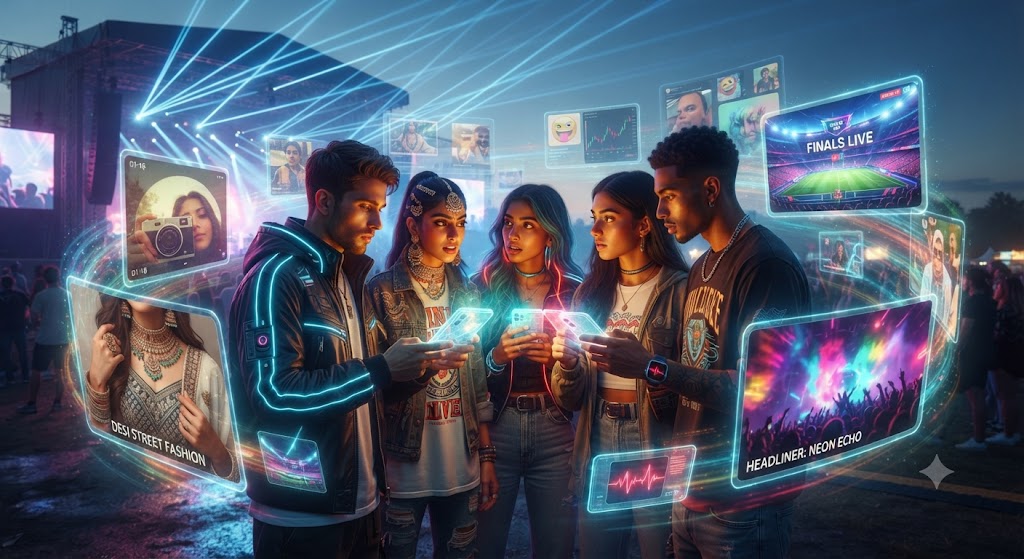
Driven by hyper-personalized algorithmic feeds, short-form video ecosystems, synthetic media proliferation, and decentralized digital communities, pop culture has fractured into millions of self-contained micro-cultures. Today, two people sitting side-by-side on a subway can inhabit entirely different media universes, consuming bespoke memes, niche musical sub-genres, and localized influencer sagas that never cross into each other’s awareness.
Yet, paradoxically, as mass media fragments, human beings are hungering more than ever for authentic, shared physical experiences and nostalgic touchstones. Here is an in-depth analysis of how pop culture evolved in 2026, the mechanics behind algorithmic fandoms, and what the death of the monoculture means for global media, entertainment, and identity.
1. From Mass Broadcast to Algorithmic Isolation
The central driver of modern pop culture’s transformation is the shift from broadcast distribution to algorithmic curation.
In the traditional media landscape, pop culture was cumulative and linear. In the digital ecosystem of 2026, recommendation algorithms continuously optimize for immediate emotional engagement, creating personalized “Echo Chambers of Attention.”
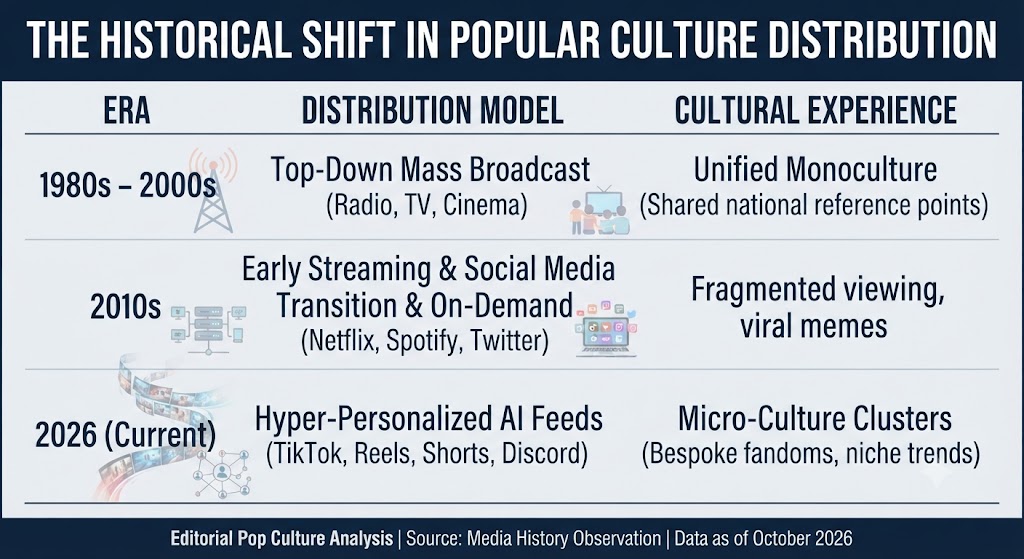
The historical shift in popular culture distribution
This structural shift has altered the lifespan of cultural phenomena:
- Hyper-Accelerated Trend Cycles: A aesthetic, phrase, or audio trend can emerge overnight, achieve saturation across tens of millions of screens within 48 hours, and become completely obsolete within a fortnight.
- The Loss of Shared Basics: Because feeds are tailored to hyper-specific tastes, mainstream “superstars” no longer command universal name recognition among the general public. An online creator can accumulate 50 million dedicated followers while remaining entirely unknown to anyone outside their specific algorithmic niche.
2. The Nostalgia Compression Loop: Why 10-Year Cycles Are Shrinking
Historically, pop culture operates on a 20-year nostalgia cycle. The 1990s obsessed over 1970s disco and fashion; the 2010s revived 1990s grunge and Y2K aesthetics.
In 2026, however, the nostalgia cycle has compressed down to just 10 years. Across digital platforms, a massive cultural wave labeled “2026 is the new 2016” has captivated Gen Z and Millennial audiences alike.
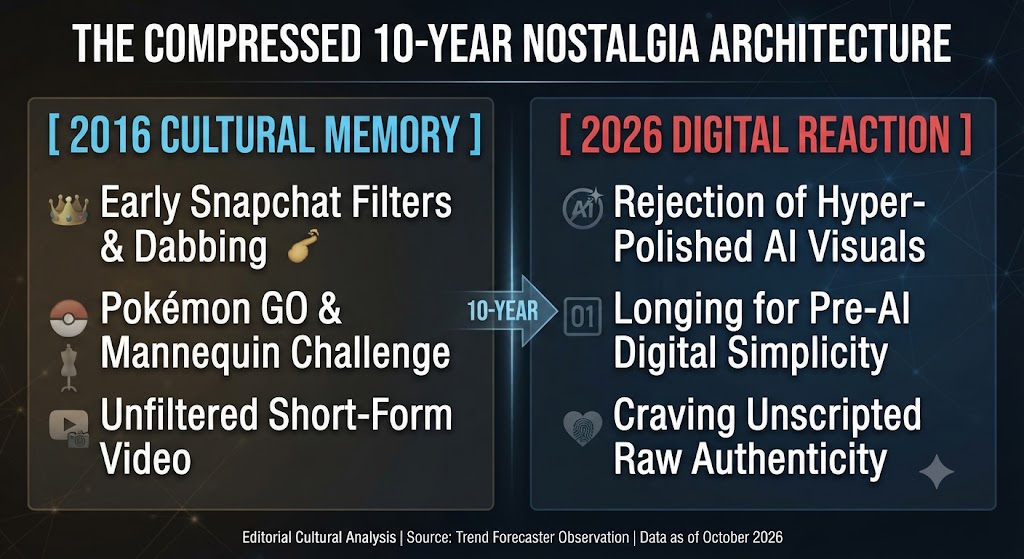
The compressed 10-year nostalgia architecture
Why are audiences yearning for 2016 so intensely just ten years later?
Sociologists and media theorists point to generative AI fatigue. As synthetic imagery, AI-generated text, and algorithmically optimized content flood social feeds, users are developing a visceral resistance to hyper-polished digital perfection. The internet of 2016 represents the final era of human-first, unpolished digital spontaneous expression—a simpler internet before sophisticated generative models and aggressive commercial monetization overtook digital spaces.
3. Hyper-Global Fusion: The Death of Western Cultural Hegemonic Dominance
For over half a century, pop culture was overwhelmingly an export of Anglo-American media hubs in Los Angeles, New York, and London. In 2026, pop culture is thoroughly multi-polar and globally decentralized.
Cultural signals now move fluidly across borders, fusing regional traditions with global urban aesthetics:
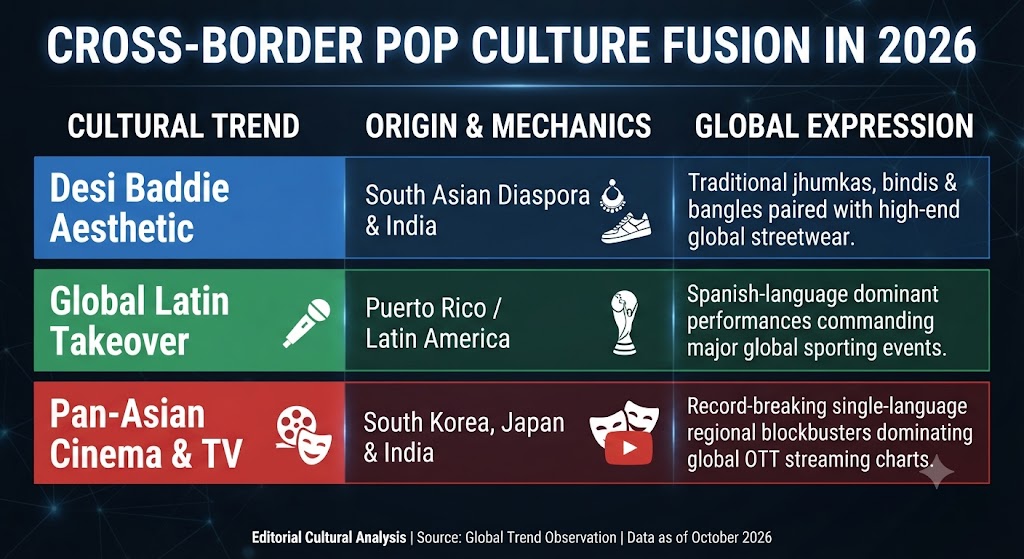
Cross-Border pop culture fusion in 2026
The rise of aesthetics like the “Desi Baddie”—where Gen Z creators across London, New York, Mumbai, and Toronto style traditional South Asian jewelry like jhumkas and bindis alongside modern streetwear—demonstrates how young populations use heritage elements to construct unapologetic, modern global identities.
Similarly, global spectacles like Bad Bunny’s Spanish-language headline performance at the Super Bowl halftime show prove that mainstream global entertainment no longer requires translation or Westernization to achieve universal acclaim.
4. The Live Spectacle Revival: Physical Gathering as Strategic Counter-Weight
As digital content becomes endless, low-cost, and frictionless, the economic and emotional value of physical, shared live experiences has soared.
Because digital media no longer provides a sense of collective connection, audiences are turning to live events—concerts, immersive theatrical productions, esports stadium finals, and physical fan conventions—as sacred spaces for real-world community building.
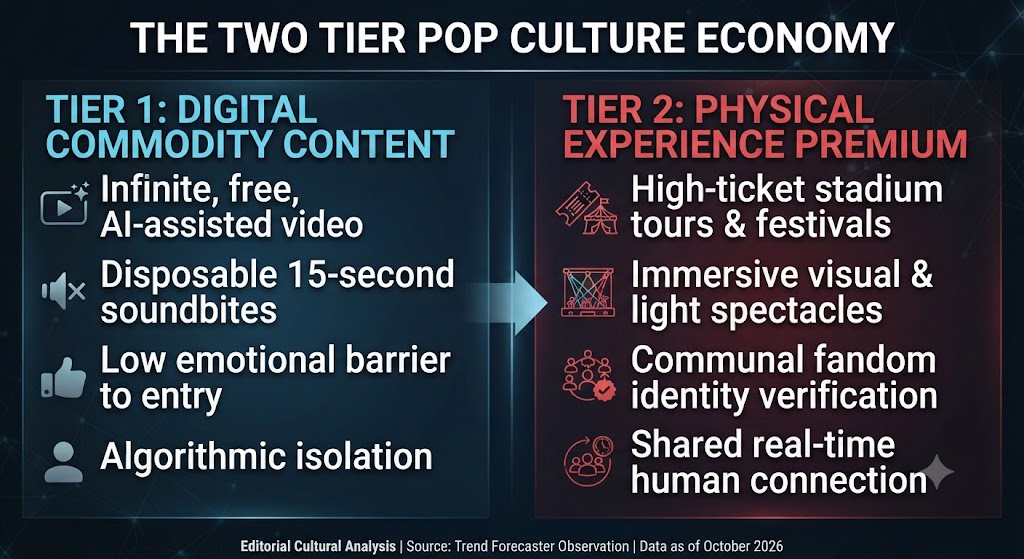
The two tier pop culture economy
Musicians and creators are responding by turning physical live performances into visually stunning, interactive art installations designed specifically to foster real-time communal awe. Fans do not merely attend a concert to hear music; they attend to participate in an offline ritual, record their presence within a physical fandom, and validate their cultural belonging.
Conclusion: Navigating the Micro-Culture Era
Pop culture in 2026 is no longer a single, unified river; it is an expansive ocean of distinct, fast-moving currents.
While the death of the monoculture has made it harder for traditional media conglomerates to engineer universal blockbusters, it has unlocked unprecedented creative freedom for diverse communities worldwide. Pop culture is no longer defined by what gatekeepers broadcast to the masses; it is defined by how decentralized groups of human beings use music, fashion, nostalgia, and shared physical spaces to find meaning, identity, and genuine connection in an increasingly automated world.
* Conceptual illustration generated using AI