In the ruthlessly transactional ecosystem of modern Formula 1, crisis management usually follows a predictable script: when a dominant team loses its competitive edge, the corporate axe falls swiftly. Aerodynamicists are quietly shown the door, technical directors are replaced amid public scapegoating, and team principals stage dramatic overhauls to appease sponsors and shareholders.
When Mercedes-AMG Petronas hit the brick wall of the ground-effect regulations in 2022—struggling through years of porpoising, inconsistent mechanical balance, and a loss of championship momentum—the Brackley-based squad broke that mold entirely.
Reflecting on Mercedes’ triumphant return to the summit of Formula 1—highlighted by Andrea Kimi Antonelli securing the Drivers’ World Championship and the team wrapping up its ninth constructors’ crown—Grand Prix winner George Russell pointed not to a revolutionary mid-season tech upgrade or a high-profile executive hiring spree, but to leadership psychology. In interviews following the recent Brazilian Grand Prix weekend at Interlagos, Russell singled out Team Principal Toto Wolff, crediting his unwavering institutional loyalty as the absolute bedrock of their championship comeback.
“We have been through a lot over those years. It’s been extremely tough times,” Russell told media outlets including RacingNews365. “Something I admire a lot about Toto’s leadership is that the people we have today are the same people who were there during the glory years, and they’re the same people who went through the difficulties during 2022 to 2025. Nobody was hired or fired.“
That counterintuitive refusal to panic-purge the engineering ranks has sparked a wider conversation across international sport regarding the value of psychological safety versus reactionary management. Here is an analytical deep dive into Mercedes’ stability-driven revival, why Wolff’s leadership architecture defied conventional motorsport logic, and how corporate loyalty engineered a title return.
1. The Anatomy of a Slump: Why 2022–2025 Broke Other Teams
To appreciate why Mercedes’ internal stability is so remarkable, one must examine the psychological and structural toll of their four-year championship drought.
From 2014 through 2021, Mercedes orchestrated the most dominant dynastic run in Formula 1 history, capturing eight consecutive constructors’ world championships. Their engineering culture was calibrated for absolute perfection. When the sweeping aerodynamic regulations introduced in 2022 upended the sport, Mercedes’ revolutionary “zeropod” design concept fundamentally failed. The W13 and its immediate successors suffered from extreme aerodynamic bouncing (porpoising), a hyper-narrow operating window, and unpredictable rear-end snap that baffled drivers and engineers alike.
MERCEDES F1 PERFORMANCE & PERSONNEL TRAJECTORY (2022–2026)
| PHASE / ERA | TECHNICAL REALITY | CORPORATE / LEADERSHIP RESPONSE |
| 2022–2023 (The Valley) | “Zeropod” concept failure; porpoising & poor balance | Public frustration; initial technical scramble; internal pressure spikes. |
| 2024–2025 (The Rebuild) | Slow convergence toward winning setups; rising friction & design debates | Toto Wolff shifts from punitive pressure to protective leadership; retention of core aerodynamicists and vehicle dynamics teams. |
| 2026 (The Summit) | New F1 regulations debut; W17 unlocked; 9th Constructors’ Crown | Fruit of long-term stability; Antonelli wins Drivers’ title; Russell secures P2/top form; “No hire and fire” philosophy vindicated. |
In any ordinary corporate structure—or within rival F1 outfits like Ferrari or Red Bull—such a prolonged slump routinely triggers an immediate executive clear-out. Technical directors are replaced, senior aero staff are dismissed, and blame is assigned publicly.
Instead, Toto Wolff chose a path of intense internal introspection. Reports from senior leadership analysts highlighted that during the height of the development struggles, Wolff recognized that piling additional panic-driven pressure onto an already overburdened technical department was counterproductive. When key senior engineers expressed burnout or considered leaving under the crushing weight of public expectation, Wolff actively adjusted his approach—shifting from punitive oversight to protective stewardship.
2. Redefining “Safety”: The Corporate Power of Zero-Attrition
When Russell used the word safety to describe the Brackley and Brixworth environment, he was not referring solely to physical paddock conditions. He was pointing to psychological safety—the foundational confidence that a brilliant engineer can take a calculated design risk, fail publicly, and not find their desk cleared out by Monday morning.
“Stability was certainly a factor, but we have also many people that have joined us recently, and I think what I would like to choose as a word is safety,” Russell explained. “You know, we are not a hire and fire organisation. The trust and belief stayed with the core group of people, and now we’ve come through… Credit to everybody in the team, but huge credit to Toto for that loyalty and belief in the people, even when times were tough.”
In high-performance engineering fields, fear is an inhibitor of innovation. If aerodynamicists know that a failed wind-tunnel correlation will result in immediate termination, they naturally gravitate toward safe, incremental, and uninspired updates. They stop taking bold risks.
By refusing to execute knee-jerk layoffs or cyclical purges, Wolff preserved the institutional knowledge base that built the 2014–2021 championship machines. The senior personnel who understood the fundamental physics of vehicle dynamics, power unit integration, and tire degradation under the old rules were kept in place to decode the complexities of the new regulations. When Mercedes finally cracked the aerodynamic code for the current ground-effect and hybrid regulations, it was engineered by the exact same minds that had conquered the turbo-hybrid era a decade prior.
3. The 2026 Redemption: Balancing Youth and Institutional Memory
The vindication of Wolff’s loyalty policy bore its sweetest fruit during the 2026 season. With F1 ushering in an entirely new generation of power units and active aerodynamic regulations, Mercedes struck gold with the W17 architecture.
The intra-team battle captivated the motorsport world: 19-year-old prodigy Andrea Kimi Antonelli mounted a sensational campaign to capture the Drivers’ World Championship, while George Russell fought valiantly to the very final rounds, showcasing relentless racecraft despite battling a tricky car operating window that occasionally tested his patience.
THE PILLARS OF MERCEDES’ 2026 TITLE-WINNING ARCHITECTURE
| PILLAR | STRATEGIC MECHANISM |
| 1. Institutional Memory | Retaining core 2014–2021 engineering veterans who understood fundamental vehicle physics. |
| 2. Psychological Safety | Toto Wolff’s “no hire and fire” policy, fostering an environment where bold innovation outweighed fear. |
| 3. Calculated Renewal | Blending seasoned veterans with elite young talent like Kimi Antonelli and hungry racers like George Russell. |
By pairing this preserved institutional core with fearless fresh talent like Antonelli—a gamble that initially caused friction with traditional sponsors—Mercedes engineered a masterclass in generational transition. Antonelli’s raw speed injected explosive energy into the garage, while Russell’s analytical feedback loop, forged through the difficult 2022–2025 development years, helped guide the team’s chassis evolution.
4. Leadership Lessons Beyond the Paddock
Russell’s public praise of Wolff offers a vital blueprint that extends far beyond the Formula 1 pit lane into global corporate management, tech startups, and high-stakes engineering firms:
- Patience Outperforms Panic: Reactionary downsizing during a market downturn or product failure destroys the most valuable asset a company possesses: tacit institutional knowledge.
- Empathy as an Engineering Asset: Pushing exhausted teams harder rarely yields better code or superior designs. Knowing when to absorb pressure rather than deflect it protects talent retention.
- Trust is a Compound Asset: Teams that endure shared institutional trauma together—and emerge intact under supportive leadership—forge a cultural resilience that transient “mercenary” hires can never replicate.
Conclusion: The Ultimate Loyalty Dividend
As Mercedes celebrated its ninth constructors’ championship and looked toward the defense of its crown, George Russell’s tribute to Toto Wolff crystallized the true secret behind their revival.
In a sport obsessed with carbon-fiber aerodynamics, telemetry data, and raw horsepower, the defining variable at Brackley wasn’t just a new wing or an engine map—it was human loyalty. By protecting his people when the stopwatch lied and the trophies stopped arriving, Toto Wolff proved that the strongest structures in motorsport are not bolted together in a machine shop; they are built on trust.
References & Primary Sources
- Motorsport.com (November 12, 2026): George Russell credits Toto Wolff’s loyalty for Mercedes’ F1 title return: “Nobody was hired or fired” — Comprehensive coverage of Russell’s post-race analysis on team stability and leadership.
- RacingNews365 (November 11, 2026): Unusual Toto Wolff method hailed for helping Mercedes through ‘extremely tough times’ — Detailed breakdown of Mercedes securing their ninth constructors’ crown and Russell’s quotes regarding corporate safety.
- Formula1.com & GrandPrix247 (October–November 2026): Russell struggling with ‘difficult’ operating window – Wolff and Toto Wolff urges George Russell to maintain the mentality of the fighter — Technical reporting on the W17 development trajectory and driver dynamics.
- Inc. Magazine & F1i.com (October–November 2026): Mercedes F1 Boss Toto Wolff Nearly Lost a Top Employee. What Happened Next Is a Lesson in Leadership — Analysis of Wolff’s leadership evolution during the team’s slump.
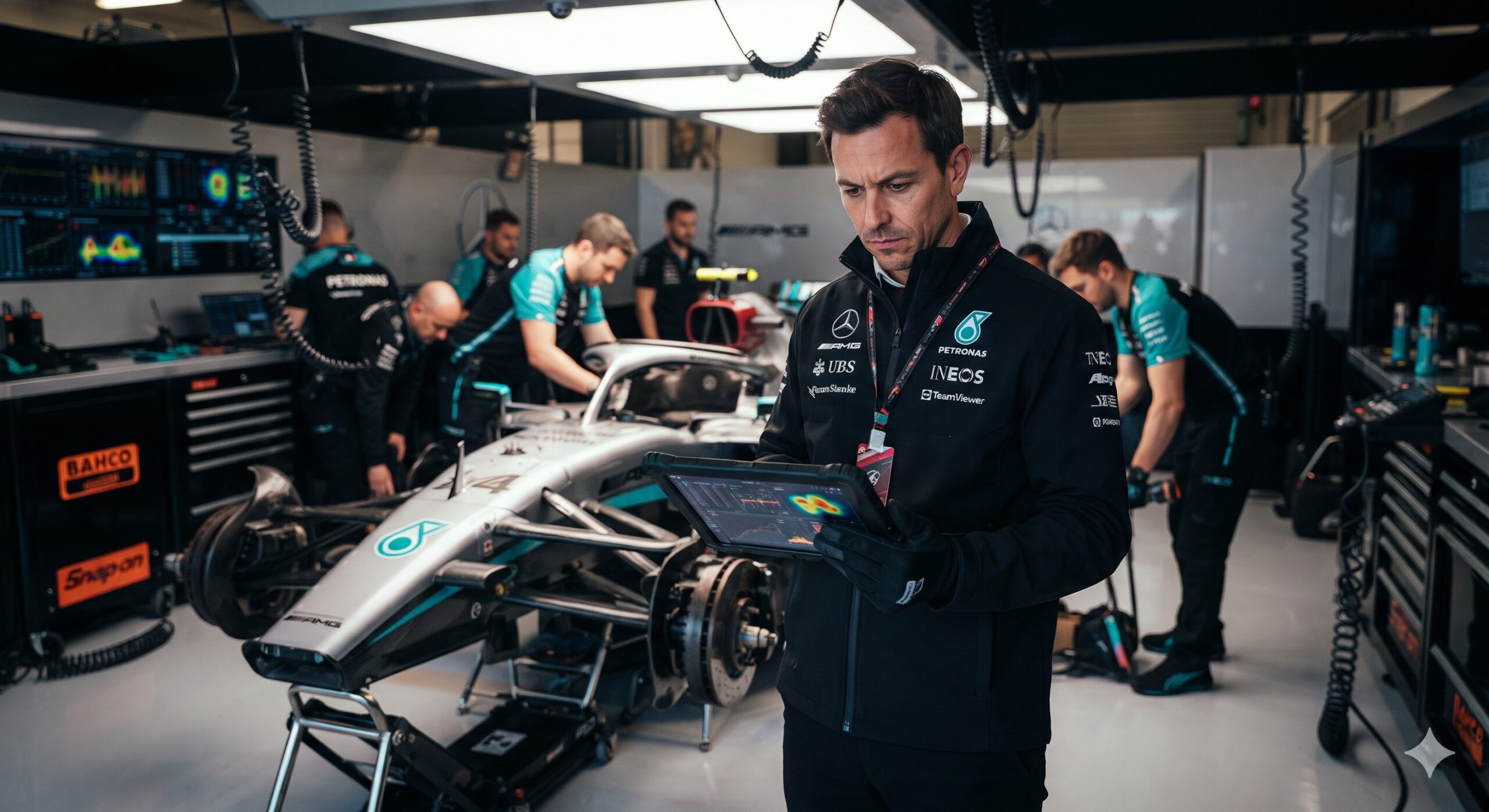
* Conceptual illustration generated using AI