
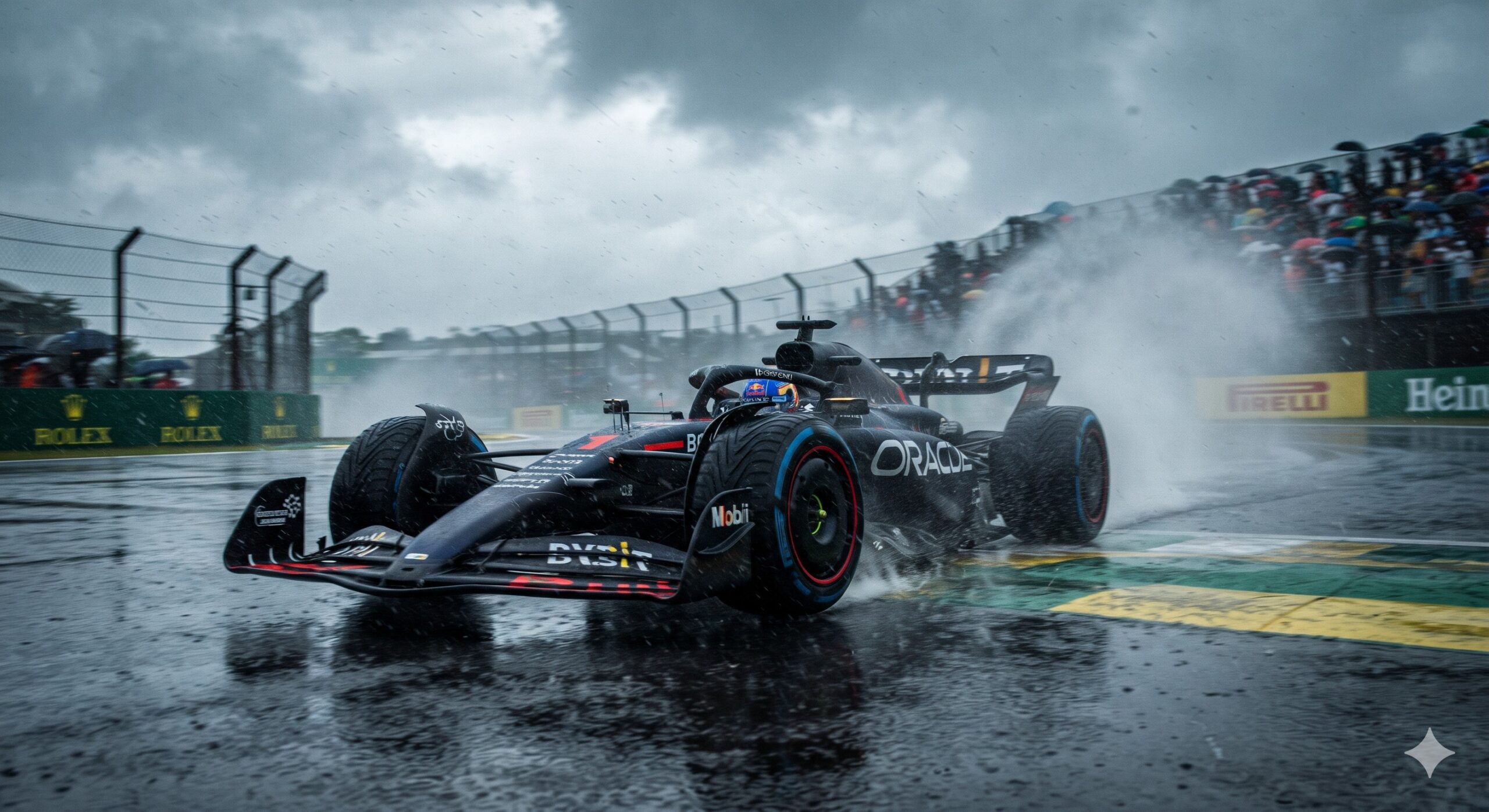
In the hyper-engineered, data-driven universe of modern Formula 1, water is the great equalizer. When the heavens open and rain saturates the asphalt, the meticulously crafted aerodynamic downforce that defines modern F1 cars is fundamentally neutralized. Grip is no longer a mathematical guarantee generated by wind tunnels; it becomes a fleeting, invisible variable that must be felt through a driver’s fingertips and the base of their spine. It is in this treacherous, low-adhesion purgatory that true generational talent is separated from mere competence.
Historically, the sport has crowned a select few as “Rainmasters”—Ayrton Senna at Donington Park in 1993, Michael Schumacher at Catalunya in 1996, and Lewis Hamilton at Silverstone in 2008. Today, that mantle belongs unequivocally to Max Verstappen.
Over the past decade, Verstappen has authored a wet-weather résumé that defies conventional motorsport physics. From his legendary arrival as a rain prodigy at Brazil in 2016 (carving from 14th to 3rd in 16 laps) to his breathtaking 2024 victory from 17th on the grid, his dominance in the wet is undisputed. Most recently, at the 2026 São Paulo Grand Prix on November 8, Verstappen delivered another mesmerizing masterclass, charging from 21st on the grid through torrential spray to finish a spectacular 2nd behind race-winner Lando Norris [1].
“Within two laps, I was just flying by cars, almost every corner,” Verstappen reflected following his 2026 podium at Interlagos. “We had a lot more grip, I guess, than most in the midfield. I don’t know what lap I was in the top 10, but it all happened very quickly” [2].
But why is Verstappen so devastatingly effective in bad weather? His supremacy is not magic; it is a quantifiable blend of unorthodox racing lines, hyper-calibrated car control, engineered thermal tire cycles, and a childhood forged in the freezing Dutch rain. Here is the analytical breakdown of Formula 1’s modern Rain Man.
1. The Physics of Grip and the “Karting Line”
To understand Verstappen’s advantage, one must understand the physics of a wet racetrack. In dry conditions, the fastest way around a circuit is the “racing line”—the geometrically optimal path through a corner. As cars lap the circuit, their tires leave behind a layer of sticky rubber on this line, providing maximum friction and adhesion.
However, when it rains, this rubbered-in line becomes a death trap. The combination of standing water, oils drawn out of the asphalt, and smooth, polished rubber turns the conventional racing line into a surface resembling black ice.
Verstappen’s most potent weapon in the wet is his immediate, instinctive abandonment of the conventional dry line. While the majority of the grid nervously tiptoes over the slippery rubber, Verstappen swings his car wide, seeking the “green” (unrubbered) asphalt. This outside line forces the car to travel a longer physical distance, but the bare asphalt contains macro-texture (tiny crevices in the tarmac). The tread blocks of the Pirelli intermediate or wet tires interlock with this macro-texture, generating significantly more mechanical grip.
Verstappen maps this grip in real-time. During safety car periods or out-laps, he can be seen driving in bizarre zig-zag patterns far off the racing line. He is not merely warming his tires; he is physically probing the asphalt, creating a mental grip-map of the circuit corner by corner. By the time the green flag waves, he already knows exactly where the mechanical adhesion lies.
2. The Virtuous Cycle of Tire Temperature
In wet weather, Formula 1 becomes a battle of thermodynamics. Pirelli’s Cinturato Green (Intermediate) and Blue (Full Wet) tires operate in incredibly narrow temperature windows. If the tire is too cold, the rubber compound stiffens, failing to bite into the track surface.
This creates a brutal paradox for most drivers: they lack the confidence to push because the track is slippery, which means they don’t put energy into the tires. Because the tires remain cold, they lose even more grip, plunging the driver into a vicious cycle of sliding and temperature loss.
Verstappen’s ability to find alternative lines with high mechanical grip allows him to break this cycle instantly. Because he finds grip on the outside line, he can carry more mid-corner speed and apply the throttle earlier. This aggressive energy transfer flexes the tire carcass, generating internal heat. That heat softens the rubber compound, which in turn provides more grip. Verstappen operates in a virtuous thermal cycle, allowing him to brake meters later than rivals like George Russell or Charles Leclerc because his tires are fundamentally operating in a different state of physical readiness.
3. Forged in Genk: The Jos Verstappen Method
Verstappen’s sensory processing in the wet was not learned in a multimillion-dollar simulator; it was beaten into him by the brutal winter elements of European karting. His father, former F1 driver Jos Verstappen, famously subjected Max to extreme training methods.
When torrential rain hit the karting tracks of Genk, Belgium, other competitors would pack up their awnings or immediately bolt on grooved wet tires. Jos, however, forced Max to stay out on the flooded track using bald slick tires. Furthermore, Jos would physically stand on the standard racing line, forcing his son to drive around him.
This draconian training regimen forced a young Max to survive in a constant state of low grip. He learned to feel the micro-shifts in yaw (the angle at which the car is sliding relative to its direction of travel) through his lower back. By practicing on slicks in the rain, he developed an unparalleled sensitivity to throttle application, learning exactly how much torque he could deliver to the rear axle before the rotational force overwhelmed the available friction.
4. Managing “Yaw” and the Pointy Car
Every Formula 1 driver has a preferred vehicle setup. Verstappen is famous for demanding a “pointy” car—a setup featuring a razor-sharp, highly responsive front-end, paired with a loose, oversteery rear-end. In the dry, this allows him to rotate the car into an apex faster than almost anyone else on the grid.
In the wet, a loose rear-end is typically a driver’s worst nightmare, making the car prone to sudden, uncatchable spins. Yet, Verstappen is entirely comfortable operating in a state of high yaw. His internal gyroscope is so finely tuned that he preemptively catches snaps of oversteer before they fully materialize. He achieves this through micro-corrections on the steering wheel and “short-shifting”—shifting up through the gears earlier than necessary to drop the engine RPMs, thereby smoothing out the torque delivery to the rear wheels and preventing wheelspin.
5. Mental Bandwidth and Real-Time Engineering
Driving an 800-horsepower, high-downforce prototype in low visibility and standing water requires 100% of a driver’s cognitive capacity just to keep the car out of the barriers. Verstappen, however, drives with spare mental bandwidth.
As track conditions evolve, the required setup of the car changes corner by corner. In the wet, because overall deceleration forces are lower, there is less forward weight transfer. If a driver leaves their brake bias in the dry setting, the front wheels will instantly lock up and cause hydroplaning. Verstappen can be seen constantly manipulating the toggles on his steering wheel mid-corner—shifting his brake migration rearward, opening the differential to allow the rear wheels to spin at different speeds for better traction, and navigating through engine braking maps.
This processing speed extends to risk management. The 2026 Brazilian Grand Prix was plagued by dangerous standing water. Following the race, Verstappen and podium-finisher Isack Hadjar were highly vocal about the narrow operating window and aquaplaning risks of the current Pirelli wet-weather tires [3]. Verstappen’s ability to visually identify standing water at 180 miles per hour, compute the aquaplaning risk, and adjust his trajectory by a matter of inches to keep the floor of the car from “planking” on the water is what allowed him to surge past 19 cars while others spun off.
The Ultimate Differentiator
Rain does not create talent; it exposes it. It strips away the insulating layer of aerodynamic superiority and places the ultimate lap time squarely in the right foot, the hands, and the sensory processing speed of the human in the cockpit.
Max Verstappen’s ability to manipulate vehicle dynamics, his mastery of thermal tire cycles, and his instinctual knowledge of where grip hides on a flooded circuit make him a generational anomaly. Whether he is starting from pole position or executing a breathtaking 21st-to-2nd charge at Interlagos, the reality of modern Formula 1 is simple: when the skies darken and the track disappears beneath the water, the grid is merely surviving, but Verstappen is hunting.
References & Primary Sources
- Google Sports Data / Formula 1 (November 9, 2026): 2026 São Paulo Grand Prix Official Results. Lando Norris (P1), Max Verstappen (P2 from P21 starting position), Isack Hadjar (P3).
- Motorsport.com (November 11, 2026): Max Verstappen explains why he’s so good in the rain in Brazil. Exclusive driver quotes regarding overtaking efficiency and midfield grip advantages during the 2026 São Paulo GP.
- GPBlog (November 11, 2026): Verstappen and Hadjar question Pirelli’s rain tyres after Brazil. Analysis of the drivers’ safety concerns regarding extreme aquaplaning and the narrow operating window of the 2026 wet-weather compounds.
* Conceptual illustration generated using AI