
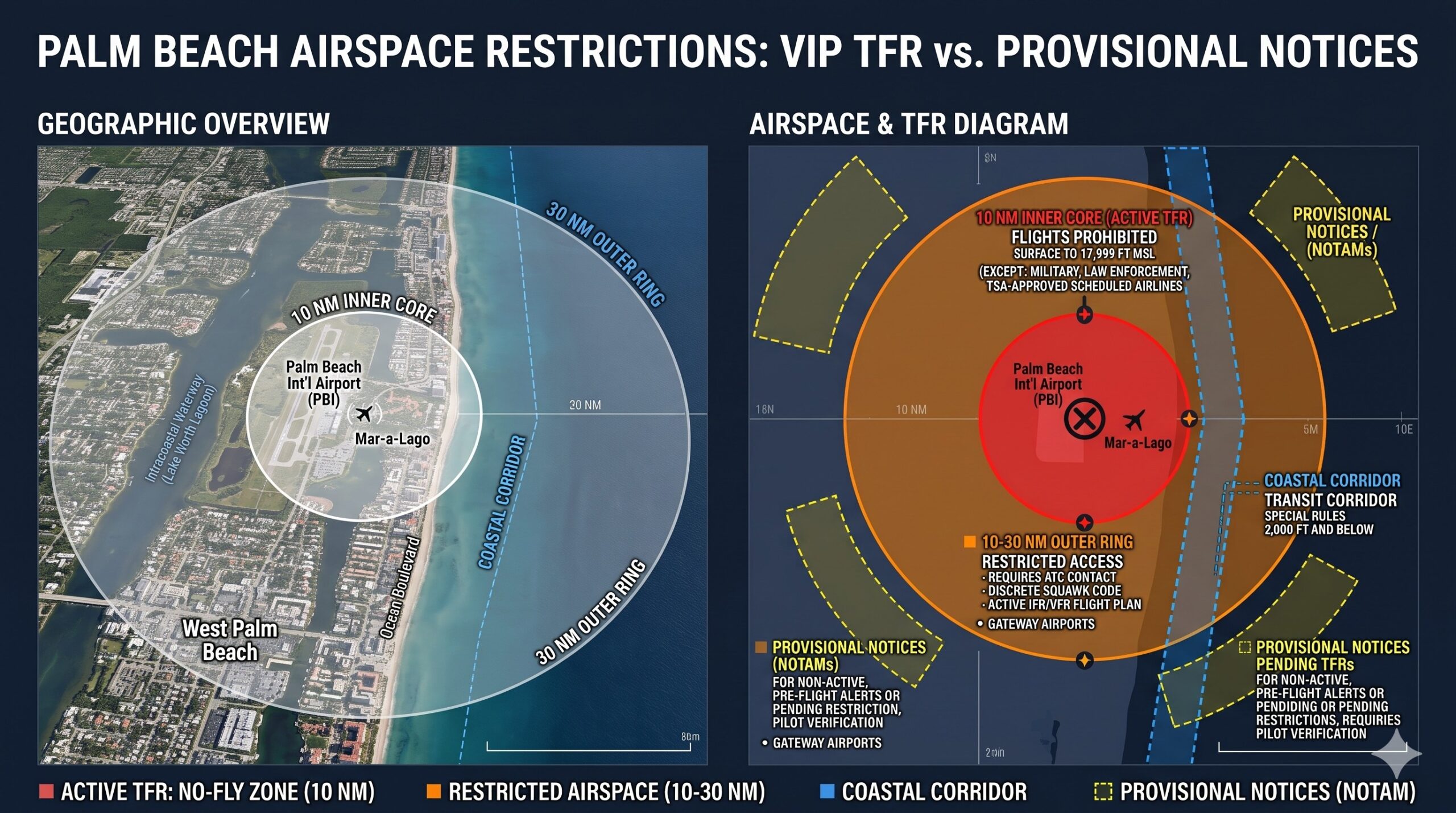
Author Note & Methodology: This independent analysis examines how Federal Aviation Administration (FAA) Initial VIP Movement Notifications, Temporary Flight Restrictions (TFRs) under 14 CFR § 91.141, and municipal airspace litigation intersect with presidential travel logistics around Mar-a-Lago in Palm Beach, Florida. Rather than treating every deleted or revised advisory as political intrigue, this assessment relies on primary regulatory frameworks—including FAA safety notices, Federal Register rulemaking dockets (such as Docket FAA-2026-10827 / 91 FR 56380), and D.C. Circuit appellate filings—alongside operational aviation realities to separate genuine signal from bureaucratic noise.
1. Executive Summary: Why “Phantom Restrictions” Are a Feature, Not a Bug
When an FAA VIP movement notice appears for Palm Beach and then disappears or shifts without a formal White House press release, observers often treat it as a dramatic reversal or a hidden political signal. In practice, aviation advisories tied to presidential travel are provisional operational planning tools. Initial VIP Movement Notifications routinely flag tentative windows—such as early-November dates around Nov. 6–8 or mid-November windows around Nov. 13–14 ahead of late-November international travel—while explicitly noting that schedules and flight restrictions remain subject to change on short notice.
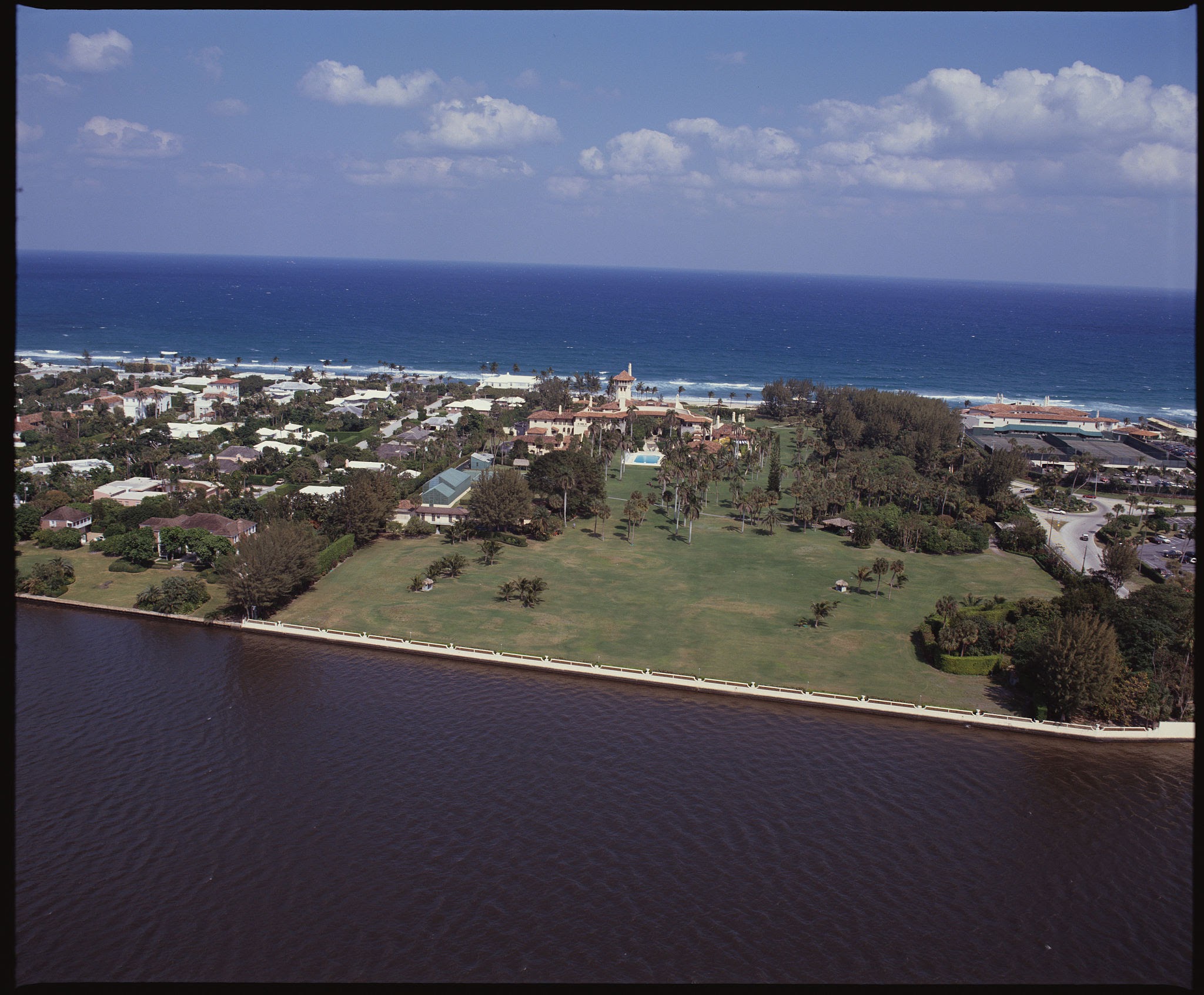
Mar-a-Lago along Palm Beach’s coastline. Source: Steven D Starr / Corbis via Getty Images
Understanding a canceled or withdrawn Mar-a-Lago weekend requires looking past cable-news speculation to three concrete mechanisms:
- Provisional Airspace Planning vs. Confirmed Movements: FAA VIP notices alert pilots and operators to potential security airspace blocks before a movement is locked in. When a trip is scrubbed, rescheduled, or kept fluid around major diplomatic travel or domestic crises, the corresponding notice may be superseded, canceled, or allowed to lapse.
- Layered Security Rules (14 CFR § 91.141 and SFRA Proposals): Presidential movements trigger strict Temporary Flight Restrictions—typically spanning an inner and outer ring (such as a 30-nautical-mile outer radius and 10-nautical-mile inner core up to nearly 18,000 feet MSL) enforced by law enforcement and fighter interceptors—distinct from baseline security rules or proposed Special Flight Rules Area (SFRA) frameworks near Mar-a-Lago and Palm Beach International Airport (rebranded/referenced in regulatory filings as President Donald J. Trump International Airport, DJT).
- High-Stakes Operational & Legal Friction: Every Palm Beach movement imposes real costs on commercial arrivals, business aviation, local road closures (such as South Ocean Boulevard), and municipal governments actively litigating airspace procedures in the U.S. Court of Appeals for the D.C. Circuit.
2. Primary Sourcing: How VIP Notices and TFRs Actually Work
To evaluate a deleted or altered FAA VIP notice independently, readers need to distinguish between advance operational notifications and active regulatory restrictions:
- Initial VIP Movement Notifications: Published through aviation safety channels (such as FAASTeam notices), these advisories give general aviation, charter operators, and flight planners advance warning of potential VIP-level airspace blocks in a geographic window (for example, Palm Beach, FL). They rarely name the protectee and are never a binding guarantee that Air Force One will land on those exact dates.
- Active TFR NOTAMs (14 CFR § 91.141): Actual binding restrictions are issued as Notices to Air Missions (NOTAMs) via the FAA’s TFR system. Once active, violating presidential TFR airspace carries severe regulatory penalties and potential interception by NORAD / fighter aircraft.
- Permanent / Semi-Permanent Airspace Proposals: Separate from weekend TFRs, federal security requests have pushed toward longer-term airspace rules—such as a proposed Special Flight Rules Area (SFRA) within a one-nautical-mile radius from the surface up to 2,000 feet MSL—triggering environmental, noise, and Administrative Procedure Act challenges from Palm Beach, Palm Beach County, and West Palm Beach.
DECODING FAA AIRSPACE SIGNALS FOR MAR-A-LAGO
| SIGNAL TYPE | OPERATIONAL MEANING & RELIABILITY | ENFORCEMENT & LEGAL BASIS |
| Initial VIP Notice | Tentative planning window; frequently revised or dropped if travel schedules shift or cancel. | Advisory advisory alert; non-binding planning window used by local aviation authorities and law enforcement. |
| Active TFR NOTAM | Binding airspace restriction block around specified geographic coordinates. | Enforced under 14 CFR § 91.141; mandatory compliance strictly monitored via air defense intercepts and mandatory rerouting. |
| SFRA / Docket Rule | Permanent or semi-permanent structural airspace regulation proposal (e.g., 91 FR 56380 / Docket FAA-2026-10827). | Formal Federal Register rulemaking process; heavily influenced by judicial challenges, noise abatement mandates, and local civil-aviation feedback. |
3. Independent Analysis: Logistics, Friction, and Why Weekends Get Scratched
A less source-dependent reading of a canceled Mar-a-Lago weekend focuses on operational trade-offs rather than assuming every disappeared notice reflects a secret political crisis.
A. Calendar Compression and Long-Haul Prep
Presidential weekends in South Florida are highly sensitive to calendar compression. Around major overseas trips—such as late-November Asia travel—or dense Washington legislative and executive schedules, a Friday-to-Sunday Palm Beach hop can quickly lose its logistical window. Even when an initial VIP advisory is posted days in advance as a placeholder, shifting briefings, cabinet coordination, or high-profile disruptions (such as nationwide aviation or infrastructure events) can force an immediate pull-back.
B. Airspace Bottlenecks and ATC System Strain
Palm Beach sits inside busy South Florida airspace where commercial traffic, business jets, and coastal corridors already compete for slots. When VIP TFRs activate, arrival and departure flows must thread narrower corridors, increasing holding times and rerouting complexity. When broader national air traffic control or communications strain hits the system—as seen during major ground-stop events—any non-essential airspace friction becomes even harder to absorb.
C. Local Pushback and the Litigation Backdrop
Presidential travel to Mar-a-Lago is not frictionless on the ground either. Secret Service perimeters routinely close key stretches like South Ocean Boulevard, while local officials and residents—represented in D.C. Circuit litigation and groups like Palm Beach Quiet Skies—have pushed back against low-altitude reroutes, noise, and historic or environmental impacts. While national security remains the overriding federal rationale for VIP restrictions, local friction reinforces why airspace notices are tightly held until operational plans solidify.
4. Practical Takeaways for Readers, Travelers, and Analysts
If you are following aviation news, flying in South Florida, or reading commentary on “deleted” government notices, apply these four rules of thumb:
- Treat VIP Notices as Hypotheses, Not Confirmations: An Initial VIP Movement Notification tells you a window is being considered, not that the trip is locked in. A quiet deletion or date shift usually reflects routine schedule fluidity.
- Check Binding NOTAMs Before Flying: Pilots and charter operators should never rely on secondary news summaries or stale notices; always verify active TFR NOTAMs directly through official FAA channels before departure.
- Separate Routine Reversals from Genuine Anomalies: A canceled weekend ahead of major foreign travel or domestic policy work is standard executive logistics. A genuine anomaly requires corroboration—such as conflicting official schedules, sudden security alerts, or broader airspace disruptions.
- Watch the Court Docket for Long-Term Change: Weekend TFRs come and go, but regulatory dockets and D.C. Circuit petitions determine whether baseline airspace rules around Palm Beach tighten permanently or face judicial pushback.
Sources:
* Conceptual illustration generated using AI