
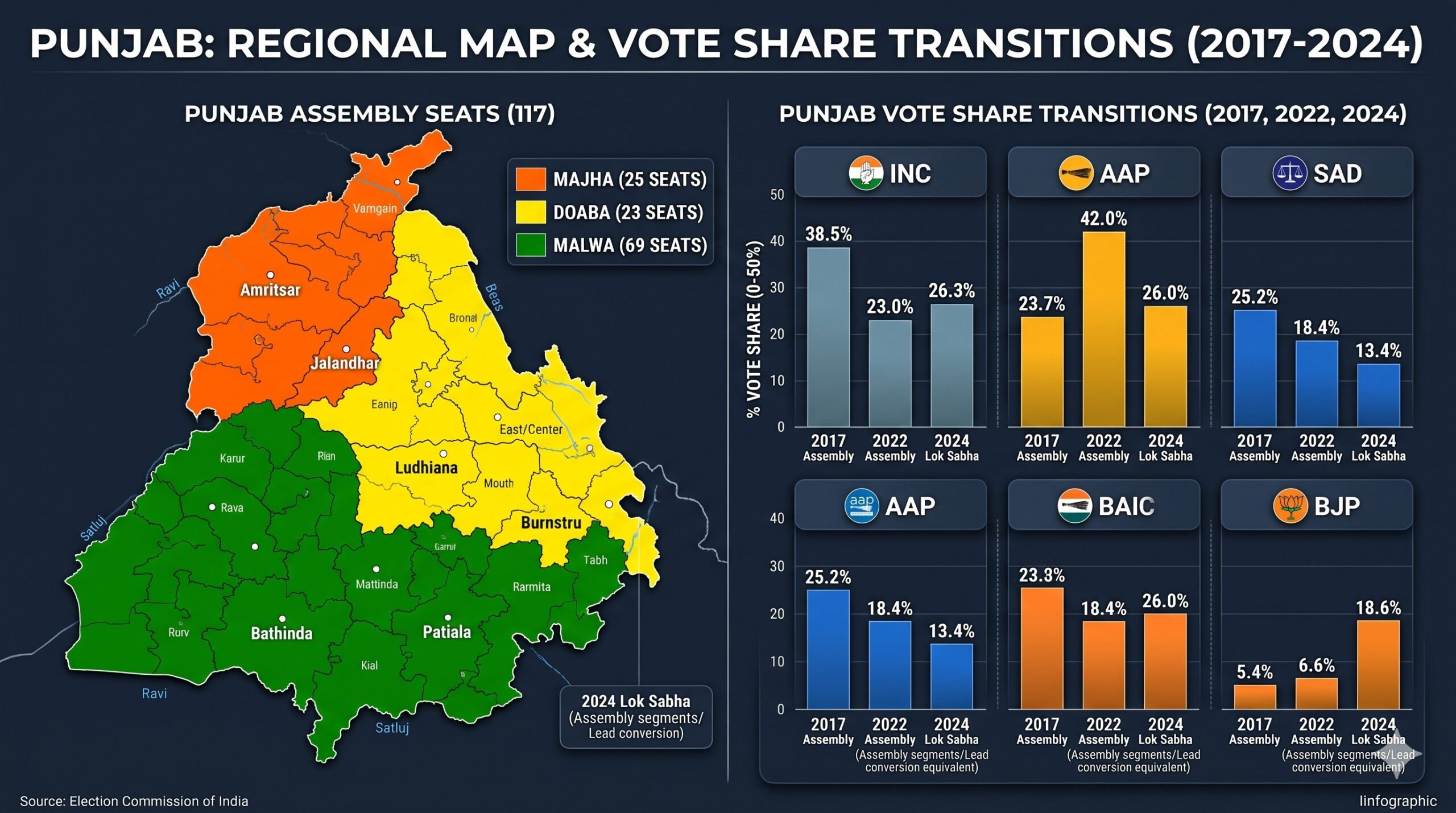
Author Note & Methodology: This electoral analysis evaluates the political terrain of Punjab ahead of the 117-seat Legislative Assembly elections due in early 2027. Grounded in primary sources—including Election Commission of India (ECI) constituency data from the 2022 Assembly and 2024 Lok Sabha elections, Reserve Bank of India (RBI) state finance reports, and extensive field mapping across Malwa, Majha, and Doaba—this report avoids superficial soundbites to unpack the structural forces shaping Punjab’s political mandate.
1. Executive Summary: The Structural Shift (2022 vs. 2024 vs. 2027)
Punjab’s political ecosystem, historically governed by a two-party equilibrium between the Shiromani Akali Dal (SAD) and the Indian National Congress (INC), experienced a seismic disruption in 2022. The Aam Aadmi Party (AAP) swept to power with an unprecedented 92 seats and a 42.01% vote share, riding a wave of voter dissatisfaction with traditional ruling elites.
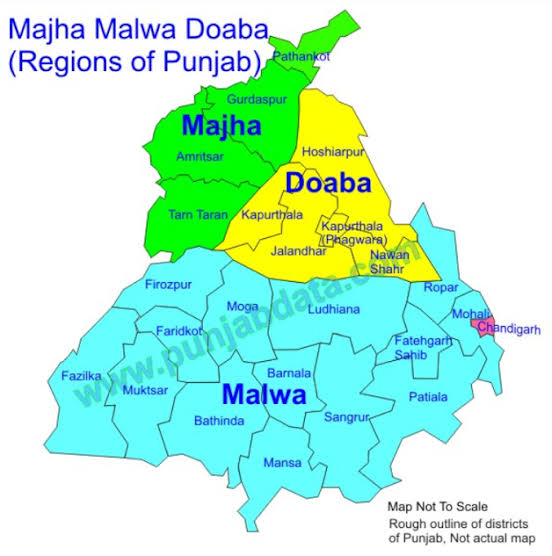
Geographical and Electoral Regions of Punjab: Malwa, Majha, and Doaba. Source: University of Michigan
However, the 2024 Lok Sabha elections and recent political maneuvers signal that Punjab has evolved from a single-party wave into a complex quadripartite battlefield. As the state enters the home stretch toward the February 2027 elections, the political landscape reflects a tri-fold structural recalibration:
- The 2022 Assembly Baseline: AAP swept 92 of 117 seats, dominated by an overwhelming performance in Malwa (66 of 69 seats). Congress managed 18 seats, SAD was reduced to 3 seats, and the BJP secured 2.
- The 2024 Parliamentary Benchmark: The Lok Sabha contest fragmented the vote share across four major players. Congress staged a strong recovery by capturing 7 Lok Sabha seats, AAP took 3 seats, independent/radical candidates won 2 seats, and the BJP expanded its urban footprint despite winning zero seats.
- The 2027 Battle Ground: With 59 seats required for a simple majority in the Vidhan Sabha, no single party currently holds an unchallenged dominant narrative, making localized seat-sharing, panthic alignment, and welfare economics the decisive vectors.
PUNJAB ELECTORAL REALIGNMENT MATRIX
| ELECTORAL METRIC | 2022 ASSEMBLY VERDICT | 2024 LOK SABHA ASSEMBLY SEGMENT LEADS | STRATEGIC REALIGNMENT & 2027 BENCHMARK |
| Aam Aadmi Party (AAP) | 92 Seats • 42.01% Vote Share • Landslide absolute majority | 33 Assembly Segments • ~26.02% Vote Share • 3 Lok Sabha Seats | -59 Segments compared to 2022. Needs +26 Segments to retain power at the 59 Majority Mark (59 / 117 total seats). Focuses on anti-incumbency mitigation, free electricity/welfare guarantees, and agrarian outreach. |
| Indian National Congress (INC) | 18 Seats • 22.98% Vote Share • Opposition status | 37 Assembly Segments • ~26.30% Vote Share • 7 Lok Sabha Seats | +19 Segments lead over 2022. Emerged as the single largest party in 2024 parliamentary segment leads. Needs +22 Segments to cross the threshold, leveraging rural revival across Malwa & traditional cadre bases. |
| Bharatiya Janata Party (BJP) | 2 Seats • 6.60% Vote Share | 23 Assembly Segments • ~18.56% Vote Share • 0 Lok Sabha Seats | +21 Segments lead growth. Showed significant urban footprint expansion across Hindu-dominated seats (Ludhiana, Jalandhar, Amritsar, Gurdaspur), making its strategic choices vital for 2027 alliance equations. |
| Shiromani Akali Dal (SAD) | 3 Seats • 18.38% Vote Share | 9 Assembly Segments • ~13.42% Vote Share • 1 Lok Sabha Seat (Bathinda) | +6 Segments lead. Core Panthic and rural base faces severe compression, pushing the leadership toward potential NDA alliance re-negotiations or structural cadre realignment. |
| Independents / Radicals (Panthic) | 1 Seat • 3.12% Vote Share | 15 Assembly Segments • Win in 2 Lok Sabha Seats (Khadoor Sahib, Faridkot) | +14 Segments surge. Jailed preacher Amritpal Singh & Sarabjeet Singh Khalsa created major sub-regional shifts in rural Majha & Malwa, disrupting traditional Panthic vote channels. |
| Total Assembly Threshold | 117 Total Seats | 117 Assembly Segments | 59 Seats Required for Simple Majority |
2. Core Strategic Drivers Shaping the 2027 Mandate
A. The Incumbent Challenge: Welfare Economics vs. Fiscal Constraints
Chief Minister Bhagwant Mann’s administration enters the 2027 cycle highlighting direct citizen-centric deliverables:
- Healthcare & Power Subsidies: The establishment of over 800 Aam Aadmi Clinics and 300 units of free monthly power have created an extensive beneficiary (labharthi) base across rural and semi-urban households.
- Fiscal Debt & Governance Autonomy: Punjab’s debt-to-GSDP ratio remains hovering above 45%, constraining capital expenditure for agrarian diversification. Concurrently, opposition parties frequently leverage charges of remote administrative control from Delhi, prompting AAP to emphasize localized Punjabi identity leadership.
- Agrarian & Environmental Pressure: Water table depletion, canal water management, crop diversification initiatives, and farm debt continue to generate friction within the influential farm unions (Kisan Jathebandis).
B. Opposition Recalibration: Re-Alignments and Electoral Formulas
PUNJAB CONTEST 2027
| PARTY / FACTION | CORE DEMOGRAPHIC BASE | STRATEGIC LEVERAGE | PRIMARY ELECTORAL MANDATE / STRATEGY |
| Aam Aadmi Party (AAP) | Rural & urban middle-class, welfare beneficiaries, low-income segments | Incumbent governance machinery, Aam Aadmi Clinics, 300-unit free power delivery | Mitigate Incumbency & Retain Baseline: Early candidate announcements and localized welfare delivery to protect its 2022 rural-urban majority. |
| Indian National Congress (INC) | Traditional rural voters, Dalit sub-castes (Ravidassia/Valmiki), anti-incumbent voters | Residual grassroot cadre, strong 2024 parliamentary segment revival (37 leads) | Consolidate Anti-AAP Sentiment: Re-establish traditional dominance across rural Malwa and Mazha belts through targeted Dalit mobilization and agrarian outreach. |
| Shiromani Akali Dal (SAD) | Traditional Panthic core, rural Jat Sikhs, agrarian networks | Deep-rooted SGPC institutions and historical panthic identity | Panthic & Agrarian Pivot: Fight for political survival by reclaiming lost rural Sikh vote banks, while evaluating strategic reunion terms with the BJP. |
| Bharatiya Janata Party (BJP) | Urban Hindu voters, business/industrial hubs, non-panthic segments | Central governance backing, expanding urban vote share, high-profile inductions | Urban Expansion & Alliance Re-negotiation: Expand beyond traditional urban strongholds (Ludhiana, Jalandhar, Amritsar) while leveraging potential SAD alliance talks on favorable terms. |
| Panthic / Radicals (e.g., Waris Punjab De / SAD-A) | Hardline Panthic voters, dissatisfied rural youth, disenfranchised Sikh peasantry | Strong localized ideological appeal, anti-establishment momentum | Sub-Regional Disruption: Fragment traditional Panthic and rural vote channels across Majha and Malwa, creating unpredictable multi-cornered contests. |
- Congress Revival Strategy: Capitalizing on anti-incumbency, Congress aims to re-consolidate its traditional voter segments. Mobilization of Punjab’s nearly 32% Dalit population—the highest proportion of any Indian state—serves as the cornerstone of their organizational pitch across Doaba and Malwa.
- SAD-BJP Alliance Realignment: Negotiations regarding a potential reunion between the Shiromani Akali Dal and the BJP carry deep structural consequences. While a joint ticket bridges the rural Sikh (SAD) and urban Hindu (BJP) vote bases, both parties face internal friction over seat-sharing ratios and lingering voter memories of the 2020 farm law controversies.
- The Panthic Vacuum & Independent Candidates: The rise of independent panthic candidates and splinter factions has fragmented the traditional Sikh vote bank, creating unpredictable triangular or quadrangular dynamics in hyper-local contests.
3. Detailed Regional Breakdown (117 Assembly Seats)
Punjab’s politics is distinctly divided across three main geographical regions, each defined by unique socio-economic dynamics.
REGIONAL MATRIX & KEY VARIABLES
| REGION | SEATS | PRIMARY DYNAMICS & KEY ISSUES | SOCIO-ECONOMIC & ELECTORAL IMPACT |
| Malwa | 69 | Agrarian distress, canal water availability, farm union strength, panthic identity. | Decisive region constituting ~59% of the Assembly. Traditionally determines Chief Ministerial outcomes; heavily influenced by BKU union mobilizations, MSP guarantees, and groundwater depletion challenges. |
| Majha | 25 | Border economics, drug law enforcement, traditional Panthic institutional politics. | Border-belt dynamics (Amritsar, Gurdaspur, Tarn Taran); institutional Panthic politics centered around SGPC influence, radical/independent surges, and cross-border drug supply chain enforcement. |
| Doaba | 23 | High concentration of Dalit voters (~37–42%), NRI remittances, industrial labor hubs. | Highest concentration of Scheduled Caste voters nationwide (Jalandhar, SBS Nagar); driven by Ravidassia/Ad-Dharmi community consolidation, NRI-led infrastructure investments, and sports goods/leather industry labor issues. |
1. Malwa (69 Seats): The Electoral Engine
Accounting for nearly 60% of the assembly, Malwa determines who forms the state government.
- Key Demographic: Dominance of Jat Sikh farmers, agrarian laborers, and significant pockets of Scheduled Caste voters.
- Strategic Reality: In 2022, AAP swept 66 of 69 seats here. For 2027, maintaining a grip on Malwa requires mitigating rural disappointment over crop MSP guarantees and local law-and-order concerns.
2. Majha (25 Seats): Panthic Heritage and Border Security
Stretching along the international border, Majha represents the ideological heartland of Panthic politics.
- Key Issues: Drug network eradication, trade corridor revivals, and governance oversight of religious institutions.
- The Political Split: Historically a contest between Congress and SAD, Majha saw significant fragmentation in 2024, opening opportunities for localized independent candidates and a re-energized Akali base.
3. Doaba (23 Seats): The NRI and Dalit Belt
Situated between the Beas and Sutlej rivers, Doaba is defined by high emigration rates and an influential Dalit voter base.
- Social Engineering: Parties are vying for the support of Ravidassia and Valmiki communities.
- Economic Drivers: Real estate stability, foreign worker policy changes, and local manufacturing growth drive urban centers like Jalandhar and Phagwara.
4. Analytical Conclusions & Strategic Outlook
- Fragmentation Leads to Lower Victory Margins: The shift from a binary system to a multi-party structure means victory margins in 2027 could tighten significantly, elevating candidate selection above overarching party popularity.
- Dalit Vote Bank is the Pivotal Swing: With 32% of the voter base, the Dalit demographic across Doaba and Malwa remains uncommitted to a single party, turning welfare policies and sub-caste representation into central campaign issues.
- Alliance Dynamics Will Dictate Thresholds: A formal SAD-BJP partnership would alter the urban-rural electoral math, whereas a split opposition could allow AAP’s organized volunteer framework to retain key constituencies.
Sources:
* Conceptual illustration generated using AI