
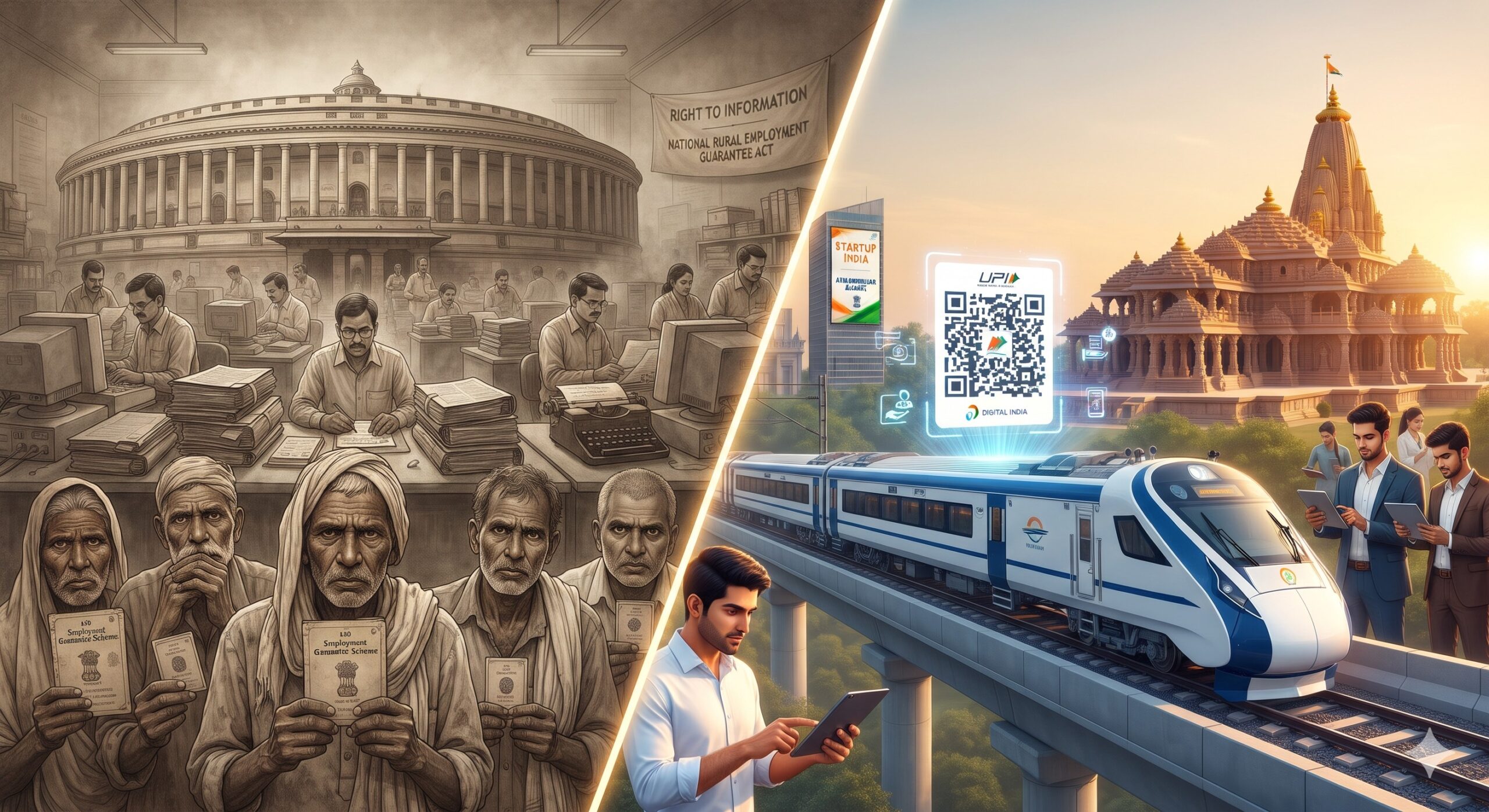
To understand the trajectory of 21st-century India is to study a profound metamorphosis in its self-imagination. Over the last two decades, the world’s most populous democracy has been governed by two fundamentally distinct political architectures: the United Progressive Alliance (UPA) led by Dr. Manmohan Singh (2004–2014) and the National Democratic Alliance (NDA) led by Narendra Modi (2014–Present).
The transition from Singh to Modi was not merely a transfer of power between rival political parties; it represented a regime shift. It marked the sunset of the post-colonial, Nehruvian consensus of civic nationalism and coalition accommodation, and the dawn of a centralized, civilizational state driven by muscular nationalism and digital techno-solutionism.
To imagine India in 2010 was to envision a booming, chaotic, rights-based democracy grappling with the frictions of coalition politics. To imagine India in 2026 is to perceive an assertive, digitally integrated global power unapologetic about its Hindu civilizational identity. Here is an in-depth analytical breakdown of the structural, economic, and ideological differences defining these two definitive eras of modern India.
1. The Welfare Architecture: Rights-Based Entitlements vs. Digital ‘Labharthi’ Delivery
Perhaps the starkest contrast between the two eras lies in how the Indian state interacts with its poorest citizens.
The Singh Era (2004–2014): The Rights-Based Framework Under Manmohan Singh, guided heavily by the Sonia Gandhi-led National Advisory Council (NAC), the state adopted a rights-based approach to welfare. The UPA government institutionalized welfare through landmark legislation, effectively transforming basic needs into actionable legal rights. This era gave birth to the Mahatma Gandhi National Rural Employment Guarantee Act (MGNREGA), the Right to Information (RTI) Act, the Right to Education (RTE) Act, and the National Food Security Act (NFSA).
While these analog frameworks were visionary in lifting millions out of poverty, their execution was heavily mediated by local bureaucracies and middlemen. As political scientist Milan Vaishnav has noted, the UPA era was characterized by “process-driven welfare” which, while democratic in design, was frequently bogged down by systemic leakage and corruption scandals (such as the 2G spectrum and Coalgate controversies) that ultimately defined Singh’s second term.
The Modi Era (2014–2026): The New ‘Labharthi’ Class and Digital Public Infrastructure Narendra Modi fundamentally re-engineered the welfare state by shifting from legislative rights to targeted, tangible asset delivery, powered by technology. The Modi government leveraged the Jan Dhan-Aadhaar-Mobile (JAM) trinity to bypass local middlemen, executing Direct Benefit Transfers (DBT) directly into citizens’ bank accounts.
Instead of abstract legal rights, the Modi era focused on delivering private goods with highly visible state branding: subsidized cooking gas (Ujjwala), toilets (Swachh Bharat), piped water (Jal Jeevan), housing (PM Awas Yojana), and free digital payment infrastructure (UPI). This created a new, fiercely loyal voting bloc known as the Labharthi varg (beneficiary class). As former Chief Economic Advisor Arvind Subramanian termed it, this was the era of “New Welfarism”—the state’s focused provision of essential private goods and services, sidestepping the messy complexities of systemic health and education reforms.
2. Foreign Policy: From Strategic Restraint to Assertive Multi-Alignment
How India projects itself onto the global stage has undergone a radical psychological transformation.
The Singh Era: Strategic Restraint and Economic Diplomacy Dr. Manmohan Singh, a technocrat and economist by training, viewed foreign policy primarily as an instrument to secure capital, technology, and energy for India’s domestic growth. His crowning achievement was the 2008 Indo-US Civil Nuclear Agreement, which ended India’s decades-long nuclear isolation and structurally aligned New Delhi closer to Washington.
However, Singh’s era was famously defined by “strategic restraint.” Following the devastating 26/11 Mumbai terror attacks in 2008, the UPA government deliberately chose not to retaliate militarily against Pakistan, prioritizing economic stability over martial retribution. Globally, India was seen as a cautious, non-disruptive, and sometimes hesitant rising power.
The Modi Era: “Vishwamitra” and Muscular Multi-Alignment Under Narendra Modi and External Affairs Minister S. Jaishankar, India shed its defensive posture, replacing “non-alignment” with aggressive “multi-alignment.” The Modi era reimagined India not just as an emerging market, but as a “civilizational state” claiming its rightful position at the global high table as a Vishwamitra (friend to the world) and Vishwaguru (teacher to the world).
This era is characterized by unapologetic pragmatism and muscular responses. The 2016 surgical strikes and the 2019 Balakot airstrikes fundamentally rewrote the rules of engagement with Pakistan. On the global stage, India confidently defied Western pressure to purchase discounted Russian oil following the 2022 Ukraine war, simultaneously expanding its role in the US-backed Quad alliance to counter China. The Modi era also weaponized the Indian diaspora, turning overseas Indians into strategic assets via massive stadium events from Madison Square Garden to Sydney, blending foreign policy directly with domestic political branding.
3. The Idea of the Nation: Civic Pluralism vs. Civilizational Resurgence
The most deeply felt transition between the two eras is the ideological redefinition of the Indian identity itself.
The Singh Era: The Climax of the Nehruvian Consensus The UPA era operated strictly within the framework of secular, civic nationalism. The state viewed itself as an impartial arbiter between India’s myriad religious and linguistic groups, with a specific focus on protecting and uplifting minorities. The 2006 Sachar Committee Report, which documented the socio-economic backwardness of Indian Muslims, epitomized this approach, as did Singh’s controversial remark that minorities must have the “first claim on resources.” In this imagining, India was a beautiful mosaic, bound together by the Constitution rather than a shared ancient culture.
The Modi Era: The Mainstreaming of Hindutva The Modi era systematically dismantled the Nehruvian secular consensus, arguing that “pseudo-secularism” had been used to appease minorities at the expense of the Hindu majority. Over the last decade, the BJP has successfully redefined Indian nationalism around a civilizational ethos rooted in Hindu culture.
This ideological shift was cemented through historic, defining milestones: the abrogation of Article 370 (integrating Jammu and Kashmir), the implementation of the Citizenship Amendment Act (CAA), and the consecration of the Ram Mandir in Ayodhya in 2024. In the Modi era, the state does not distance itself from religion; rather, the Prime Minister actively leads religious and cultural revivals. The cultural subtext of “India” has been heavily replaced by the civilizational resonance of “Bharat.”
4. Leadership Style and Institutional Governance
The contrast in the personal leadership styles of Singh and Modi dictated the functioning of the Indian state.
The Singh Era: The Coalition Manager Manmohan Singh was the quintessential “accidental Prime Minister”—a scholar-bureaucrat who never won a direct Lok Sabha election, elevated by Sonia Gandhi to lead a complex, fragile coalition of regional satraps. The Prime Minister’s Office (PMO) during this time shared power with the party high command and powerful regional allies. This decentralized power structure allowed for wide-ranging democratic debates and civil society influence, but ultimately resulted in crippling “policy paralysis” during UPA-II, as the government found itself unable to clear infrastructure projects or control inflation amidst intra-coalition vetoes.
The Modi Era: The Centralized Strongman Narendra Modi governs with the mandate of an absolute single-party majority—a structural luxury Singh never possessed. Modi’s leadership style is highly personalized, charismatic, and deeply centralized. The PMO in the Modi era wields unprecedented authority, driving policy from the top down. Elections have been heavily “presidentialized,” with citizens voting explicitly for the Prime Minister rather than the local Member of Parliament. While this centralization has resulted in remarkable efficiency in infrastructure execution—building thousands of kilometers of highways, railways, and airports at a record pace—critics argue it has simultaneously weakened parliamentary oversight, the press, and independent institutions.
Conclusion: From an Accommodative State to an Assertive Power
Imagining India in the Manmohan Singh era meant picturing a nation cautiously opening up to the world, grappling with the chaotic beauty of coalition democracy, and lifting millions out of poverty through legal entitlements, even as it was weighed down by systemic corruption and administrative hesitation.
Imagining India in the Narendra Modi era is to witness a confident, technologically accelerated civilizational state that has formalized its economy, upgraded its physical and digital infrastructure, and projects muscular power abroad. Yet, this efficiency and cultural resurgence come with intense debates over the centralization of power, the shrinking space for religious minorities, and the gradual erosion of federalism.
Ultimately, the shift from 2014 to 2026 is the story of India transitioning from a state that sought to accommodate its contradictions, to a state that seeks to decisively resolve them.
References & Citations
- Subramanian, Arvind (2019): The New Welfarism of the Modi Government. Concept detailing the shift from public goods to tangible private asset delivery.
- Vaishnav, Milan (2019): The BJP in Power: Indian Democracy and Religious Nationalism. Carnegie Endowment for International Peace. Analysis of the shift from civic to civilizational nationalism.
- Jaffrelot, Christophe (2021): Modi’s India: Hindu Nationalism and the Rise of Ethnic Democracy. Contextualizing the centralization of executive power and marginalization of minorities.
- Baru, Sanjaya (2014): The Accidental Prime Minister. Insights into the decentralized and dual-power structure of the Manmohan Singh PMO.
- Jaishankar, S. (2020): The India Way: Strategies for an Uncertain World. Theoretical framework for India’s transition from non-alignment to assertive multi-alignment.
* Conceptual illustration generated using AI