
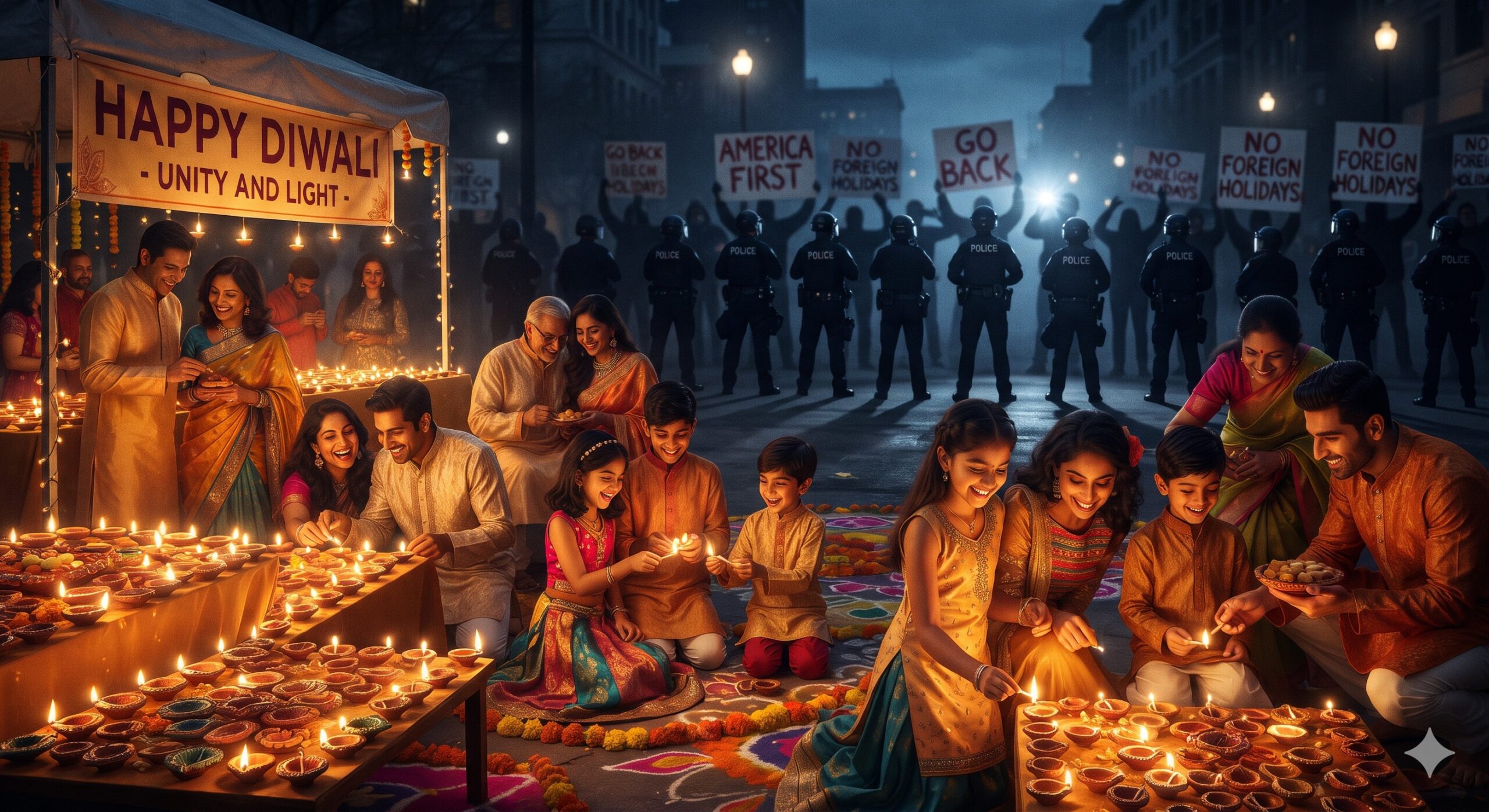
Diwali, the ancient Hindu festival of lights, is universally recognized as a celebration of the triumph of light over darkness, knowledge over ignorance, and good over evil. Rooted in the foundational dharmic principles of peace, community, and introspection, Hindu festivals are inherently non-intrusive. Hindus, who represent a highly integrated, peaceful, and economically productive demographic in the United States, do not proselytize, nor do their celebrations pose any public nuisance or harm.
Yet, paradoxically, the visible celebration of Hindu culture in the West has increasingly become a flashpoint for cultural anxiety, xenophobia, and targeted hate crimes. In November 2026, this underlying tension erupted violently when far-right activists stormed a peaceful children’s Diwali celebration in Seattle, brandishing explicitly racist and xenophobic signs. This incident is not an isolated anomaly, but rather the latest manifestation of a growing phenomenon: Hinduphobia in America.
To understand why a peaceful community’s festival triggers such intense hostility, one must analyze the complex intersection of demographic anxiety, religious exclusivity, political polarization, and the resurgence of the “Great Replacement” theory.
The Seattle Diwali Disruption: A Symptom of a Deeper Rot
On November 8, 2026, a Diwali event held as part of the Seattle Center Festal—a cultural series that usually attracts hundreds of thousands of diverse attendees—was violently disrupted. As children were performing on stage, far-right activists, identified as Jake Lang (a January 6 Capitol riot participant pardoned in 2025) and Thomas Allen, burst into the venue.
The signs they carried stripped away any veneer of subtle bias, displaying blatant hatred: “Deport All Dot Heads” and “Stop Hindu Replacement of Christians”. The men were eventually escorted out by attendees, but the psychological damage was done. The event, intended to be a joyous community gathering, was transformed into a scene of religious intimidation.
Lang later took to the social media platform X, claiming without evidence that he was “assaulted by ANTIFA & Hindus” and spewing further political vitriol, complaining that “Hindus flipped Texas blue”. This political framing by extremist elements underscores a critical reality: anti-Hindu hate in the United States is rapidly evolving from localized ignorance into an organized, ideologically driven movement.
The Roots of Cultural Anxiety: Why Hindu Festivals Trigger Nativist Backlash
If the Hindu community is statistically proven to be highly educated, law-abiding, and deeply integrated into the American economic fabric, why do their cultural expressions trigger such visceral anger among certain extremist groups? The answer lies in four analytical pillars of modern Western xenophobia.
1. Demographic Panic and the “Great Replacement” Theory
The most glaring indicator of the motivation behind recent anti-Hindu attacks is the language used by the perpetrators. The sign “Stop Hindu Replacement of Christians” directly invokes the “Great Replacement” theory—a white supremacist and nativist conspiracy theory which posits that white, Christian populations in Western countries are being deliberately replaced by non-white, non-Christian immigrants.
The rapid socio-economic rise of the Indian American and Hindu diaspora—who today number approximately four million in North America—has made them highly visible targets for this anxiety. From leading Fortune 500 tech companies to achieving prominent positions in federal politics across both the Democratic and Republican parties, Hindus are highly visible in the American public square. For far-right nativists, this success is not viewed as the realization of the American Dream, but as a demographic and cultural threat.
2. The Political Weaponization of the Diaspora
As the Hindu American community has grown in political influence, they have been unfairly scapegoated for broader electoral shifts. Jake Lang’s furious assertion that “Hindus flipped Texas blue” highlights how the community is being politically targeted.
Remarkably, this hate crosses the political aisle. Whether it is progressive Democratic Representative Pramila Jayapal condemning the Seattle attacks as a “vile and racist display,” or conservative figures like Kash Patel and Tulsi Gabbard facing racial slurs and being accused of “worshipping demons” during their own Diwali greetings, Hindus are frequently attacked regardless of their political affiliation. They are targeted simply for their religious and ethnic identity.
3. Religious Exclusivism and “Othering”
A significant driver of Hinduphobia stems from theological ignorance and religious supremacy. Hinduism, as a polytheistic and dharmic tradition, stands in stark contrast to the Abrahamic religious frameworks that have historically dominated the West.
Extremist factions often mischaracterize Hindu deities and practices. Comments referring to Hindus as “worshipping demons” or labeling their ancient practices as “satanic” are common tropes used to dehumanize the community. This form of theological “othering” creates a moral permission structure for extremists to vandalize temples and harass devotees, convincing themselves they are fighting a spiritual war rather than committing a hate crime.
4. The “Model Minority” Shield and Institutional Blindness
Because Hindu Americans are often stereotyped as a successful “model minority,” their struggles with discrimination are frequently overlooked by civil rights organizations and the media. When a community is perceived as affluent and privileged, institutional mechanisms designed to protect minorities are often slow to respond to their victimization. The Coalition of Hindus of North America (CoHNA) has repeatedly pointed out that authorities and institutional players are often reluctant to even name “anti-Hindu bigotry” as the driving force behind these actions.
A Pattern of Escalation: From Vandalism to Foiled Mass Shootings
The disruption in Seattle is part of a terrifying escalation in violence against Hindu Americans. This is not the first time the community has faced unprovoked aggression.
Just weeks prior to the Seattle incident, in October 2026, the FBI and local law enforcement thwarted a planned mass shooting at the Sri Venkateswara Swami (Balaji) temple in Aurora, Illinois. A 19-year-old neo-Nazi, Alexandros Paporakis, was arrested after outlining a detailed plot to massacre worshippers at the temple.
Historically, this bigotry traces its roots back to the early 20th century when South Asian immigrants were driven out of the Pacific Northwest by racist mobs. In the 1980s, the “Dotbusters” hate group terrorized the Hindu community in New Jersey. In the post-9/11 era, Hindus were frequently targeted in misdirected xenophobic attacks. Today, the hate is direct, organized, and fueled by social media echo chambers that churn out vitriolic memes attempting to portray Hindus as unclean, violent, or culturally incompatible with the West.
Reclaiming the Light: The Path Forward
The irony of anti-Hindu hate peaking during Diwali is profound. A festival dedicated to the victory of light over darkness is being overshadowed by the darkness of ignorance and bigotry. Representative Raja Krishnamoorthi summarized this poignant reality by stating, “Today is supposed to celebrate the victory of light over darkness. But that victory is not automatic… When people are chanting hateful anti-Indian and anti-Hindu slogans, you know we have a lot of work to do”.
Addressing this crisis requires a multi-pronged approach:
- Institutional Recognition: Law enforcement, media, and federal institutions must explicitly recognize “Hinduphobia” as a distinct and rising form of hate crime, discarding the assumption that the community’s economic success immunizes them from bigotry.
- Political Solidarity: Leaders across the political spectrum must unite to condemn these attacks without caveats. The push by lawmakers like Representative Grace Meng to make Diwali the 12th federal holiday is a crucial step toward cultural normalization and inclusive messaging.
- Educational Outreach: Demystifying Hinduism in American school curricula and media can combat the exoticization and demonic framing of Dharmic traditions.
The Hindu American community has contributed immeasurably to the fields of medicine, technology, public service, and the arts in the United States. They deserve the fundamental human right to celebrate their heritage freely, safely, and proudly. As the diaspora continues to grow, the true test of Western pluralism will be whether it can embrace the light of Diwali, or succumb to the shadows of a fabricated culture war.
* Conceptual illustration generated using AI