
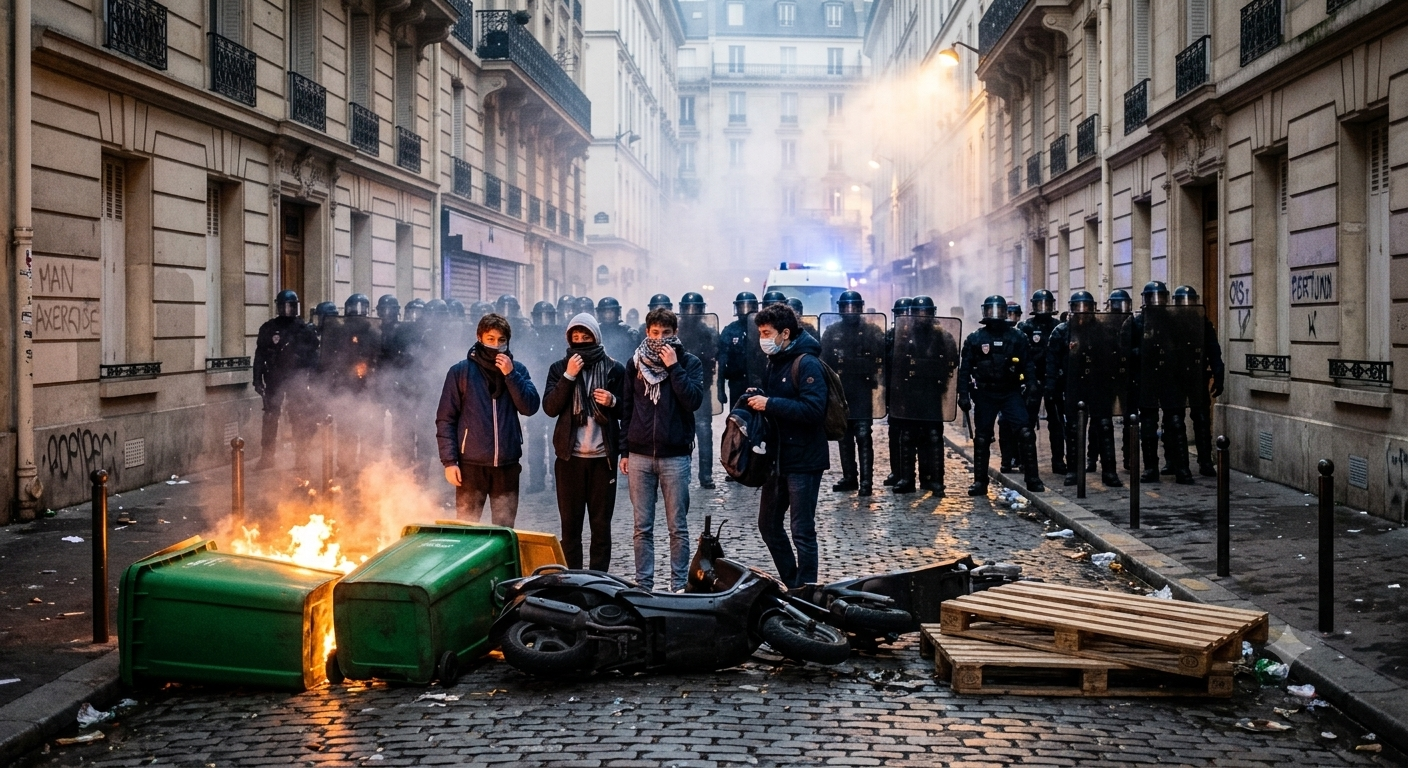
The streets outside hundreds of French high schools resemble urban battlegrounds this week, as a nationwide student protest over the decaying state of the public education system has rapidly devolved into violent clashes with riot police. What began in late September 2026 as coordinated, peaceful student blockades against overcrowded classrooms and severe teacher shortages has escalated into an acute political and security crisis for the French government.
By the first week of October, the situation had deteriorated significantly. According to the Interior Ministry, over 400 high schools were forced to close, with nearly 2,000 students, the vast majority of whom are minors, detained by authorities across the country. The violence has left more than 83 police officers and gendarmes injured, alongside dozens of firefighters, teachers, and pupils.
The Breaking Point: Why the Students Are Revolting
The unrest stems from deep-rooted, systemic grievances regarding the daily realities of the French education system. High school students (lycéens) have organized under the banner of the High School Students’ Union (Union Syndicale Lycéene), pointing to a chronic lack of funding and resources.
The primary complaints driving the blockades include:
- Exhausting Timetables: Students are protesting grueling daily schedules that often stretch from 8:00 AM to 6:00 PM, with placards at the Lamartine lycée in Paris reading, “More hours of lessons than sleep”.
- Infrastructure Collapse: Pupils have cited deplorable physical conditions, including dilapidated buildings, water leaks, inadequate toilet facilities, and classrooms that become dangerously overheated during heatwaves. One 17-year-old student from Strasbourg summarized the environment simply: “The building is falling apart, the cafeteria is too small. There’s zero budget, zero resources”.
- Severe Staff Shortages: A lack of teachers and substitute staff has left some classes without essential subject educators for entire academic years. One 15-year-old student in central Paris noted that their class went a full year without a science teacher or textbooks, adding, “And still, we’re the lucky ones. It’s even worse in the suburbs”.
- Overcrowded Classrooms: Many students report being crammed into classes with 32 to 35 pupils, making effective learning virtually impossible.
These frustrations have been exacerbated by the government’s recently announced budget plans, which outline €54 million in public spending cuts. The student movement quickly paralleled a nationwide strike by public sector workers, which saw an estimated 40% of primary school teachers walk off the job to protest the financial squeeze.
The Descent into “Urban Violence”
While union leaders urged students to keep the protests peaceful, the massive blockades quickly morphed into what government officials have labeled “urban violence”. In cities ranging from Paris and Lille to Marseille and Strasbourg, masked youths set fire to rubbish bins, erected makeshift barricades, and destroyed public infrastructure such as bus stops and tram lines. Fire damage in a Nantes school was so extensive that authorities announced it would remain closed for a month.
The scale of the violence has shocked the nation, with several deeply disturbing incidents pushing the crisis to a new level:
- Marseille Arson Attacks: At the Victor Hugo High School in Marseille, a headteacher was reportedly attacked and doused in petrol. In a separate incident at Saint-Exupery High School, a fire truck responding to a blaze was surrounded by hundreds of youths, struck with metal objects, and set on fire, forcing the firefighters to flee.
- Assaults on Law Enforcement: Interior Minister Laurent Nunez reported that troublemakers were utilizing the chaos to actively target police. In some of the most violent clashes, officers were attacked with hurled paving stones, bottles, and, in seven separate instances, hydrochloric acid.
Tear Gas and Accusations of Police Brutality
The government’s response has been swift and heavily militarized. Riot police have been deployed en masse to clear the blockades, frequently relying on tear gas, baton charges, and riot-control projectiles.
However, the heavy-handed tactics have sparked fierce backlash from students and sympathetic teachers. Students have openly accused the police of using wildly disproportionate and excessive force against teenagers. In the Paris suburb of Saint-Denis, demonstrators held signs asking, “Can we explain ourselves without being teargassed?”.
The resulting injuries from police projectiles have triggered an internal investigation by the Interior Ministry into allegations of police brutality against at least three pupils. Several teachers have actually joined the blockades not to protest, but to form human shields between the heavily armed riot police and their students. Juliette Estiville, a high-school Spanish teacher in Paris, noted that she was there strictly to provide protection for the young people, stating that the aggressive police response disgusted her.
A Looming Political Crisis Ahead of 2027
The blazing school gates have quickly ignited a fierce political battle in Paris, arriving just over half a year before the highly anticipated 2027 presidential elections.
Prime Minister Sébastien Lecornu and Justice Minister Gerald Darmanin have taken a hardline stance against the rioters. Darmanin has explicitly asked prosecutors to hold the parents of the rioting minors financially and legally liable for the destruction of public property, emphasizing that parents must step up and ensure their children are kept off the streets for their own safety. Lecornu condemned the escalation as entirely irresponsible, stating that nothing justifies endangering school staff or police.
Conversely, the political left has firmly aligned itself with the students. Jean-Luc Mélenchon, the firebrand leader of the hard-left France Unbowed (LFI) party and a presidential candidate, has fiercely condemned the government’s crackdown. Mélenchon characterized the police brutality as an “irresponsible” and “racist” escalation against harmless teenagers, openly encouraging LFI activists and elected officials to step in and support the youth. The government, in turn, has accused Mélenchon and his party of exploiting the genuine anger of the students for partisan gain, actively encouraging the unrest.
As the tear gas clears and the ashes of burnt barricades are swept away, the fundamental crisis remains entirely unresolved. The students have vowed to continue their blockades until the government addresses the systemic starvation of the public education sector. With budget cuts looming and a bitter presidential election on the horizon, the battle for the future of French schools has moved from the classroom to the streets—and neither side appears ready to surrender.
* Conceptual illustration generated using AI