
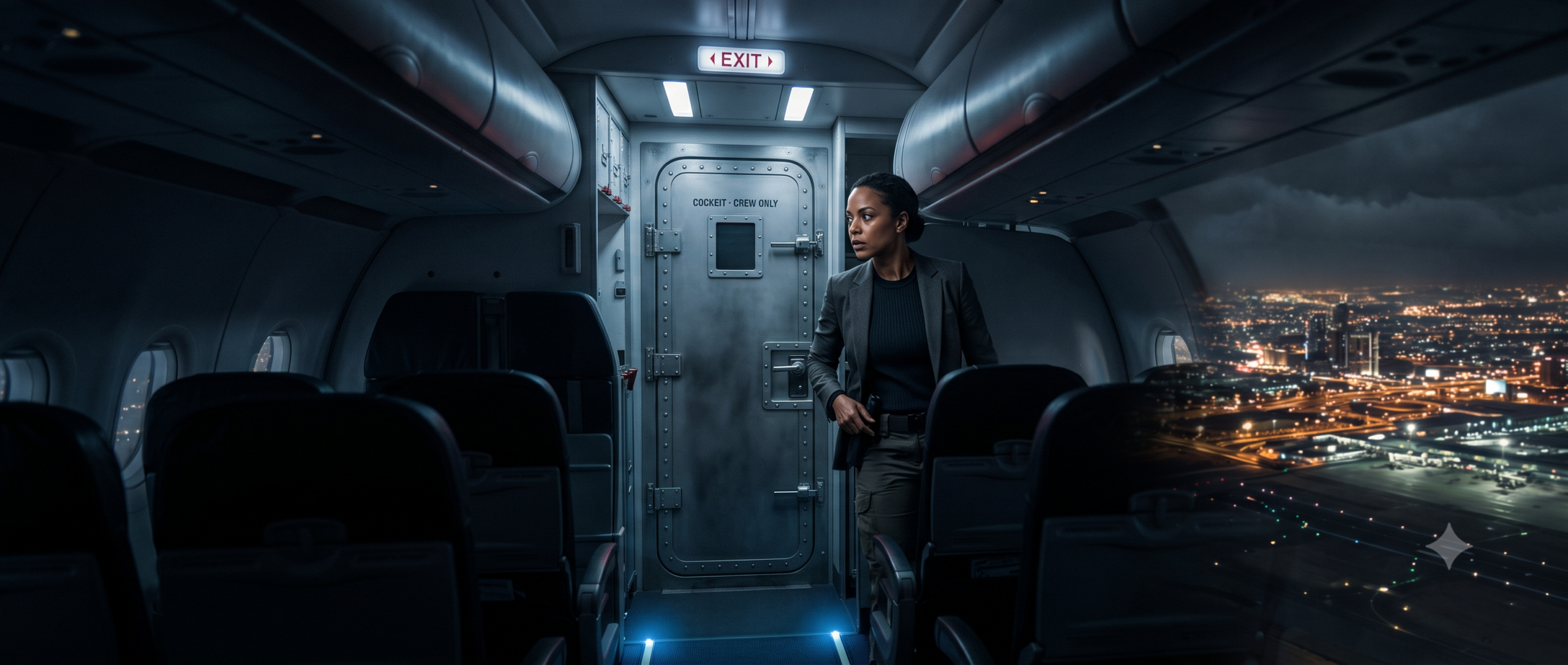
When passengers board a commercial airliner, their ultimate trust is placed in the two highly trained professionals seated behind the reinforced cockpit door. That fundamental trust was violently shattered on a Tel Aviv-bound FlyDubai flight when an Omani co-pilot intentionally initiated a terrifying 14,000-foot plunge, wielding a crash axe against his captain in a suspected jihadist attack. The Boeing 737, carrying 182 people, narrowly avoided complete catastrophe thanks to the extraordinary heroism of its Indian captain and the swift intervention of Israeli passengers.
However, as the dust settles on the emergency landing strip in Tabuk, Saudi Arabia, the sheer terror of the incident is being eclipsed by a staggering revelation regarding aviation security. According to recent reports, the co-pilot responsible for the attack had previously been barred from flying by his native Oman over explicit concerns regarding his extremist views. How a pilot deemed a security risk by one Gulf nation was subsequently hired by a major airline in a neighboring country and cleared to fly to Israel is now the central question in an unprecedented geopolitical and aviation crisis.
The Terrifying Plunge of Flight FZ1073
The timeline of the near-disaster reads like a cinematic thriller, though the horror experienced by the 174 passengers. the vast majority of whom were Israeli citizens, was chillingly real. Mid-flight, the Omani co-pilot, who had been employed by the United Arab Emirates-based FlyDubai for approximately eight months, suddenly attacked Captain Smit Machchhar with a crash axe.
During the violent struggle inside the locked flight deck, the co-pilot sent the aircraft into a catastrophic nosedive. The plane plummeted nearly 14,000 feet (roughly 4,267 meters) in less than 30 seconds. Passengers recounted the horrifying sensation of freefall, accompanied by the agonizing screams of children shouting, “We don’t want to die!”.
Despite sustaining severe injuries and heavy bleeding from the axe attack, Captain Machchhar fought back with sheer desperation. In a televised video call from his hospital bed in Abu Dhabi with Indian Prime Minister Narendra Modi, Machchhar, his head heavily bandaged, broke down recounting the ordeal. “I had so many wounds. I had fallen down,” he explained. “I was fighting for my life. At one point, I realized that if I didn’t get up… then passengers would lose their lives”.
Machchhar’s ultimate act of heroism was managing to unlock the reinforced cockpit door. This allowed a group of Israeli passengers to storm the flight deck, overpower the co-pilot, and physically restrain him. A reserve crew onboard the aircraft was then able to stabilize the Boeing 737, pulling it out of its death dive and executing an emergency landing in Tabuk, in northwestern Saudi Arabia.
The Vetting Catastrophe: Ignored Red Flags
The physical survival of the passengers is a miracle, but the bureaucratic failure that placed the attacker in the cockpit is a scandal of massive proportions. Information has surfaced indicating that the co-pilot was well-known to aviation authorities in his home country. A person familiar with the ongoing investigation confirmed that Oman had actively removed him from flying duties over signs of extremist ideology.
Colleagues who worked with the Omani national noted that his behavior had raised significant red flags. According to Israeli media reports, he exhibited unusual religious practices compared to his peers, notably praying excessively throughout the workday and strictly refusing to shake hands with female colleagues.
The critical failure lies in the siloed nature of international background checks. When Oman identified the pilot as an extremist liability and grounded him, that intelligence seemingly did not cross the border to the UAE. It remains unclear to what extent FlyDubai or Emirati aviation authorities vetted the individual when he was hired just eight months prior to the attack. This intelligence gap exposes a massive vulnerability in the global aviation sector: if national databases regarding suspected radicalization are not seamlessly integrated and shared between allied nations and airlines, the industry remains highly susceptible to insider threats.
Geopolitical Shockwaves and the Abraham Accords
Beyond the immediate aviation security implications, the attack has sent deep geopolitical shockwaves across West Asia. The route from Dubai to Tel Aviv is highly symbolic. Following the signing of the Abraham Accords in 2020, which normalized relations between Israel and the UAE, Dubai became a massively popular destination for Israeli tourists and businesspeople.
Israeli Prime Minister Benjamin Netanyahu did not mince words in the aftermath, labeling the incident an act of terrorism. Speaking to international media, Netanyahu stated that the co-pilot had undergone “Islamist radical indoctrination” and appeared to be suicidal, intending to use the aircraft as a weapon. While Israeli diplomats in the UAE cautioned that final conclusions should await the end of the formal probe, the immediate optics have forced a severe regional reaction.
The UAE, fiercely protective of its reputation as an ultra-secure global travel and business hub, immediately launched a comprehensive investigation led by its Attorney-General. Authorities are desperately trying to determine if the pilot acted as a lone wolf or if the attack involved prior planning, direction, and connections to broader terrorist networks.
In the interim, the crisis has severely disrupted regional travel. The UAE temporarily canceled all commercial flights to Israel, stranding hundreds of passengers and forcing governments to arrange special repatriation flights. The logistical nightmare was further complicated by the emergency landing taking place in Saudi Arabia—a nation that currently has no formal diplomatic ties with Israel. Despite this diplomatic hurdle, Saudi authorities allowed a special repatriation flight to transport the Israeli passengers home safely, while the attacker and the injured captain were returned to the UAE for interrogation and medical treatment, respectively.
Redefining Global Aviation Security
The FlyDubai FZ1073 incident will undoubtedly become a watershed moment for aviation security, much like the Germanwings tragedy in 2015, which forced airlines to re-evaluate pilot mental health protocols. However, the threat here is ideological, not strictly psychological.
Aviation regulatory bodies, including the International Civil Aviation Organization (ICAO), will face immense pressure to mandate the cross-border sharing of intelligence regarding aviation personnel. If a pilot is blacklisted for extremism in one jurisdiction, that red flag must immediately trigger an alert across global hiring networks.
As Captain Machchhar recovers from his wounds, he is rightfully being hailed as a global hero who prevented an international tragedy. But the broader aviation industry must face a sobering reality check. The reinforced cockpit doors implemented after 9/11 were designed to keep terrorists out of the flight deck. The FlyDubai incident proves that if the vetting process fails, those exact same doors can lock the terrorists inside, leaving hundreds of innocent lives at the mercy of the enemy within.
* Conceptual illustration generated using AI