The future of the U.S.-India trade relationship no longer depends on diplomatic talks in New Delhi or economic forecasts in Mumbai. Instead, it hinges on a high-stakes constitutional showdown taking place in Washington.
With the U.S. House of Representatives joining the Senate to clear the Lindsey O. Graham Sanctioning Russia and Iran Act of 2026, the legislation now sits directly on President Donald Trump’s desk. The bill forces an immediate clash between two irreconcilable visions of American statecraft: an executive branch that wants to preserve a prized $500 billion bilateral trade agreement with Prime Minister Narendra Modi, and a congressional majority determined to mandate 100% tariffs on any nation buying Russian crude oil.
How this standoff resolves will define the next decade of transpacific trade, cross-border supply chains, and Indo-Pacific security.
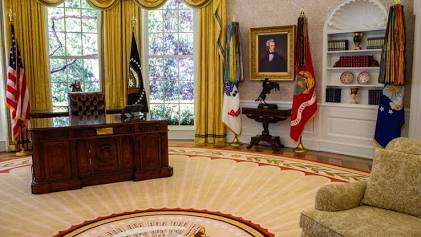
The-Oval-Office-White-House
The Dilemma on the President’s Desk
For President Trump, signing or vetoing the Graham Sanctions Act presents a profound political and economic dilemma.
On one hand, the legislation bestows upon the White House immense statutory power. By explicitly authorizing the President to impose tariffs of up to 100% on major Russian energy buyers, Congress is effectively handing the executive branch a legal hammer far more durable than the shaky emergency orders previously struck down by the courts. For an administration that views tariffs as the primary tool of foreign policy, vetoing such expansive executive authority is a rare, counterintuitive prospect.
On the other hand, exercising that power against India destroys the cornerstone of the administration’s Asian economic strategy. In February 2026, President Trump personally negotiated a historic interim framework with Prime Minister Modi, securing commitments for $500 billion in Indian purchases of U.S. energy, aircraft, technology, and agricultural products in exchange for dropping punitive tariffs down to 18%.
If the administration yields to congressional pressure and levies 100% tariffs on Indian goods over Russian oil imports, that $500 billion deal dies instantly. New Delhi will cancel its purchasing commitments, pull back on market access concessions, and retaliate with heavy duties on American agricultural and industrial exports. The President must choose between honoring a deal he negotiated or enforcing a congressional mandate he did not create.
The 180-Day Institutional Trap
Even if the White House attempts to navigate a middle ground—signing the bill into law while attempting to grant informal leniency to India—the structure of the legislation makes sustained ambiguity nearly impossible.
The Graham Sanctions Act institutes a strict, rolling 180-day review mandate. Every six months, the U.S. Trade Representative (USTR) is legally required to publish an updated list of the top five global importers of Russian crude oil and natural gas. Because India currently imports over 30% of its total crude from Russia, it is mathematically locked into this top-tier group for the foreseeable future.
This 180-day statutory cycle creates a permanent engine of market volatility:
- Continuous Exposure: Every six months, Indian exporters will face the threat of sudden, mandatory tariff spikes up to 100%, destroying the long-term predictability required for capital investment.
- Congressional Oversight: The statutory mechanism gives Congress constant leverage to haul administration officials into hearings if the White House refuses to apply maximum tariffs on listed nations.
- Legal Inflexibility: Unlike executive orders under IEEPA, which the courts invalidated, a direct congressional mandate under Article I of the Constitution gives importers virtually no room to challenge the tariffs in federal court.
This institutional setup transforms trade policy from a series of negotiable executive decisions into an automated, statutory trap.
Actionable Playbook for Trade Compliance Executives
As Washington grapples with this internal power struggle, global supply chain executives and trade compliance officers cannot afford to wait for political clarity. The volatility of 2025 and 2026 has proven that static compliance playbooks are obsolete.
Organizations operating across the U.S.-India corridor should immediately execute three strategic adjustments:
- Prepare for the Collapse of the 18% Framework: Compliance teams must model their financial exposure under scenario-based pricing. Calculate the immediate margin impact if the 18% interim rate is abruptly replaced by 50% or 100% statutory penalties under the Graham Act.
- Audit Country-of-Origin and Value Addition: If maximum tariffs are triggered, Customs and Border Protection (CBP) will aggressively scrutinize transshipment. Ensure that products assembled in third countries (such as Vietnam or Malaysia) using Indian components strictly satisfy regional value content (RVC) rules to avoid being tagged with Indian tariff rates.
- Diversify Energy and Material Sourcing Contracts: U.S. buyers relying on Indian pharmaceutical ingredients, textiles, or tech components should insert flexible cancellation or duty-sharing clauses into supplier agreements, allowing costs to be reallocated if congressional tariffs take effect.
The Final Verdict
The U.S.-India trade relationship has reached its ultimate inflection point. The conflict between executive deal-making and legislative mandates reflects a deeper struggle within Washington over how American power should be projected abroad.
Whether President Trump signs the bill, seeks a narrow legislative waiver, or attempts to stall its implementation, the message to global markets is clear: the era of stable, treaty-bound international commerce has ended. In its place stands a volatile, highly politicized trade landscape where a single vote in Washington can rewrite the rules of global supply chains overnight.
Source: The People’s House (White House Historical Association)