In the high-stakes game of international trade, leverage is everything. But as the U.S. Congress advances legislation threatening 100% tariffs on India over its reliance on Russian energy, New Delhi finds itself trapped in an impossible geopolitical squeeze. Capitulating to Washington’s demands would ignite a domestic inflation crisis capable of destabilizing the world’s fifth-largest economy. Defying them risks a catastrophic trade war that could cripple Indian manufacturing.
However, India is not passively accepting its role as a pawn in Washington’s sanctions regime. Instead, New Delhi is pointing out the glaring hypocrisy of American policy while simultaneously accelerating its integration into non-Western financial systems to insulate its economy.
The Hypocrisy of the U.S. Energy Stance
To understand the frustration radiating from India’s Ministry of External Affairs, one must examine the paradox of U.S. energy policy over the last two years.
When geopolitical conflicts effectively choked transit through the Strait of Hormuz and the Red Sea, global oil markets teetered on the brink of a historic crisis. The United States and its European allies desperately needed global crude prices to remain stable to avoid crippling domestic inflation.
During this period, India’s massive purchases of discounted Russian crude—which were subsequently refined into diesel and jet fuel in Indian facilities and exported globally—acted as a critical safety valve. In many instances, the West quietly tolerated, or even issued tacit waivers for, these transactions because they kept global supply high and prices low.
Now, the U.S. Congress is attempting to weaponize that exact same supply chain.
By pushing the Sanctioning Russia and Iran Act of 2026, lawmakers are effectively punishing India for utilizing the very economic mechanism that prevented a global energy meltdown. From New Delhi’s perspective, Washington expects India to absorb the devastating inflationary blow of decoupling from cheap Russian oil, while the West reaps the diplomatic rewards.
New Delhi’s Firm Line
India’s response has been unapologetic. For Prime Minister Narendra Modi’s government, energy security for a rapidly developing nation of 1.4 billion people is not a diplomatic bargaining chip; it is a pillar of national survival.
Following the passage of the sanctions bill in the U.S. House of Representatives this week, Indian officials doubled down. The government has repeatedly labeled the U.S. secondary tariffs as “unfair, unreasonable, and unjustified.” By refusing to sever ties with Moscow—and by continuing to import nearly a third of its crude from Russia—India is firmly asserting its policy of strategic autonomy.
But New Delhi is no longer just playing defense. It is actively leveraging its leadership on the global stage to push back against Washington’s economic statecraft.
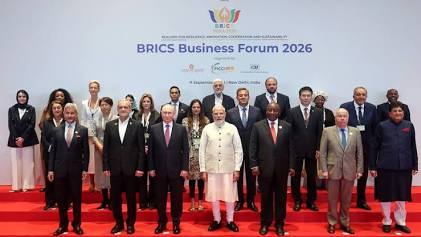
BRICS Leaders at the 2026 Summit in New Delhi
The September BRICS Backlash
The clearest signal that India is preparing to insulate itself against American trade threats occurred just days ago. On September 12, 2026, Prime Minister Modi hosted the 18th BRICS Summit, culminating in the unanimous adoption of the “New Delhi Declaration.”
The language in the declaration was a direct, unmistakable shot across Washington’s bow.
According to reports by The Indian Express, the BRICS nations—led by India—issued a scathing denouncement of “unilateral coercive measures” and “secondary sanctions.” While the document tactfully avoided naming the United States directly, it explicitly condemned the “indiscriminate rising of tariffs and non-tariff measures” that are inconsistent with World Trade Organization (WTO) rules.
For India, this declaration served a dual purpose. First, it provided multilateral diplomatic cover against the looming U.S. congressional threat. Second, it positioned BRICS as a unified counterweight to the weaponization of the American consumer market.
Accelerating the Non-Western Financial Ecosystem
The most consequential fallout from Washington’s tariff threats is not the immediate economic damage—it is the accelerated fragmentation of the global financial system.
The U.S. relies on the dominance of the dollar and the SWIFT messaging system to enforce its sanctions. By repeatedly threatening a massive trading partner like India with 50% and 100% tariffs over geopolitical disagreements, the U.S. has inadvertently supercharged India’s desire to find alternatives.
During the New Delhi BRICS Summit, the bloc took measured but significant steps away from the U.S. dollar. Rather than attempting to launch a unified “BRICS currency”—a highly complex and unlikely endeavor—India and its partners focused intensely on local-currency settlements.
As noted by The Economic Times, the BRICS Payment Task Force was formally backed to develop pragmatic, cross-border payment mechanisms that operate entirely outside of Western jurisdiction. India’s Commerce Minister Piyush Goyal aggressively advocated for linking national payment systems (similar to India’s Unified Payments Interface, or UPI) to facilitate local-currency trade.
The Cost of the Tariff Hammer
The geopolitical tightrope India is walking reveals a critical flaw in Washington’s current trade strategy. By using heavy-handed tariffs to force compliance on secondary issues like Russian oil, the U.S. is alienating a crucial democratic ally in the Indo-Pacific.
India is signaling that it will not be bullied into compromising its energy security. If the U.S. Congress follows through with its 100% tariff threat, it may succeed in hurting Indian exporters in the short term. But in the long term, it will only accelerate New Delhi’s drive to build a sanctions-proof, de-dollarized global economy.
Source: Anadolu Agency