For nearly two years, the economic corridor between New Delhi and Washington has resembled a high-stakes diplomatic obstacle course. Ever since bilateral trade agreement (BTA) negotiations were officially launched following Prime Minister Narendra Modi’s visit to Washington in February 2025, progress has repeatedly stalled against a backdrop of sweeping tariff changes, geopolitical pressure over Russian crude oil imports, and fierce domestic agricultural protections in India.
As the dust settles from the United States midterm elections, the trajectory of the India-US trade talks has shown clear signs of acceleration. Following technical discussions in New Delhi involving a visiting American trade team, senior Indian leadership — including External Affairs Minister S. Jaishankar and Commerce Minister Piyush Goyal — have publicly indicated that the prolonged negotiations are entering their final phase. Yet significant open questions remain.
Are the talks genuinely approaching a conclusion, or is this another cycle of optimistic signalling? Here is a fact-based assessment of the post-midterm dynamics, the current status of the Bilateral Trade Agreement, and the remaining obstacles.
1. The Post-Midterm Shift: Political Realities and Continuing Engagement
The outcome of the US midterm elections introduced a new variable into the bilateral equation. With the political landscape shifting in Washington, analysts in both capitals suggested that the administration may feel pressure to deliver concrete international economic outcomes.
Despite speculation that domestic political friction could stall trade initiatives, Indian Commerce Ministry officials confirmed that diplomatic and technical engagements have continued without interruption. In early November 2026, a specialised US delegation travelled to New Delhi to refine language on customs procedures and trade facilitation.
India’s export resilience provides important context. Shipments to the United States rose 11% to $50.80 billion between April and September FY27, underscoring the depth of commercial integration. External Affairs Minister S. Jaishankar stated in mid-November that the bulk of major structural issues had already been settled, with most remaining adjustments occurring on the American side. Commerce Minister Piyush Goyal has similarly described the emerging framework as a “very good deal.”
2. Navigating the Sticking Points: Tariffs, Oil, and Agriculture
To understand the current state of negotiations, it is necessary to examine the legacy hurdles that slowed progress through 2024 and 2025:
KEY STICKING POINTS & CURRENT STATUS
| Core Issue | Initial Friction | Current Status / Notes |
|---|---|---|
| Tariffs & Duties | Punitive actions linked to Russian oil and Section 301 labour probes | US has given verbal assurance of a “comparative tariff advantage” for India over competing economies. Final tariff schedule still pending. |
| Agricultural Access | US demands for deeper access to India’s dairy and farm sectors | India has successfully ring-fenced its sensitive agrarian market. |
| Customs & Facilitation | Red tape, valuation disputes, and border procedures | Technical teams made substantial progress during the November 2026 visit to New Delhi. |
The most consequential development has been the US assurance of a “comparative tariff advantage.” Indian officials, including Piyush Goyal, have emphasised that New Delhi will not finalise any agreement unless Indian exporters retain preferential margins relative to competitors such as Bangladesh, Vietnam, and Cambodia. This assurance has been reported across multiple Indian media outlets citing official briefings.
However, two important caveats remain. First, the precise tariff schedule has not yet been locked in. Second, ongoing US Section 301 investigations into industrial overcapacity and forced labour continue to create uncertainty. Until these processes conclude and the final tariff architecture is published, the comparative advantage remains a political commitment rather than a fully enforceable legal outcome.
3. The G20 Horizon: Opportunity, Not Certainty
Attention is now focused on the G20 Summit scheduled for 14–15 December 2026 in Miami. Prime Minister Narendra Modi is expected to travel to the United States for the summit, creating a natural opportunity for a bilateral review with President Donald Trump.
Trade watchers have speculated that the leaders could announce completion of the first tranche of the Bilateral Trade Agreement on the sidelines of the Miami meetings. US Ambassador to India Sergio Gor has also noted that the majority of major roadblocks have been dismantled.
Nevertheless, experienced observers caution that a formal announcement is not guaranteed. Outstanding issues around the final tariff structure and residual Section 301 exposure mean that December remains an opportunity rather than a fixed deadline.
4. Macroeconomic Context: Why the Deal Still Matters
India’s broader trade strategy in 2026 provides useful context. Over the past year, New Delhi operationalised its Comprehensive Economic and Trade Agreement with the United Kingdom (effective 15 July 2026) and advanced its Free Trade Agreement with the European Union. Securing a durable framework with the United States remains the largest outstanding piece of India’s export diversification strategy.
For Washington, anchoring supply chains with a major democratic partner in the Indo-Pacific continues to be a strategic priority, particularly in the context of reducing over-reliance on concentrated manufacturing hubs elsewhere in Asia.
Conclusion: Meaningful Progress, Remaining Uncertainty
So, are India-US trade talks getting somewhere after the midterms? The evidence shows clear forward movement.
Technical negotiations have advanced, high-level political signalling from both S. Jaishankar and Piyush Goyal has been consistently positive, and both sides appear to have stepped back from maximalist positions. India has protected its agricultural red lines; the United States has offered a comparative tariff advantage in principle.
At the same time, the most difficult elements — the final tariff schedule and the outcome of pending Section 301 processes — remain unresolved. A December announcement is possible, but not assured.
The India-US trade pact is closer to completion than it has been at any point in the past two years. Whether it crosses the finishing line in the coming weeks will depend on how both sides resolve the last outstanding technical and political questions.
References & Citations
- The New Indian Express (11 November 2026): India, US hold fresh trade talks as Trump’s midterm setback raises hopes for BTA progress
- Business Standard (14 November 2026): India-US trade deal nearing finish line, may be sealed soon: Jaishankar
- The Print (13 November 2026): US ‘assures’ India of ‘comparative tariff advantage’ as trade talks continue
- Quartz (13 November 2026): U.S. promised India lower tariffs than peers in bilateral trade deal
- PTI / Chinimandi (13 November 2026): India’s exports to US rise 11% to USD 50.80 billion in Apr-Sep FY27
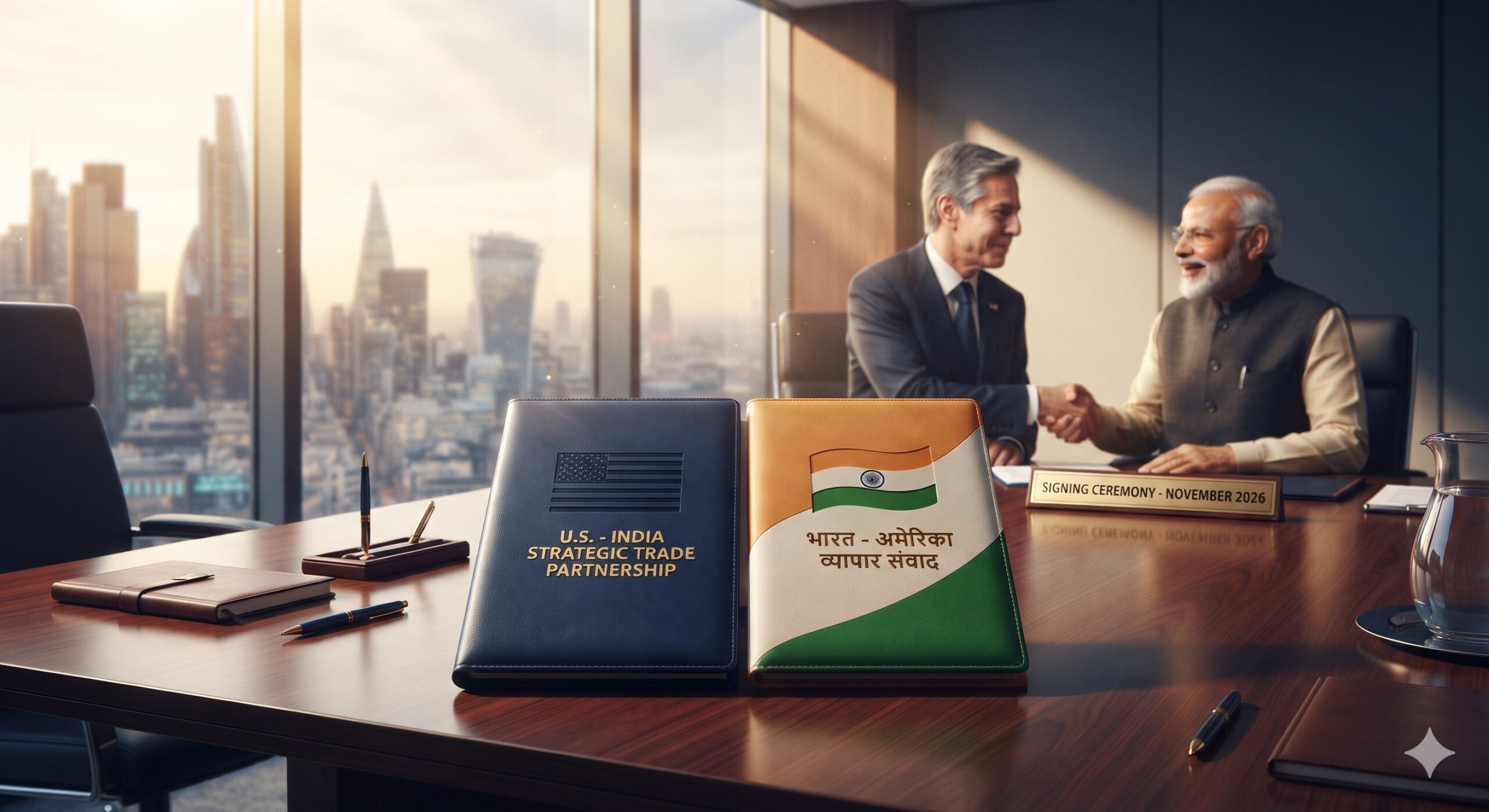
* Conceptual illustration generated using AI