
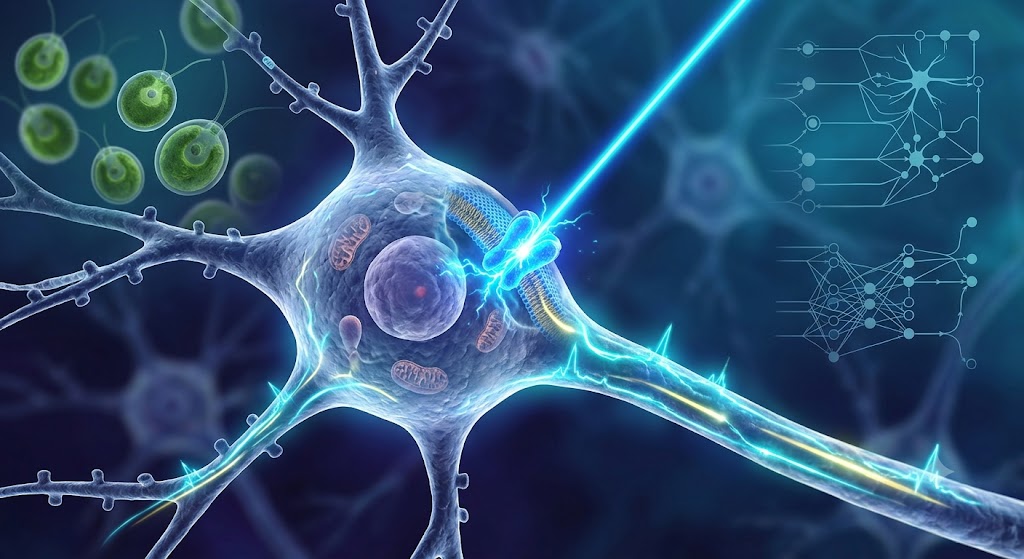
The Royal Swedish Academy of Sciences in Stockholm has awarded a landmark Nobel Prize in Physiology or Medicine to American bioengineer and psychiatrist Karl Deisseroth, along with German biophysicists Peter Hegemann and Georg Nagel. The trio was honored for their revolutionary development of optogenetics—a ground-breaking technique that uses light to control individual, living nerve cells with millisecond precision.
By marrying molecular biology, optics, and neuroscience, Deisseroth, Hegemann, and Nagel transformed a curious cellular mechanism found in green algae into one of the most powerful toolkits in modern medical science. Today, optogenetics allows scientists to turn specific neural circuits on and off at will, unraveling the dense, intricate wiring of the brain and opening radical new pathways to treat psychiatric disorders, Parkinson’s disease, blindness, and addiction.
The Algae Paradox: How Light-Sensing Proteins Changed Medicine
To appreciate the scale of this scientific breakthrough, one must understand the fundamental challenge that has plagued neuroscience for over a century: the brain’s overwhelming complexity. With roughly 86 billion neurons interconnected by trillions of synapses, attempting to understand or treat a specific brain circuit using traditional tools—like electrical stimulation electrodes or systemic pharmaceutical drugs—is akin to trying to repair a Swiss watch using a sledgehammer. Electrical currents stimulate all surrounding tissue indiscriminately, while drugs spread throughout the entire body, causing widespread side effects.
The solution to this precision problem came from an unlikely source: microscopic, single-celled green algae (Chlamydomonas reinhardtii).
In the late 1980s and 1990s, biophysicists Peter Hegemann and Georg Nagel began investigating how these simple organisms detect light to swim toward optimal energy sources. They discovered and characterized light-sensitive proteins called channelrhodopsins. These proteins act as light-gated ion channels embedded in the cellular membrane. When hit by a specific wavelength of light (such as blue light), the channel snaps open, allowing positively charged ions to flood into the cell and generating a tiny electrical current.
Nagel and Hegemann successfully demonstrated that these algal proteins could be extracted, expressed, and functionally operated inside complex animal cells. Their foundational biophysical research proved that light could be used as an instant, remote-control switch for cellular electrical activity.
The Stanford Breakthrough: Wiring the Brain for Light
While Hegemann and Nagel unlocked the biophysical engine, it was Karl Deisseroth—a practicing psychiatrist and neuroscientist at Stanford University—who realized the revolutionary implications for the human brain.
In the mid-2000s, working alongside his then-graduate students Edward Boyden and Feng Zhang, Deisseroth pioneered the bioengineering feat of inserting the genetic code for channelrhodopsin into specific populations of mammalian neurons using harmless viral vectors. Once inserted, the targeted brain cells began producing the algal light-sensor on their own surfaces.
By inserting ultra-thin fiber-optic threads directly into brain tissue, Deisseroth and his team demonstrated that flashing pulses of light could selectively trigger or quiet targeted neurons in real-time while an animal was awake and moving. If scientists wanted to know what a specific cluster of 500 neurons in the amygdala did, they no longer had to guess; they could pulse a blue laser and observe the immediate change in behavior, emotion, or movement.
Optogenetics solved the two greatest hurdles in brain research simultaneously:
- Cellular Specificity: Only the precise neurons genetically programmed to express the light-sensing proteins respond to the light, leaving neighboring cells completely untouched.
- Temporal Precision: The response occurs in milliseconds—matching the natural speed at which neurons communicate.
From Bench to Bedside: Transforming Medicine
The impact of optogenetics on biomedical research over the last two decades has been nothing short of transformative. It has fundamentally re-mapped our understanding of how neural networks drive human experience.
- Psychiatry and Addiction: As a practicing psychiatrist, Karl Deisseroth approached the technology with a deep desire to alleviate human suffering. Optogenetics has allowed researchers to isolate the exact neural circuits responsible for depression, anxiety, PTSD, and compulsive behaviors. By activating or suppressing specific pathways in animal models, scientists have identified the precise cellular mechanisms of motivation and fear, paving the way for hyper-targeted pharmaceutical drugs and deep brain stimulation protocols.
- Parkinson’s Disease: Traditional Deep Brain Stimulation (DBS) for Parkinson’s patients involves sending continuous electrical shocks into deep brain structures, which helps manage tremors but often causes speech and cognitive side effects. Optogenetics revealed precisely which cell types within those deep structures needed stimulation, allowing engineers to design smarter, more selective electrical stimulation algorithms for human clinical trials.
- Restoring Sight: Perhaps the most direct clinical application of optogenetics is in ophthalmology. For patients suffering from retinitis pigmentosa—a genetic condition that destroys the light-sensing rod and cone cells in the retina—optogenetic gene therapy offers a path back to vision. By delivering channelrhodopsin genes into the surviving, deeper layers of retinal ganglion cells, scientists can essentially turn those remaining cells into new light detectors. Clinical trials in humans have already demonstrated that blind patients can regain the ability to perceive shapes, movement, and objects.
A Masterclass in Interdisciplinary Science
The story of the 2026 Nobel Prize highlights a vital truth about modern scientific progress: breakthrough discoveries rarely happen in isolation.
The journey from studying the swimming mechanics of pond algae in Germany to engineering fiber-optic brain control in California represents a masterclass in cross-disciplinary collaboration. It bridged botany, biophysics, genetic engineering, optics, and clinical psychiatry. Without Hegemann and Nagel’s rigorous fundamental research on algal proteins, Deisseroth would not have had the biological tools to build his neural control systems. Conversely, without Deisseroth’s visionary application to neuroscience, the biophysics of channelrhodopsin might have remained a niche topic in plant physiology.
Illuminating the Future
As the scientific community celebrates this well-deserved Nobel recognition, the field of optogenetics continues to evolve at a blistering pace. Researchers are now developing red-shifted proteins that can be activated by light passing safely through the skull without requiring fiber-optic implants, as well as non-invasive Sonogenetics (using sound waves) and Magnetogenetics (using magnetic fields).
Karl Deisseroth, Peter Hegemann, and Georg Nagel did not just invent a new laboratory technique; they fundamentally altered humanity’s relationship with its own mind. By giving scientists the ability to write and read the electrical language of the brain using light, they turned the black box of the central nervous system into a fully illuminated map.
* Conceptual illustration generated using AI