
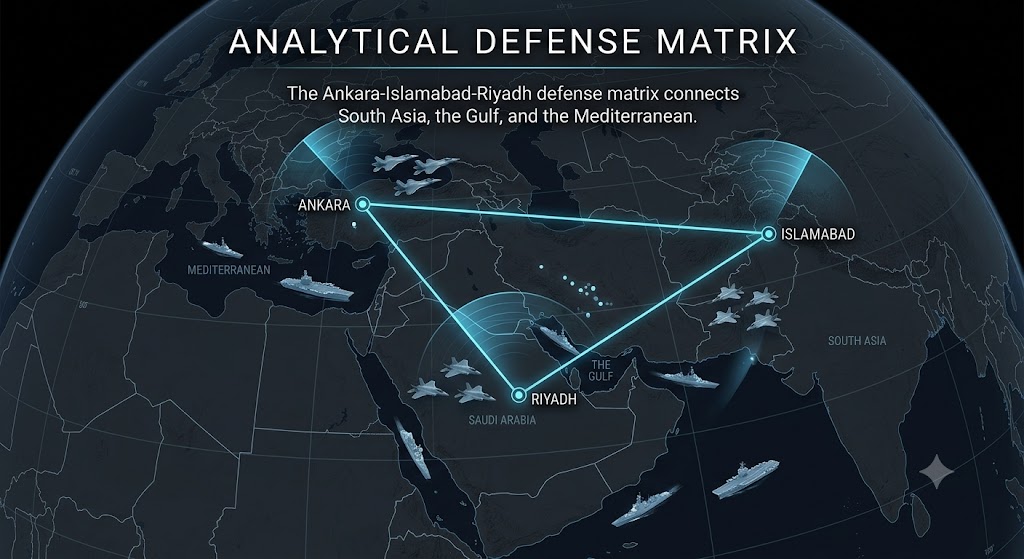
In an unprecedented geopolitical maneuver that signals a monumental shift in the security architecture of the Middle East and the broader Islamic world, Saudi Arabia, Pakistan, and Türkiye have formally activated the Mecca Joint Defence Agreement. Responding directly to recent aggressive actions by the Iran-aligned Houthi group in Yemen, the trilateral alliance has announced the immediate and rapid deployment of military forces to defend the Kingdom of Saudi Arabia.
This activation represents the first practical test of a defence pact that has been described by international relations experts as a “major change” in regional geopolitics, fundamentally altering how collective security is managed in a region historically reliant on a US security umbrella.
The Trigger: Escalating Houthi Attacks on Holy Sites
The activation of the pact, announced following a critical meeting in Riyadh, was triggered by a dangerous escalation in the ongoing Yemen conflict. The Strategic Political and Defence Committee of the alliance, operating under the mandate of the Mecca Agreement, cited the necessity to activate “collective deterrence measures” in direct response to “heinous attacks” targeting the Kingdom.
Saudi Defense Minister Khalid bin Salman confirmed the activation on social media platform X, emphasizing that the committee had expressed full solidarity with Saudi Arabia. The primary catalyst appears to be a reported Houthi attack on a power distribution station in Medina, a critical facility that supplies electricity to the Prophet’s Mosque—one of the absolute holiest sites in Islam.
A joint statement from the three nations fiercely condemned what they characterized as attempted attacks on Mecca, Medina, and various Saudi economic facilities. The Saudi Ministry of Foreign Affairs vehemently denounced the Houthis’ “continued targeting of civilians and civilian and economic facilities in the Kingdom,” specifically highlighting the repeated threats to Abha, Khamis Mushait, and the holy cities.
The ‘Article 5’ of the Islamic World
To understand the magnitude of this deployment, one must look at the foundational architecture of the Mecca Joint Defence Agreement. Formally concluded on August 7, 2026, in the holy city# The Ankara-Islamabad-Riyadh Axis: Decoding the Strategic Impact of a Trilateral Defense Convergence
Geopolitical tectonic plates across South Asia, the Middle East, and Eurasia are shifting at an unprecedented pace. The rapid convergence of Türkiye, Pakistan, and Saudi Arabia into a synchronized mutual security framework marks one of the most significant strategic developments of the 21st century.
For decades, security in these regions relied on fragmented bilateral treaties and heavy dependence on Western security umbrellas. Today, the operationalization of a formal defense alignment among Ankara, Islamabad, and Riyadh consolidates three distinct vectors of power—Saudi financial leverage, Turkish defense-industrial capabilities, and Pakistani strategic military depth—into a single self-sustaining security bloc.
Understanding the mechanics, motivations, and global ramifications of this alliance reveals how it redefines the multipolar security landscape.
The Strategic Triad: What Each Nation Brings to the Table
To comprehend the weight of this collective agreement, one must evaluate the complementary strengths each state contributes. The alliance operates on a synergy where individual vulnerabilities are counteracted by collective capabilities.
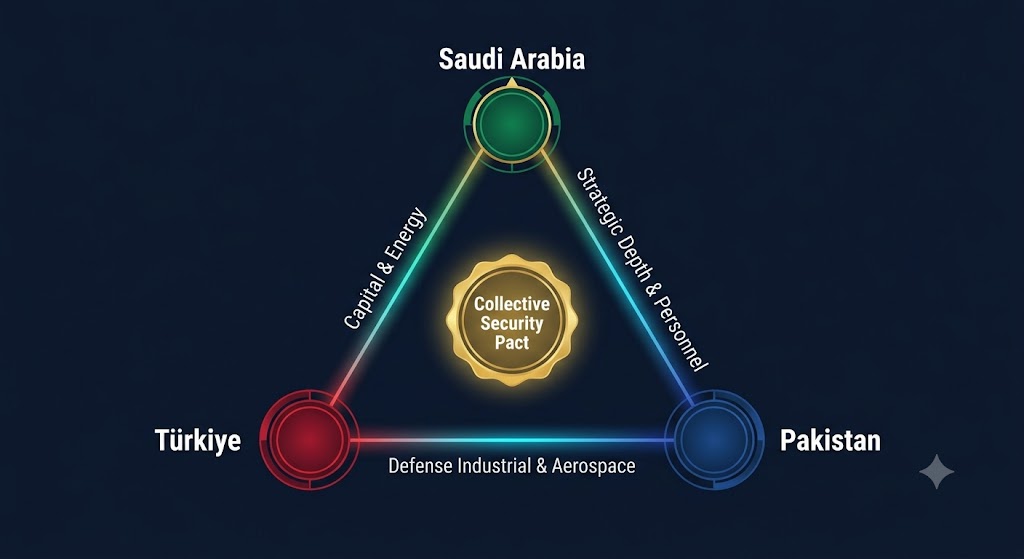
THE TRILATERAL DEFENSE TRIAD
1. Saudi Arabia: Capital, Energy, and Strategic Depth
Saudi Arabia’s primary driver is strategic autonomy. Following years of fluctuating policy commitments from Western allies and escalating regional threats across critical maritime choke points (such as the Bab el-Mandeb and the Strait of Hormuz), Riyadh has aggressively pursued defense self-reliance under Vision 2030.
- Financial Capital: Saudi Arabia provides the liquidity required to fund large-scale defense Research and Development (R&D) and military infrastructure.
- Energy Security: Guaranteed energy supplies stabilize the industrial output of partner nations during contingencies.
- Geographic Anchor: Riyadh anchors the security architecture of the Arabian Peninsula and the Red Sea corridor.
2. Türkiye: High-Tech Defense Manufacturing and Aerospace
Türkiye enters the alliance as a top-tier supplier of indigenous defense technologies. Having drastically reduced its military import reliance over the past two decades, Ankara brings combat-proven hardware and aerospace engineering to the alliance.
- Unmanned Aerial Systems (UAS): Combat-tested platforms like the Bayraktar TB3 and Akıncı UAVs provide immediate aerial dominance and surveillance capabilities.
- Fifth-Generation Aerospace & Naval Assets: Through projects like the KAAN fighter aircraft and the MILGEM naval corvette program, Türkiye provides advanced platforms without restrictive end-user export clauses.
- NATO-Standard Doctrine: Turkish armed forces bring NATO-compliant operational standards, command-and-control architectures, and tactical doctrines.
3. Pakistan: Battle-Tested Forces and Strategic Deterrence
Pakistan brings human capital, operational combat experience, and strategic deterrence that balances the coalition’s physical posture.
- Human Capital and Deployment Capacity: Pakistan’s armed forces boast extensive experience in conventional warfare, counter-insurgency, and desert operational environments.
- Strategic Training and Intelligence: Islamabad’s intelligence apparatus and elite training institutions provide immediate force-multiplier benefits to Gulf security forces.
- Strategic Balancing: As a nuclear-armed power, Pakistan offers an indispensable deterrent shadow, discouraging major power adventurism against alliance members.
Primary Objectives of the Mutual Defense Framework
This defense framework moves far beyond standard joint military exercises. It creates a structural binding mechanism focused on three primary operational pillars:
I. Joint Defense Industrial Co-Production
Rather than operating as a buyer-seller relationship, the pact establishes joint defense manufacturing facilities across all three territories. Major initiatives include:
- Establishment of localized drone assembly lines and armored vehicle manufacturing in Saudi Arabia.
- Joint development of missile technology, air defense systems, and ammunition production facilities in Pakistan.
- Shared funding for Türkiye’s next-generation fighter programs and naval platforms.
II. Interoperable Command & Control (C4ISR)
A collective posture requires seamless communication. The alliance prioritizes integrating Command, Control, Communications, Computers, Intelligence, Surveillance, and Reconnaissance (C4ISR) networks. Shared radar tracking, early-warning missile defense networks, and satellite intelligence sharing allow for a unified operational picture stretching from the East Mediterranean to the Arabian Sea.
III. Mutual Security Assurances and Force Projection
While structured around defense and deterrence, the core commitment ensures that an attack on the sovereignty or critical infrastructure of one member triggers coordinated intelligence, logistical, naval, and defensive military support from the others. This explicitly secures critical energy infrastructure, trade lines, and territorial integrity.
| Strategic Sphere | Primary Impact & Realignment |
| South Asia Middle East NATO & Western Allies China & Russia | Alters regional military balance; shifts deterrence Creates indigenous security umbrella; reduces US tie Challenges Western defense export monopolies Complements multipolar trade routes (BRI/INSTC) |
1. South Asia and the Indian Ocean
For South Asia, Pakistan’s formal defense integration with Ankara and Riyadh enhances its strategic depth. Access to advanced Turkish aerospace technology funded by Saudi capital significantly modernizes Islamabad’s conventional deterrence capabilities. However, it also requires delicate diplomatic navigation regarding regional trade partners in the Indian Ocean.
2. The Middle East and the Gulf
The pact reduces the Arabian Gulf’s historical dependency on Western military deployments. By building a localized defense framework composed of major Muslim-majority military powers, the alliance establishes a self-contained security umbrella capable of responding to regional maritime threats, piracy, and non-state aggression.
3. The Western Alliance and NATO
Ankara’s active leadership in an independent security pact highlights Türkiye’s evolving role within global security dynamics. While remaining a key NATO member, Türkiye demonstrates its ability to build parallel strategic alliances across the Global South. Western defense contractors face increasing competition as Riyadh and Islamabad pivot toward non-restricted Turkish hardware.
4. Beijing and Moscow’s Perspective
Both China and Russia view the alliance with calculated pragmatism. While it establishes a powerful independent bloc, it aligns with their broader vision of a multipolar world order that is less reliant on Western security architectures. Furthermore, it stabilizes key transit hubs vital for trade networks like China’s Belt and Road Initiative (BRI).
Operational Challenges Ahead
Despite its vast potential, the tripartite alliance faces operational complexities that require long-term diplomatic management:
- Command Integration: Harmonizing three distinct command structures, operational languages, and doctrinal histories takes years of sustained joint exercises.
- Diplomatic Balancing: Each nation maintains unique external relations. Türkiye’s commitments within NATO, Pakistan’s extensive economic alignment with China, and Saudi Arabia’s strategic balance between global powers require careful diplomatic coordination to avoid friction points.
- Economic Dependencies: Sustaining long-term defense-industrial investments demands economic stability across all partner states despite global market volatility.
A Paradigm Shift in Global Security
The activation of a mutual defense framework between Pakistan, Türkiye, and Saudi Arabia represents a permanent transition toward regional self-reliance. By combining military hardware manufacturing, strategic force capacity, and financial capital, this coalition creates a formidable security structure across Eurasia and the Middle East.
As the alliance matures, it will not only reshape defense procurement and regional deterrence, but also serve as a blueprint for middle-power security coalitions in an increasingly multipolar world.
* Conceptual illustration generated using AI