
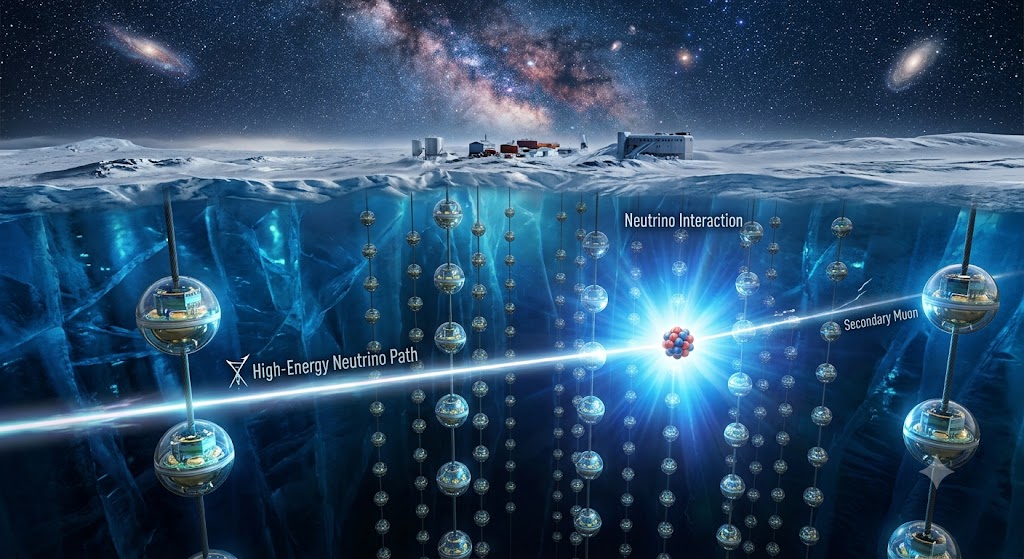
The Royal Swedish Academy of Sciences in Stockholm has awarded the 2026 Nobel Prize in Physics to Belgian-American particle physicist Francis Halzen. Currently a researcher at the University of Wisconsin–Madison, Halzen was honored for his decisive contributions to the IceCube Neutrino Observatory and the groundbreaking discovery of high-energy neutrinos originating from astrophysical sources. By transforming a cubic kilometer of Antarctic ice into the world’s most unusual telescope, Halzen’s vision and scientific leadership successfully opened an entirely new window into the universe, giving birth to the field of neutrino astronomy.
The Enigma of the Ghost Particle
To understand the magnitude of Halzen’s achievement, one must first grasp the frustrating nature of the neutrino. Often described as “ghost-like,” neutrinos are subatomic particles that possess virtually no mass and carry no electrical charge. This unique physical profile allows them to travel vast cosmic distances without being deflected by magnetic fields or absorbed by matter.
At this exact moment, billions of these particles are passing through your body every single second, completely unnoticed. They stream effortlessly through buildings, bore through mountains, and traverse the entire Earth as if the planet were completely transparent. While this ghostly ability to ignore matter is what makes neutrinos incredibly valuable to scientists seeking uncorrupted messengers from the deep universe, it also makes them infuriatingly difficult to detect. Traditional astronomical instruments, which rely on capturing light, are completely blind to them.
For decades, astrophysicists knew that the universe’s most violent and energetic processes—such as supermassive black holes feeding on galaxies, or the cataclysmic collapse of dying stars—were producing these high-energy neutrinos. Yet, because the particles rarely interact with anything, catching one required an observation medium of unprecedented scale.
The IceCube Vision: A Telescope Pointed Down
Born in 1944 and having earned his Ph.D. in 1969 from KU Leuven in Belgium, Francis Halzen spent years pondering how to trap these elusive cosmic messengers. The solution required an enormous, perfectly transparent medium where a rare neutrino collision could be observed. In 1988, Halzen proposed a radical, ambitious idea: rather than looking up at the sky, scientists should look down into the immense, pristine volume of Antarctic ice at the South Pole.
Halzen realized that the South Pole’s deep ice was an ideal trap. The underlying physics of the proposal was elegantly simple, even if the engineering was overwhelmingly complex. Very rarely, a high-energy neutrino traveling through the Earth will collide head-on with an atomic nucleus trapped within the ice. This violent, subatomic collision produces a faint flash of light. By embedding highly sensitive light sensors deep within the glacier, scientists could theoretically detect and track these flashes, tracing the path of the original neutrino back to its cosmic source.
What began as a theoretical proposal in the late 1980s eventually evolved into the IceCube Neutrino Observatory. Completed in 2011, this astonishing feat of engineering effectively weaponized the harshest environment on Earth for the pursuit of fundamental physics. The observatory spans a massive cubic kilometer of Antarctic ice, equipped with thousands of specialized light sensors. It stands as a testament to Halzen’s persistent leadership over a project that spanned decades and required extreme logistical endurance.
Decoding Cosmic Accelerators
The scientific payoff for burying a kilometer of sensors in the South Pole was monumental. Shortly after its completion, IceCube began detecting high-energy neutrinos that clearly originated far beyond our own Solar System. These were not the relatively low-energy particles produced by our Sun or local atmospheric events; these were cosmic heavyweights, carrying the energetic signatures of the universe’s most extreme environments.
This discovery fundamentally validated Halzen’s lifelong pursuit. The Nobel jury highlighted that IceCube allows researchers to capture these high-energy particles stemming from incredibly energy-rich processes in the distant cosmos. Neutrinos act as uncorrupted hard drives of cosmic data. Because they travel in perfectly straight lines without being scattered by cosmic dust or warped by magnetic fields, they point directly back to their origins.
By analyzing the continuous stream of neutrino interactions collected by IceCube, the global scientific community is gaining entirely novel knowledge about the violent cosmic settings where these cosmic particle accelerators exist. The award-giving body specifically noted that this continuous data collection “could even reveal previously unknown cosmic phenomena”. We are no longer limited to studying the universe through the electromagnetic spectrum; we can now “see” the cosmos through the particles it hurls at us.
A Legacy Cemented in Ice
The 2026 Nobel Prize in Physics is a fitting capstone to a career defined by audacity and patience. From earning his doctorate in 1969 to conceptualizing an ice-based observatory in 1988, to finally completing the facility in 2011, Halzen’s trajectory represents the grueling, multi-decade marathon that defines modern experimental physics.
The transition from capturing photons (light) to capturing neutrinos marks a paradigm shift in astronomy. For centuries, human understanding of the universe was constrained by what our telescopes could see. Light, however, is easily blocked by cosmic dust clouds or absorbed by dense matter. By successfully harnessing the ghost-like neutrino, Francis Halzen has provided humanity with the tools to look directly into the hearts of active galaxies, exploding stars, and the most violent, high-energy phenomena in existence. The universe has always been speaking to us through these invisible messengers; thanks to a cubic kilometer of ice at the bottom of the world, we are finally able to listen.
* Conceptual illustration generated using AI