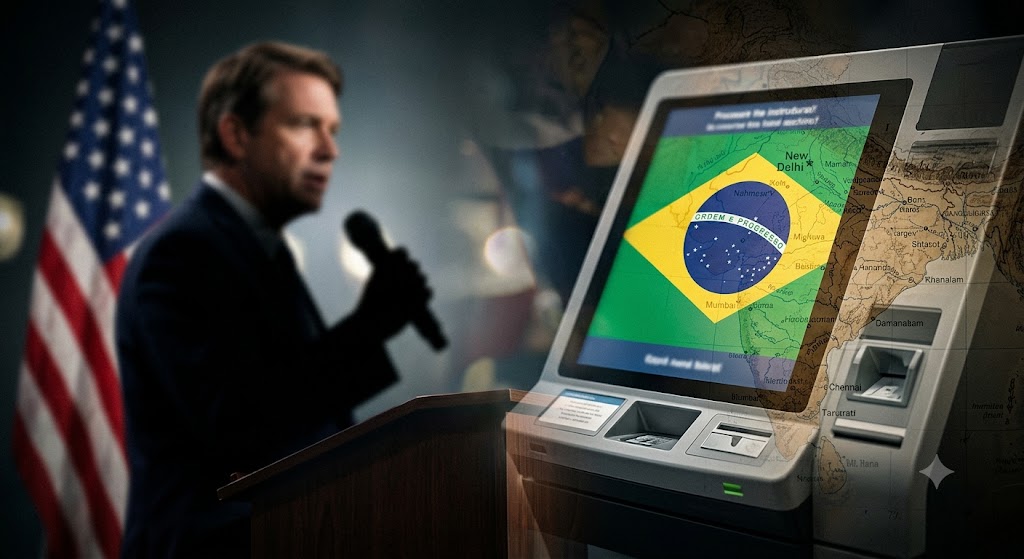
In the modern political arena, social media platforms have fundamentally altered the speed and filter through which world leaders communicate. While this allows for unprecedented direct engagement with the public, it also creates an environment highly susceptible to real-time, highly visible errors. Such was the case this week when US President Donald Trump took to Truth Social to launch a blistering attack on the integrity of the American electoral process. However, in his attempt to draw a sharp, critical contrast, the President committed a significant geographical and political blunder: he confused the ongoing, high-stakes presidential election in Brazil with a non-existent election in India.
The gaffe has quickly reverberated across diplomatic channels, drawing wry amusement from international observers while simultaneously highlighting the President’s relentless, ongoing campaign to cast doubt on domestic US vote-counting procedures.
The Anatomy of the Error
The controversy stems from a post Trump published on Truth Social on Monday, October 5, 2026. The President was clearly attempting to leverage the rapid vote-counting turnaround of a major international election to criticize the often slower, decentralized process in the United States.
“125 MILLION people voted in India’s Presidential election,” Trump proclaimed to his millions of followers. “The results came out shortly after the vote closed, on the SAME DAY!”
He then immediately pivoted to his primary grievance regarding domestic American cities, writing: “In Detroit, Philadelphia, California, and numerous other US Cities and States, the results, with much smaller numbers, will often take weeks to Rig, I mean, calculate. Voting in America is CORRUPT”.
The structural flaw in the President’s argument was immediately apparent to anyone following global affairs: there was no presidential election in India over the weekend. Furthermore, India does not elect its president through a direct, popular, nationwide vote. The current Indian President, Droupadi Murmu, was elected by an Electoral College consisting of elected members of parliament and legislative assemblies in July 2022, and her term runs for five years.
The Real Target: Brazil’s Electoral Showdown
It quickly became clear that the President was attempting to reference the massive first-round presidential election that had taken place just a day earlier, on Sunday, October 4, in Brazil.
The statistics Trump cited perfectly align with the South American nation’s electoral data. On Sunday, nearly 125 million Brazilians cast valid votes in a deeply polarized contest between the incumbent leftist President Luiz Inácio Lula da Silva and the right-wing challenger, Senator Flávio Bolsonaro (son of former President Jair Bolsonaro).
Because Brazil utilizes a highly centralized, completely electronic voting system, the country’s Supreme Electoral Court is able to tally tens of millions of votes with staggering speed. Within hours of the polls closing on Sunday evening, it was confirmed that Flávio Bolsonaro had secured roughly 47% of the vote against Lula’s 45%. As neither candidate crossed the 50% threshold, the rapid count immediately set the stage for a runoff election scheduled for October 25.
Trump’s core point regarding the speed of the electronic tally was factually accurate regarding Brazil, but entirely misattributed to India.
A History of Electoral Comparisons
While this specific geographic mix-up is embarrassing, the underlying rhetorical strategy is not new for President Trump. He has frequently looked abroad to find examples of electoral systems that align with his preferred policy changes for the United States.
Ironically, Trump has previously cited India in discussions regarding election integrity. In past remarks, he has repeatedly praised India’s robust, nationwide voter identification system, using it to advocate for stringent photo ID requirements in US federal elections. India’s massive logistical undertaking—deploying millions of electronic voting machines (EVMs) and requiring mandatory voter ID across a staggering electorate of nearly one billion people—has long been a talking point for American conservatives demanding stricter voter verification.
The Broader Implications
Beyond the immediate viral mockery of confusing a South American election with a South Asian democracy, the President’s post underscores his enduring focus on the mechanics of US elections.
By explicitly naming Democratic strongholds like Detroit, Philadelphia, and California, and using the word “Rig” (before correcting it to “calculate”), Trump continues to actively undermine public faith in the decentralized American system. In the US, elections are administered at the state and county levels, resulting in vastly different rules regarding mail-in ballots, early voting, and when the counting process can legally begin. This decentralization often leads to the “red mirage” or “blue shift” phenomenons, where early results shift significantly in the days following an election as massive quantities of mail-in ballots are meticulously processed and verified.
For the Trump administration, comparing this slow, deliberate US process to the lightning-fast, centralized electronic tallies of countries like Brazil (or, mistakenly, India) serves a dual political purpose: it stokes domestic outrage over the speed of the count while laying the rhetorical groundwork to challenge future slow-arriving results in closely contested swing states.
As the international community watches the geopolitical tension surrounding the upcoming Brazil runoff between Lula and Bolsonaro—an election in which Washington is heavily invested—the White House’s latest social media misfire serves as a bizarre footnote. It is a reminder that in the high-speed ecosystem of modern political communication, a potent political narrative can easily be derailed by a failure to check a map.
* Conceptual illustration generated using AI