
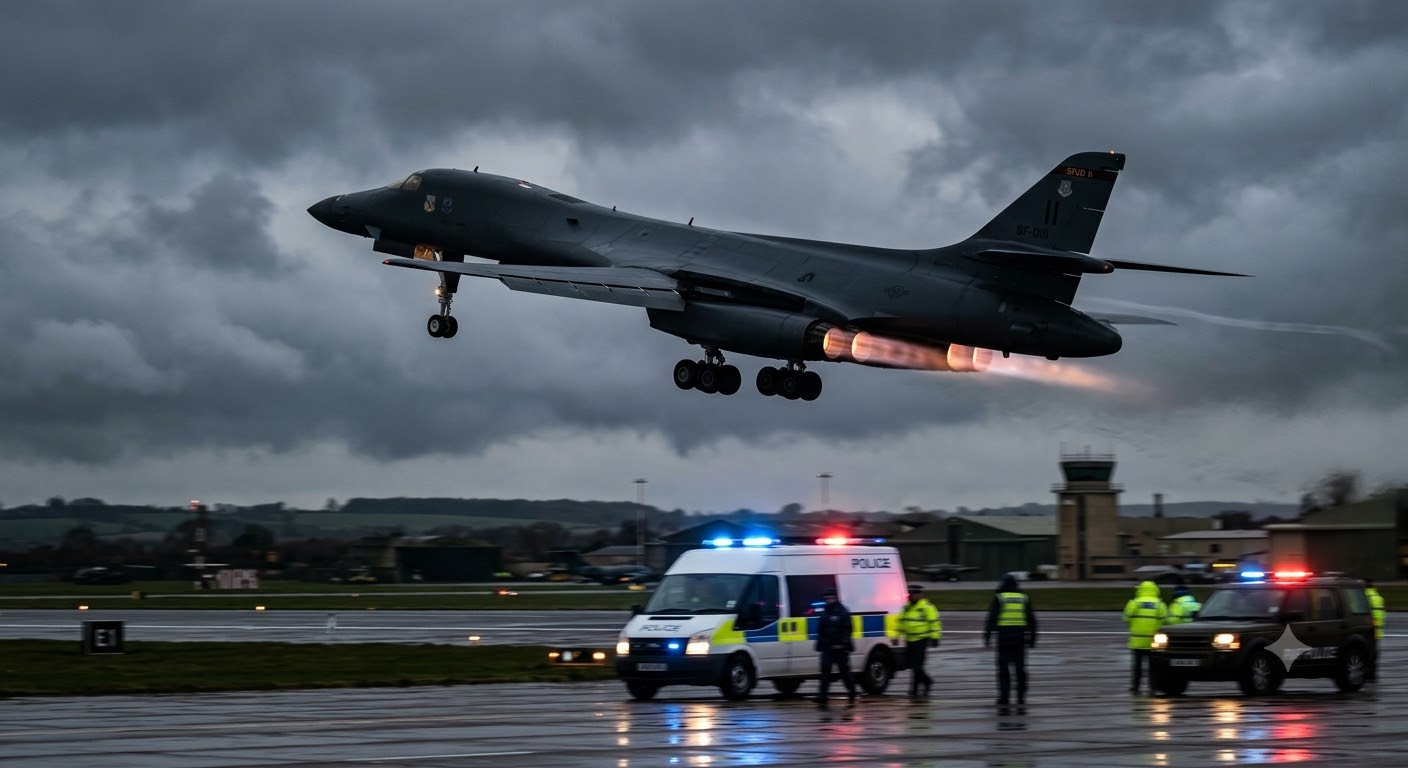
The sight of Rockwell B-1 Lancer heavy bombers roaring out of RAF Fairford is a familiar one to the residents of Gloucestershire. The installation has served as a critical forward operating base for US Global Strike Command for decades, projecting American airpower across the Middle East. However, the mass exodus of the bomber fleet over this past weekend was anything but routine. Following a murky, convoluted terror scare outside the base’s perimeter, the United States has officially withdrawn all its B-1 bombers from the United Kingdom, abruptly flying them back to their home stations across the Atlantic.
This highly unusual redeployment, explicitly ordered by US President Donald Trump and confirmed by the Pentagon, exposes a deep nerve in the ongoing conflict with Tehran. It also highlights a growing transatlantic disconnect regarding security assessments, as Washington pulls its multi-million-dollar assets off the tarmac while London insists the base remains perfectly secure.
The Anatomy of a Bizarre “Bomb Plot”
The catalyst for the sudden withdrawal was a sequence of events that began on September 27. Gloucestershire Police and Counter Terrorism Policing declared a major incident near RAF Fairford, resulting in the evacuation of nearby homes and the arrest of five British men in their 20s from London.
Initial reports suggested an imminent threat to the base, which has been actively utilized by the US to launch strikes against Iranian targets in the ongoing Middle East conflict. The situation escalated dramatically when a 25-year-old British-Iranian dual national was subsequently arrested, providing authorities with a tangible link to Tehran.
Yet, as the investigation unfolded, the narrative grew increasingly complex and contradictory.
- The 999 Call: Bizarrely, it emerged that one of the initial five suspects had actually called emergency services (999) himself to report the incident, an incredibly unconventional move for an active terror cell.
- No Viable Explosives: Following a thorough forensic examination of three white vans found near the installation, British authorities confirmed that no viable explosives were discovered on the premises.
- Suspects Bailed: In a move that surprised many international observers monitoring the high-stakes terror probe, all six suspects were subsequently released on bail pending further investigation.
Despite the lack of a detonated device or concrete bomb-making materials, the mere proximity of a suspected Iranian-linked plot to America’s premier strategic bombers was enough to trigger a massive geopolitical reaction.
Trump’s Tactical Calculus: Protecting the Assets
For the White House, the ambiguous nature of the Gloucestershire arrests did not dilute the severity of the threat. President Donald Trump addressed the hasty withdrawal directly on Monday, October 5, confirming that “threats” linked to Iran had forced his hand.
“There were some threats,” Trump told reporters. “And rather than tempting the enemy—we’ll capture the enemy and beat the enemy, but why should we leave them there? So we moved them around a little bit, not very far”.
The tactical logic underpinning the Pentagon’s decision is deeply rooted in asset protection. The B-1 Lancer is a highly sophisticated, expensive, and relatively scarce strategic asset. While they are devastatingly effective in the air, heavily fueled and armed bombers sitting exposed on a tarmac are incredibly vulnerable soft targets. Even a rudimentary drone strike or a small-scale perimeter breach could result in catastrophic operational losses.
According to US officials speaking to CNN, the threat was categorized as a “real-world incident”. However, defense analysts have noted that it is highly unusual for the US military to return the bombers all the way to their home stations in the United States rather than simply redeploying them to another secure base within the European theater. The sheer haste of the departure—with some of the bombers having only arrived on rotation less than a week prior—underscores the acute alarm felt within the Pentagon.
The Transatlantic Disconnect and Regional Fallout
The abrupt withdrawal has left the British government navigating a delicate diplomatic tightrope. UK Prime Minister Andy Burnham and Downing Street have sought to project absolute stability, insisting that RAF Fairford remains fundamentally “safe” and secure despite Washington’s dramatic exit.
This transatlantic divergence in threat assessment is palpable. While the US opted for immediate risk elimination by pulling its aircraft, the UK is treating the incident strictly as an ongoing domestic police investigation. The optics of the United States pulling its premier strike aircraft out of a steadfast NATO ally’s territory due to local security concerns is undoubtedly a friction point, even if publicly downplayed by both administrations.
Meanwhile, the geopolitical fallout continues to spread. Iran has fiercely denied any involvement in the Gloucestershire incident, dismissing the accusations as entirely baseless. In a standard diplomatic counter-maneuver, Tehran officially summoned the British ambassador to protest the allegations of state-sponsored terrorism on UK soil.
A Shifting Posture in the Iran Conflict
The emptying of the flightline at RAF Fairford is more than just a localized security precaution; it is a clear indicator of how the protracted conflict with Iran is stretching global military logistics.
By pulling the B-1 bombers back to the continental United States, Washington removes a highly visible target for Iranian asymmetric warfare, but it also increases the transit time required for future strategic bombing runs in the Middle East. To compensate for this sudden vacuum in forward-deployed airpower, US defense officials have indicated that they may accelerate the deployment of naval assets, potentially resulting in three carrier strike groups operating simultaneously in the region by the end of October.
The events in Gloucestershire demonstrate that the frontlines of the current Middle East conflict are not confined to the Persian Gulf or the Levant. When a suspected plot involving white vans and a 999 call in the quiet English countryside can force the immediate redeployment of the United States’ most formidable strategic bombers, it becomes clear that asymmetric threats are successfully dictating the movements of conventional superpowers. The bombers may have flown home, but the vulnerability they left behind remains.
* Conceptual illustration generated using AI