
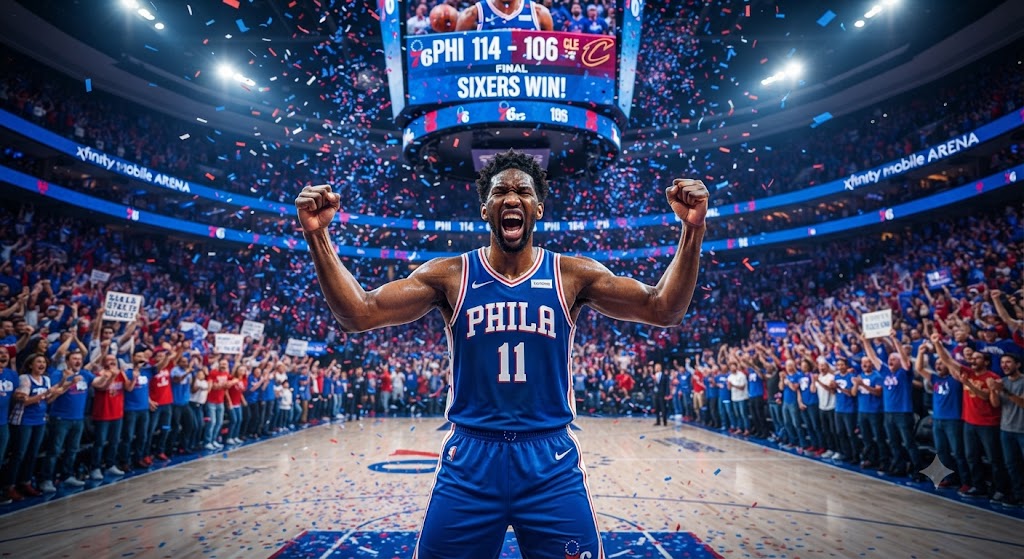
For 18 minutes on Thursday night, the atmosphere inside Philadelphia’s Xfinity Mobile Arena felt less like a celebration of a brand-new NBA season and more like a collective wake. Trailing 58-29 midway through the second quarter against a clinical Cleveland Cavaliers squad led by Donovan Mitchell and James Harden, the 76ers looked disorganized, gassed, and entirely overwhelmed. The electric optimism of a transformative summer—which saw Philadelphia assemble a star-studded lineup around Joel Embiid, Tyrese Maxey, Jaylen Brown, and 41-year-old icon LeBron James—appeared to be dissolving into familiar local cynicism.
Then, the impossible happened.
Over the final two-and-a-half quarters, Philadelphia unleashed a relentless 85-48 deluge, roaring back to claim a stunning 114-106 victory. The 29-point turnaround stands as the largest comeback win in the 76ers franchise history since the 1997-98 season and marks the single largest regular-season deficit overcome in LeBron James’ extraordinary 24-year, 1,624-game career.
Here is an analytical breakdown of how Philadelphia engineered an opener for the ages, the tactical adjustments that turned the tide, and what this dramatic victory signals for the 2026-27 NBA season.
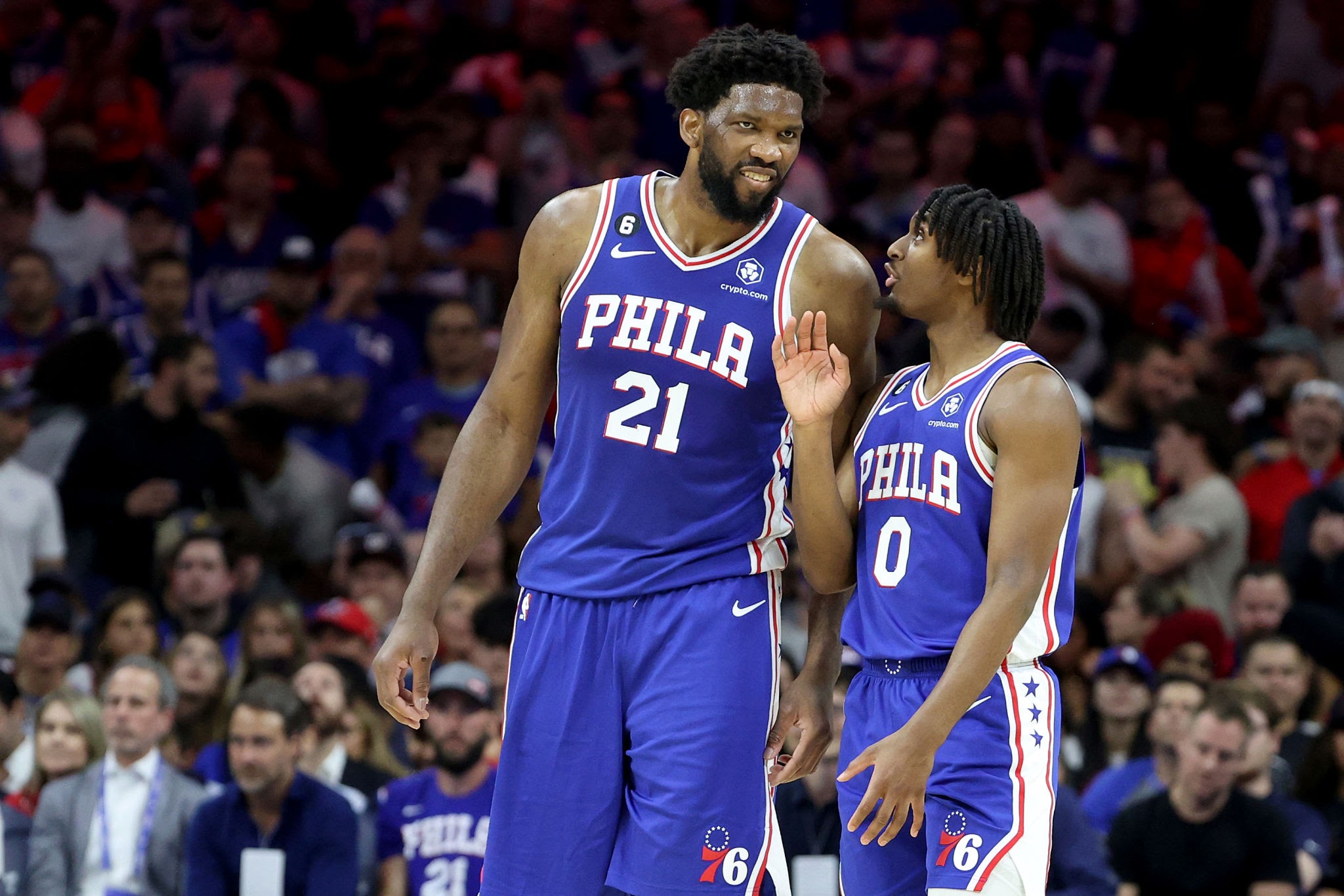
Embiid and Maxey sparked Philadelphia’s historic comeback
The Trajectory of the Turnaround
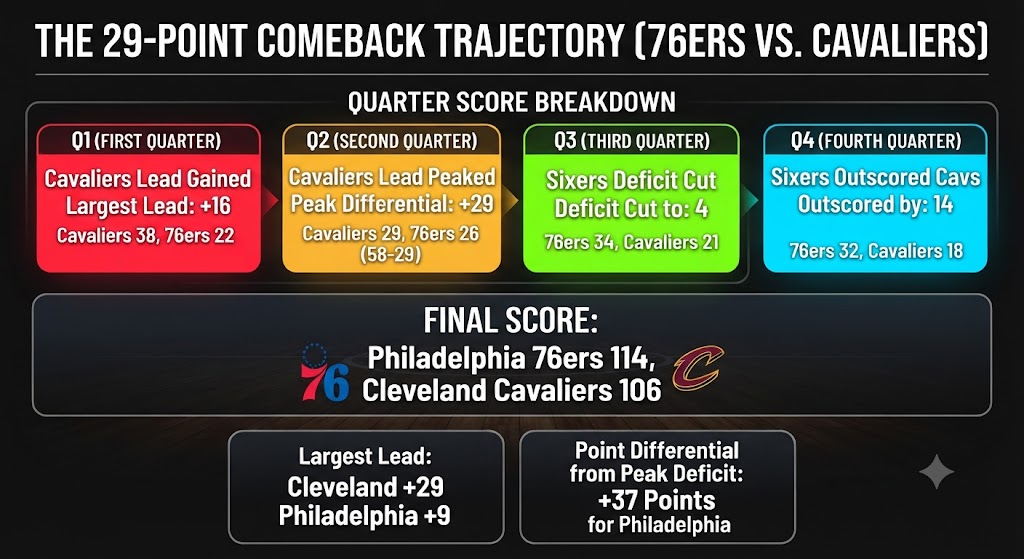
To appreciate the scale of Philadelphia’s resurgence, one must examine how quickly the game inverted between the second and fourth quarters.
During the Cavaliers’ initial onslaught, Cleveland dominated every metric: shooting 62% from the field, punishing Philadelphia’s transition defense, and opening up a 29-point cushion behind Mitchell’s early perimeter barrage. Philadelphia’s response was not driven by a single explosive run, but by a systematic, quarter-by-quarter ratchet of defensive pressure and paint dominance.
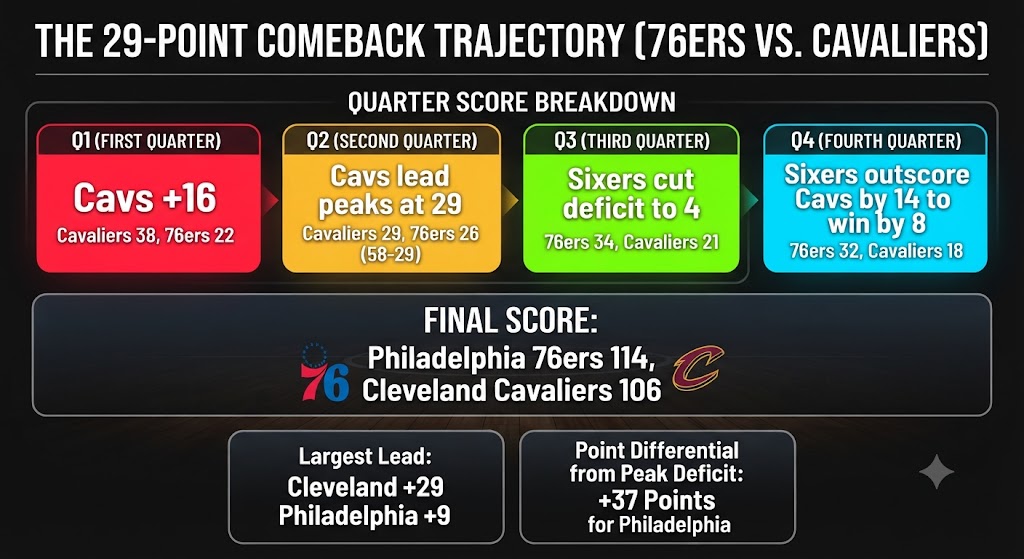
The 29-Point Comeback Trajectory (76ers vs. Cavaliers)
The “Big Five” Synergy: 105 Points of Dominance
While comeback stories often feature a rogue bench spark, Thursday’s victory was defined by sheer top-heavy firepower. Philadelphia’s newly minted “Big Five” starting lineup accounted for 105 of the team’s 114 total points, combining for 35 rebounds, 22 assists, and 9 steals in an overwhelming display of starters’ dominance.
The 29-Point Comeback Trajectory (76ers vs. Cavaliers)
1. Tyrese Maxey’s Explosive Engine (32 Points)
Maxey proved why he is the engine of Philadelphia’s offense. Logging 42 minutes, the young guard shredded Cleveland’s perimeter defense in the second half, repeatedly driving into the lane and finishing through contact. His back-to-back fastbreak layups midway through the fourth quarter gave Philadelphia its first lead of the night, sending the 20,000-plus crowd into a frenzy.
2. Embiid’s Interior Anchor (24 Points, 7 Rebounds)
Despite battling early foul trouble, Joel Embiid provided crucial stabilization. Rather than forcing perimeter jumpers against Jarrett Allen and Evan Mobley, Embiid operated methodically out of the low post, drawing 9 free-throw attempts and commanding double-teams that opened up wide-open lanes for Maxey and Brown.
3. LeBron’s Historic Masterclass in Facilitation
At 41 years old and playing in his 24th NBA season, LeBron James delivered a masterclass in situational basketball. James did not look to overpower Cleveland with scoring; instead, he functioned as a point-forward orchestrator, recording 17 points, 10 rebounds, 5 assists, 3 steals, and a game-sealing chase-down block in the final two minutes. The 29-point comeback eclipsed his previous career-best deficit override (a 27-point comeback with the Miami Heat in 2013), adding yet another milestone to his unmatched resume.
4. Jaylen Brown and V.J. Edgecombe’s Wing Balance
Acquired in a blockbuster offseason move, Jaylen Brown brought essential two-way toughness, contributing 21 points and 8 rebounds while defending Donovan Mitchell in crucial late-game possessions. Meanwhile, rookie Guard V.J. Edgecombe provided electric perimeter defense, racking up 3 steals and 6 assists while making key hustle plays that repeatedly disrupted Cleveland’s offensive flow.
Tactical Adjustments: How the Defense Shifted the Game
Philadelphia’s second-half resurgence was not merely an offensive explosion; it was built on a dramatic tactical pivot engineered by the coaching staff.
A. Swapping to Full-Court Ball Denials
In the first half, James Harden and Donovan Mitchell walked the ball up the floor untouched, initiating Cleveland’s high-pick-and-roll sets with 18 seconds on the shot clock. In the third quarter, Philadelphia deployed Edgecombe and Maxey in full-court ball denial, forcing Cleveland’s guards to waste 6 to 8 seconds just crossing midcourt. This pressure disrupted Cleveland’s timing, leading to 21 total turnover points for Philadelphia.
B. Pushing the Pace off Defensive Rebounds
In the first half, Philadelphia played a sluggish, half-court game that played directly into Cleveland’s rim-protecting hands (Jarrett Allen and Evan Mobley recorded 2 blocks combined). In the second half, whenever LeBron James or Jaylen Brown secured a defensive rebound, they immediately fired outlet passes to a sprinting Maxey. Philadelphia outscored Cleveland 24 to 23 in fastbreak points, completely changing the tempo of the game.
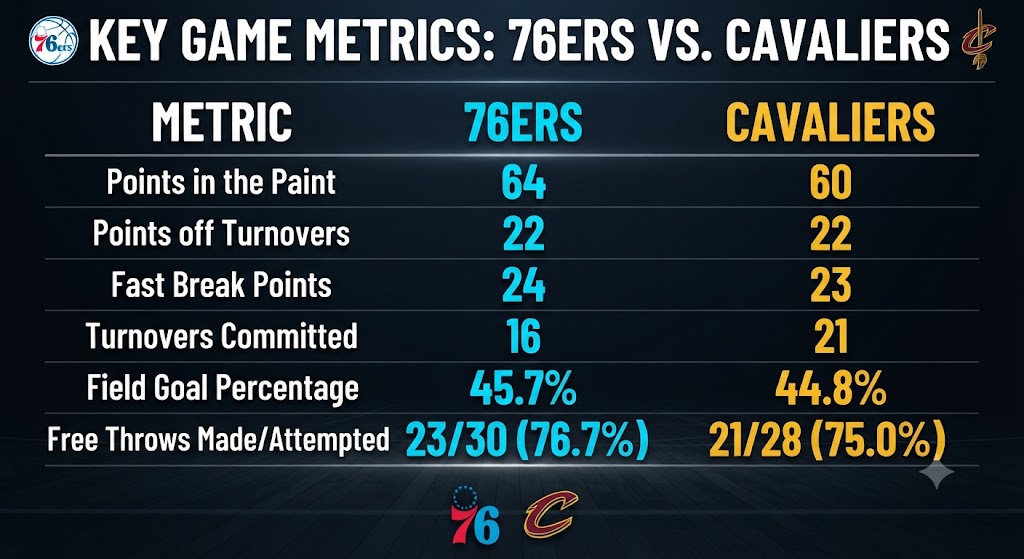
Key Game Metrics, 76ers vs. Cavaliers
What the Win Means for Philadelphia’s Championship Ambitions
Opening the 2026-27 season with back-to-back statement victories—first defeating the New York Knicks at Madison Square Garden on Tuesday, followed by a 29-point comeback over the Cavaliers on Thursday—has fundamentally reshaped expectations around the 76ers.
For years, Philadelphia teams were plagued by fragile late-game execution and emotional collapses when falling behind early. Erasing a 29-point deficit against an Eastern Conference contender demonstrates a level of mental resilience and veteran composure that previous rosters lacked.
However, the game also exposed clear areas for improvement:
- Bench Depth Concerns: Philadelphia’s bench contributed just 9 total points, raising questions about workload management for Embiid and James over an 82-game regular season.
- First-Quarter Slow Starts: Allowing 38 points in the opening quarter against elite offenses is a habit Philadelphia cannot afford to repeat.
Conclusion
Philadelphia’s 114-106 victory over the Cleveland Cavaliers was more than just a home opener win; it was a thunderous declaration that the 2026-27 76ers possess both the elite talent and the competitive grit required to compete at the highest level. By overcoming a 29-point deficit, LeBron James, Joel Embiid, and Tyrese Maxey gave Philadelphia fans a night they will remember for years—and provided the rest of the NBA with a chilling preview of what this team can achieve when firing on all cylinders.
* Conceptual illustration generated using AI