
In today’s corporate ecosystem, an employee can be lauded as indispensable at 10:00 AM and rendered entirely expendable by lunchtime. A public enterprise can report record quarterly profits on Monday, unveil a sweeping artificial intelligence strategy on Tuesday, and inform thousands of skilled workers by Wednesday morning that their roles are no longer required.
Welcome to the modern workplace, where business is booming, stock valuations are near all-time highs, technology is advancing at a breathtaking pace, and yet, human employment is increasingly treated as an optional operational expense.
While mass redundancies have been a recurring feature of the tech and corporate landscape over the past few years, 2026 has introduced a chilling new phrase to the human resources vocabulary: “Performance-Focused Layoffs”. By framing structural workforce reductions around employee reviews and organizational efficiency, corporations are fundamentally redefining the implicit contract between employer and worker.
Here is an investigative analysis of how major global corporations—from semiconductor giants and banking conglomerates to gaming titans and e-commerce platforms—are using performance metrics to mask structural downsizing, the mathematical toll on the global workforce, and why the traditional corporate bargain is rapidly unravelling.
Case Studies in Contraction: When Profits Do Not Equal Protection
The trend of masking broad-based downsizing under the banner of performance management or strategic realignment spans multiple industries, each with distinct business models but identical outcomes for workers.
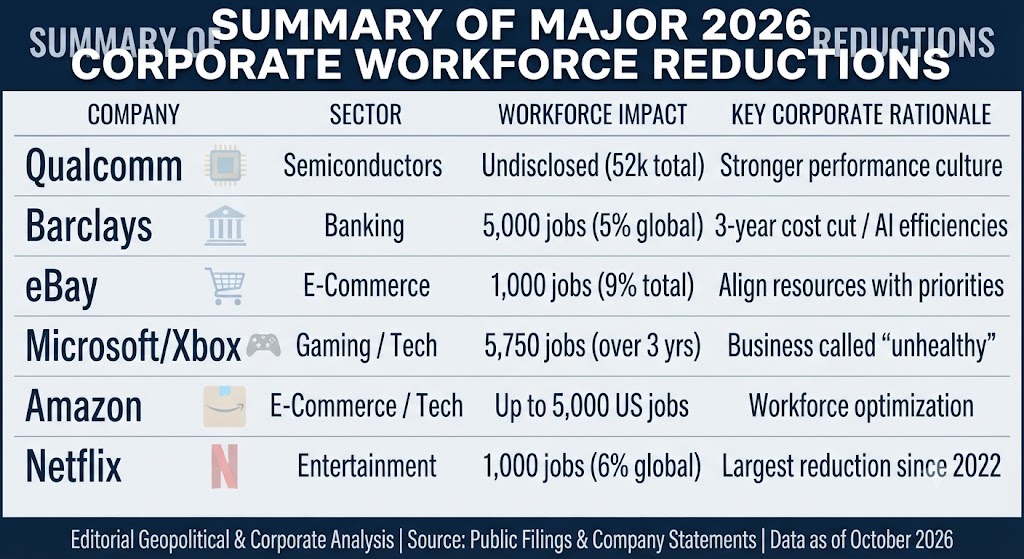
Summary of Major 2026 Corporate Workforce Reductions
1. Qualcomm: Weaponizing the Annual Review
San Diego-based semiconductor giant Qualcomm, whose chips power hundreds of millions of smartphones and connected edge devices globally, is preparing a significant round of global job cuts following its annual employee evaluation cycle.
In an internal memorandum leaked to the press, Qualcomm’s Chief Executive Officer stated that the primary objective of these cuts is to “build a stronger performance culture” and address areas where the company has “consistently fallen short of expectations”. Affected employees are scheduled to receive formal notifications in November.
While Qualcomm employs roughly 52,000 workers worldwide, the company has declined to disclose the exact headcount at risk. Performance evaluations are standard corporate practice across industries, but utilizing annual reviews as the legal and public basis for large-scale redundancies raises a profound ethical question: When a company claims it wants to improve performance, is it trying to help its employees perform better, or is it simply deciding which human beings are no longer worth keeping?
2. Barclays: Profitable, Yet Purging
If Qualcomm represents the tech hardware sector, British banking titan Barclays illustrates the trend within financial services. Barclays is currently executing a plan to eliminate approximately 5,000 positions globally—representing roughly 5% of its total workforce. Over 1,000 roles have already been erased, with an additional 4,000 reductions scheduled before the end of the year.
Crucially, roughly 60% of these eliminations hit support functions, including software developers and IT engineers. The impact is particularly acute in offshore operational hubs like India, where significant back-office, software development, and technical infrastructure support for Barclays’ UK operations are executed.
Barclays frames these cuts as part of a multi-year cost-cutting and modernization program, with management explicitly describing Artificial Intelligence as “the icing on the cake” for driving efficiency gains. Yet, Barclays reported a staggering $3 billion profit for the three months ending in September 2026 alone. This is not a business fighting for solvency; it is a healthy, highly profitable enterprise opting to become leaner, cheaper, and less dependent on human labor.
3. Microsoft and Xbox: Chronic Volatility in Gaming
Within the interactive entertainment space, Microsoft’s Xbox gaming division has become a symbol of perpetual restructuring. Reports indicate that Xbox is preparing additional rounds of layoffs scheduled for November 2026 and January 2027.
Xbox Chief Executive Officer Asha Sharma reportedly characterized the gaming business as “unhealthy,” citing early strategic investments that failed to yield expected commercial returns. To cut costs, Microsoft is reducing spending on external vendors, eliminating middle-management layers, and streamlining studio operations.
This comes on the heels of major cuts earlier in the year:
- July 2026: Microsoft announced a massive plan to eliminate 3,200 jobs across divisions by the end of fiscal year 2027, with 1,600 employees let go immediately.
- September 2026: An additional 260 gaming employees were let go.
- Three-Year Horizon: Over the past three years alone, Microsoft has eliminated a staggering 5,750 jobs from its gaming division.
4. eBay, Amazon, and Netflix: The Broad-Based Squeeze
The contraction is equally evident across digital commerce and streaming media:
- eBay: The e-commerce pioneer is cutting approximately 1,000 full-time roles (roughly 9% of its workforce), following an earlier round in February that eliminated 800 positions. Management cited the need to “align teams and resources with strategic priorities”—a corporate euphemism that translates to dropping roles that no longer fit automated workflows.
- Amazon: Reports indicate Amazon is preparing to eliminate up to 5,000 corporate positions in the United States, following earlier workforce reductions across the U.S., UK, and India.
- Netflix: The streaming giant is cutting approximately 1,000 employees (~6% of its global workforce) in its largest single round of redundancies since 2022.
The Human Toll: 665 Layoffs Every Single Day
When viewed in isolation, individual corporate announcements sound like routine operational recalibrations. When aggregated across the macro economy, however, the numbers reveal a relentless, systemic crisis.
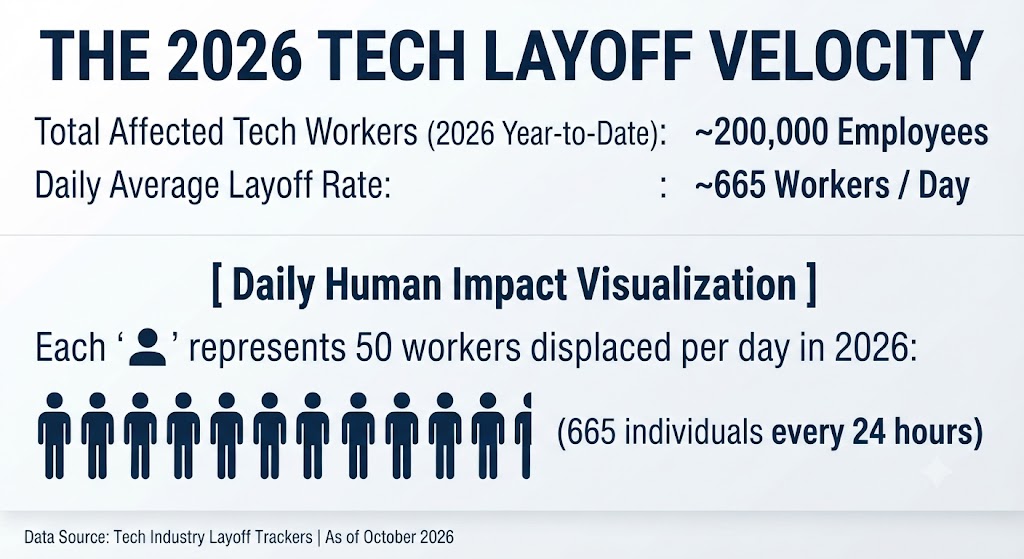
The 2026 Tech Layoff Velocity
Close to 200,000 technology and corporate employees have been affected by layoffs in 2026 so far. That translates to an average of roughly 665 skilled workers losing their livelihoods every single day of the year.
The Broken Bargain: Re-Justifying Your Existence Daily
For generations, the unwritten corporate contract was straightforward and mutually understood:
- The Employee Input: Brought specialized skills, dedicated time, hard work, and professional loyalty to the enterprise.
- The Employer Output: Provided competitive compensation, opportunities for professional growth, and, crucial above all else, a baseline measure of job security.
Today, the ground beneath that historical bargain has collapsed. Doing your job well is no longer a guarantee of security. In the modern corporate regime, employees are required to continuously prove not just that they are performing their assigned duties efficiently, but that the company still needs the role itself to exist at all.
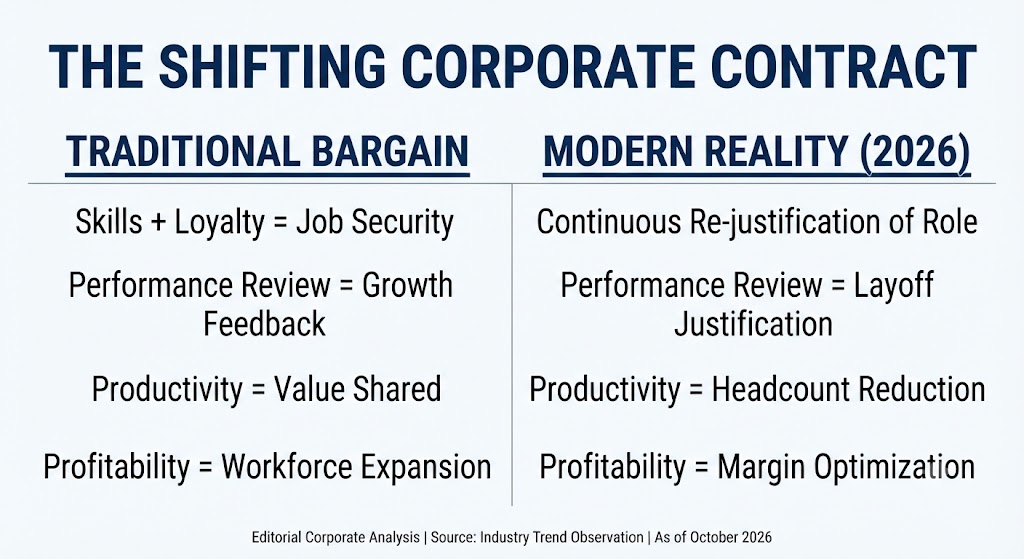
The Shifting Corporate Contract
The Efficiency Paradox: Who Benefits from Productivity?
This structural shift brings us to the central paradox of the modern economy. Historically, gains in productivity—driven by technological innovation, automation, and process optimization—were meant to create greater economic value, expanding the pie for capital and labor alike[cite: 1].
In 2026, every efficiency gain achieved through software, generative AI, or organizational streamlining is immediately followed by another round of headcount reduction[cite: 1].
When a corporation utilizes artificial intelligence or leaner operational structures to achieve record productivity and multi-billion-dollar quarterly profits, who actually benefits?[cite: 1] The capital markets reward the stock price; senior executives secure margin-based bonuses; and the workforce that built the operational efficiency is handed a severance package[cite: 1].
Conclusion
The rise of “performance-focused layoffs” is more than a passing management trend; it is a fundamental realignment of corporate power[cite: 1]. By rebranding structural downsizing as individual performance failures or strategic resource realignments, corporations are attempting to insulate themselves from public backlash while maintaining absolute flexibility over human capital[cite: 1].
As software tools and AI models continue to absorb analytical, administrative, and creative tasks, the global workforce faces an uncomfortable truth: in the eyes of the modern enterprise, no level of past loyalty or current performance guarantees immunity[cite: 1]. Until labor policy and corporate governance adapt to protect human value in an era of hyper-efficiency, millions of workers will remain locked in a perpetual struggle.
* Conceptual illustration generated using AI