
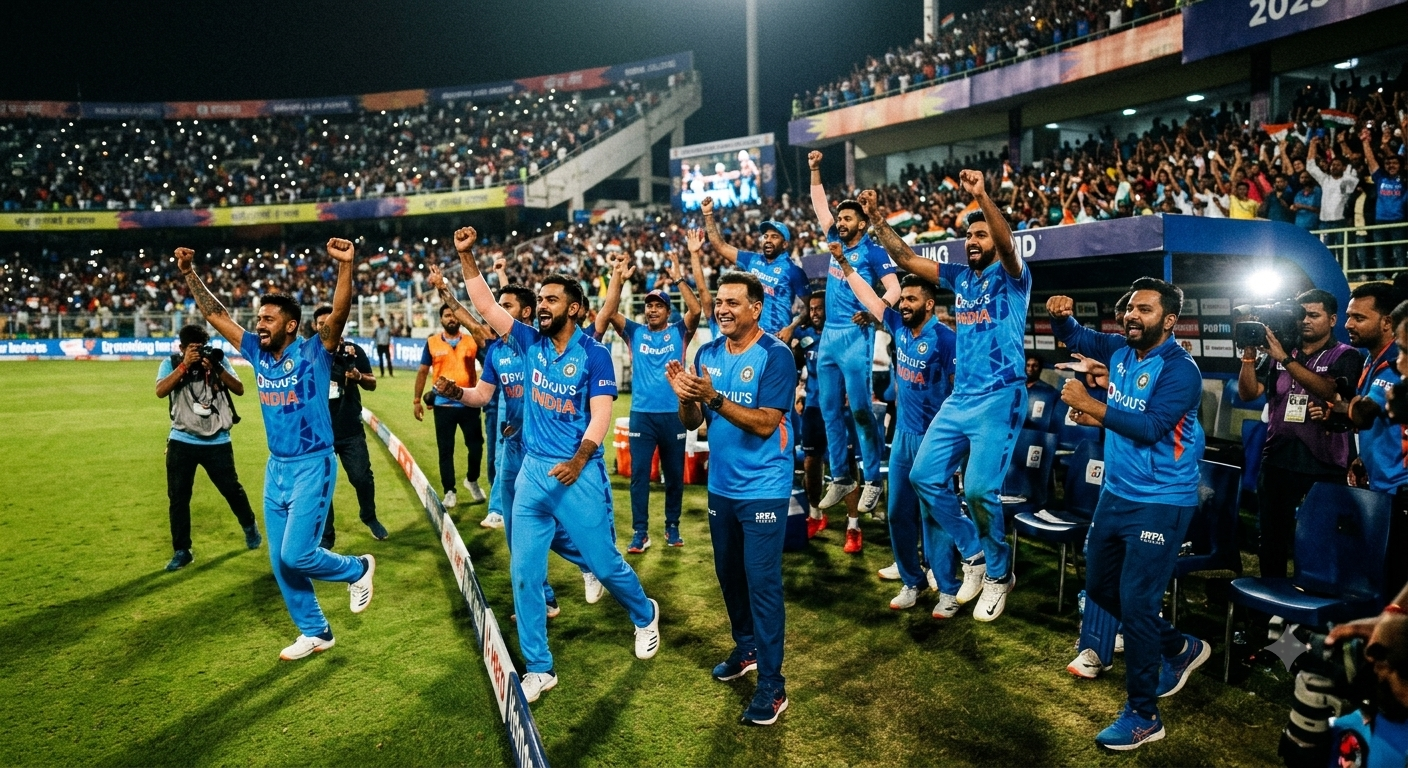
The Barsapara Stadium in Guwahati witnessed a spectacle of unprecedented run-scoring on Wednesday, culminating in the highest successful run chase in One Day International history. India successfully overhauled a mountainous target of 406 set by the West Indies, finishing at 408 for two with a staggering 39 balls to spare. The second ODI of the bilateral series produced over 800 total runs, five individual centuries, and a relentless boundary-hitting highlight reel that will be broadcast for years. Yet, amidst the intense euphoria of a world-record chase and a confirmed 2-0 series victory, India’s Head Coach Gautam Gambhir delivered a sobering, deeply critical assessment of the pitch and the deteriorating balance of the modern 50-over game.
“This is not cricket, this is only batting,” Gambhir stated bluntly to Star Sports in the immediate aftermath of the eight-wicket victory.
For a national head coach to publicly critique the playing conditions immediately following a historic, morale-boosting triumph speaks volumes about Gambhir’s underlying cricketing philosophy. Rather than merely celebrating the sheer dominance of his batting unit, Gambhir directed his analytical focus toward the bowlers from both sides. On an unforgiving, glass-flat surface, international bowlers were effectively reduced to bowling machines, serving up deliveries to be dispatched into the stands.
The Anatomy of an 800-Run Runfest
To truly understand the weight and validity of Gambhir’s frustration, one must look closely at the sheer volume of numbers generated during the match. The West Indies, batting first, capitalized on the incredibly true bounce, lack of lateral movement, and a lightning-fast outfield to post a colossal 406. Their innings was anchored by three distinct centuries from opener John Campbell, skipper Shai Hope, and rising star Amir Jangoo. In almost any traditional era of ODI cricket, a score north of 400 with three centurions would guarantee a resounding, one-sided victory.
However, India’s response made a complete mockery of the target. Skipper Rohit Sharma continued his legendary white-ball career by smashing his 35th ODI century, setting a blistering, aggressive platform at the top of the order. But the day truly belonged to Shubman Gill, who obliterated the Caribbean bowling attack to finish with an astonishing, unbeaten 223. The Indian batting lineup achieved the 400-plus chase—only the second time such a monumental feat has been accomplished in the history of ODI cricket—in just 43.3 overs, barely breaking a sweat.
The Plight of the Modern Bowler
While the capacity crowd in Guwahati was treated to an unforgettable exhibition, Gambhir viewed the match strictly through the lens of fundamental sporting fairness. A genuine cricket match, by its very definition, requires a legitimate, ongoing contest between bat and ball. When pitches are curated exclusively to facilitate entertainment and boundary-hitting, that core contest evaporates entirely.
“For the records it’s outstanding, for the crowd it’s outstanding, for the broadcaster it’s outstanding, but as a genuine cricket fan and as a coach, I have to have sympathy for the bowlers as well,” Gambhir remarked, outlining the stark difference between a lucrative television product and a balanced sporting event.
The structural rules of modern One Day Internationals already stack the deck heavily against fielding sides. Gambhir explicitly pointed out that bowlers are currently forced to navigate stringent fielding restrictions, the mandated use of two new balls which virtually nullifies traditional reverse swing, and the highly aggressive mindsets of modern T20-trained batters. When these systemic disadvantages are combined with a lifeless, concrete-like pitch, bowlers are left with zero margin for error.
“When you bowl on this kind of a wicket, it’s not fair for the bowlers. So we’ve got to give something to the bowlers so there’s at least something which the bowlers can work with,” he urged. “Often, you can’t be hard on bowlers, because sometimes bowling figures are such that they haven’t bowled as poorly as their figures suggest… Because the margin is very small”.
Nurturing Talent in Unforgiving Conditions
Gambhir’s concerns extended well beyond the immediate West Indies series, touching upon the long-term development of India’s fast-bowling reserves as the team builds its core strategy for the upcoming 2027 World Cup. He expressed particular sympathy for young, inexperienced players trying to establish their footing in international cricket on such demoralizing surfaces.
The match in Guwahati notably marked the international debut of young fast bowler Auqib Nabi. Tasked with containing a rampaging West Indian batting lineup on a graveyard for bowlers, the debutant was thrown directly into the fire without any assistance from the pitch.
“Auqib Nabi was playing his first game,” Gambhir noted, stressing the vital need to protect the psychological confidence of emerging talent. “So somewhere, you need to give them a bit of support and keep a bit of an extra cushion for them. But unfortunately, there wasn’t much for any bowler in this game”.
If international debuts routinely occur on pitches that freely concede 800 runs, team managements risk destroying a bowler’s confidence before their career has a chance to properly begin. Gambhir warned that evaluating a bowler based on a scorecard from such a match is inherently flawed. “If you get too hard just looking at their analysis, then we will never be able to develop bowlers,” he cautioned.
The Existential Crisis of the 50-Over Format
Gambhir’s post-match intervention strikes at the heart of an ongoing existential debate surrounding the 50-over format. As T20 cricket continues to monopolize global attention with its rapid-fire entertainment, ODI cricket has often attempted to mimic its shorter counterpart by artificially inflating scores through flat pitches and shortened boundaries.
However, cricket purists argue that the true charm of the 50-over game lies in its ebb and flow—the periods of tactical consolidation, the grueling bowling spells, and the hard-fought partnerships on testing, variable tracks. When a team can chase down 406 in 43.3 overs with eight wickets in hand, the format risks losing its unique identity, devolving into an extended, seven-hour T20 match.
As the Indian squad travels to New Chandigarh for the third and final ODI on Saturday, holding an unassailable 2-0 lead, all eyes will be on the local pitch preparation. Fans and broadcasters may clamor for another double-century and a rain of sixes, but the Head Coach has made his strategic stance unequivocally clear. For India to build a robust, world-beating bowling attack capable of winning tournaments in all global conditions, the systemic neutering of bowlers on home soil must immediately stop.
* Conceptual illustration generated using AI