
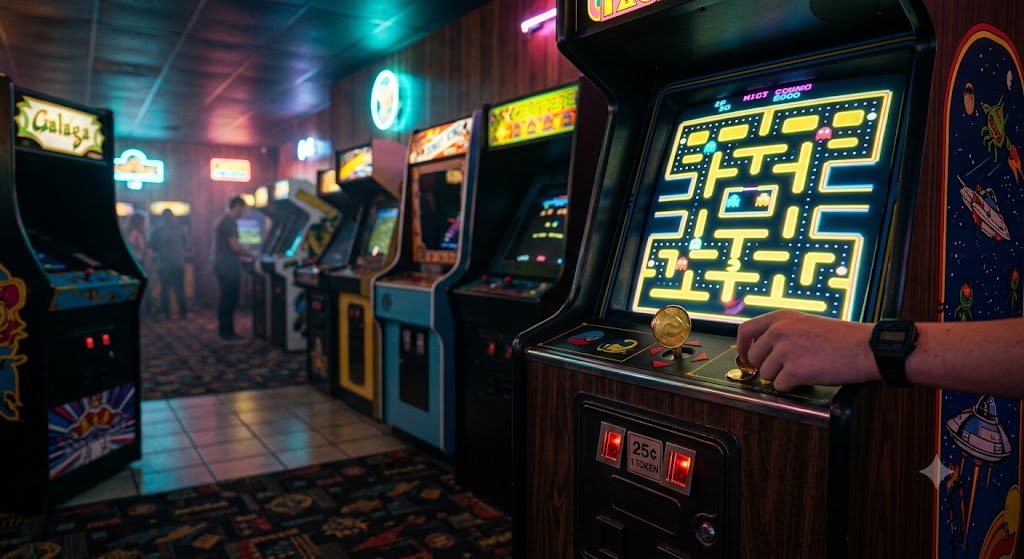
The morning puzzle ritual has evolved into a cornerstone of modern digital life. While Wordle established the daily habit and Connections tested our ability to categorize lateral concepts, Strands—the newest darling of the New York Times Games ecosystem—challenges our spatial awareness and thematic intuition. Part word-search, part anagram, and entirely addictive, Strands requires players to untangle a grid of letters based on a cryptic daily theme.
For Sunday, October 4, 2026, the puzzle masters at the Times delivered a theme that instantly transported millions of players back to the neon-soaked, carpeted floors of the 1980s. Titled “Grab your tokens”, today’s puzzle is a brilliant homage to the Golden Age of coin-operated entertainment.
If you are currently staring at a jumble of letters and feeling the frustration mount, do not worry. Below is a comprehensive guide to today’s hints, the elusive spangram, the final answers, and a deep dive into the cultural history behind the words you are searching for.
Decoding the Theme: “Grab your tokens”
Before we hand over the outright answers, let us examine the psychological prompt of the theme. “Grab your tokens” is an immediate sensory trigger. It evokes the distinct weight of brass coins in your pocket, the cacophony of 8-bit synthetic soundtracks blending into a deafening roar, the glow of CRT monitors, and the frantic clicking of micro-switch joysticks.
This theme is not about modern console gaming or mobile apps; it is strictly rooted in the retro arcade era. You are looking for the foundational titles that defined the coin-op industry in the late 1970s and early 1980s.
Gentle Hints to Nudge You Forward
If you want to solve the puzzle yourself but need a slight directional push, here are three progressive hints to help you decode the board:
- Hint 1 (The Vibe): Think of the games that required a quarter (or a token) to play. We are looking for classic, highly recognizable retro video game titles.
- Hint 2 (The Mechanics): One of the hidden words involves a very anxious amphibian trying to navigate highway traffic. Another word is the absolute grandfather of digital sports—a simple game of virtual table tennis.
- Hint 3 (Starting Letters): The five main theme words begin with the letters A, C, F, P, and S.
The Spangram Revealed
Every Strands puzzle features a “Spangram”—a core word or phrase that perfectly summarizes the theme and physically spans the entire board, touching two opposite edges. Finding the spangram is often the key to unlocking the rest of the grid, as it visually divides the remaining letters into more manageable, bite-sized sections.
- Today’s Spangram: ARCADE GAMES
If you trace your finger across the grid to connect A-R-C-A-D-E to G-A-M-E-S, you will slice the board in half, making the remaining titles much easier to spot.
The Final Answers
If you have run out of non-theme words to generate in-game hints, or if you simply want to preserve your daily streak without the headache, here is the complete list of answers for the October 4 Strands puzzle:
- PONG
- ASTEROIDS
- FROGGER
- CENTIPEDE
- SCRAMBLE
Insightful Analysis: The Cultural Weight of Today’s Answers
The brilliance of NYT Strands lies not just in the wordplay, but in the curation of its themes. Today’s puzzle serves as a miniature museum exhibit of digital history. Each of the five answers represents a distinct evolutionary leap in how humanity interacted with computers.
1. PONG (1972) It is fitting that Pong is hidden in today’s grid, as it is the Big Bang of the video game industry. Developed by Allan Alcorn for Atari, Pong stripped gaming down to its absolute bare essentials: two paddles, a square “ball,” and a dotted line serving as a net. Its genius was its intuitive simplicity. You did not need a manual to understand it; you just turned the dial and tried not to miss. Pong proved that video games were a commercially viable entertainment medium, effectively launching the arcade revolution.
2. ASTEROIDS (1979) Following the success of Space Invaders, Atari released Asteroids, a game that introduced players to the anxiety of multidirectional threats. Utilizing striking vector graphics—which gave the floating space rocks a sharp, neon-wireframe aesthetic—Asteroids required players to manage momentum, thrust, and spatial awareness. The inclusion of the “hyperspace” button, a desperate gamble that could either save your ship or instantly destroy it, introduced a thrilling element of risk-reward gameplay that remains a staple in game design today.
3. FROGGER (1981) Developed by Konami and distributed by Sega/Gremlin, Frogger shifted the arcade paradigm away from shooting aliens and toward situational survival. The premise was deceptively simple: guide a frog across a busy multi-lane highway, and then across a treacherous river filled with sinking turtles and predatory alligators. Frogger remains a masterclass in timing and pattern recognition. It also possessed an incredibly catchy, albeit repetitive, soundtrack that became permanently etched into the minds of a generation.
4. CENTIPEDE (1981)Centipede holds a massive place in gaming history, notable not only for its frantic, bug-blasting gameplay but also because it was co-designed by Dona Bailey, one of the few female game programmers in the industry at the time. The game utilized a trackball controller, allowing for rapid, fluid movement as players desperately shot at a segmented centipede winding its way down through a field of mushrooms. Its vibrant pastel color palette and fast-paced mechanics made it one of the highest-grossing arcade cabinets of its era.
5. SCRAMBLE (1981) While perhaps slightly less of a household name today than Pong or Frogger, Konami’s Scramble was a monumental technical achievement. It is widely credited as the first forced-scrolling shooter with distinct, progressive levels. Instead of a static single screen, players piloted a spaceship through continuously changing, cavernous terrain, managing both enemy fire and a strictly depleting fuel gauge. Scramble laid the definitive groundwork for legendary side-scrolling franchises like Gradius and R-Type.
Strategy Guide: How to Master NYT Strands
If today’s puzzle gave you trouble, here are a few editorial tips to improve your Strands gameplay for tomorrow:
- Farm for Hints Early: Do not hesitate to string together random, non-theme words (four letters or longer). Every three non-theme words you find fills your hint meter, allowing you to reveal the exact location of a theme word’s letters.
- Attack the Corners: The four corners of the grid are often the most restrictive spaces. Letters trapped in the corners usually only have two or three viable paths. Start your search at the edges and work inward.
- Look for Common Suffixes: Keep your eyes peeled for common word endings like “-ING,” “-ED,” “-TION,” or “-ERS.” Spotting these clusters can quickly unravel a long, complicated word.
Today’s “Grab your tokens” theme was a delightful detour into digital nostalgia. As the New York Times continues to expand its gaming portfolio, puzzles like Strands prove that word games can be both intellectually stimulating and culturally resonant. We will see you tomorrow for the next grid.
* Conceptual illustration generated using AI